What? The course will give an overview of the sources and methods for the study of the archaeology, community and family history of County Offaly, and how to do research on areas that may interest you in local and family history. Thematic sessions will be delivered by experienced local scholars, who will introduce participants both to physical sources and to online resources. Offaly is taken as the example, but most of the records will have application for the entire country.
When? All talks will be held on Wednesday nights, from 7.30 to 9.30 pm.
Where? Offaly History Centre, Bury Quay, Tullamore, Co. Offaly, R35 Y5V0
Fees? The course fee for all ten sessions is €50, payable to the Offaly Heritage Centre at the time of booking. Please provide your credit or debit card details when booking, or visit the shop Monday–Friday, 9:30 am–4:30 pm.
Alternatively, payment can be made by bank transfer: Best contact us first as only a few places are left.
This course is supported by the Heritage Council and Offaly County Council. Places are limited to 25 participants, so early booking is strongly advised.
Please call or email us to check availability and make your booking
Alongside John O’Donovan and Eugene O’Curry the name of George Petrie (1790–1866) will forever be remembered as one of Ireland’s greatest scholars of the first half of the nineteenth century. It was a time when tremendous work was done for Irish archaeology and history. Petrie was a major figure in the historical research section of the Ordnance Survey. Jeanne Sheehy in her The Rediscovery of Ireland’s Past 1830–1930 states that he was the founder of systematic and scientific archaeology in Ireland.
Petrie was involved in the work of the Ordnance Survey from 1833 for ten years. He was very much a polymath and in his late years published a volume of Irish music arising from his efforts to collect and preserve old Irish music.
Saturday 21 JuneVisit to Westmeath andFore with Rory Masterson. Depart Tullamore at 10. a.m. Car sharing from Bury Quay let us know your needs.
St. Féichín’s Church by Rory Masterson, our guide
The walk will consist of a walk to St. Féichín’s church that was the church of the old monastery founded in the seventh century.
The Anchorite’s Cell
This will be followed by a visit to the Anchorites Cell. Anchorites were hermits who enclosed themselves in a cell for the rest of their lives in order to attain greater sanctity. The last recorded anchorite was at Fore in the closing decades of the seventeenth century. I am hoping to get the keys so that we can get access to the cell.
The North Gate
After the coming of the Anglo-Normans, Fore became a chartered borough. In the 15th century the borough came under attack from the neighbouring Gaelic Clans the O’Reillys and O’Farrells. So it received a murage grant to enable it to charge a tax on all good coming and leaving the town to cover the cost of building town defences
St. Feíchín’s Mill
Dating from the time of the early monastery founded by St. Féichín the mill is referenced at still in operation when the Normans arrived and is mentioned by Gerald of Wales in one of his stories The mill, like the church was an area that women were forbidden to enter as referenced by Gerald of Wales in the thirteenth century.
The Benedictine Priory
The large Benedictine priory of Fore that as commented by many looks more like a fortress than a monastery. Founded by Hugh de Lacy before his death in 1186 (at Durrow in Offaly) i’’s mother house was in Normandy in France. It was richly endowed by de Lacy but fell on hard times during the hundred years war. During that era England and France began to see themselves as separate (though most English nobility and kings continued to speak French as their everyday language until the end of the fifteenth century) as so the Benedictine priory came to be seen as ‘alien property’. As a result the monastery was taken into royal custody during the war and drained of as much of its resources as possible.
In the fifteenth century the priory was run down and with the Gaelic resurgence a change of government policy occurred. Instead of seeing the priory as French property they now came to see it as vital for the defence of the Pale from the Gaelic Irish. The priory was granted to a series of loyal local Anglo-Normans who seem to be responsible for the addition of the two towers to the priory. In fact the priory became a fortress cum monastery with both sharing the same space. The priory was dissolved in 1539
St. Féichín, the founder of the Gaelic monastery at Fore, Co. Westmeath, was born in Billa, in the townland of Collooney in Co. Sligo. A student of St. Nathí of Ardconry he is associated with a number of foundations in the west of Ireland, including Cong in Mayo, Omey and High Island in Galway as well as Termonfeckin in Co. Louth. However, Fore in Westmeath is considered as his most successful establishment. He is said to have died in 665 of the Yellow Plague or Buidhe Chonnail. While we cannot be certain what the disease was it is reputed to have lasted for almost ten years and was followed by leprosy. The name ‘Yellow’ suggests that it was some form of jaundice. Three ‘lives’ of St. Féichín have come down to us, one in Latin and two in Irish. In addition we have Colgan’s commingled Latin life of the seventeenth century. Lives of the Irish saints were not historical biographies of the saint in question actual life. Written long after the subject under discussion had died, their purpose was to promote the sanctity of the founder as his or her value as a saint to venerate. Details of relics of the saint, real or fabricated, which the monastery retained, were interwoven into the saint’s live to demonstrate their powers.
John O’Donovan was in Birr in early 1838 and having obtained a copy of The Picture (1826) by Thomas Lalor Cooke thought better of him as a scholar, but one subject to some foolish ideas after the school of Charles Vallancey. O’Donovan identified Cooke as ‘B’ in the Penny Journal articles he wrote and one of these was on the monastery of Seir Kieran at Clareen. It is interesting to compare the article in the 1834 issue of the DublinPenny Journal with that in the 1875 publication. Also of interest is to take into account the manuscript annotations to the Picture of 1826, now in Birr Castle Archives. And if that was not enough Cooke has letters and other MS sources in the RIA, NLI and the National Archives. In his letters of 1850 to the Cork antiquarian, John Windle (now in RIA) he tells Windle that he was the author under the pseudonym ‘B’ of articles in the Penny Journal and under his own initials of articles in the Dublin Evening Post. Despite the published work of George Petrie on the Round Towers (1833 and 1845) Cooke continued to put forward the Vallancey-style notion that the origin of the round towers lay in early times and were temples of fire.
It was a big day for Offaly at the Heritage Week Awards held in the wonderful Royal Hospital Kilmainham on Friday 15 November 2024. As Amanda Pedlow, the Offaly Council Heritage Officer noted:
It was Offaly’s day at The Heritage CouncilHeritage Week Awards in Kilmainham today. James Scully is the well-deserved winner of the national Heritage Hero Award.
Lemanaghan Bog Heritage and Conservation Group were runners up in the Intangible Cultural Heritage Award (The Mícheál Ó Muircheartaigh Award) for their project recording traditions and folklore of Lemanaghan.
Patrick Lopeman was born at Riverstown, Birr in 1893 (although army records sometimes list 1894). Over the next decade, his parents Patrick senior and Letitia (Sometimes listed as Alicia) moved with the family between several addresses in Kildare and Birr. Patrick Sr worked as a painter.
In Lopeman’s youth his family suffered from economic hardship, living in lanes around Birr like Mount Sally which were essentially slums. In 1917, Birr’s parish priest Canon Horan described the conditions in which families like the Lopeman’s dwelled…
‘In many cases there were neither doors to the front or to the rear, and the roofs were also in a defective condition. It could hardly be said that there were floors to the houses and their condition generally was deplorable. In fact, he said the houses were nothing more or less than mouldering heaps of rubbish. How the poor people managed to live in such hovels he did not know…. they were unfit to kennel a dog’
Even by the standards of the time Patrick endured a very difficult childhood. In May 1904, his ten-month older sister Agnes died of hydrocephalus. In November 1905 his six-month-old his brother James died of convulsions. Three months later James’s twin sister Esther died of whooping cough and pneumonia. By the time of 1911 census Patrick Lopeman Sr had died, and the family were spread across different addresses. Eighteen-year-old Patrick was living in a boarding house at High Street, Birr with his younger sisters Bridget and Catherine.
Wellington’s victories in the battles in the Peninsular War were celebrated by Thomas Acres by the erection of the folly or tower in the garden of his private house at Acres Hall. This is now the Tullamore Municipal Council building and the garden is in part used for parking. The entire Acres development in Cormac Street west was based on the 1790 Kilcruttin Hill lease. The folly has been largely restored in 2020-22, but the part of the hill that was removed to facilitate more council parking ought to be replaced. In time perhaps the entire garden and folly could be incorporated into the town park.
So far we have looked at the 1821 and 1901 censuses for Castle Street, Birr together with traders in the street in the nineteenth century (see previous articles by going to the blog section on http://www.offalyhistory.com.) There were a lot of new families in Castle Street in 1911 when compared with 1901 based on the surname of the occupiers – not always a reliable guide. Families where there was continuity included that of John Wall, James Sammon, Patrick Connors, Laurence Kennedy, Owen Gaffney and Elizabeth Watterson.
In my previous article (Part 4) on the history of the Ballyduff quarries I looked in more detail at one of the Wrafter families involved in stonecutting at far back as at least 1807. In this article I will relate the story of two other Wrafter families of stonecutters. Members of these families are still active in the cutting, carving and sculpting of stone.
Wrafter family #2
This Wrafter family were also from Ballyduff and were heavily involved in the stonecutting trade at least from the 1850’s onwards. Between 1850 and the 1950’s at least 12 men from three generations of this family were stonecutters and most of them had at one time or another lived in Ballyduff and learned their trade at the nearby quarries. The lack of older records makes it impossible for me at present to say to what extent this family, and indeed even the other Wrafter branches, were involved in stoneworking before 1800.
Belonging to the earliest generation of stonecutters were Thomas (b. 1835, d. before 1882) and Patrick (b. ab. 1842, d. 1889). Five sons of Patrick Wrafter and his wife Katherine (nee Walsh) became stonecutters (John, Patrick, Jim, Joseph and Alec). After learning their trade in Tullamore Jim, Joseph and Alec practised their trade for extended periods in Cork and Dublin.
John worked a quarry of his own in Ballyduff in the late 19th – early 20th century. Patrick worked a quarry together with some employees in the neighbouring townland of Arden until at least 1928. Alec returned to Tullamore and also worked part of the Ballyduff quarries up to the 1950’s.
Stonecutters from this Wrafter family worked on the building of the new Catholic Church in Tullamore circa 1906. In 1908, they carved the stone tracery for a new stained-glass window for St Catherine’s Church (Church of Ireland) in Tullamore. Several of the Celtic cross grave monuments at Clonminch cemetery in Tullamore bear the names of John and Patrick Wrafter, and can arguably be considered works of art.
Clonminch, Tullamore 2
Fig. 1. Celtic cross headstones sculpted by John Wrafter (1866-1941). Erected in or around 1910 in Clonminch cemetery, Tullamore. The monument in the photo on the right (2) was made by John for his own family; three of his children and his wife are named on the headstone.
Four of the Wrafter brothers (John, Jim, Alec and Joseph) were active in the Stonecutters’ Union of Ireland, a trade union for stonecutters. The photo below is of representatives of various branches of the Stonecutters’ Union of Ireland, as well as of the union’s central organisation. The picture was taken about 1905. Two of the brothers feature in the photo:
John Wrafter (b 1864), representative for Tullamore and Alec Wrafter (b 1879), representative for Dublin.
Fig 2. Photo of members of the Stonecutters Union of Ireland (obtained from Barry Wrafter). Alec Wrafter (Dublin) back row, 2nd from the left. John Wrafter (Tullamore) back row, 2nd from the right.
James (Jim) Wrafter (b 1872) was Treasurer of the Union (perhaps the Dublin Branch) about 1909.
Joseph Wrafter (b 1882) was elected Annual Auditor of the Stonecutters’ Union of Ireland in 1907. Joseph was not living in Dublin at the time so involvement in the union would have meant regular trips by train to Dublin to attend meetings in Capel St. Several years later Joseph moved to Dublin and by 1932 he had been elected the General Secretary of the Stonecutters’ Union of Ireland. He died in Dublin in 1936.
Among the members of the Tullamore Company of the Irish Volunteers in 1916 were several stonecutters and masons from the Bracken, Wrafter and Molloy families. Joseph Wrafter was an active member and played a big part in the events of 20 March 1916, which became known as the “Tullamore incident”. In a skirmish, shots were fired and a bullet from the gun of Peader Bracken (another stonecutter) hit police sergeant Ahern. Joseph and his fellow volunteers were tried by a military court and ultimately released without conviction. Joseph was the father of the late Sister Oliver, who was a Presentation nun in Rahan and a keen local historian.
Recurring issues at the Union meetings reported by the press were demands for the use of Irish limestone in construction and the employment of Irish stonecutters in quarrying and dressing stone. Another demand was that available jobs should go to trade union stonecutters.
In 1896 stonecutters of the Stonecutter’s Union at the Ballyduff quarries went on strike over demands for higher wages and a half-day on Saturdays. The strike was short-lived as a settlement was promptly reached. Three decades later in 1922, there was another dispute over wages. This time the settlement resulted in a reduction of wages of stonecutters by 5 shillings to £3-10s, and of quarrymen by 2 shillings to £3. This may have reflected a decrease in the demand for quarried stone. In the early years of the 20th century concrete blocks began to replace stone for construction purposes, a development that was much criticized by the Stonecutter’s Union.
Several of the next generation of the Wrafter family entered the stonecutting trade. I will mention just two of them here. Patrick Joseph, born c. 1899, son of James, emigrated to America. He states his occupation as stone carver on his wedding certificate of 1922 in Albany, New York State.
John born 1891, son of John (b 1864), became a stonecutter/sculptor in Tullamore. By the 1930s he had left the stone trade and became a grocer and publican, with premises on Harbour Street (Wrafter’s Harbour Bar).
The latter half of the 20th century saw the continuing decline of the stonecutting trade. The carving of headstones was one of the few activities that survived for the employment of stonecutters. Among the Wrafters of Tullamore the trade died out. Four or five decades passed without a Wrafter putting his signature to a piece of stonework. Then in the late 1990s the Wrafter name appeared once again in connection with stonework. Barry Wrafter, the great-grandson of stonecutter John Wrafter, born 1864, and grandson of John Wrafter of the Harbour Bar, revived the family tradition, and has made a name for himself as a sculptor and stone carver.
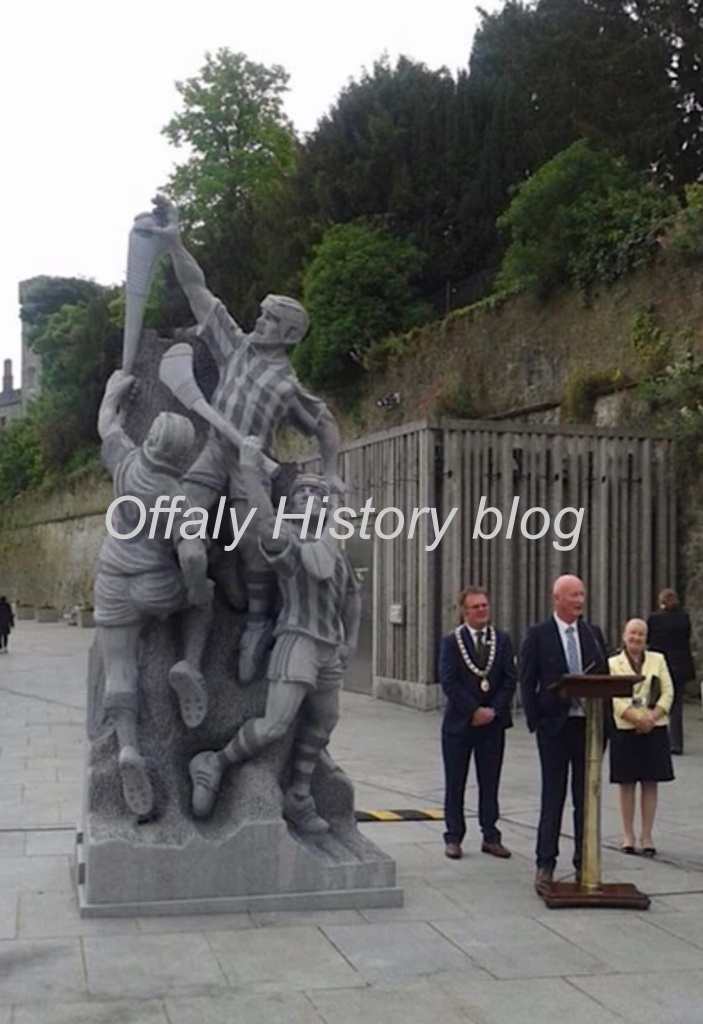
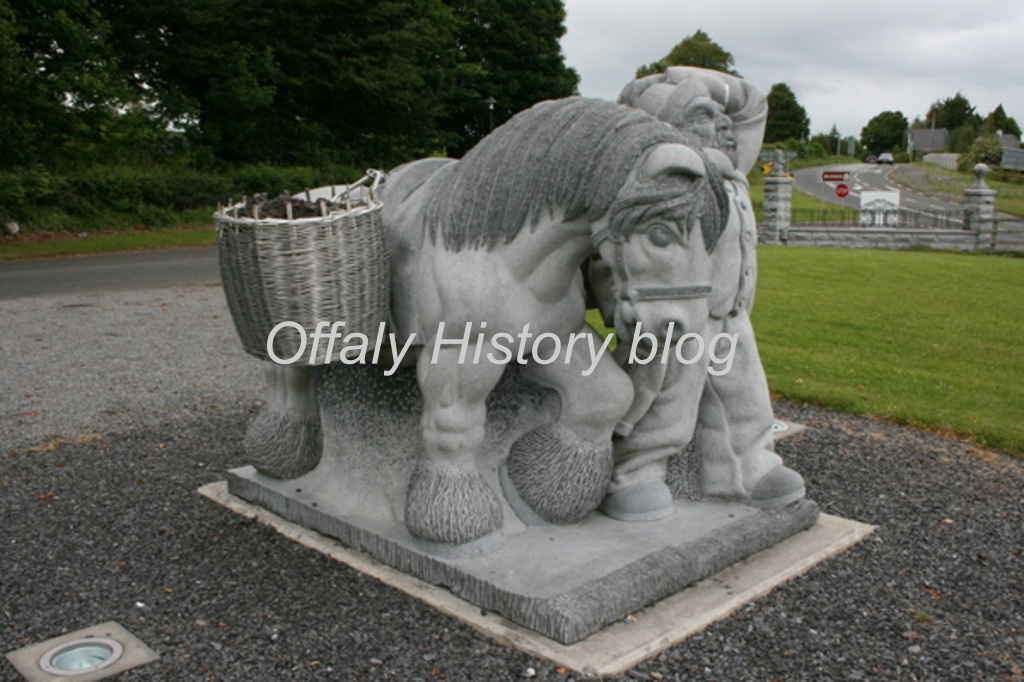
Growing up in Ennis, Co Clare, Barry returned to the trade of his forefathers as an outlet for his creative talent. He became interested in stone carving and sculpting after learning about the history of stonecutting in his family. Barry is one of only a few stone carvers using traditional methods and skills operating at the current time in Ireland. Since 1999 he has been commissioned to produce several public works throughout Ireland. His most ambitious work to date is undoubtedly the hurling sculpture in Kilkenny city (Fig 2), which he worked on in 2016-17. Closer to the home of his ancestors is “The Turf Cutter” from 2007, which is to be seen at the entrance to Belvedere House Garden and Park, near Mullingar (Fig 3).
Fig 3. Barry’s major work, the Kilkenny Hurling sculpture in Irish limestone completed in 2017. (Photo: http://www.barrywrafterart.com)
Fig 4. The Turf cutter sculpture at the entrance to Belvedere House and Gardens. (Photo: http://www.mckeonstone.ie)
More recently (in 2022), Barry was employed in the restoration of the Primark store (also called The Bank Buildings) in Belfast. The building, made of red sandstone from Scotland and completed in 1900, was ravaged by a fire in 2018. Some of his work can be seen in the photos below.
Fig 5. Pieces of carved sandstone ready for mounting into place in the Primark department store in Belfast. (Photo: Barry Wrafter)
Fig 6. Part of the facade of the Primark department store in Belfast during restoration. (Photo: Barry Wrafter)
Wrafter family #3
The third Wrafter branch involved in stonecutting may have started with Timothy Wrafter, born about 1804. Timothy, who lived in Aharney (a townland about 6 km northwest of Tullamore), was a stonecutter and farmer. He married Bridget Houghran in 1839 and had a large family; they had at least 11 children between 1840 and 1861.
At least two of the sons became stonecutters. John, born 1840, had settled in Chicago by 1880. He was married to Mary Molloy. He died in Chicago in 1904, age 65, occupation “Stone cutter”.
Another son, Timothy, born in 1849, married Anne Somers in 1877 and emigrated with his wife and two young children to Australia in 1883. They settled in the Brisbane area, where Tim continued his trade as a stonemason. Before leaving Ireland he probably worked for John Molloy at the Ballyduff quarries.
Timothy’s nephew, also called Tim, was a stonecutter according to the 1911 census. He was living with his parents in Ballykillmurray, close to Tullamore and the quarries, according to the same census. A couple of years later, in 1913, Tim made the same journey as his uncle had done 30 years earlier. He arrived in Brisbane, Queensland on 19 December 1913 on the ship Perthshire. Working with his uncle Timothy, the younger Tim learned the ropes of the trade.
Timothy eventually procured the business from his uncle and together with his two sons, Denis and Joseph, who were apprenticed as stonemasons, they founded the firm, T. Wrafter & Sons in Brisbane. It is still owned and run by the Wrafter family. They are the fifth or sixth generation of this Wrafter family involved in stonecutting. The company produces monuments, memorials, public works, and carries out church work, stone artworks and heritage restorations.
One of their most recent works is a 5-meter-tall Celtic cross standing on the grounds of Nudgee College in Brisbane. The monument, erected in August 2021 to mark 130th anniversary of the college, celebrates the school’s Irish Catholic heritage. Peter Wrafter, Company Director and a qualified stonemason, is a former pupil of the school. The material sought after for the cross was one that would exhibit good weathering properties and would have a colour resembling crosses in Ireland. Australian black granite was chosen and after a sandblast finish resembles the colour of Irish limestone. This beautiful work of art is a testament to the legacy of the Ballyduff stonecutters.
Fig 7. A recently erected Celtic cross on the grounds of Nudgee College in Brisbane made by T Wrafter and Sons, Stonemasons. (Photo: https://twstone.com.au)
Fig 8. An example of one of many public works in stone designed and produced by T Wrafter and Sons, Stonemasons., Brisbane. (Photo: https://twstone.com.au)
Given the prevalence of the name Timothy in this family there may be a link with another Timothy Wrafter who died in 1815 and whose headstone can be found in the graveyard of the old Church of St Carthage in Rahan. The tombstone is ornately carved as can be seen below.
Fig 9. The gravestone of Timothy Rafter who died in 1815, aged 33, in the graveyard of the old Church of St. Cartage in Rahan. (Photo: Paul Stafford. From booklet Offaly Tombstone Inscriptions. 1. Rahan Graveyards)
Thomas Wrafter is another Wrafter stonecutter that emigrated to Australia in the 19th century. Thomas ran a quarrying business on the outskirts of Adelaide in South Australia in 1880. He employed several stonecutters. He may be the same Thomas Wrafter that emigrated from Ireland and arrived in Brisbane in 1866. I have not been able to link him to any specific branch of the Wrafters.
Conclusion
In my research into the quarries and stonecutters of Ballyduff and Tullamore a picture has emerged that shows that the limestone quarries of Ballyduff produced some of the finest building and monument stone in Ireland. Moreover, the stonecutters that originated in Tullamore were widely recognized as some of the best in the country, and those that left Ireland (mainly to Australia) found that their skills were highly valued in their new homelands.
Many thanks to John Wrafter for these articles. Great research and we look forward to a printed publication in due course, Ed.
Father Grogan was born on June 14th, 1873, in Brocca, Screggan County in Offaly. His parents were Joseph Grogan and Mary Molloy. He received his early education at Mucklagh National School, Saint Columbus School, Tullamore and Saint Finian’s College Navan. At the solicitation of his uncle, the Reverend, Anthony J. Molloy of the New York Archdiocese, came to the United States and was admitted to Saint Joseph Seminary then located in Troy, New York. He continued his studies there and at the new St. John’s Seminary in Dunwoody, where he was ordained on May 27th, 1899. He celebrated his first mass at Saint Peter’s church in Yonkers, NY, where his uncle was the Past
His first assignment was to Rosendale, NY for one year. He was transferred to the Mission of Our Lady of the Rosary, where he remained uninterruptedly serving as assistant until 1922.





 offalyhistoryblog