‘Early April 1921. There was an ambush outside our house, in which a Black and Tan was shot dead. The Black and Tans forced their way into our house, searched every inch and left a huge mess. They also left my terrified mother, father and five brothers and sisters. Three weeks later, I was born & my mother often recounted the fact that after my birth I was a very jumpy baby.’ Nuala Holland (née Mahon, Charleville Road, Tullamore).
Nuala Mahon was referring to the attacks on the RIC in Tullamore in April 1921 that are matter-of-factly referred to by Sean McGuinness of Kilbeggan in his witness statement, now in the Military Archives (online, p. 29 in the pdf), in what he called ‘onslaughts on Tullamore RI.C. patrols at Charleville Road, New Road, Hayes Cross and Barrack Street, all on 1 April 1921 in which policemen and I.R.A. men were wounded and killed’.
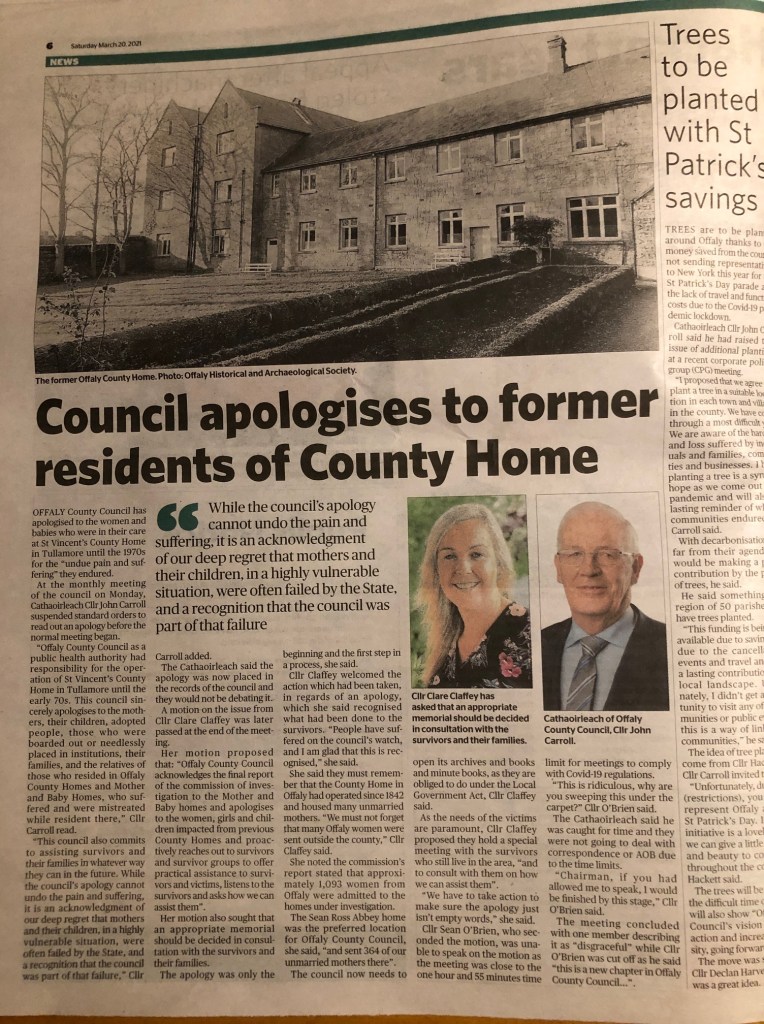
With the recent publication of the Report of the Commission of Investigation into Mother and Baby Homes chaired by Judge Yvonne Murphy, the notion and concept of shame is very much in the news. Shame is a negative influence that is so powerful that it can destroy and ruin lives. It can have appalling consequences. It can be public or private.
Shame guilt and apologies. The county council apology this week for things past Offaly Independent 20 3 2021. The council’s record on tuberculosis prevention was good with a central dispensary opened at the back of the county infirmary in June 1916. Dr O’Regan had been appointed to the prevention campaign in 1912 and four years earlier Lady Aberdeen had visited the town in support of her personal campaign.
Public shame is easier to deal with, for example the Government`s handling of such and such a problem was shameful. This is easy to handle as the Government is a distant entity, and their nonfeasance or apparent nonfeasance can be punished at the next election.
However personal shame is much more traumatic and can have devastating consequences. We have seen over the last forty or so years a series of scandals all of which had catastrophic effects on very innocent victims. When we look at these `scandals` from today`s vantage point it is hard to understand how the particular activity involved could have caused the outrage they did. It is difficult to understand that what is today accepted as quite normal could stigmatize an individual to such an extent that their lives were ruined and indeed that such ignominy could attach itself to an entire family.
However, the story I wish to relate is a simple enough tale, where a totally innocent condition had to be hidden. The person I wish to talk about is my grand uncle Kieran Claffey. He was one of twelve children born to Patrick Claffey and Anne Flannery, who were married in Shannonbridge in 2nd January 1853. They were farming folk who lived in Bloomhill near Ballinahown.
Offaly History intended to have a walk on 26 December 2020 through the historic Lloyd Town Park, Tullamore, but had to cancel due to the imposition of the third wave of restrictions since March 2020 designed to reduce the impact of the Covid-19 virus. An historic year and one we will be glad to see the back of. After fifty-years of mostly progress since the 1960s we have become accustomed to the shock of change for the worst since the banking crisis and the bail-out. Now it’s the Covid-19 virus and in the background climate change, and in Offaly the end of the bogs – so much a part of growth in Offaly from the 1950s. Today we are visiting the Lloyd town park, Kilcruttin, Tullamore and reflecting on its historical features and change in the landscape of the area and the town of Tullamore since the 1700s.
The park area in 1838 on the six-inch scale with Water Lane, gazebo and the new courthouse and jail. A second Methodist church was located in Crow/Tara Street from the 1820s to 1877. The landscaped gardens of Acres Hall can be seen on Charleville Street, now Cormac Street.(more…)
A new book detailing the history of Birr Military Cemetery has been published by Offaly County Council. Researched, written and designed by Stephen Callaghan the book gives an authoritative history of the cemetery and all those identified as buried there. While the cemetery only contains 52 inscribed memorials, the book gives biographical details of a further 230 people buried there. The memorials which survive are also examined and described in detail, including information about type, symbols and details about the materials used and the stonecutters who made them. The cemetery is one of the few surviving features of Birr Barracks and is an important link to the past. The people buried there are a mix of soldiers, soldiers’ wives and children, the latter make up most of the burials.
An attractive new book on the history and memorials of Saint Rynagh’s Old Graveyard in Banagher has just been published. The book has 192 pages, almost 400 photographs and historical images plus a collection of essays and short articles on eminent souls buried there and on aspects of the site’s ecclesiastical history. The book is written by James Scully, a long-time student of Banagher’s history. This is your Saturday blog coming early because of Halloween.
`Arising from the Covid-19 virus due to government advice regarding public gatherings a private funeral will take place, but may be viewed on the Church website.`
This notice is now a regular feature of obituary notices in current newspapers and website dealing with death notices.
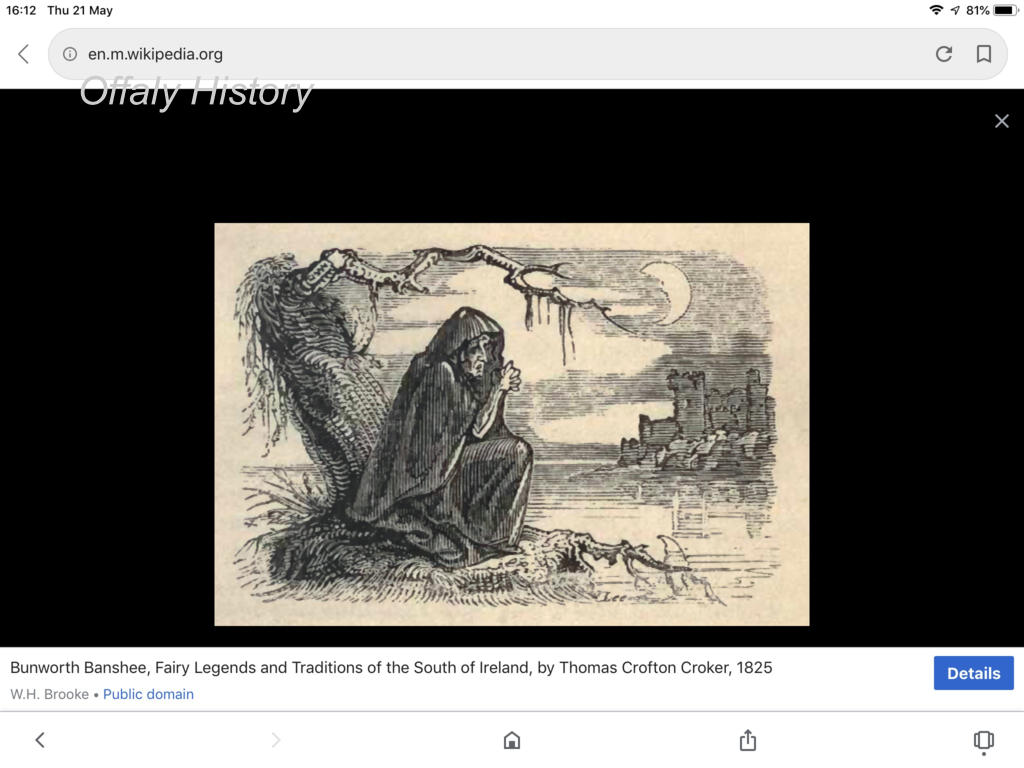
The story I wish to relate deals with an earlier time, from the early 50s, and I hope to recreate an image of the funeral process back then in west Offaly. It was a time when the medical condition of a sick person or indeed a visit by a doctor to such a person was not the only omen that death was imminent. A much more reliable harbinger of such an event was when a report came in, that the `banshee` had been heard. My grandfather, Michael Claffey originally from Bloomhill, near Ballinahown, totally believed in the banshee. He was a well-read literate man, yet if someone was ill in the parish, he would not show much concern until it was reported that the cry of the banshee had been heard. Once that occurred, it was good night Vienna, as far as he was concerned. He would then just wait for the inevitable, which from my memory always seemed to happen.
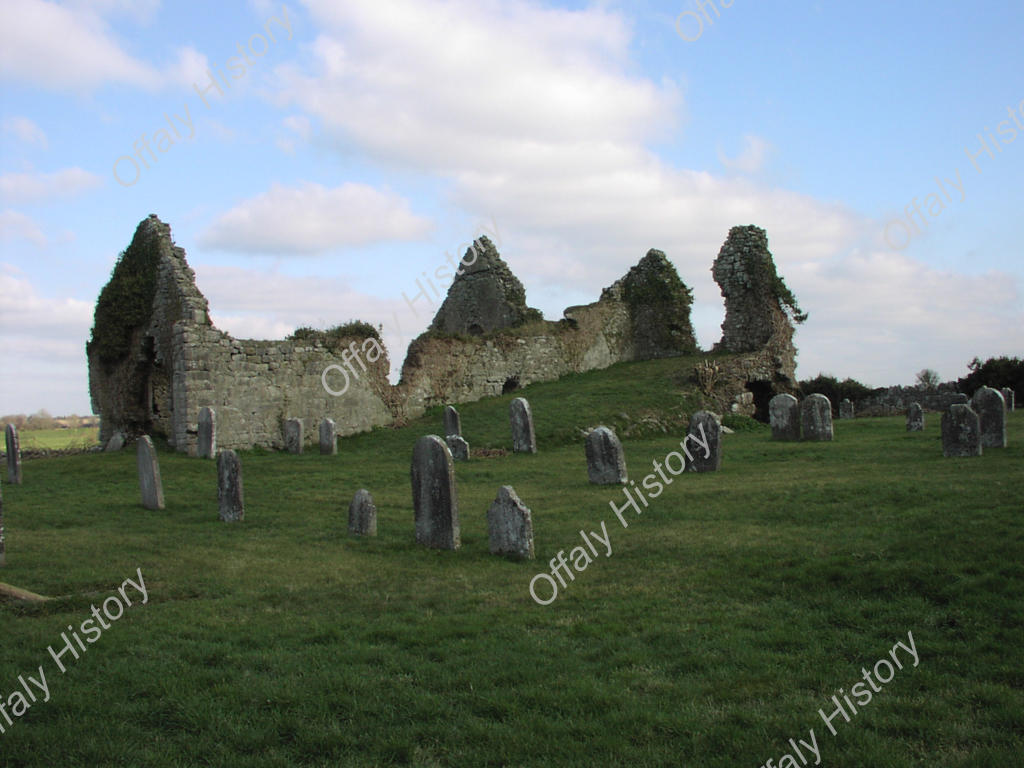
The old cemetery at Lynally where Dames and Rector Coffey are buried. No stone has been found for Dames.
The Longworth family and George Dames of Tullamore
Reading in the National Archives some time ago I came upon a small envelope of papers that Athlone-born Revd George Stokes had put together on the Longworth family. He was constructing a family tree and it was that family’s connections with Athlone that appealed to him. The envelope included two Wills. One was that of George Dames of Tullamore, dated 1662, who died in June, 1666. In it, Dames is described as a yeoman. The Dames and the Longworth families intermarried in successive generations and it is no surprise that this Will was filed with some of the Wills of the Longworth family. They were both Cromwellian families that settled in the midlands.
Back in 2014 I was an intern in the Heritage Office in Offaly County Council. I compiled a database of all known post 1700 burial grounds in the county. Compiling the database required thorough desk and field based research. During fieldwork I visited 170 of the 187 burial grounds I recorded. While visiting these places I noted many interesting and unusual features, some of which are the basis for this blog post. The list is of course subjective. There are certainly more interesting and unique features waiting to be discovered in Offaly burial grounds. (more…)
Durrow Abbey in 1914. The First World War had just started.
Leaving to one side the work of the Ordnance Survey in the 1830s, the work of Petrie at Clonmacnois, and that of Cooke at Birr in 1826 and 1875, the references to and work done or written up on the historical sites of north Offaly in the nineteenth century are hard to come by. Fr Cogan published historical material on the Offaly parishes in the diocese of Meath in his three-volume work, 1862-1870; Thomas Stanley corresponded with the Royal Society of Antiquaries (RSAI) in 1869 in regard to the nine-hole stone or bullaun at the Meelaghans while Stanley Coote contributed an illustration of Ballycowan Castle for the Memorials of the Dead – a published record from the 1880s to the 1930s of selected tombstone inscriptions in Ireland and in County Offaly.
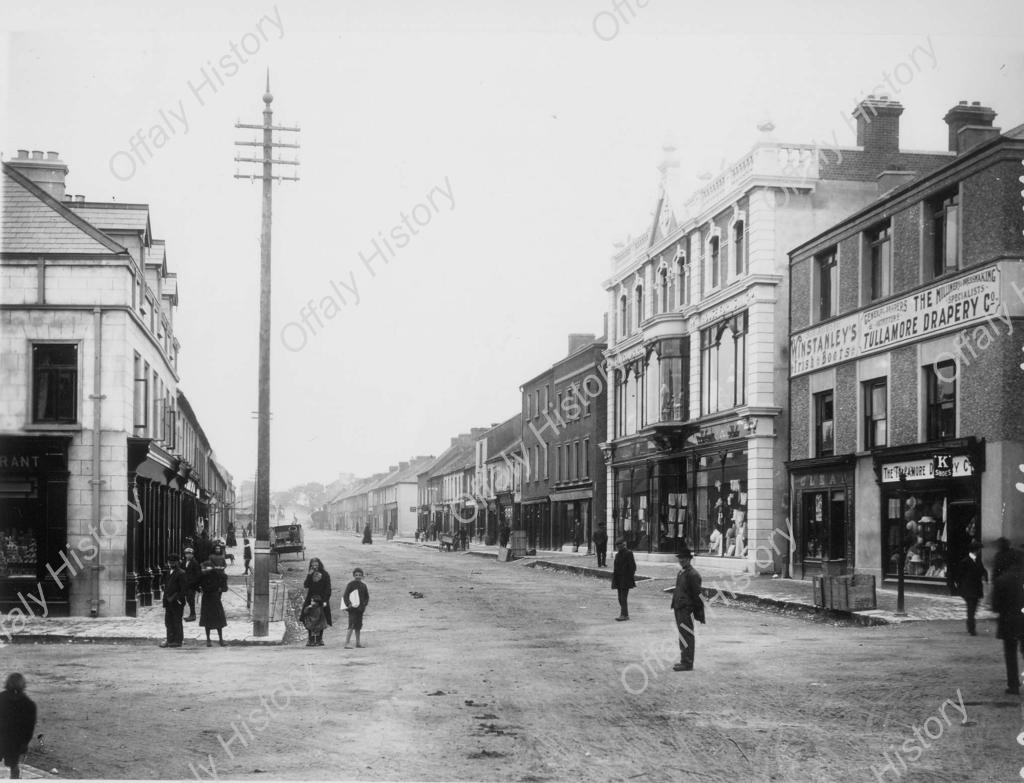
Columcille Street about 1914 with the new Scally drapery of 1912, next a Scally shoe shop and no, 5 was McMichael’s Medical Hall, now Dolan’s Pharmacy. Thomas Acres was the developer of most of the street and notice the uninformity in roofline save in the most profitable area near Hayes’ Cross.
Is Dolan’s Pharmacy in Pound/William/Columcille Street, Tullamore the oldest family pharmacy in Ireland? It almost certainly is now that so many of the old family pharmacies have been bought up by pharmacy chains. Up to the decade ending 2020 it was the one area of shopping in Tullamore that was still largely locally controlled and in the same family for generations. One thinks of Dolan’s (the Dolan and later the O’Connell family since the 1940s); Quirke’s Medical Hall (Carragher’s from the 1930s until 2019); Fahey’s from 1955; and Adams’s in Bridge Street since the 1940s and still in the family. Up to twenty-five years ago there was not much above seven pharmacies in Tullamore but that changed in 2002 with deregulation as to the number permitted vis a vis the population served. Even by that time pharmacy chains were growing in strength with one company (Unicare) having fifty outlets, but seventy percent of the market outlets were still controlled by independent pharmacists. Today Tullamore has thirteen pharmacies and new locations at Ardan Road (2), Clonminch Road (1), Church Road (2) and Main Street (1). The town centre still has five around the former Hayes’ Cross with three in Bridge Street, Patrick Street (1) and Columcille Street (1).



 offalyhistoryblog