A few years back I met up with some members of the Offaly diaspora in the Gresham Hotel, Dublin, for coffee, and we had a reflective chat about the Faithful County. My fellow aficionados were Laura Price and the late Dr. Michael J.S. Egan. Dr. Egan, a truly wonderful Offaly man, raised the idea of marking the termans at Clonmacnoise.
While I had grown up in the area I had never heard the expression. He explained it was the point where funeral corteges paused on the way to the cemetery. I was well aware of the practice, for as a child in the area every funeral paused at what was called the `coffin bush`. I have enquired from local folk and found nobody had used the expression in this context.
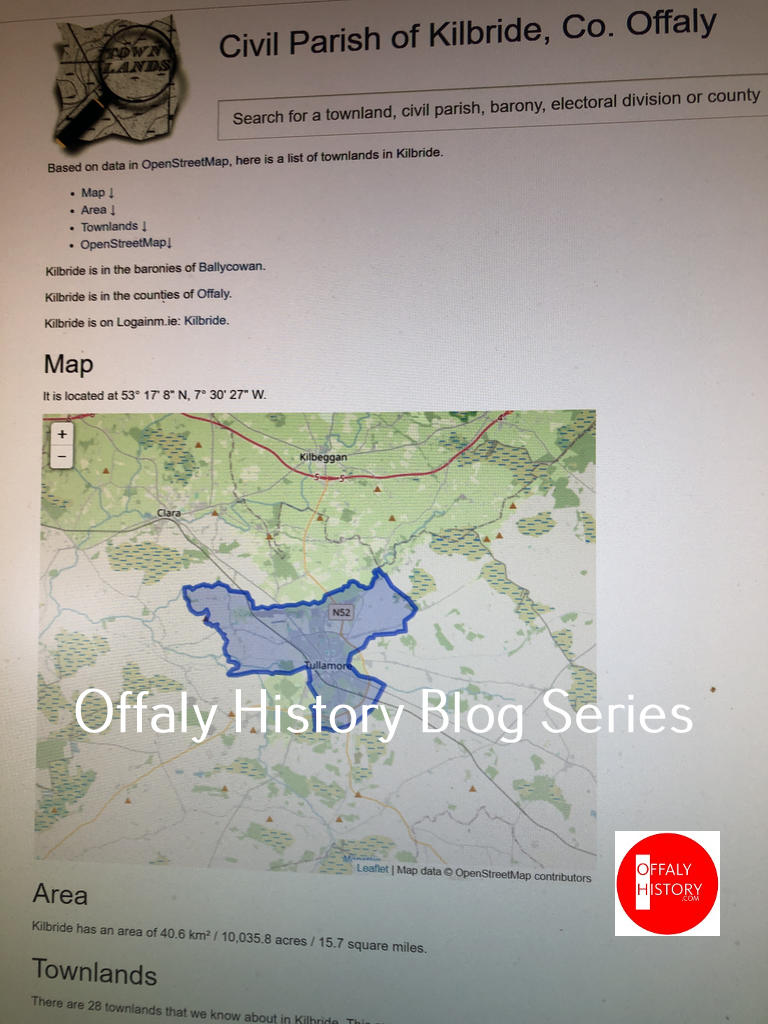
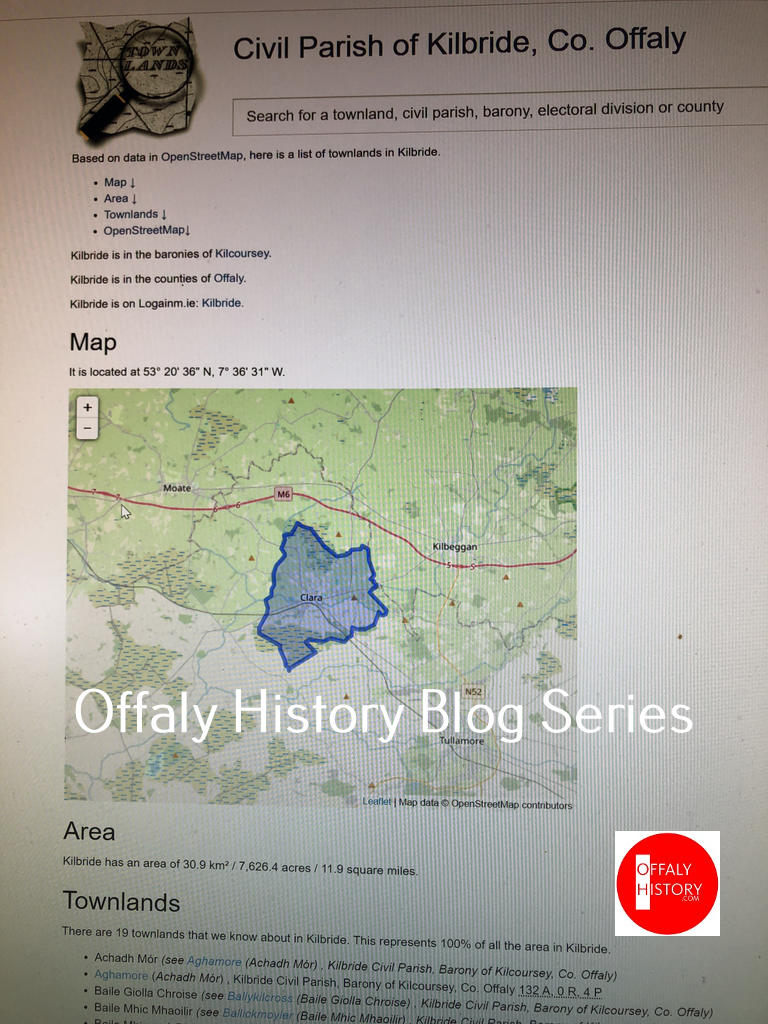
Tullamore is situated in the civil parish of Kildbride with 28 townlands and so too is the town of Clara with 19 townlands. Both parishes have a connection with the churches dedicated to Saint Brigid. Now Ireland mark the saint’s day on 1st of February with a public holiday, the beginning of spring and the celebration of Lá Fhéile Bríde, St Brigid’s Day.
These are the only townlands in Offaly dedicated by name to a church associated with Saint Brigid.
Kilbride (Cill Bhríde) , Kilbride Civil Parish, Barony of Ballycowan, Co. Offaly 193 A, 3 R, 20 P
Kilbride (Cill Bhríde) , Kilbride Civil Parish, Barony of Kilcoursey, Co. Offaly 146 A, 2 R, 30 P
The proximity of the two parishes often leads to confusion especially when tracing soldiers of the First World War who gave their place of birth as the civil parish of Kilbride without distinguishing wherether it was Clara or Tullamore.
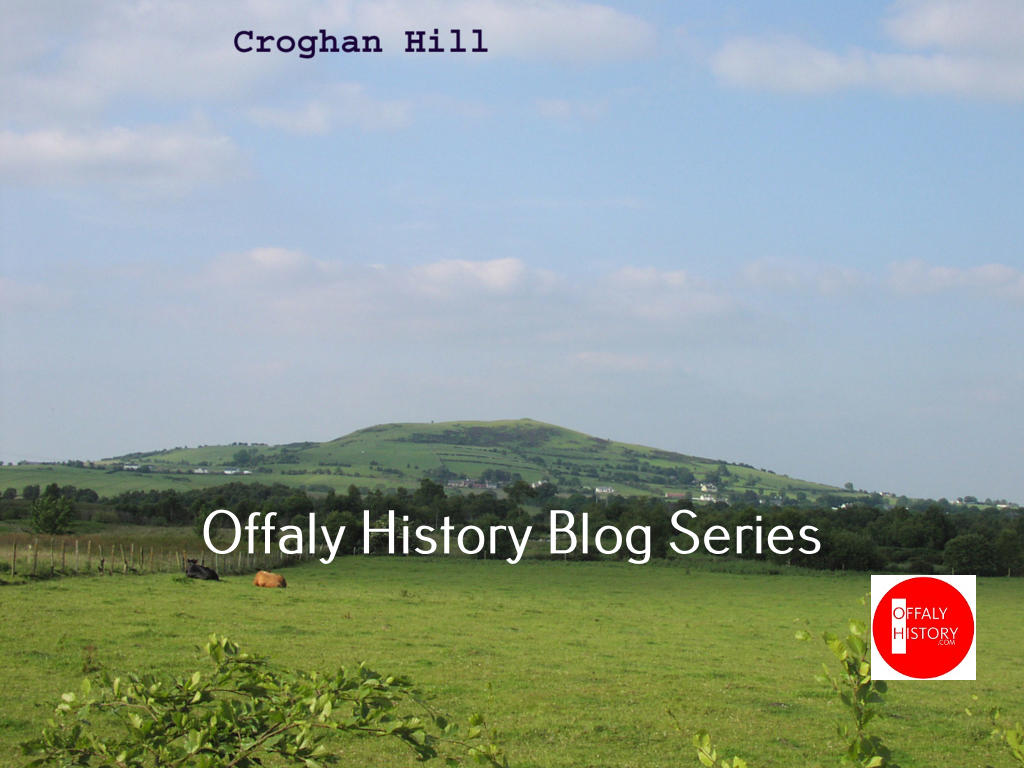
To the east of both towns is Croghan Hill associated by some scholars with the birthplace of St Brigid. John O’Donovan was well aware of the association of the hill with the legend and cult of St Brigid and wrote of it in the Ordnance Survey letters. The Ordnance Survey Letters for County Offaly form part of a countrywide series, are commonly known as O’Donovan’s Ordnance Survey Letters.
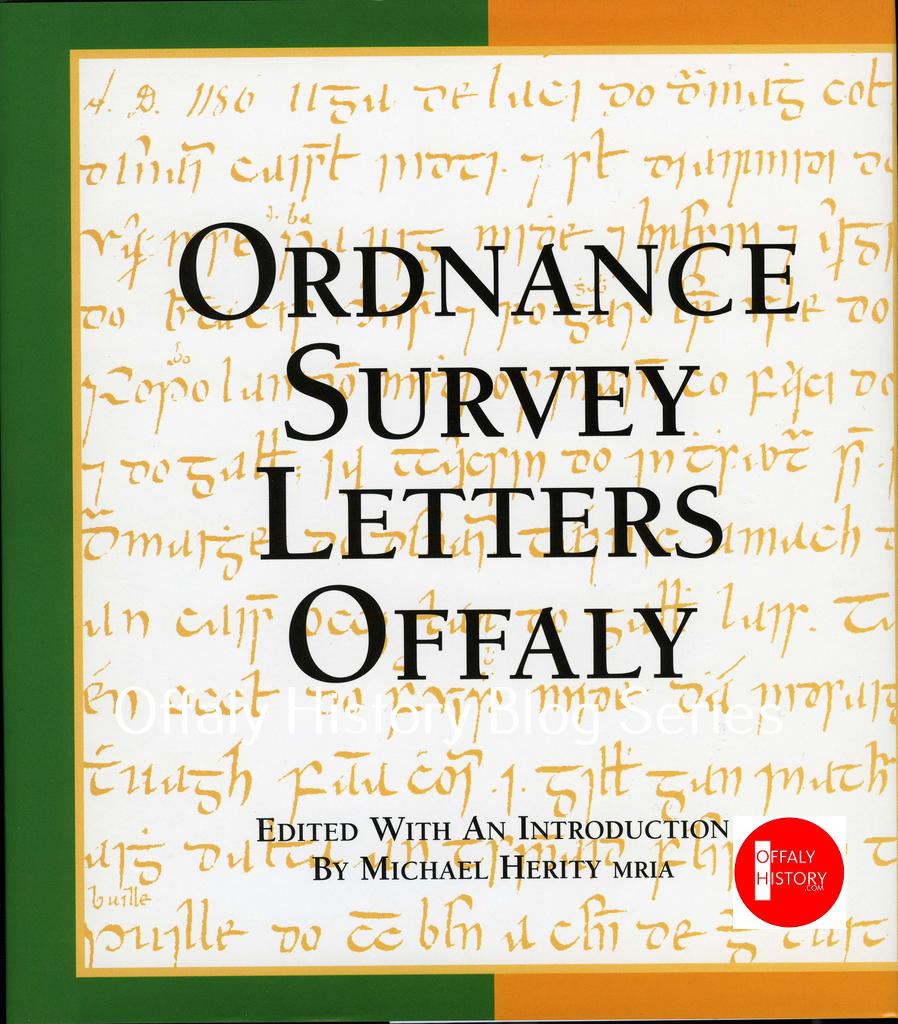
The Ordnance Survey Letters for Offaly of 1837-1838 represent the first attempt on a systematic basis to collect material on Offaly’s historical and archaeological remains. The pioneering effort of the Ordnance Survey and of its topographical department, in particular, was not emulated until the publication some 150 years later of the Archaeological Inventory of County Offaly by Caimin O’Brien and P. David Sweetman. O’Donovan’s Ordnance Survey Letters are in manuscript form in the Royal Irish Academy and were published in a typescript by Fr. Michael Flanagan in 1933. The late Professor Michael Herity edited the volume of letters for Offaly and this book is available from the Society and can be ordered online at our shop at www.offalyhistory, or consulted at Offaly History Centre.
Civil parish of Kilbride, Tullamore from Townlands.ieCivil parish of Kilbride, Clara from Townlands.ie
The Offaly material consists of fifty-one letters of John O’Donovan and of Thomas O’Conor. O’Conor, a native of Carrickmacross, was assistant to O’Donovan. Both men had spent September, October and November of 1837 in County Westmeath and in late December of 1837 their attentions turned to Offaly, then and until 1920 called King’s County. The letters concern local antiquities, placenames, early Irish history and the genealogy of the native families
It should be noted that in the Westmeath letters volume are one of John O’Donovan’s from Tullamore and another from Edenderry. That from Tullamore is dated 1st January 1838 and could properly be in the King’s County volume. A list of the fifty-one letters concerning King’s County written over the period from 18 December 1837 to 11 February 1838 with the inclusion of two letters about Durrow, that of October 1837 and the second written on 1 January 1838.
O’Donovan wrote of the legends associated with St Brigid as follows:
St. Briget was consecrated a Bishop.
(Father Bollandus complains of the silliness of the writers of the lives of the Celtic Saints; and the Benedictines complain of the folly even of St. Jerome and Augustin!.)
“Bridget was desirous that a degree of Penance (gradh Aithrighe) should be conferred upon her. Hearing that Bishop Mel was at Bri Éle (Croghan old Church) she repaired thither, accompanied by seven nuns. But on their arrival the Bishop was not there, but had gone into the Country of the Hy Niall “terra nepotum Neill” (Meath). On the morrow she passed in search of him in company with Mac Caille (the Bishop of Brig-Ele) who guided her over the bog of Monaidh Fathing, which she converted into a flowery plain. When they had come close to the Town (baile) where Bishop Mel was, Briget told Mac Caille (Macaleus) to put (place) a veil on her head, that she did not wish to appear unveiled before the clergy. Upon her arrival a pillar (column, a glory?) of fire sprung rose, shot out) from her head, reaching even to the roof of the church. When Bishop Mel had seen this, he asked: “Who are the Nuns”? Mac Caille answered: “This is Briget, the celebrated Nun of Leinster.”
“My affection to her, said Bishop Mel, it was I who predicted her greatness, even while she was in her mother’s womb, and it is I who will confer orders on her.”
“This (gloss) alludes to one occasion that Bishop Mel came to the house of her father, Dubhthach; he saw the wife of Dubhthach grieved and sorrowful, and he asked whence the cause of her sorrow. I have cause of sorrow, said she, for Dubhthach admires (loves) the handmaid who attends. This is just (meet, dethbhir) said Bishop Mel, for thy seed shall serve (obey) the seed of this handmaid, alluding to Bridget.” (Bridget was illegitimate, but not the worse Bishop for that, and —-).
“Then Mac Caille placed a veil (caille, cowl) on the head of Briget. Wherefore, from that day to this, the Coarb (successor) of St. Briget (Abbess of Kildare) is entitled to receive the grade (dignity, orders) of a Bishop.”
“Wherefore have the Nuns come? said Bishop Mel. To have orders of Penance conferred on Bridget, said Mac Caille. Then he conferred orders on Briget, and it was the orders of (gradha eps.) a Bishop, that Bishop Mel conferred upon her!”
(Columbkille intended to get himself made a Bishop, but the Consecrator made him only a Priest by mistake. The authorities of the Irish Bulls Begins with Brian Boru).
“While St. Briget was being ordained, she held the foot of the altar (the altar was like a little table) in her hand; and (since that time) seven churches were burned down, in which this altar was, but it received no injury from the fire: Sed servata est per gratiam (favor) Brigidae. Dicunt alii, that this Church, to which Bishop Mel had gone, is in Feratullach. Ita ut alii putant.” (Fartullagh is near Bri Ele). – Liber Maculatus, Leabhar Breac, Fol. 31.
Colgan was ashamed of this. Cogitosus has not a word about it, or if he has, Colgan has suppressed it. I don’t laugh at these stories, for I think they are very nice if they were well told.[1]
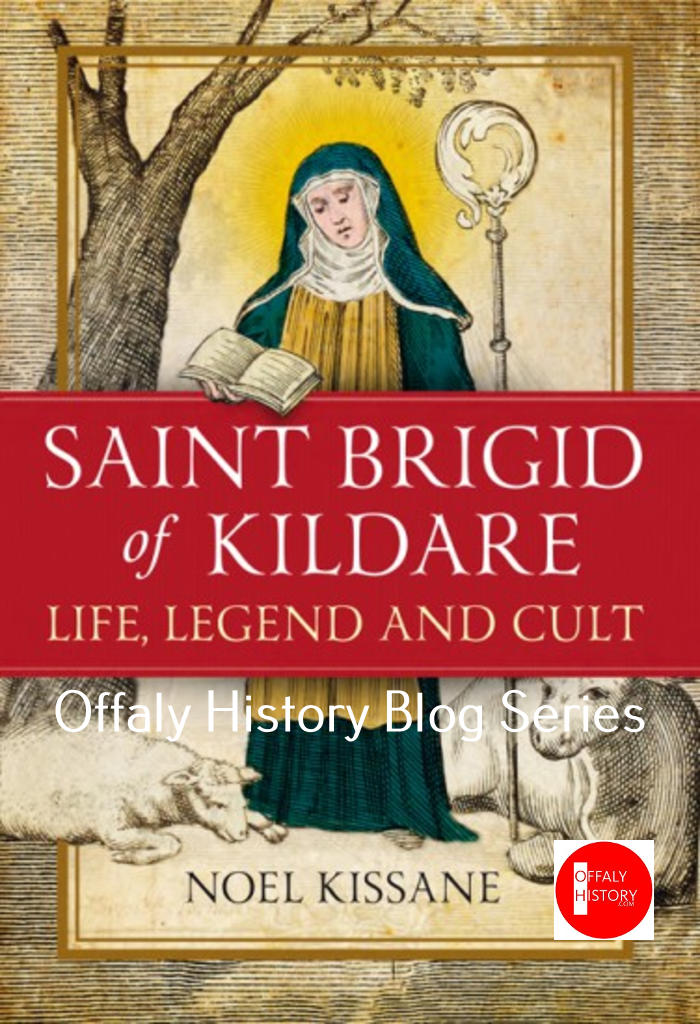
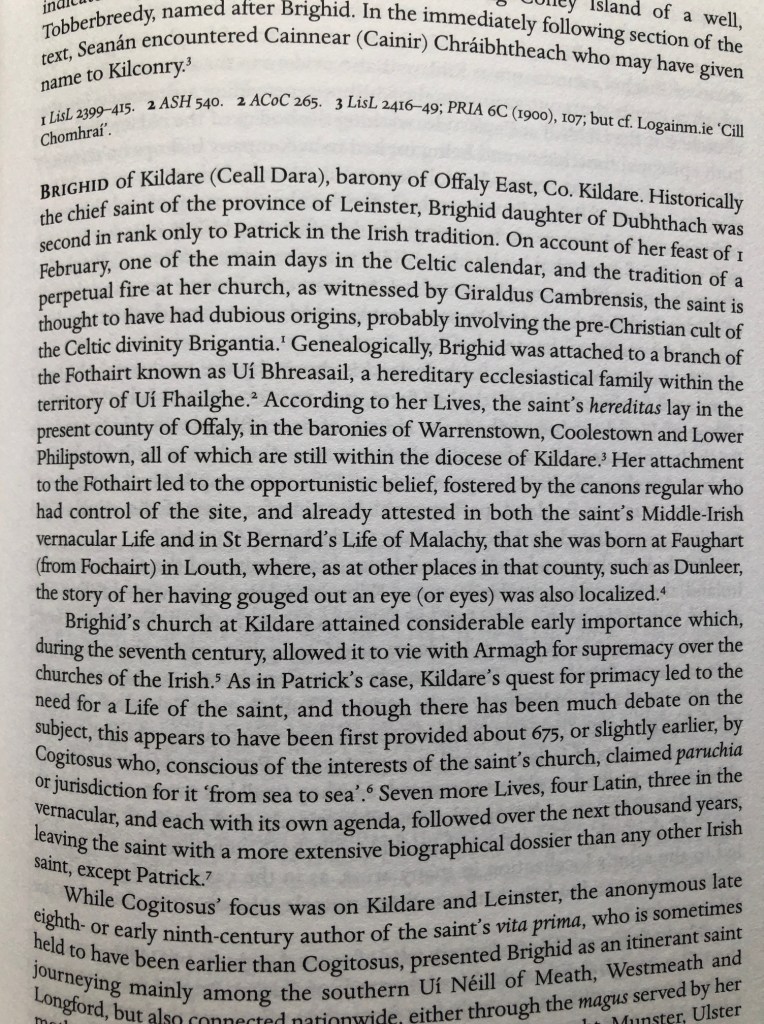
For more on the Saint Brigid story see the Noel Kissane Life in the online Dictionary of Irish Biography. Some extracts below
The Brigit story Brigit was the daughter of Dubthach son of Deimre, a nobleman or military leader. He was of the Uí Bressail (Rawl. B. 502, 126a 28), a sept of the Fothairt, a subject people located in the present Co. Offaly, but with branches elsewhere. Brigit’s mother was named Broicsech; she is presented in alternative accounts as Dubthach’s wife (Cogitosus) or slave. When Broicsech becomes pregnant by Dubthach, in the scenario where she is a slave he sells her to a poet but retains ownership of the unborn child. The poet later sells Broicsech to a druid (magus) in whose house Broicsech gives birth to Brigit, who is born with the status of a slave. The location is not stated; claims for Faughart, Co. Louth are based on late medieval tradition. The druid kindly allows Brigit to live with her father Dubthach whose house was seemingly located in the area east of Cruachan Breg Éile (Croghan Hill, Co. Offaly). She is particularly involved with dairying and looking after the cattle, activities commonly represented in her iconography. She is especially kind to the poor and performs various miracles on their behalf. Her father and brothers want her to marry a suitor, but she refuses as she is committed to a celibate life in the service of God. Her father eventually allows her to take the veil. The ceremony is performed, according to different accounts, by one or other of the bishops Mel (qv) (d. 487) or Mac-Caille (qv) (d. c.489), the location probably being in Mag Tulach (the present barony of Fartullagh, Co. Westmeath).
Croghan Hill, County Offaly, associated with the Life of St Brigid
Brigit is said to have established a convent at Kildare, but the Lives are silent regarding the date and the circumstances. ….
The hagiography of St Brigit is typically Christian and it echoes the Old and New Testaments, the Apocrypha and the early Fathers. It presents her as wise, humane, charitable to a fault, and concerned with the welfare of the common people. She is in constant communion with the Lord and is a prolific worker of miracles, which are almost invariably attributed to divine intervention and often have precedents in the New Testament. Many of the miracles and other aspects of the Lives, however, seem to reflect pagan religion or superstition; for example, the story of Brigit’s origin features a poet and a druid, both from classes with important functions in pre-Christian society; her suitor is the fictional poet Dubthach (qv) of the moccu Lugair, who is represented in seventh-century literature as a pagan who converts to Christianity; the only milk she can tolerate as a child is that of a white red-eared cow; and she resolves an unwanted pregnancy as if by magic. A notable feature of the Lives is a preoccupation with fire and light: a column of light rises from Brigit’s head; she hangs her cloak on a sunbeam to dry; the house in which she is asleep catches fire but remains intact. .
Folklore Echoes of pre-Christian religion and superstition are also intrinsic features of the folklore associated with St Brigit. Her feast-day (Lá Fhéile Bríde) on 1 February coincides with the pagan festival of Imbolc, one of the four quarter days of the pagan year, which marked the beginning of spring, lambing, and lactation in cattle. The feast of a saint was normally celebrated on the anniversary of the death, but there is no evidence that Brigit died on 1 February. Cogitosus states that she did, but the context suggests that his only evidence was her feast-day. In any case, the celebration of St Brigit’s feast-day retained various features of the pagan festival, including probably the straw or rush crosses, believed to bring luck to the home and the byre, and the strips of cloth representing Brat Bhríde (St Brigit’s mantle) which were claimed to protect virginity, cure barrenness, and relieve women in labour. The ceremonial often included visits to Brigit’s wells, some of which were thought to cure sterility. While much of the imagery relating to Imbolc was probably censored or Christianised at an early date, some of the folk customs associated with St Brigit’s Day retained explicit references to sexuality and fertility. Séamas Ó Catháin has identified parallels in the international folklore of northern Europe, especially that of Scandinavia, which suggests that the cult of the goddess was widespread and tenacious.
See also the Dictionary of Irish Saints by Pádraig Ó Riain below from the 2011 edition:
There is little doubt that contact by sailors from Norway had occurred over many years in the 8th and 9th centuries between the islands of northern Scotland, the east coast of England and with Ireland. Most of these sailors would have been fishermen or traders and would have acquired details of the Irish coastline, location of rivers and awareness of monastic sites. This intelligence was readily available when the Viking raiders came calling.
Tony Lucas in his paper on the plundering of Irish churches makes the point that of the 309 ecclesiastical sites that were plundered between 600 and 1163AD, the Irish themselves were responsible for 139 of these. Only 140 of these can be directly attributed to the Vikings and 19 raids are attributed to the Irish and Norse together. An entry in the Annals of Ulster for 755 records ‘The burning of Cluain Moccu Nóis on the twelfth of the Kalends of April’ by the Irish long before the arrival of any Viking.
What? The course will give an overview of the sources and methods for the study of the archaeology, community and family history of County Offaly, and how to do research on areas that may interest you in local and family history. Thematic sessions will be delivered by experienced local scholars, who will introduce participants both to physical sources and to online resources. Offaly is taken as the example, but most of the records will have application for the entire country.
When? All talks will be held on Wednesday nights, from 7.30 to 9.30 pm.
Where? Offaly History Centre, Bury Quay, Tullamore, Co. Offaly, R35 Y5V0
Fees? The course fee for all ten sessions is €50, payable to the Offaly Heritage Centre at the time of booking. Please provide your credit or debit card details when booking, or visit the shop Monday–Friday, 9:30 am–4:30 pm.
Alternatively, payment can be made by bank transfer: Best contact us first as only a few places are left.
This course is supported by the Heritage Council and Offaly County Council. Places are limited to 25 participants, so early booking is strongly advised.
Please call or email us to check availability and make your booking
Alongside John O’Donovan and Eugene O’Curry the name of George Petrie (1790–1866) will forever be remembered as one of Ireland’s greatest scholars of the first half of the nineteenth century. It was a time when tremendous work was done for Irish archaeology and history. Petrie was a major figure in the historical research section of the Ordnance Survey. Jeanne Sheehy in her The Rediscovery of Ireland’s Past 1830–1930 states that he was the founder of systematic and scientific archaeology in Ireland.
Petrie was involved in the work of the Ordnance Survey from 1833 for ten years. He was very much a polymath and in his late years published a volume of Irish music arising from his efforts to collect and preserve old Irish music.
Saturday 21 JuneVisit to Westmeath andFore with Rory Masterson. Depart Tullamore at 10. a.m. Car sharing from Bury Quay let us know your needs.
St. Féichín’s Church by Rory Masterson, our guide
The walk will consist of a walk to St. Féichín’s church that was the church of the old monastery founded in the seventh century.
The Anchorite’s Cell
This will be followed by a visit to the Anchorites Cell. Anchorites were hermits who enclosed themselves in a cell for the rest of their lives in order to attain greater sanctity. The last recorded anchorite was at Fore in the closing decades of the seventeenth century. I am hoping to get the keys so that we can get access to the cell.
The North Gate
After the coming of the Anglo-Normans, Fore became a chartered borough. In the 15th century the borough came under attack from the neighbouring Gaelic Clans the O’Reillys and O’Farrells. So it received a murage grant to enable it to charge a tax on all good coming and leaving the town to cover the cost of building town defences
St. Feíchín’s Mill
Dating from the time of the early monastery founded by St. Féichín the mill is referenced at still in operation when the Normans arrived and is mentioned by Gerald of Wales in one of his stories The mill, like the church was an area that women were forbidden to enter as referenced by Gerald of Wales in the thirteenth century.
The Benedictine Priory
The large Benedictine priory of Fore that as commented by many looks more like a fortress than a monastery. Founded by Hugh de Lacy before his death in 1186 (at Durrow in Offaly) i’’s mother house was in Normandy in France. It was richly endowed by de Lacy but fell on hard times during the hundred years war. During that era England and France began to see themselves as separate (though most English nobility and kings continued to speak French as their everyday language until the end of the fifteenth century) as so the Benedictine priory came to be seen as ‘alien property’. As a result the monastery was taken into royal custody during the war and drained of as much of its resources as possible.
In the fifteenth century the priory was run down and with the Gaelic resurgence a change of government policy occurred. Instead of seeing the priory as French property they now came to see it as vital for the defence of the Pale from the Gaelic Irish. The priory was granted to a series of loyal local Anglo-Normans who seem to be responsible for the addition of the two towers to the priory. In fact the priory became a fortress cum monastery with both sharing the same space. The priory was dissolved in 1539
St. Féichín, the founder of the Gaelic monastery at Fore, Co. Westmeath, was born in Billa, in the townland of Collooney in Co. Sligo. A student of St. Nathí of Ardconry he is associated with a number of foundations in the west of Ireland, including Cong in Mayo, Omey and High Island in Galway as well as Termonfeckin in Co. Louth. However, Fore in Westmeath is considered as his most successful establishment. He is said to have died in 665 of the Yellow Plague or Buidhe Chonnail. While we cannot be certain what the disease was it is reputed to have lasted for almost ten years and was followed by leprosy. The name ‘Yellow’ suggests that it was some form of jaundice. Three ‘lives’ of St. Féichín have come down to us, one in Latin and two in Irish. In addition we have Colgan’s commingled Latin life of the seventeenth century. Lives of the Irish saints were not historical biographies of the saint in question actual life. Written long after the subject under discussion had died, their purpose was to promote the sanctity of the founder as his or her value as a saint to venerate. Details of relics of the saint, real or fabricated, which the monastery retained, were interwoven into the saint’s live to demonstrate their powers.
Thomas Lalor Cooke’s Picture of Parsonstown was first published in 1826 and a revised edition by his son William Antisell Cooke in 1875. So this year marks the 150th anniversary of the revised issue and in 2026 we mark the 200th anniversary of T.L. Cooke’s first and now rare book, the Picture of Parsonstown. A reprint of the 1875 greatly expanded history was issued by Esker Press in 1989 with a new introduction by Margaret Hogan. It is now also out of print. A reissue of the 1826 book is now under active consideration.
How often have we seen relatively small scale and cheap solutions deferred in the expectation that more ambitious longer-term projects will arrive at some future date to solve everything? Frequently the costs of the more grandiose schemes balloon over time and their implementation indefinitely deferred or even abandoned. Meanwhile the problem gets progressively worse – often to the point that any solution becomes unrealistic.
While the making of good long-term plans must always be pursued, the delivery of shorter term and achievable remedies should not be easily dismissed. Two high profile projects in the Tullamore area offer classic examples of the dilemma.
In early 1914, a controversy erupted over public access to Durrow Abbey that illuminates broader tensions regarding cultural heritage, religious identity, and national monuments in pre-independence Ireland. The dispute began when the Local Government Board ordered the closure of Durrow’s graveyard, citing “insanitary conditions.” This administrative decision catalyzed a remarkable public debate that revealed deep fissures in how Ireland’s sacred spaces were controlled, preserved, and accessed.
On Monday, 24 March. at 7 30 p.m. (please note the earlier time) Angus Mitchell will speak at Offaly History Centre, Tullamore. All are welcome. The public lecture is titled:
Sacred Space and Public Access: The Durrow Abbey Controversy of 1914
The 1914 controversy over public access to Durrow Abbey serves as a compelling lens through which to examine broader questions of cultural heritage, national identity, and preservation rights in pre-independence Ireland. When historian Alice Stopford Green published her indignant letter about restricted access to this ancient monastic site, she ignited a significant public debate that transcended local boundaries. The ensuing discourse, played out in Ireland’s leading newspapers, revealed deep tensions about proprietorial rights, Protestant privilege, and the role of local authorities in monument preservation. This controversy emerged at a crucial moment when sacred spaces were being reimagined as vital coordinates in Ireland’s cultural landscape. The debate highlighted a fundamental disparity in how ancient monuments were protected under British law in Ireland compared to Britain itself, raising questions about cultural sovereignty that would resonate well beyond independence. Though the immediate controversy lasted only weeks, its implications for heritage management and public access endured well past 1922. That Durrow Abbey remains largely inaccessible to the public in 2025 invites reflection on the persistent challenges of balancing preservation, private property rights, and public cultural access. This lecture examines how historical controversies about sacred spaces shaped, and continue to shape, dialogues about cultural identity and heritage management in Ireland.
The origin of Lynally as a religious centre can be traced to Colmán who founded a monastery here in the seventh century. His death is recorded in 611. Colmán himself was from Connor in modern day county Antrim. His family were of the Dál Sailni clan who ruled the area around Connor. According to an early Latin life of Colmán, it was St. Columcille who requested that a site be granted to Colmán for a monastery and as a result Aed Sláine (d.604) granted him Lynally.
Three ‘Lives’ of St. Colmán have come down to us, two in Latin and one in Irish. It should be pointed out that these so called ‘Lives’ are not biographies. Written long after the saint’s death the so called lives are in fact glorified fictional accounts of the saint’s life designed to justify property claims or political allegiances of his foundation by linking them to purported events in the founder’s life. Thus the close relationship between Lynally and St. Columcille’s foundation at Durrow is depicted in the lives by tales of friendly encounters between Colmán and Columcille. We have already seen how the early life of Colmán credits the founding donation of the site of Lynally to the request of Columcille while a later Irish Life even claims that Columcille’s sister was Colman’s aunt.

 offalyhistoryblog