It is hard to believe that we are catching up on history. In seven years time we mark the 200th anniversary of the building of the Catholic church in Durrow. This year is the thirtieth anniversary of the major renovation. The catholic church now in use at Durrow dates back to 1831and was completed in 1832 and consecrated by the then bishop Rahan-born Dr John Cantwell, on 24 September 1832. In an unpublished report on the houses and churches of County Offaly prepared for the Offaly Historical Society in 1985, William Garner wrote:
Early in the summer of the year 697, probably in May, a great assembly of kings, bishops and abbots, along with their followers and servants, took place in Birr. It was a joint meeting of kings (rígdál) and of church leaders (synod). They came together to proclaim a law for the protection of women, children, clerics and other people who did not bear arms, in times of conflict. The law was called Cáin Adomnáin or the ‘Law of the Innocents’ (Lex Innocentium) and later referred to in a poem as the ‘Great Law of Bir
There was an extraordinary Synod held in Birr in 697AD. This synod was called by Adomnán, abbot of Iona, who arrived in Birr with the princes of church and state and who produced an edict that fundamentally challenged the way warfare was carried out in Ireland and beyond.
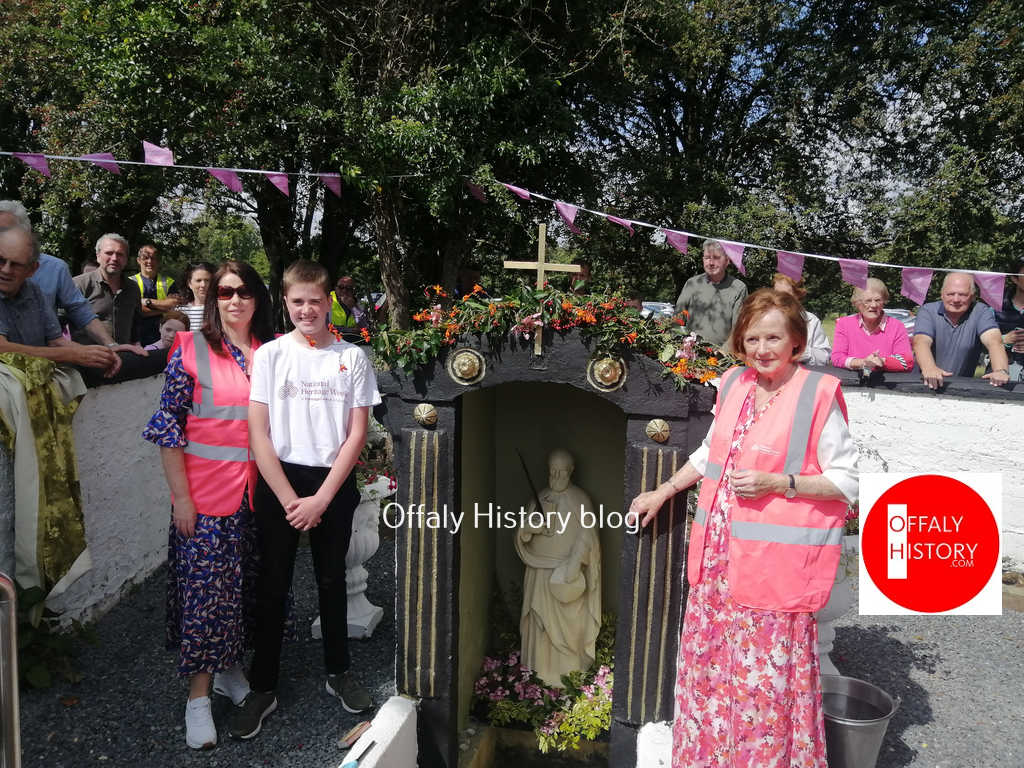
Bracknagh Heritage Society unveiled a statue of Saint Brochan in Saint Brochan’s Well, Clonsast, County Offaly for National Heritage Week. The Blessing was performed by Fr. Gregory Corcoran, P.P and by Reverend Alan Melbourne. Mary Briody on behalf of Bracknagh Heritage Society welcomed a large crowd who gathered at the Holy Well and Monastic site at Clonsast (on farmland) as Frances Cunningham unveiled the statue. Mary Delaney gave a talk on the History of St. Brochan and the 7th century monastic site. Pat Carey read an “Ode to St.Brochan’s Well”, composed by Mary Crotty.
The event was accompanied by the local Choir and Ciaran Flood played the pipes.
Address from Mary Delaney, local historian and chairperson of Bracknagh Heritage Society
Good afternoon, Fr. Corcoran, Reverend Melbourne, Ladies and Gentlemen
Today we gather in this sacred place to remember Saint Broghan and to pay tribute to him by placing a statue of the Saint into this holy well. We hope that this will enhance the historical importance of the monastic ruins here in Clonshannon and will provide a valuable resource for future generations.
From the early 6th century young men and indeed some young women, as was the case of Saint Brigid, left their homes and families and decided to devote their lives to God in a special way. Some joined monasteries and convents while others like Saint Broghan established their own monasteries. Today, only fragments of the landscape they created survive. Nonetheless they left a legacy that deserves recognition. This legacy is an important part of our historical past.
The townland of Clonsast or Clúin Sasta is the site of the monastery founded by Saint Broghan in the 7th century. Monks usually chose isolated locations on which to establish their holy grounds, locations that would be free from distraction. Clonsast translates as “the meadow of tranquility” and would have provided an idyllic refuge in which Saint Broghan and his monks could pray and work. The monastery was built on a section of dry land surrounded by the Bog of Clonsast and the greater Bog of Allen and was in close proximity to Croghan Hill, another important seat of worship.
Please see an invitation from the community in Lemanaghan about two events this Saturday 12 August as part of Heritage Week. We are publishing early this week as part of our Heritage Week Specials from 12 to 20 August. So keep in touch with us on Social Media and do call to Offaly History Centre and Offaly Archives as part of next week’s 2023 programme.
The community of Lemanagahan extend a special invitation to you for a truly remarkable event – the book launch of “The Annals of Clonmacnoise” where the links with Lemanaghan will be discussed by the author Nollaig Ó Muraíle. Event Details: Date: Saturday, August 12th, 2023 Time: 2:30 PM Venue: The Granary, Boher, Ballycumber, Offaly, N35NX30 [beside St. Manchans Church]
“The Annals of Clonmacnoise” is a meticulously compiled chronicle that offers a panoramic view of Ireland’s past. Through its pages, you’ll be transported to a world of ancient tales, historical intrigue, and cultural treasures that have shaped the very essence of our heritage.
Mag Léna is of interest for two events that occurred in the early historic period. The first event is the pseudo historic Battle of Mag Léna. The second event was the significant Synod of Mag Léna and the Letter of Cummain, part of the Irish church row with Rome over the dating of Easter.
Both incidents caused a split in Ireland!
What’s in a name?
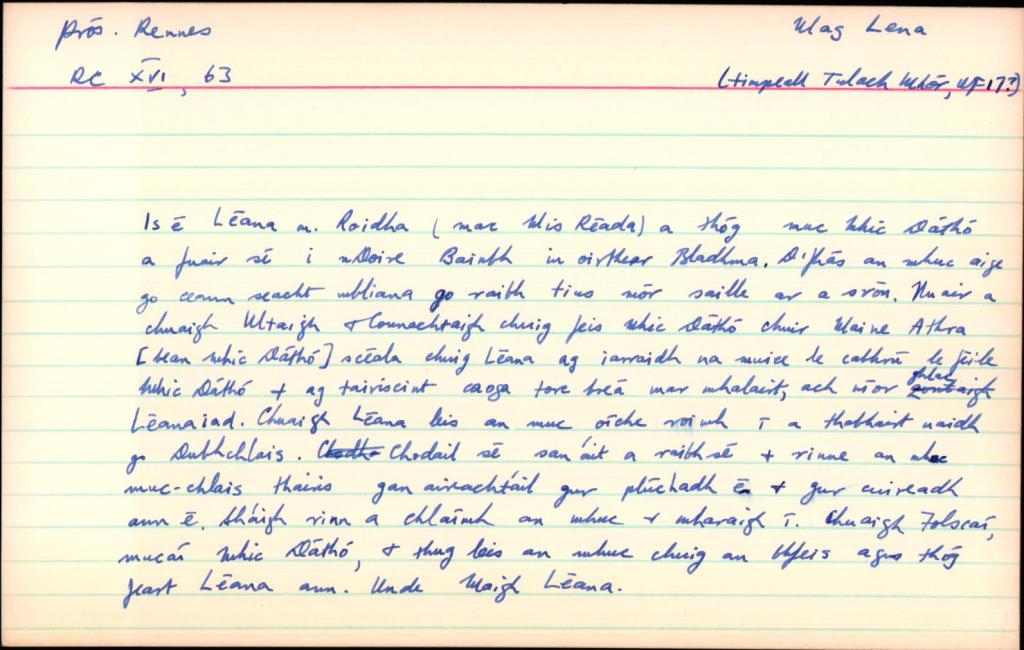
Mag Léna is mentioned in logainm.ie as Moylena and places it in the parish of Kilbride, Co. Offaly. Mag or Magh translates as a plain or open country, there is no information provided on the meaning of the word Léna. Unusually, there are no additional references other than the basic location details, also this older relic from the original card index system below. A 13th century manuscript mentions Cath Mhuighe Léana. Magh Léana is mentioned elsewhere. In his Survey Letters we find O’Donovan used a variety of spellings for the name – Moylena, Moyléna, Moyleana, Moleany and Moy-leana.
Logainm index card for Mag Léna.
As usual there are difficulties with the older Gaelic placenames and how they were recorded over time. Today the only memory of the name is in Tullamore, where the Moylena road joins the Clara Road and eventually joins the Rahan Road through Glendaniel.
When Christians arrived in Ireland and started to write about the country they found an island of Gaelic kingdoms, perhaps up to 150, that was dynastic and the political organisation was based on the tuath. The tuath was the bedrock of the Gaelic political system and is described as a small kingdom. Most of what we know now has been gleaned from the Irish Law Tracts, commonly known as the Brehon Laws. Other written sources include the Hero and Saga Tales.
Traditionally it has been believed that St. Columba, or Colmcille, left this world on 9 June 597, marking his departure from this world and entering a new life. Throughout those 77 years on this earth, according to his first hagiographer, Adomnán, he is reported to having performed many ‘prophecies, miracles and visions’[1] some of them astounding and others quite the opposite. Although much has been made of his more breathtaking and spectacular feats of saintliness, his less notable achievements have garnered significantly less consideration, though they might be worth reflecting on too. Here we take a few examples directly from Adomnán’s writings – one example from each of his three parts or books – and determine if they have any currency today, 1425 years later. (This article is published to mark St Colmcille’s Day on 9 June. Wishing our President Helen Bracken and all who have worked hard to see Durrow fully restored to public health and public access. Ed.)
Adomnán’s work is divided into three books, and according to the title, the first concerns prophetic revelations, the second miracles, and the third visions. There is no chronological order to most of it. He is sometimes painfully clear about some of his sources, and vague or silent about others. Over the centuries it has been added to, and the veracity of his writing has been the subject of much debate, with some researchers more disparaging than others. Here, we are only concerned with the original Adomnán work, and nothing later than that.[2] It was written at least 60 to 100 years after Colmcille’s death. It is worth adding that the version used in this article is a 1995 translation with extensive and informative notes by Richard Sharpe.
The Penguin edition edited by Richard Sharpe(more…)
The earliest writing is recorded in eastern Asia about 5,000 years ago. The spread was westwards with the use of earthen (cuneiform) tablets that are still found today in the Tells of modern Iraq and in the Fertile Valley. Cuneiform tablets were mainly used for recording stock control items and account balances; at the same time Egyptian hieroglyphs were starting to record the stories of the Pharaohs.
Cuneiform and Hieroglyphs
The Greeks and Romans introduced writing to the Mediterranean countries and it spread across Europe to Britain with the arrival of the first Roman invasion in 55BC.
Ogham is the first recorded writing in Ireland, based on inscriptions on stone. Ogham is a language based on the Roman alphabet. The influence of the Roman empire had introduced the Latin language and writing to most of Europe. Only two other societies used stone – Pictish symbols in Scotland and Norse Runes in northern Europe. Ogham stones are found in Ireland and in the Irish areas of influence in Scotland and Wales.
This week we welcome Ronan Healy, a new contributor to our series of articleson Offaly History. We are pleased to have his contribution and invite our readers to put the hand to the churn and write for the series.
In the townland of Strawberry Hill lies a cross-slab with a history that has generated a number of different theories but no definitive answer. This cross-slab is indistinct in the landscape. You would easily drive or walk past it without even noticing it. However this simple piece of stone has a history, folklore and decoration that suggests it is much more than a simple stone on the side of the road. This blog post will look at the history of the cross-slab, previous research on the slab and some suggestions for the future preservation of the cross-slab.




 offalyhistoryblog