
One of the saddest events in Tullamore history was the destruction of the 1906 Church of the Assumption by fire in the early hours of 31 October 1983. By morning all that remained was a burnt-out shell and the spire which survived. It is ironic that in the opening of Heritage Week 2026 Tullamore is also marking the 40th anniversary of the opening of the new and third church on the same site at Harbour and Chapel Street, Tullamore. Another example of the Phoenix at work in Tullamore over the past 250 years.
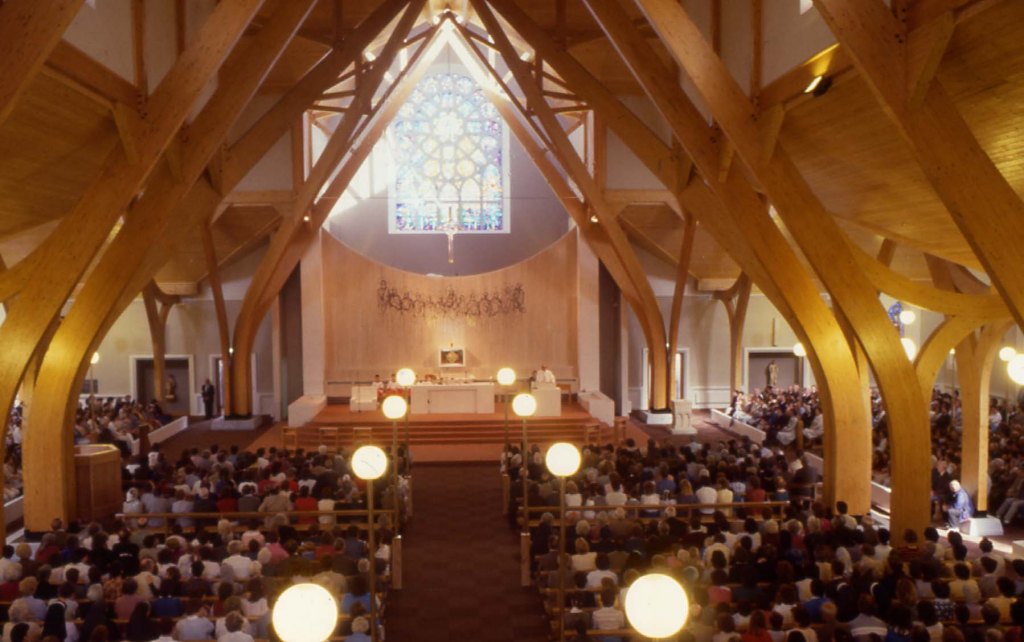
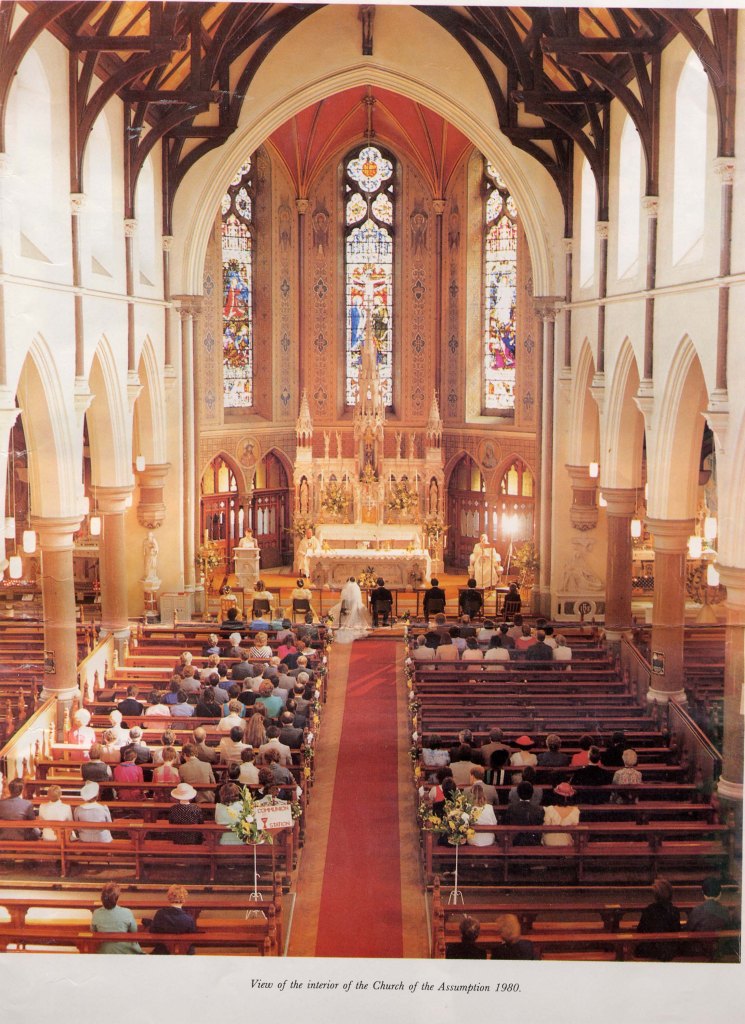
The background to the fire was well documented in several publications and resulted from a break-in and carelessness in not reporting a small fire that had been started by the lighting of a candle near a confessional curtain after the church had been closed and locked at 8.30 p.m. By 2.00 a.m. the building was gutted and gone with it were all the improvements since the late 1960s including the great refurbished organ and the well varnished pitch pine. It was a great tragedy for the parish.
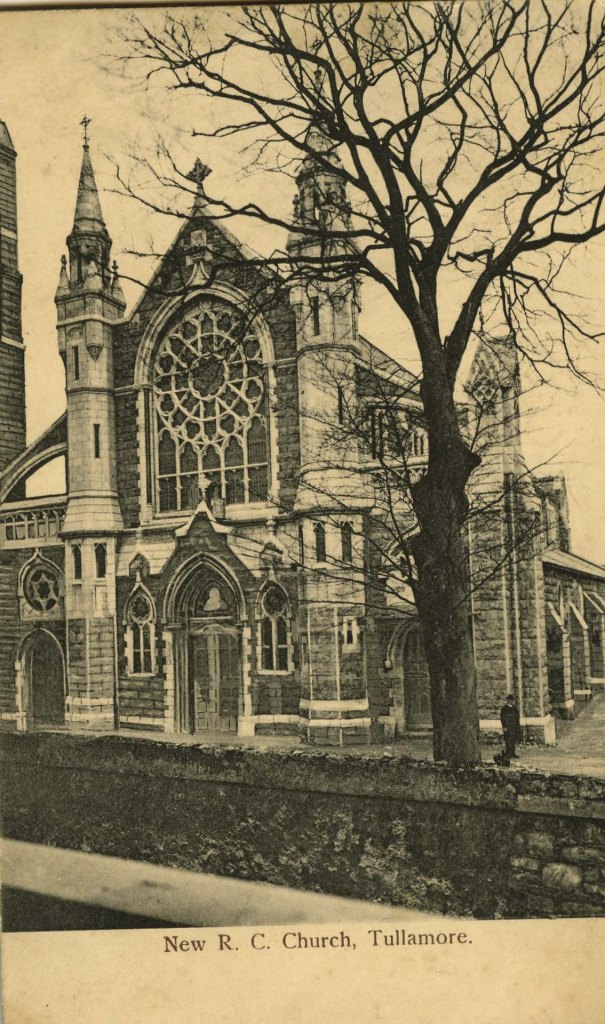
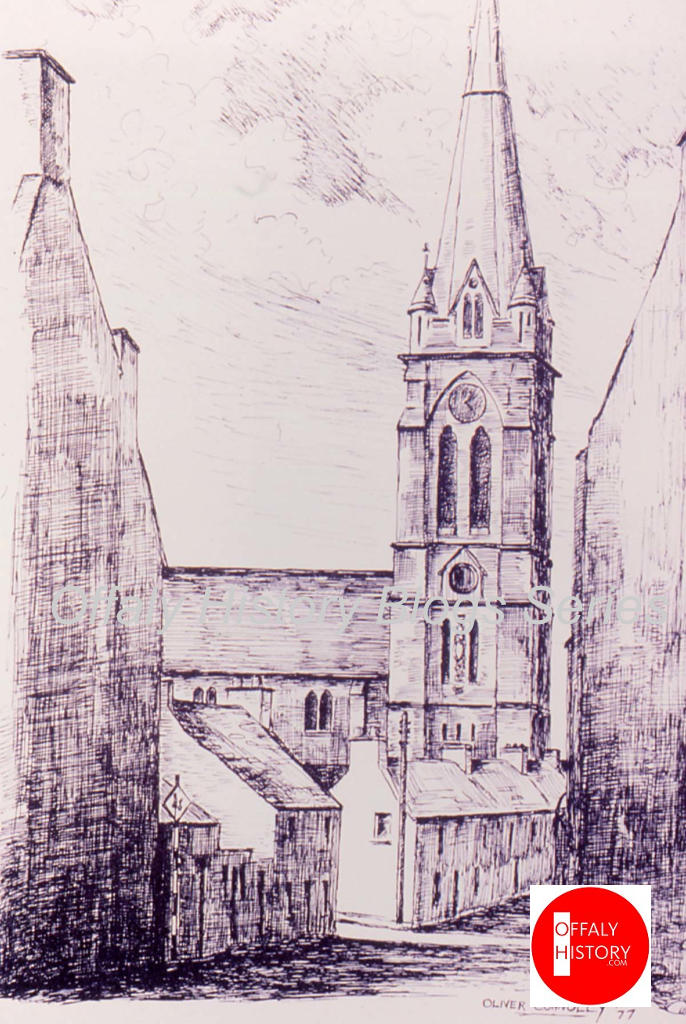
The building was deemed too unsafe to permit investigation of the causes of the fire, and as a result important and never-to-be replaced architectural features were taken down. Whether the stone could have been salvaged was contested by at least one architectural historian. The question of building a second church in Tullamore, which had been on the agenda in some shape since the mid-1960s, was now solved by a decision to build a new and larger church on the existing site in keeping, in so far as this was possible, with the old church. Edward N. Smith and Partners, architects, were selected by the then parish priest, Fr Fallon, to design the new church (there was no competition).
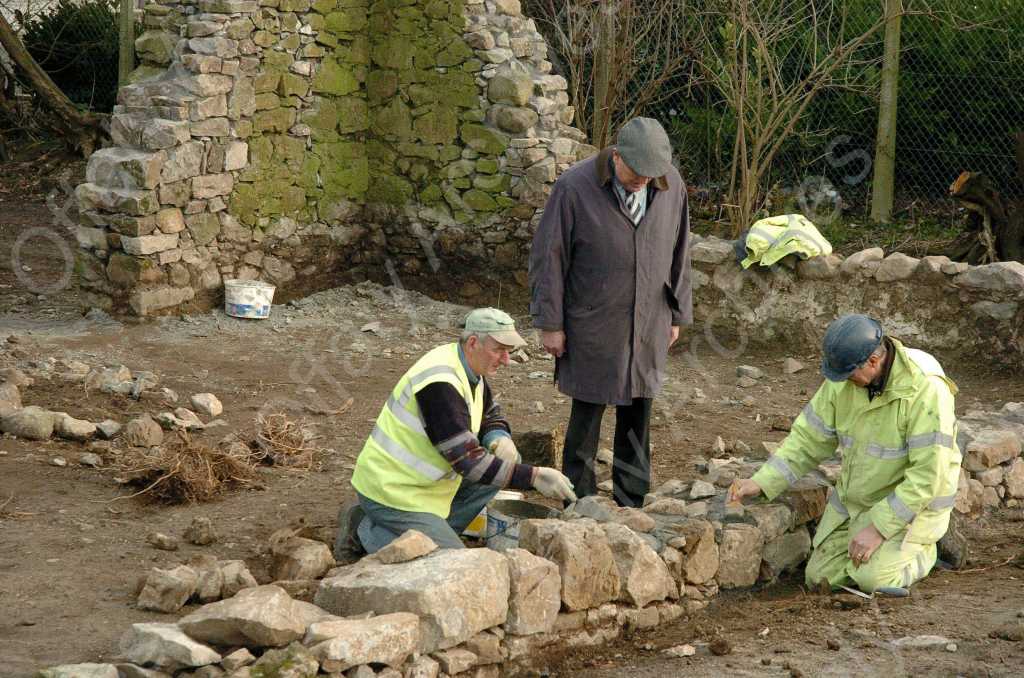
The architect’s brief was to re-build the church in such a way as to ‘retain or regain as much as possible of the character of the old church but in a modern idiom’. This was next to impossible to achieve. He reused much of the old stonework especially on the Chapel Street side and went for a contemporary interior. What was lost of the Gothic exterior and interior was replaced in the self-finished timber ceilings and laminated structural frames of the interior. Full restoration of the exterior was not possible on expense grounds in the 1980s.
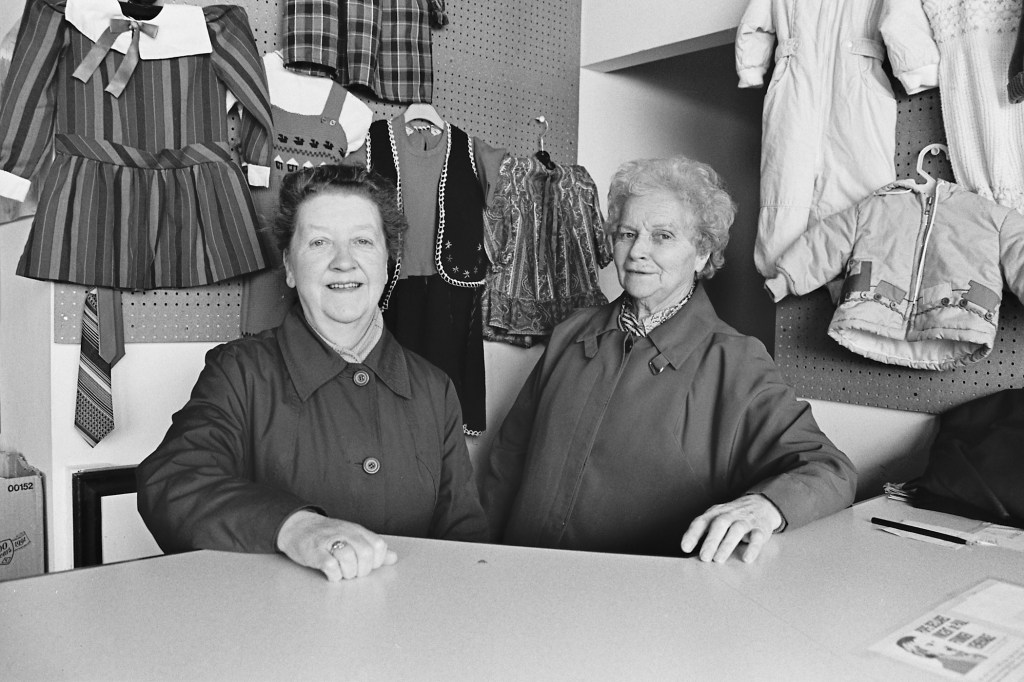
Miss Fallon of Robbins Limited and a friend – all great church people of the 1900s to the 1980s
For many the most attractive feature of the new church was the warm and modern interior with its timber spans. John Flanagan & Sons Limited, the Tullamore-based building firm, was appointed builders and work began in October 1984 and was completed for the opening of the present and third church on the Harbour Street site in August 1986. For almost three years masses were said at the Tullamore GAA Centre, Tullamore Vocational School gym, Scoil Mhuire, Tullamore Harriers Pavilion and St Mary’s Hall. Weddings were generally in Durrow and a few were held in St Catherine’s Church of Ireland church.
William Ralph
Fundraising for the new building had started almost immediately after the fire and a sum of £700,000 was raised through donations, raffles and special events. The chairman of the Finance Committee was William Ralph, who was a corporate director of the Williams Group. The experience of Williams trained directors and managers would benefit not only Tullamore Parish but also Tullamore Credit Union and could be seen in the shrewd management of money. A sum of £2.85m was eventually paid by the state in settlement of the malicious damages claim and part of this amount had, in the meantime, been advanced by the insurer, Church & General. That sum combined with the donations earned for the parish over £600,000 in investment income. Ralph believed in working from cash flow and in trying to maintain capital and use interest to fund projects. It worked because some of the more expensive stonework features were not restored and as result the parish was left with about £1m which was placed in a Trust Fund for the ongoing maintenance of the new church. In the mid-1990s the High Court confirmed that the money could only be used for this specific purpose which accorded with the intention of the donors and could not be called on to fund broader charitable proposals. The Trust Fund has continued to benefit Tullamore parish in that way and is managed by local trustees with the benefit of professional advice.
Donation of an organ by the Lutheran church in Copenhagen
In 1994 a sum of £90,000 was paid from the Trust for the installation of the organ donated by the Lutheran cathedral church in Copenhagen. The organ was built by one of the world’s leading organ building firms, Th. Frobenius of Lyngby (Copenhagen), in 1965 for the great cathedral church of Denmark’s capital city. The organ obviously needed a new case to fit the gallery dimensions of Tullamore’s fine new church. This was designed and built by the Frobenius firm with the work carried out by a team of three Frobenius craftsmen. The net result was that Tullamore now has the largest mechanical action church organ in Ireland, and the sole example in the country of the Frobenius firm’s renowned skill and craftsmanship. The organ was inaugurated in a gala concert on 10 May, 1995. Tullamore’s requirements for an organ at that time and their request to Prof. Gerard Gillen, NUI Maynooth, to assist them in securing an instrument, brought about a remarkable series of coincidences which resulted in the organ’s installation in Tullamore in the latter months of 1994. A Tullamore International Summer Organ Series (TISOS) of concerts was inaugurated in 1999 and has continued since. This series would not be possible without the help of Professor Gillen.
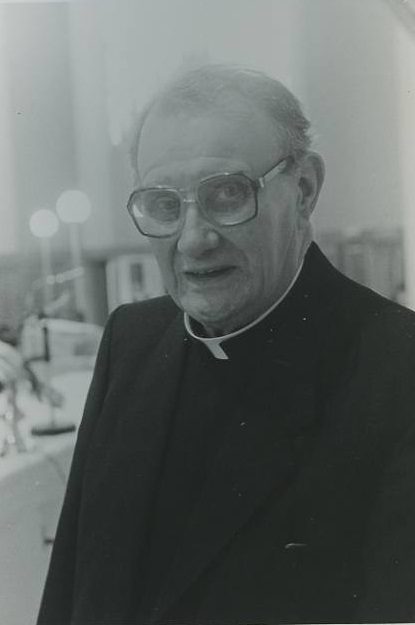
Fr Fallon and his team of curates
While in a sense things worked out well Tullamore lost its Hague-McNamara designed church of 1906 and the strain of the decision-making over three years affected the health of Fr Fallon and he died just three years later, aged 70, in 1989.
During his time in Tullamore Fr Fallon had among his curates some very popular men. He had the benefit of John Charles O’Reilly until his transfer in 1981 and also of Edward Daly who was a curate in Tullamore from 1970 to 1979. Fr Daly was later transferred to Kilcormac as parish priest. Seamus Giles (later PP in Castletown, d. 2013) was a curate in the Tullamore parish from 1965 to 1974 and was popular with young people because of his easy way of connecting with the trends of the late 1960s and 1970s. Another man who had a lot of experience of Tullamore was Joe Gleeson who had been a curate for a short time in 1958 and again from 1966 to 1976. A native of Kilcormac parish he was transferred at about the same time as Fr Fallon was appointed to Tullamore. Fr Colm Savage was in the parish from 1972 to 1983 and worked closely with the Tullamore Vocational School.
Probably best known in the late 1970s and early 1980s was Michael Lynn. He had been in Peru for ten years and had a close affinity with the ordinary person, and the Travellers at the several halting sites. This was helped by his cycling about the town in a leisurely way, something that gave him more immediate contact with parishioners than is possible in a motor car. He was curate in the parish of Tullamore from 1975 to 1986. His commitment to the social dimension of the Church mission found another outlet as a member of the Education Committee of the Tullamore Credit Union. In this he was unusual as unlike in other places in Ireland this important local organisation had no other clerical activist since the days of Fr Fintan Cassidy as a founding director (1963-64). Fr Lynn celebrated twenty-five years as a priest in 1985 and told those present that in the large class from which he was ordained in June 1960 62 were still in the priesthood. ‘The man on the bike’ the Tullamore Tribune called him when he departed Tullamore to serve as PP in Duleek in 1988.
Fr Sean McGearty spent ten years in Tullamore from 1979 to 1989. He was on loan from Adelaide, Australia and during his time in Tullamore made a singular contribution to the development of family history in Ireland through his appreciation of the importance of the Catholic parish registers and the need to index and conserve them. He was the inspiration for the setting up of the Offaly Historical and Archaeological Society family history project which in the 1980s was the host for the country-wide development of the Irish Family History Society and the Irish Family History Foundation. He made a valuable photographic record of the course of building of the new church over the period 1984 to 1986. His colleague, Fr Tom Mullen, came to Tullamore in the same year as Fr McGearty and from late 1983 to 1985 led the fundraising drive for the new church. He was appointed as parish priest of Kilcormac in 1985. Fr Philip O’Connor served in the parish from 1984 to 1988 as did Fr David Hanratty from 1984 to 1985. In the year before Fr Fallon’s death, Fr Dermot Farrell, was appointed to the parish and remained for two years. His forte was in administration and he went on to serve as vice-president and president of Maynooth College and later as parish priest of Trim. He is now Archbishop of Dublin.
 offalyhistoryblog