The making of O’Connor Square, Tullamore: People, Houses and Business will be launched on Wednesday 10 December 5 p.m. at the Brewery Tap, Tullamore. The Brewery Tap is the longest established business in the square dating back to the 1830s as a pub and brewery. The lease of the site was dated to 1713 with the property in possession of the Brennan and Thornburgh families, later Deverell, Egan, Adams, Carragher and now Paul and Cathy Anne Bell.
We look forward to meeting you at the launch where savouries and tea/coffee will be served. Parking will be available at this time and should not cost more than 1 euro for an hour. Walkers and cyclists go free.
At the same event we launch Offaly Heritage 13. This the 13th issue of the Offaly History Journal It’s another bumper issue with over 330 pages and well-illustrated, €19 soft and €25 hardback. The issue is dedicated to the late Christy Maye – a great friend to Offaly History.
The two books are now available from Offaly History Centre, Midland Books and at www.offalyhistory.com for online.
A chance find led me to the story of Andrew and Eleanor (Ellen) Conway born in Offaly in the late 1790s. Looking for local records in the National Archives of Ireland I found a letter written to Mrs Eleanor Conway of Ferbane, King’s County. It was from her husband, Andrew Conway, a transported convict in New South Wales, Australia. Andrew wrote to Eleanor telling her of his life in Australia and how she and their child might petition to join him there.[1] He gives a very interesting account of his life in the colony, the prices of goods there, and his hopes for the future. He ends with a request to be remembered to family and friends.
Church Street is unusual in Tullamore in that it does not have a common width throughout and its lower half, closest to the town centre, is clearly earlier than the upper half from the Methodist church to the Pound Bridge over Tullamore River. While the building pattern is now post 1786 in date it did have at least two earlier buildings in the Protestant church built by Mrs Ellen Moore in 1726. She was the mother of the first Lord Tullamore who died in 1725. Charles the second Lord Tullamore succeeded while still a minor, having been born in 1712.[1] In an earlier article we reproduced maps from the 1770s depicting the church and noted that the building was shown on the on the 1730 Mountrath (Coote) estate map. The church stood in what was post 1820 the yard shown as The Shambles and was not aligned to the later street.[2]
On the 1st of February, 1910, a Gaelic League nationalist died quietly in his home in Derrinlough House, Birr, County Offaly. Four days later, in An Claidheamh Soluis, he was briefly memorialised in print by Seán Ó Ceallaigh:
On Tuesday, Lá Fhéile Brighde, the first day of spring, Señor Bulfin was carried off by a sudden attack of pneumonia, before even his friends knew he was ill. The Gaelic League loses in him a great champion of its ideals, and the Irish of Argentina their leader… He was known and admired wherever an Irish class existed.
The name William Bulfin, in our time, does not live up to the description offered above, though it may well arouse some curiosity at the mention of an Irish Argentine. However, Bulfin, though his credentials remain firmly intact — An Irish nationalist, a Gaelic Leaguer who was present at the opening of the Argentine Gaelic League branch in 1899 and at many important league summits in Ireland — has largely fallen by the wayside in the discussion of Irish nationalist figures of the late nineteenth and early twentieth centuries. When reading the musings and sophisticated theses of Rambles in Éirinn, his seminal work, one realises that obscurity ought not to be the final resting place of this man of two countries, who loved both so well.
The 1920’s saw high levels emigration to the United States from Ireland. Among those crossing the Atlantic Ocean was James Foley from Endrim near Ferbane. James was 21 when he boarded the RMS Cedric at Cobh enroute to New York in March 1927.
His brother Peter had arrived in the Big Apple a year earlier. In 1929 the Wall Street Crash heralded the end of the Roaring Twenties and the beginning of the Great Depression. Offalians in the city found mutual support in the Offalyman’s Association, an organisation in which the Foley family were closely associated.
James was living on Milton Street in the Greenpoint district of Brooklyn when he applied for US citizenship in 1933. After his marriage to Mary Egan, the daughter of Mr & Mrs Lawerence Egan from Kilcormac, the couple lived at Inwood on Manhathan and later in the Bronx.
Do come to the lecture and musical event on 12 April, 3 p.m. Saturday at Offaly History Centre, Bury Quay, Tullamore (beside New Aldi and Old Warehouse)
Bernard Delaney (1854-1923) – Offaly piper conquers America
Bernard Delaney was an extraordinary man, a superb musician and above all a survivor. Birr Historical Society presented the story of piper Bernard (Barney) Delaney in January and we are glad to confirm a further lecture and musical afternoon to recall his life and contribution to Irish traditional music. This time in his home town of Tullamore. Delaney suffered the loss of three of his four children and his wife in the late 1870s and was forced to leave his country in search of hope and a better life in the New World. Delaney was a master of the Uileann Pipes. The Talk will focus on his life, the story behind his enrolment into the elite Irish Music Club of the Chicago Police Department and his legacy.
Short presentations will be given by both Frank Kelly and Seamus Kelly.
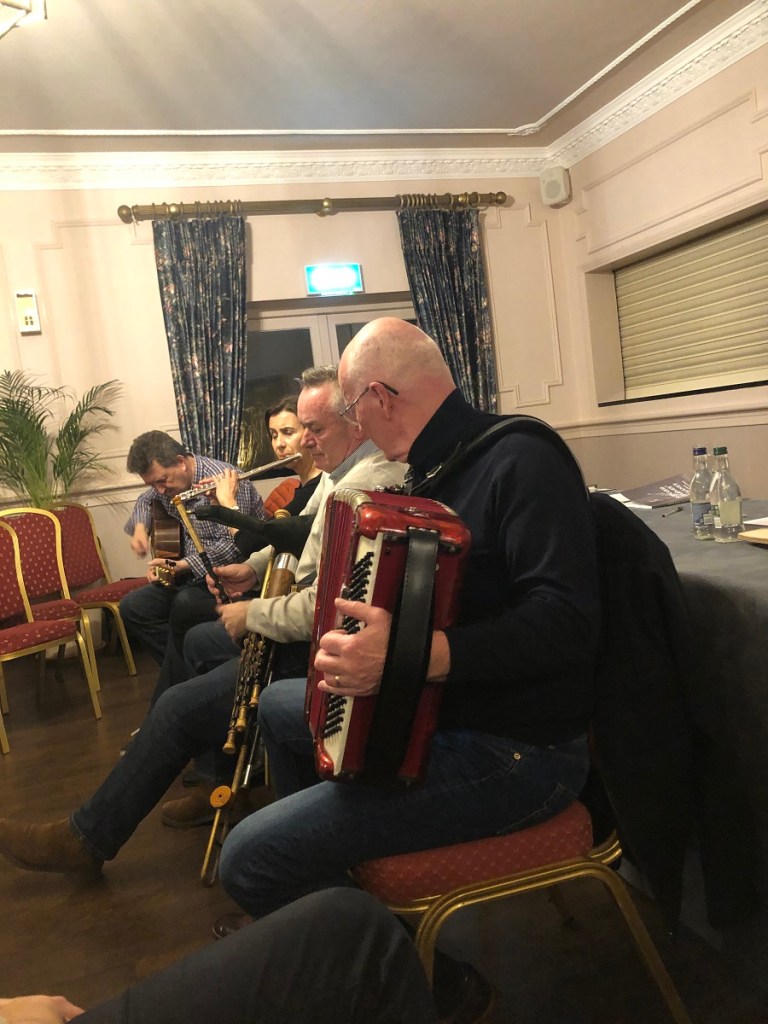
Delaney’s musical heritage will be played at the event by Frank Kelly and musical friends.
Frank Kelly is from Lusmagh and has written articles about Delaney for the Fleadh Cheoil Clár and the Comhaltas magazine Treoir.
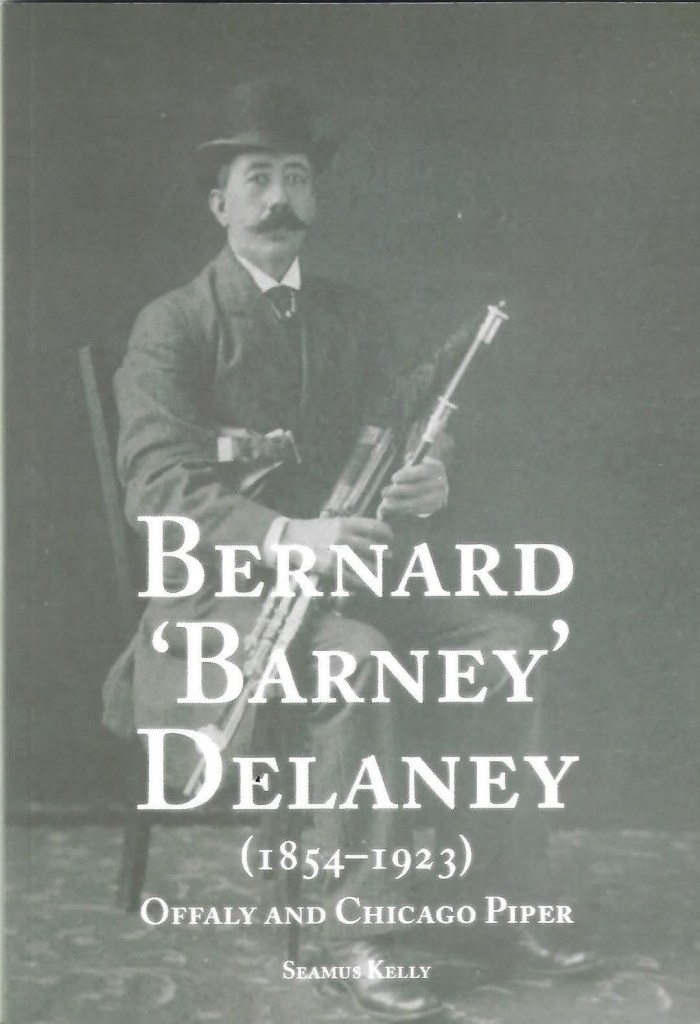
Seamus Kelly is from Kildare with Birr connections. He has researched Barney’s life and written the book Bernard ‘Barney’ Delaney (1854-1923) Offaly and Chicago Piper. Copies available from Offaly History Centre.
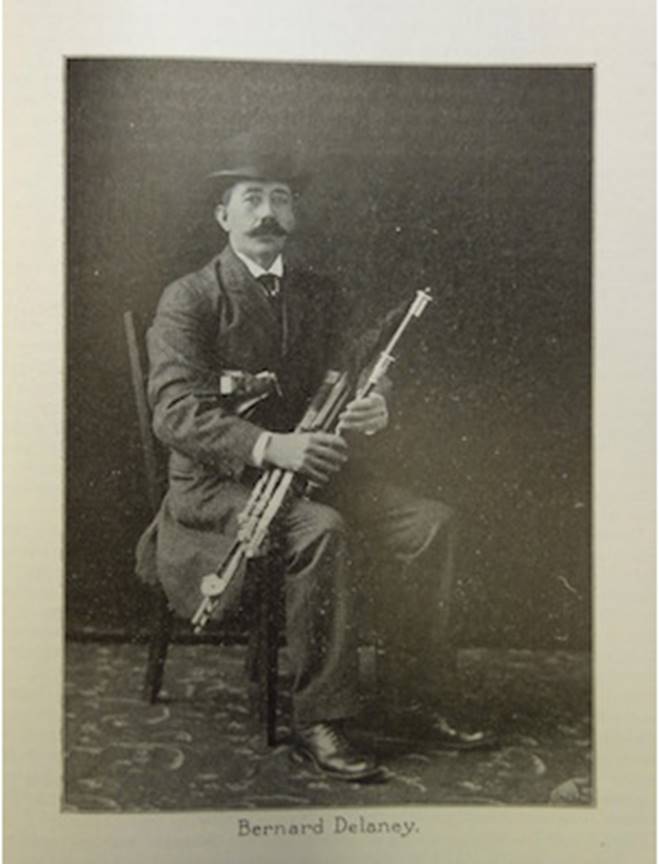
Bernard Delaney, Source: Francis O’Neill, Irish Minstrels and Musicians (1913)
‘We are more or less indebted to Bernard Delaney for the introduction of many fine tunes to our community. His well-deserved reputation as an Irish piper did much to spread the local knowledge of his music among local musicians, as well as to promote the popularity of Irish music in general.’ Source: Francis O’ Neill, Irish Folk Music (1910)
Ahead of Fleadh Cheoil ns h-Éireann 2009, I researched the life of Bernard (Barney) Delaney of Killeigh so as to publish a piece on him in the Fleadh brochure. Offaly has a rich Traditional-Music Heritage and a multitude of All-Ireland champions since modern competitions began in Fleadhanna in the 1950s. However, our folklore is filled with records in the oral and written traditions of musicians dating back to the courts of our Gaelic Chieftains, our famed monastic settlements and music even has filtered through to us from the Celtic mists of ancient Ireland.
Due to the devastating famines of the 1840s and the following poverty in the 1860s and 70s when the people’s main motivation was pure survival, our musical heritage fell away among the general population. It fell to the immigrant classes to carry their music and song with them to the far-flung places where they could find work and sustenance.
Bernard Delaney of Killeigh was typical of these survivors. Unlike many of his fellow immigrants, he had a “magic wand” in his pocket in the form of a penny whistle and all the melodies that instrument could conjure up. Melodies that would provide his sorry Irish comrades with hope, joy, and the happier memories they may have associated with these tunes.
Following my meagre scraping of the surface in 2009, a hero emerged in the form of Seamus Kelly of County Kildare who dug deeper Delaney’s life. Then, with the backing of Attracta Brady; the soon-to-be Uachtarán of Comhaltas Ceoltóirí Éireann, local researcher, Brendan Berry and Seamus’ own team of sleuths, the life of Bernard or Barney Delaney was uncovered. Before the launch of this delightful publication, few in Offaly or Killeigh would have known much of the life of the once-celebrated uilleann piper of Chicago and American fame. Now, it’s about time Barney was given the recognition he truly deserves. The following are a few snippets of background from Seamus Kelly.
Frank Kelly
The musicians at the Birr Historical Society event in January 2025.Courtesy Bantry Historical Society
Seamus:
Frank Kelly’s article in Treoir outlined some of Barney’s background and early life in Ireland. Without Frank Kelly, and his many Offaly contacts, my publication would not have seen the light of day. The support of Attracta Brady, now President of Comhaltas Ceoltóirí Eireann (CCE), was also crucial.
The Offaly Independent (18 September 1992 stated that Offaly has a tradition of excellence in music and added that ‘Offaly can also boast one of the great Irish pipers in Barney Delaney who was born in the Tullamore area about 1860…’. He was, in fact, born there in 1854.
The book was brought to fruition by three Kellys – Seamus, Frank and Michael. Michael Kelly and Brendan Berry’s pioneering work in following up on Delaney’s family in Ireland has made a real difference to our knowledge of the ‘Offaly piper’. An article by John Ennis in The Gael magazine (February 1902) also provided us with a wonderful photo of Delaney.
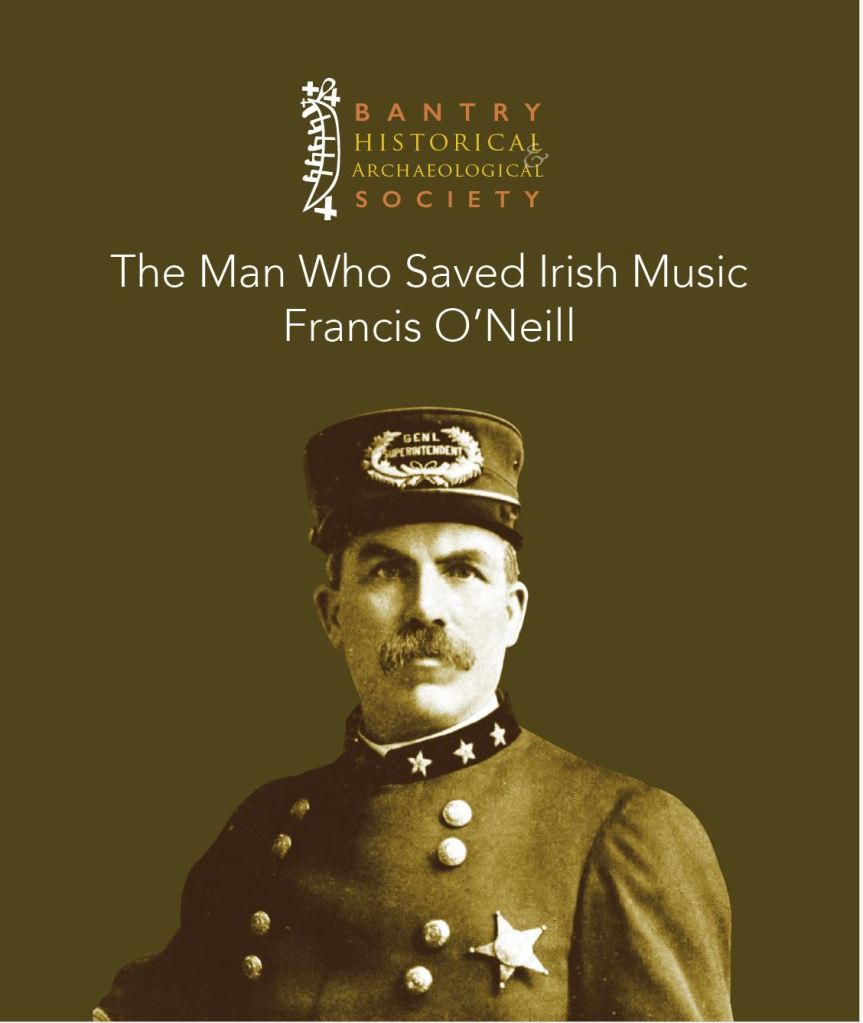
Francis O’Neill wrote in 1910 that he was delighted that Bernard Delaney brought himself and his tunes from Offaly ‘Here, indeed was a prize and what a repertory of unfamiliar tunes he had from Tullamore, his native place! Chief O’Neill, mentioned that Barney was from around Tullamore. Well, could we be more specific? Yes, we can.
Finding out that his father’s name was Patrick (from Bernard’s passport application in 1919) was a start. Frank Kelly’s article entitled ‘The Offaly-Chicago connection from Scrubb, Killeigh, to Ocean Springs, Mississippi’ (Treoir, 2009, 2020) tried to identify Barney Delaney’s birthplace. Brendan Berry was able to pinpoint Patrick Delaney’s plot to Meelaghans instead of Scrubb.
The Killeigh Co. Offaly Delaney connection was further confirmed by the excellent research of Michael Kelly. Aileen Saunders accessed the transcript of Bernard Delaney’s baptismal record. It informs us that Bernard was from the Parish of Killeigh, just south of Tullamore. The name was misspelt ‘Delay’ on this electronic record which was unhelpful. It gives us Bernard’s mother’s name as Eliza Dinn (possibly Elizabeth Dunne). It also gives the date of his baptism, in Killeigh, as the 25 May 1854.That date is reliable although it conflicts with other records. For example, in the 1900 US Census Barney gave his birth date as August 1852. His police record says he was born on 24 March 1854.
Bernard had a family of his own, in Offaly, before he emigrated to America in the early 1880s. Aileen Saunders noted from US Census records that Bernard Delaney had a daughter Elizabeth. Barney was around 20 years old when he married Mary Farrell on the 23rd October 1874. Bernard’s age was given as 20 while Mary was 24. They were married in Tullamore. Mary Farrell, from Tullamore, worked as a servant and was the daughter of Charles Farrell who was a carpenter. Bernard’s father Patrick had died before the wedding. Throughout this period (1876–1882) Bernard Delaney is described as a labourer. The children of Mary and Barney Delaney:
Thanks to Michael Kelly’s research we know when the Delaney children were born and when they died. Bernard and Mary lived in Charleville Road, Tullamore but mostly after that they were in Distillery Lane until at least May 1882. Their first child Patrick was born on 25 March 1875 at Charleville Road in Tullamore. Soon after they moved to Distillery Lane in Tullamore where most of the children were born. Second son John was born there on 6 September 1876. Their first daughter Mary arrived in April 1879 followed by Elizabeth on 2 July 1880. Their last child, Ellen was born in February 1880. Five children in five years!
Note: ‘The Tullamore Piper’ title is still accurate in the sense that he lived as a young married man in Tullamore though he was a native of and was baptised in Killeigh; RC parish. A tune in O’Neill’s Music of Ireland (1903) (Number 1773) is called The Tullamore piper. The title can only refer to one man!
Tragically, all of the Delaney children, except Elizabeth, died young between 1879 and 1882. Patrick died from typhoid fever on 1 March 1877, aged 2. Mary died (aged 1 year), John died (aged 6) and Ellen (aged 3 months). Barney’s wife Mary Farrell died from measles, pneumonia and heart disease in Tullamore Union Workhouse or the infirmary attached to it, on 21 May 1882, aged 30.
Their youngest child Ellen had died the day before. Mary died 8 days after her son John died from measles.
The family struggles must have been traumatic. Mary Delaney must have suffered terribly. The losses of his wife and four of his children must have taken its toll on Bernard. These very harsh family circumstances probably influenced his very rapid decision to emigrate, and may have impacted on him later in life.
The full publication is available in the Offaly Historical Society book shop on Bury Quay.
Frank Kelly
Venue for the Saturday lecture and music session, Bury Quay (beside New Aldi and Old Warehouse restaurant).
Published as part of the County Offaly 2025 Commemorative Programme with the support of Department of Tourism, Culture, Arts, Gaeltacht, Sport and Media
The recently announced sale on 11 March 2025 by Noonans of Mayfair of the Jutland medals of Tullamore man Arthur Craig (assumed Waller in 1920 on inheritance) is a reminder of the fact that despite being an inland county Offaly (King’s County up to 1920) has a significant association with the Royal Navy through the celebrated achievements of Birr-born Charles Parsons (1854–1951), of Dreadnought fame; Birr-born Sir Frederick Charles Dreyer (1878–1956), the expert in naval gunnery; and Tullamore-born Alexander Percival McMullen (1885–1916) who was killed at the Battle of Jutland in 1916. The Birr men could have lost the war in an afternoon! Both McMullen and Craig were associated with St Catherine’s, Tullamore – the first of an old Tullamore family who emigrated to Canada in 1910, and Craig as a son of the rector of the parish from 1869 to 1902. His brother succeeded in 1902 and was parish rector up to his death in 1929.
In January 1953 Clara and Tullamore district was introduced to its very own ‘bat mobile’ the recently launched sports car, the Jaguar XK120. After the austerity years of WW II its sleek design and incredible speed was said to have inspired the creators of the fictitious ‘bat mobile’ in 1966. It was owned by Larry Egan of Gayfield, Clonminch Road. Larry was joint managing director (with his relation Paddy [P. V.] Egan, Cloncon and later Spollanstown) of the firm P. & H. Egan Limited headquartered on Tullamore’s Bridge Street. Their relation and good friend, Clara’s ace motorcar and motorcycle racer Charlie O’Hara raced it for them.
Recently, I walked Clara’s Main Street and was again reminded of its relative short length and the relatively small size of its adjoining, almost hidden, Market Square. A square and street where much trade, barter and banter, laughter, disagreements, or agreements on family member marriages, and heated discussions on political reform, occurred on a regular basis for hundreds of years.
Many local hostelries were frequented, where typically a farmer and his wife and family would come to settle bills, visit the local medic for advice, or attend religious services. Today the square is modernly paved, almost hidden and its well-maintained former Market House now tucked away from the passing motorised traffic. Sadly, as in the case of many Irish provincial towns several old buildings have fallen into a state of disrepair and exude an aura of reduced circumstances.
Back in 1826, Clara’s Main Street and Market Square was a hive of activity and was where many notable families conducted their commercial business and resided upstairs. As I strolled the street and looked above the ground floor level of today’s shop fronts, I wondered who were these former resident families and what ever became of some of them?
Clearly, this is just a chosen snapshot of some Clara families, and I would be keenly interested to hear from family members of their stories from those days’ past.
The oral story of Offaly people in the Offaly History Centre sound archives collection. 21 October 2024, 8 p.m. Offaly History Centre, Bury Quay Tullamore, R35 Y5V.
The presentation by Aidan Barry will consist of the following: – An overview of the oral history resources available at Offaly History and how to access them. – Commemorating the work of Maurice O Keefe (RIP) at Irish Life and Lore and Albert Fitzgerald (RIP) at — – Midlands103 and also the late James Kenny of Clara Bridge, Tullamore. – Listening to samples from the Oral History collection at Offaly History – Recording Oral History and editing recordings – Transcribing Oral recordings using the latest technology



 offalyhistoryblog