On June 15th 1991, I climbed a locked gate marked Bloomville, just as the rain stopped and the sun came out. There were some lovely beeches, but no sign of a house. I then spotted two ancient chestnuts, and it was only then that I could see the house in the distance.
It was a case of love at first sight, with everything sparkling in the sunshine, and I wondered why the agent’s advertisement had not included a photograph. Only when I approached the house could I understand the reason. The traditional roses (still flourishing 29 years later) looked pretty, but, close up, the house looked very neglected.
Written and compiled by John Wright- owner/editor of the King’s County Chronicle, Birr, from 1872 until his death in 1915 – the book was published early in 1890 as ‘The King’s County Directory’. His son Archie succeeded and died in 1954. Increasingly, over the intervening years, it has been treasured as an invaluable source of reference for local historians but it has long been out of print and only a few copies remain extant. It was reprinted in 1989 now in hard back form, in a facsimile edition which reproduces its 368 pages – including 24 pages of advertisements and a number of drawings of noteworthy buildings. Since then it has also been made available on CD.
Over the past few months I have been finalizing a book on the memorials in Saint Rynagh’s Graveyard in Banagher. For some time now the recording of the transcriptions has been complete but the decision to add a description of each memorial has absorbed more time than intended. It has however been a most rewarding task because now when I visit other graveyards I look at memorials with a more trained eye and with greater awareness of the skills and talents of the stonecutters. This has fostered a greater appreciation of the decorative carvings and lettering styles which are abundant throughout County Offaly. It has also prompted greater recognition of unusual features such as ligatures, mirrored letters, ampersands and other hallmarks of a vernacular style. Above all it has stimulated a resolve to publicize those monuments which are unique whether it be for the occupational or funerary symbols portrayed on them or that they are fine examples of a particular stonecutter. Tombstones which have a dedication of literary merit or those which carry symbols of the Passion of Our Lord will also be a focus of attention.
In December 1968 Thomas [Tommy] Dunne received the tribute of a soldier’s burial from surviving I.R.A comrades in Offaly and the army in Annaharvey graveyard, near Tullamore.
Thomas Dunne grew up in Ballinagar (between Daingean and Tullamore) along with his siblings Mary, Richard, Margaret and James in the late 1800s. Their father was Tommy and their mother was Anne Brien from nearby Clonmore. Tommy was in his time a leading member of the local Fenian movement and came to Ballinagar from Rathfeston during the time Trench was the land agent for Lord Digby. The family tradition was that Tommy was about 27 at the time and by all accounts was a fine strapping young man. A family of Dunne’s owned the farm at the time, they were relatives of Tommy’s, but because they were all females and because of the impossible situation of that time, they were about to throw up the farm. Trench had someone in mind for the farm but Tommy took it over. One day Trench arrived on the farm and spent a while staring and trying to unsettle the young Dunne. Then Trench spoke “I see you have come Dunne.” “Yes” was the firm reply. Trench then said “On account your family has been here for so long I will let you stay, but instead of the rent being 7 shillings and sixpence an acre it will now be 30 shillings an acre.” This left it nearly impossible to farm but he managed. This incident took place shortly after the infamous evictions on the Geashill estate, where it was reported that the evicted tenants of Geashill filled the streets of Tullamore. A lot of these tenants went on a ship called Erin go bragh to Australia which was charted by a Fr Dunne from Daingean who raised funds for this purpose. He was possibly a relation of the Ballinagar Dunnes.
Louis Darcy, former Offaly county hurler, another altar boy rostered for Ned Doorley’s funeral
WE are glad to bring you the second part of Pádraig Turley’s piece this August 1 2020. We have reached 55,000 views for our stories this year so far. The same as the entire of last year. You can see all 212 stories on http://www.offalyhistoryblog and there is a shortcut to them at http://www.offalyhistory.com You do not need to be on Facebook to view. Why not contribute and send to info@offalyhistory.com.
FUNERAL OF NED DOORLEY:
The story of the funeral of Ned is one worth relating. This is a story I was always aware of, but was inclined to take it with a grain of salt. However, recently I received a communication from Shannonbridge native James Killeen, currently residing in Illinois, which virtually tallied with the version I had. Ned was the last survivor of the Doorley family when he died in Tullamore Hospital. My uncle Joseph Claffey and the undertaker Kieran Flannery volunteered to go to Tullamore, to pick up the corpse. James tells me that he and Louis Darcy (former Offaly county hurler)and Leslie Price were the altar boys rostered to be on duty to assist the Parish Priest Fr. Frank Donoghue, who having served in Brooklyn, NY, liked things to be done pronto.
The funeral was expected in Shannonbridge at 8.00 p.m. Everything was ready and in order, candles blazing. It did not arrive at 8.00 p.m. or indeed 9.00 p.m. or 10.00 p.m. Needless to say Fr. Donoghue was getting very edgy. There was no sound or sight of the funeral. James tells me that post war traffic in the area was about one motorized vehicle every forty minutes. So in the silence one could hear a car approaching from as far as Moystown, a distance of 9 km. Sometime after midnight James says, one could hear the grinding of the old 14.9 hp Ford engine somewhere around Blackwater, about 2 km away. On arrival Kieran Flannery, the undertaker announced they had a breakdown in Ferbane, and as it was a Sunday night, they had difficulty sourcing the part.
I once more visited by friends in Tullamore, Killoughy and Banagher after an unexpected gap of almost six months. Young Covid intervened and I did not get down from my perch in D4 until ten days ago.
Upper East Side Tullamore
It was great to see my old town looking so well and all the works in the square and from High Street to Kilbeggan Bridge almost finished. Walking from the railway station down to the square brought me back to the 1950s and 1960s when I lived in the town and the High Street was a busy spot. The footpaths are wide now but there were few walking and even on Saturday the street was quiet. I see no space to park for my mother (if she were alive God rest her) to pull up in the old Prefect that she had. Sure that is progress. Maybe the plan for High Street got mixed up with O’Connell Street or Grand Parade! Anyway, today I am writing about the east side of High Street, what I will call ‘Upper East Side’, and I will talk about the west side of the street on another visit – if the pause button is not changed to stop!
`Arising from the Covid-19 virus due to government advice regarding public gatherings a private funeral will take place, but may be viewed on the Church website.`
This notice is now a regular feature of obituary notices in current newspapers and website dealing with death notices.
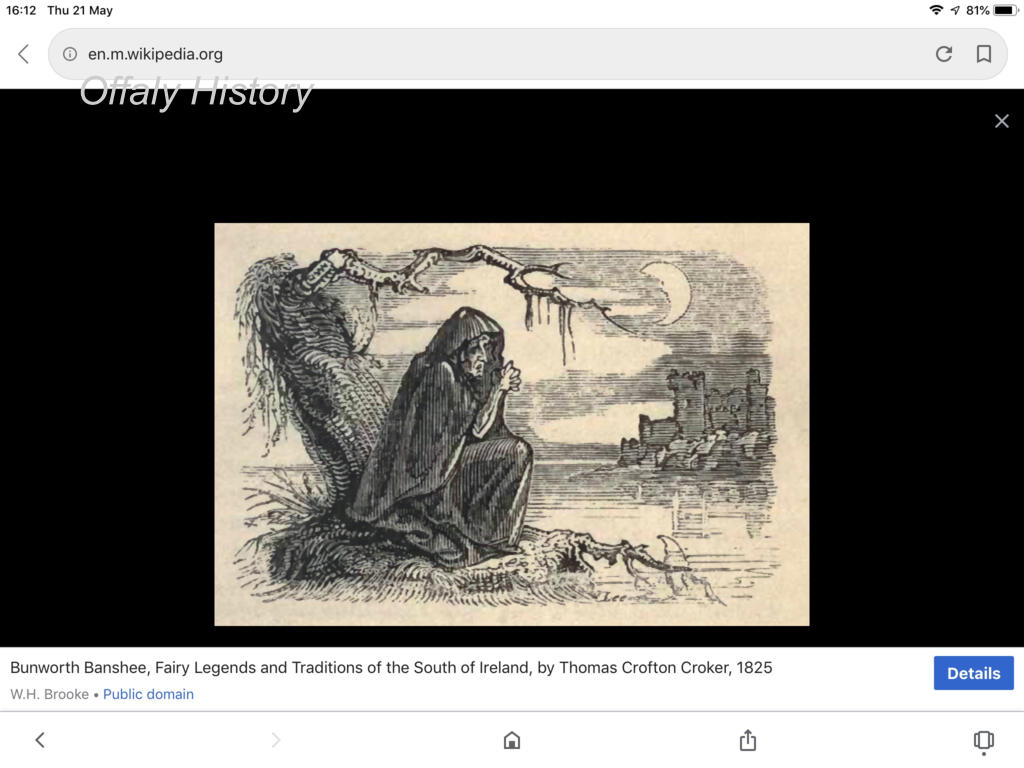
The story I wish to relate deals with an earlier time, from the early 50s, and I hope to recreate an image of the funeral process back then in west Offaly. It was a time when the medical condition of a sick person or indeed a visit by a doctor to such a person was not the only omen that death was imminent. A much more reliable harbinger of such an event was when a report came in, that the `banshee` had been heard. My grandfather, Michael Claffey originally from Bloomhill, near Ballinahown, totally believed in the banshee. He was a well-read literate man, yet if someone was ill in the parish, he would not show much concern until it was reported that the cry of the banshee had been heard. Once that occurred, it was good night Vienna, as far as he was concerned. He would then just wait for the inevitable, which from my memory always seemed to happen.
Consumed by political and economic turmoil, the first half of the 20th century was a fallow period for the visual arts and archaeological scholarship in Ireland and certainly Offaly was no different. The post-war period dominated by scarcity and emigration, was particularly stifling.
The first glimmerings of change came with the national festival of An Tóstal in 1953. Emulating the very successful Festival of Britain two years earlier, its primary intention was to boost tourism in the Easter off peak period – or as the poet Patrick Kavanagh called it ‘The Monsoon Season’.
Whether or not the festival brought any tourists to Ireland or not is debatable but it certainly had a dynamic cultural impact, particularly outside of Dublin. Local societies emerged to organise exhibitions of arts, crafts and heritage. An awareness of the need for civic improvements led to the Tidy Towns movement. Most importantly, a spirit of optimism and openness was created.
This sense of a new beginning was particularly evident in Tullamore where a small local elite led by individuals with connections to the Dublin art and theatrical world were beginning to promote a more open and less traditional approach.
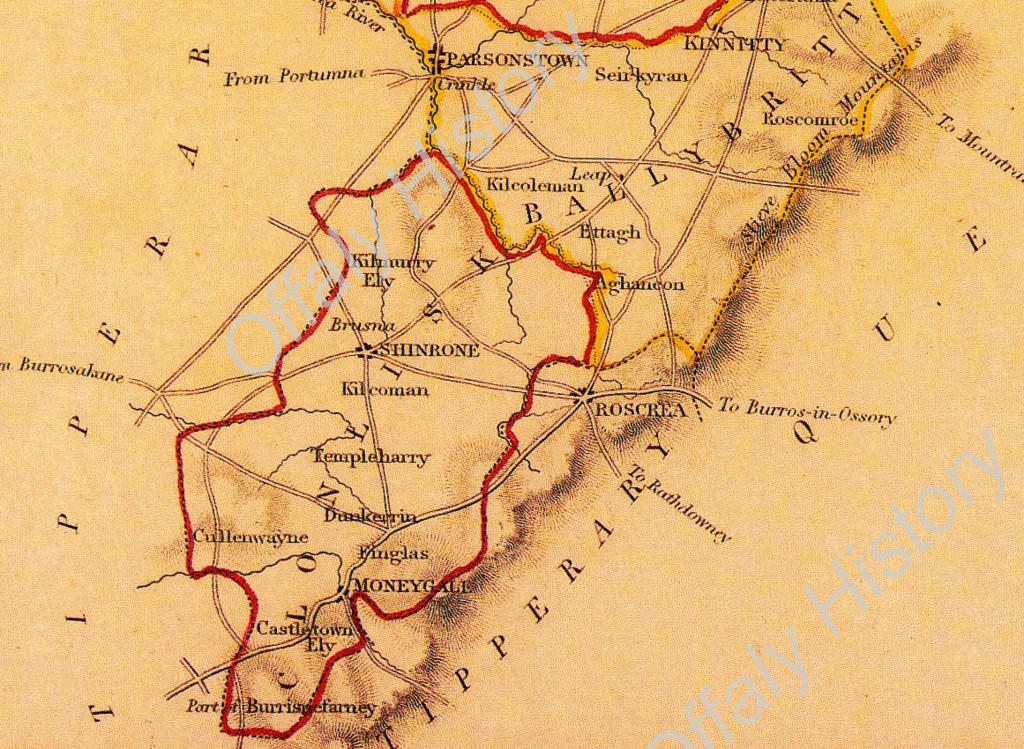
A document in the National Library of Ireland sheds important light on the fate of the inhabitants of a part of county Offaly during the years of the Great Famine. Here the names and circumstances of almost 500 people in the village of Shinrone and its hinterland are included on a register for relief, which was provided during the summer and autumn of 1846. Among the names may well be an ancestor of Barack Obama, 44th President of the United States of America. While Obama’s Irish heritage has been well documented in the past, not least during his visit to Ireland in 2011, few descriptions survive of how the Great Famine directly impacted the Kearney families and their community. It is hoped that this document will be transcribed and made available in Offaly Heritage in the near future.
Michael Scott’s Williams shop in Patrick Street from 1942 and lost with the move of Five Star to what was later Quinnsworth and Tesco .
The contemporary arts scene in Ireland from the 1940s to the 1970s and to a certain degree in Offaly also, was dominated by the friendship between the architect Michael Scott and the Jesuit priest Fr. Donal O’Sullivan. Both Scott and O’Sullivan were close friends of Desmond Williams, the managing director of Irish Mist and a director of Williams’s whose commercial interests extended beyond the famous whiskey brand to a chain of grocery shops and pubs in Offaly and Westmeath. Williams and his wife Brenda, whose father Oliver St John Gogarty had been an early supporter of the painter Jack B. Yeats, owned many superb works by the artist.