Thomas Armstrong, son of Andrew Armstrong and Lucy Charnock, was born on 22nd August 1702 and when he retired from his position as First Director of his Majesty’s Engineers, Chief Engineer of Minorca and Senior Engineer in the service, purchased the estate of Moorock and built a house there. He died in 1747, unmarried and the estate passed to his brother Warneford Armstrong.
On the 9th October 1793, Warneford Armstrong (1699- 1780) made a lease agreement for three lives and thirty one years of the House, Gardens and Land of Moorock to Richard Holmes, a gentleman of an old King’s County family based in nearby Prospect House. The 390 acres had been leased to James and John Reamsbottom. In 1795 Warnesford Armstrong demised the whole estate of Moorock to Richard Holmes of Prospect House for “lives renewable forever”.
On the 1809 map of King’s County by William Larkin, one can easily fail to spot the tiny T-shaped symbol about 1 mile northwest of the town of Tullamore. There is no description to inform the reader what the object represents. Its shape and its location, however, leave no doubt as to what it symbolizes. It is the first post-Reformation Catholic church in the parish of Tullamore. Erected in 1775 in the townland of Ballyduff, the chapel’s out of the way location some distance from the town of Tullamore seems peculiar today. Another look at the 1809 map provides at least a partial clue to its location. Not more than about a hundred metres from the chapel is a quarry, probably one of the earliest limestone quarries to be opened in the area and almost certainly the source of the stone of which the chapel was built. The chapel was presumably built by the workers and tradesmen of the local quarries. Today the ruins of the Ballyduff chapel are located in the middle of the Axis Business Park accessed from the Clara Rd.
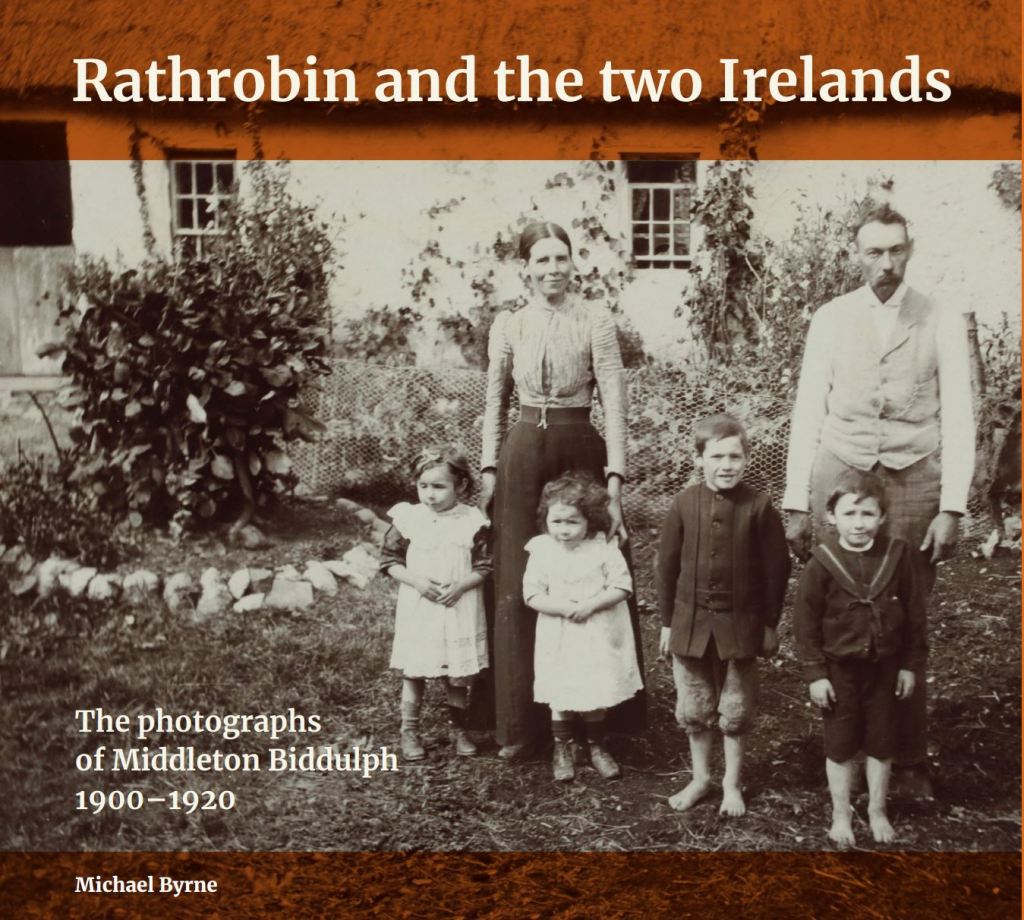
On Monday 21 February 2022 Offaly History will host a public lecture on the photographic work of Middleton Westenra Biddulph (1849–1926) of Rathrobin, Tullamore. The lecture will also be streamed via Zoom and will start at 8 p.m. at/from Offaly History Centre. Biddulph’s photographs of Offaly and midlands interest together with Big Houses in Ireland have been published in Michael Byrne, Rathrobin and the two Irelands (Tullamore, 2021).For the link to Zoom email info@offalyhistory.com. There is no charge.
The new large format book has over 300 photographs with context and captions and is available for €25 in hardback. The publication was supported by the Decade of Centenaries and took fourteen months to prepare.
Middleton Westenra Biddulph was born on 17 August 1849 at Rathrobin, Mountbolus, King’s County. He was one of six children and the eldest surviving son of Francis Marsh Biddulph (1802–1868) and Lucy Bickerstaff (d. 1896). She was born in Preston, Lancashire and they married in 1845 when F.M.B. was 45 and Lucy 24.[1] The Bickerstaff connection was to be an important one for the surviving sons of F.M.B. and led to a substantial inheritance in the 1890s for Middleton W. Biddulph (M.W.B.) and his brother Assheton who lived at Moneyguyneen, Kinnitty. F.M.B. was of a large family of eleven children. All were girls save their one surviving brother. F.M.B. lived with at least three of his sisters at Rathrobin, few of whom married and at least three emigrated to Australia or the United States.
In person and online. For link email info@offalyhistory.com(more…)
The whole of Ireland will be watching Mountbolus today for perhaps the first time in its history. None would want the attention it will receive as the family of Ashling Murphy, her friends and representatives of state, gather for her final mass in the lovely church dominating the village of Mountbolus. The family who have given and suffered so much may now need privacy in their great sorrow.
This famous phrase or exclamation or some version of it has been in use for hundreds of years. There are few instances if any in the English-speaking world where a placename appears in this manner. In all cases it was used dramatically to emphasise in a humorous way what has been said or written. The phrase was seldom if ever employed in a derogatory sense. It was regularly used by public speakers such as members of parliament or lawyers and judges in court. While it was often referred in Great Britain, and indeed in other countries throughout the world, the most common usage was by people at all levels of society in Ireland and it was very much an Irishism. It appears in the works of many famous writers such as AnthonyTrollope, William Carelton, W.B.Yeats, Joyce’s Finnegans Wake and Plunkett’s Farewell Companions. It also featured regularly in newspapers and on other media as can be seen in the selection below:
Skating on Charleville Lake, Tullamore was a popular pastime when I was a young lad. I remember the cold icy winters of 1962, 1982 and 2010. I can recall as a young man the Tullamore people skating on Charleville Lake in 1962. I am a long time now in D 4 but I got down a few weeks before Christmas to the nice butchers in Tullamore – old Tormey’s is still going strong and now you have, Hanlon’s, Crossan’s of Main Street, Ray Dunne and Fergus Dunne, and a few more I would not know. I was sorry to see Grennan’s shop closed for now. I miss Paddy Mac’s, Cleary’s and Joe ‘the Butch’ Kearney and not forgetting Dunne’s butchers off the Square. It was Treacy’s later. Liver we got a lot of and sheep’s hearts in that fine shop. Many old friends gone to the heavenly pastures. I always like to get my turkey in Tullamore and a nice ham even though I am out of the town now for over forty years. What with the bacon factory open until 1989, and now Tullamore Meats, the town has a long tradition in fine food. Come to think of it the bacon factory did a huge business in turkeys back in the 1940s and 1950s when my father was rearing same.
Pauline Clooney’ Charlotte & Arthur, an imaginative recreation of the Charlotte Brontë’s honeymoon in Wales and Ireland, is an exciting combination of fact and fiction. The extensive historical research which preceded the writing of the book is evident throughout and this coupled with the creation of less historic characters and the weaving in of more fictional nuances ensures a work that is at once refreshing and convincing. While the sources of history are comparatively plentiful for this episode due to Charlotte’s prolific letter writing and an abundance of biographies of the two main characters, it is the richness of Pauline Clooney’s writing that makes the work engrossing and appealing.
All the books here can be purchased from Offaly History (Bury Quay, Tullamore and online) and at Midland Books, Tullamore. You can also view/ borrow at Offaly Libraries and consult at Offaly History Centre.
Rathrobin and the two Irelands: the photographs of Middleton Biddulph, 1900-1920. Michael Byrne (Offaly History, Tullamore, 2021), 330 pages, 280×240, hardcover, €24.99.
Rathrobin is a book that keeps on giving. Its 250 Biddulph photographs from the 1870s to 1920s, all carefully captioned, depict the two Irelands – unionist and nationalist, Catholic and Protestant, landed and cabbage garden. What is interesting about the pictures of Colonel Biddulph (1849-1926) of Rathrobin near Mountbolus are the nuances. He was of the lesser gentry, was a tenant of the Petty Lansdownes, and was well aware of the Plantations of the 16th and 17th centuries. He appreciated the needs of the farm labourers and was decent to his own tenants, staff and farm workers. His entire estate was not much more than a 1,000 acres. Biddulph’s circle was also the lesser gentry and those who served it such as land agents, bankers and clergy. The Catholic Protestant divide was strong but landed Catholic families did mix in Bidduph’s set, but not merchants or traders (even if very rich). Biddulph had an empathy with his farm workers and their families and sought their advancement. Many local families were photographed, together with the farming activities of his own employees.
Biddulph’s story, and that of his associates and friends, is illustrated by a selection of over 300 pictures in all, of which 250 are from the Biddulph Collection in Offaly Archives, and fifty more to illustrate the introductory essay and provide the all-important context. The essay and the photographs provide a more nuanced understanding of Ireland in the revolutionary period of 1900–23. Biddulph’s wonderful house at Rathrobin that he had so carefully ‘restored’, and all his farm improvements, were lost in the Civil War in 1923. Many other big houses from Ashford, to Ballyfin, Durrow, Brookfield, Screggan Manor and Charleville are also recorded in this volume. Some such as Brockley Park in Laois are now gone thereby making this an important work of record. The photographs by Middleton Biddulph were taken at a crucial moment in Ireland’s history. Their publication now could not come at a better time. Rathrobin is the portrait of one small estate and Killoughy parish in Offaly from the 1650s to the 1920s, but the story is of national interest. T.E. Lawrence spoke of the Arab Revolt, perhaps in Ireland we can talk of the Irish Revolt and not the full circle Revolution. You decide.
Rathrobin was supported by the Decade of Commemorations Unit in the Department of Tourism, Culture, Arts, Gaeltacht, Sport and Media
Warner Francis John Plantagenet Hastings was born on 8 July 1868 at 54, St Stephen’s Green Place, Dublin. He was the son of Francis Power Plantagent Hastings, 14th Earl of Huntingdon, and Mary Anne Wilmot Westenra. The title of Earl of Huntingdon was an English peerage title originally created in 1065, the current title is its seventh incarnation which was created in 1529.
The 14th Earl married Mary Anne Wilmot Westenra 15 August 1867, who was the only daughter of Colonel Honourable John Craven Westenra, of Sharavogue, King’s County – a member of the Irish Whig party.
The family acquired lands in Waterford and King’s County. In the latter they lived in Sharavogue House. The house was originally built in the 1820s and was described as containing drawing and dining rooms of the finest proportion, a library, seven bedrooms, servant apartments, stables, coach houses and offices. A walled garden and 100 acres of land. Later additions to the house were made by notable Irish architect Sir Thomas Deane.
Take the good and bad in life as it comes; be satisfied with your fate; if you find yourself in an argument, get out of it as quickly as possible. This was the philosophy of Mr Michael Coughlin (or Coughlan), of Rapp, Tullamore, who celebrated his 107th birthday in November 1929. I am told by Offaly History that he was the oldest man to die in Tullamore in the history of record keeping. He and his wife ‘who is nearing her century, have based 80 years of married life on this happiness recipe and he guarantees that if this advice is followed it will bring contentment to thousands of married couples.’ News of their recipe for ’80 years of marriage and never having quarreled’ went around the world and is said to have featured in Ripley’s Believe it or Not. Michael Coughlin was a native of Eglish and had worked for Malachy Scally as a gardener at Moore Hall, Tullamore in his later years. Rapp is the road to Tyrrellspass from the canal at Whitehall and was the main road from Tullamore to Westmeath until the canal was completed in 1798. Housing there was decimated in the Famine years.



 offalyhistoryblog