Imagine passing construction work on the street or in the countryside, what might you expect to come across or see? Perhaps old masonry, historic detritus or nothing at all?! How about a skeleton? Throughout the nineteenth and twentieth century it was not too unusual to come across human remains during construction work or in sand pits owing to the historic nature of an area. This blog post looks at some of the human remains uncovered around Offaly over the past 200 years which were reported in local newspapers.
In August 1860 a party of soldiers found the skeleton of fully grown man while digging earth works in the Fourteen Acres, adjacent to Birr Barracks. The skeleton was found three feet underground. There was no trace of a coffin or clothing. Despite no signs of trauma to the remains it was assumed at the time that the remains belonged to a murdered man. The burial almost certainly pre dates the barracks (1809-1812) and it would not be surprising if it had been there a great deal longer.
This is our first blog of 2021 and we are pleased to have a growing number of contributors as the interest in local studies continues to expand in Offaly and in Ireland. Last year our blog posts (82) reached over 103,000 and amounted to 144,000 words. Michael Goodbody has two important articles on Clara houses, Drayton Villa and Inchmore, in Offaly Heritage 11 (published in December 2020). The latter house now in a very different state to 2007 and the former lately bought by Offaly County Council. Robert Goodbody was the founder of the Clara dynasty of Quaker merchants and was born at Mountmellick in 1781 and died at Drayton Villa, Clara (later the Parochial House) in 1860. In 1825 he moved to Clara to set up his sons in business at the Brosna mills. He built Inchmore, Clara in 1843 and for a time lived at Tullagh House, Tullamore. During the Famine years he practised as an amateur doctor. He had six sons of whom five survived to make a huge contribution to industry in Clara and Tullamore.If you have an article on Offaly history for the blog, email us at info@offalyhistory.com.
It was not unusual for amateur doctors to practice their skills and theories among the poor in Ireland during the nineteenth century. One such was Robert Goodbody of Clara, who earned the gratitude of the Earl of Charleville for his activities around Tullamore during the Great Famine of 1846–49.
Offaly History intended to have a walk on 26 December 2020 through the historic Lloyd Town Park, Tullamore, but had to cancel due to the imposition of the third wave of restrictions since March 2020 designed to reduce the impact of the Covid-19 virus. An historic year and one we will be glad to see the back of. After fifty-years of mostly progress since the 1960s we have become accustomed to the shock of change for the worst since the banking crisis and the bail-out. Now it’s the Covid-19 virus and in the background climate change, and in Offaly the end of the bogs – so much a part of growth in Offaly from the 1950s. Today we are visiting the Lloyd town park, Kilcruttin, Tullamore and reflecting on its historical features and change in the landscape of the area and the town of Tullamore since the 1700s.
The park area in 1838 on the six-inch scale with Water Lane, gazebo and the new courthouse and jail. A second Methodist church was located in Crow/Tara Street from the 1820s to 1877. The landscaped gardens of Acres Hall can be seen on Charleville Street, now Cormac Street.(more…)
Hunston is the name of a townland in the west of Offaly, close to where the Brosna and Shannon rivers meet. It is unlike many place names in Ireland which relate to an anglicised geographical description. It originates from a planter family who came to Ireland from England in the 16th century during the first plantation of Ireland.
Following Henry VIII claimed of kingship over all of Ireland in 1541, the English wished to extend their control further than the area called the Pale around Dublin to the whole of Ireland. One way was to drive the Irish landowners off their land and replace them with English or Scottish settlers, called ‘planters’. The first plantation took place in the region now known as Offaly and Laois in 1556. It was from this area that the O’Connor and O’Moore clans had invaded the Pale. The Government divided the land into Counties. Present day Laois was named Queen’s County, after Queen Mary, daughter of Henry VIII and present-day Offaly was named King’s County after Mary’s husband King Philip of Spain. Forts were built at Maryborough (Portlaoise) and Philipstown (Daingean).
The current issue of Irish Historical Studies (no. 165, May 2020) has a featured review of five issues from the Maynooth Local Studies series published in 2019. That brought the number issued to 144. We attach the list to 144 for your convenience and we bring to your attention the latest batch of four. Raymond Gillespie is the quiet man behind the series and who has acted as general editor since its inception in 1995. The reviewer in IHS, Maura Cronin, reminds of his characterising local history as being ‘primarily about people in places over time’. Place is described as the bedrock of local history, but it must be seen in the context of the actions of people and the pivotal role of historical research is looking for the forces of disruption and of cohesion. What brought people together and what drove them apart.
The four new issues of 2020
Four new volumes have been published in the Maynooth Studies in Local History series (general editor Professor Raymond Gillespie). The volumes by Denis Casey, Emma Lyons, Brendan Scott and Jonathan Wright and can be ordered via Offaly History Centre.
Louis Darcy, former Offaly county hurler, another altar boy rostered for Ned Doorley’s funeral
WE are glad to bring you the second part of Pádraig Turley’s piece this August 1 2020. We have reached 55,000 views for our stories this year so far. The same as the entire of last year. You can see all 212 stories on http://www.offalyhistoryblog and there is a shortcut to them at http://www.offalyhistory.com You do not need to be on Facebook to view. Why not contribute and send to info@offalyhistory.com.
FUNERAL OF NED DOORLEY:
The story of the funeral of Ned is one worth relating. This is a story I was always aware of, but was inclined to take it with a grain of salt. However, recently I received a communication from Shannonbridge native James Killeen, currently residing in Illinois, which virtually tallied with the version I had. Ned was the last survivor of the Doorley family when he died in Tullamore Hospital. My uncle Joseph Claffey and the undertaker Kieran Flannery volunteered to go to Tullamore, to pick up the corpse. James tells me that he and Louis Darcy (former Offaly county hurler)and Leslie Price were the altar boys rostered to be on duty to assist the Parish Priest Fr. Frank Donoghue, who having served in Brooklyn, NY, liked things to be done pronto.
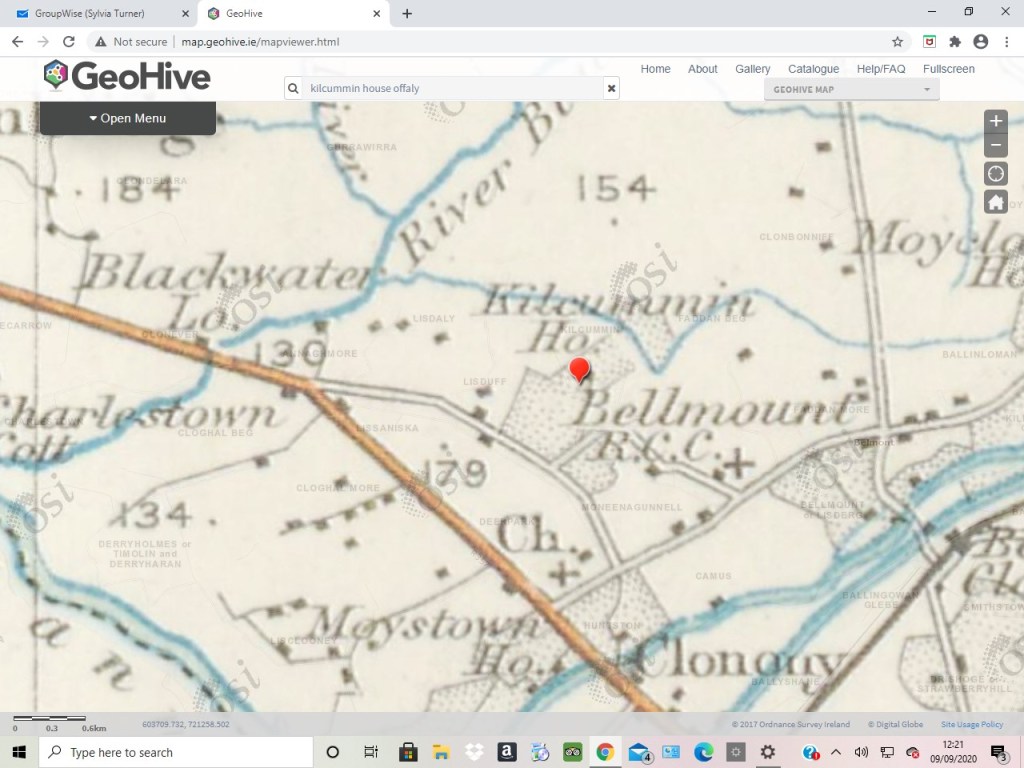
The funeral was expected in Shannonbridge at 8.00 p.m. Everything was ready and in order, candles blazing. It did not arrive at 8.00 p.m. or indeed 9.00 p.m. or 10.00 p.m. Needless to say Fr. Donoghue was getting very edgy. There was no sound or sight of the funeral. James tells me that post war traffic in the area was about one motorized vehicle every forty minutes. So in the silence one could hear a car approaching from as far as Moystown, a distance of 9 km. Sometime after midnight James says, one could hear the grinding of the old 14.9 hp Ford engine somewhere around Blackwater, about 2 km away. On arrival Kieran Flannery, the undertaker announced they had a breakdown in Ferbane, and as it was a Sunday night, they had difficulty sourcing the part.
`Arising from the Covid-19 virus due to government advice regarding public gatherings a private funeral will take place, but may be viewed on the Church website.`
This notice is now a regular feature of obituary notices in current newspapers and website dealing with death notices.
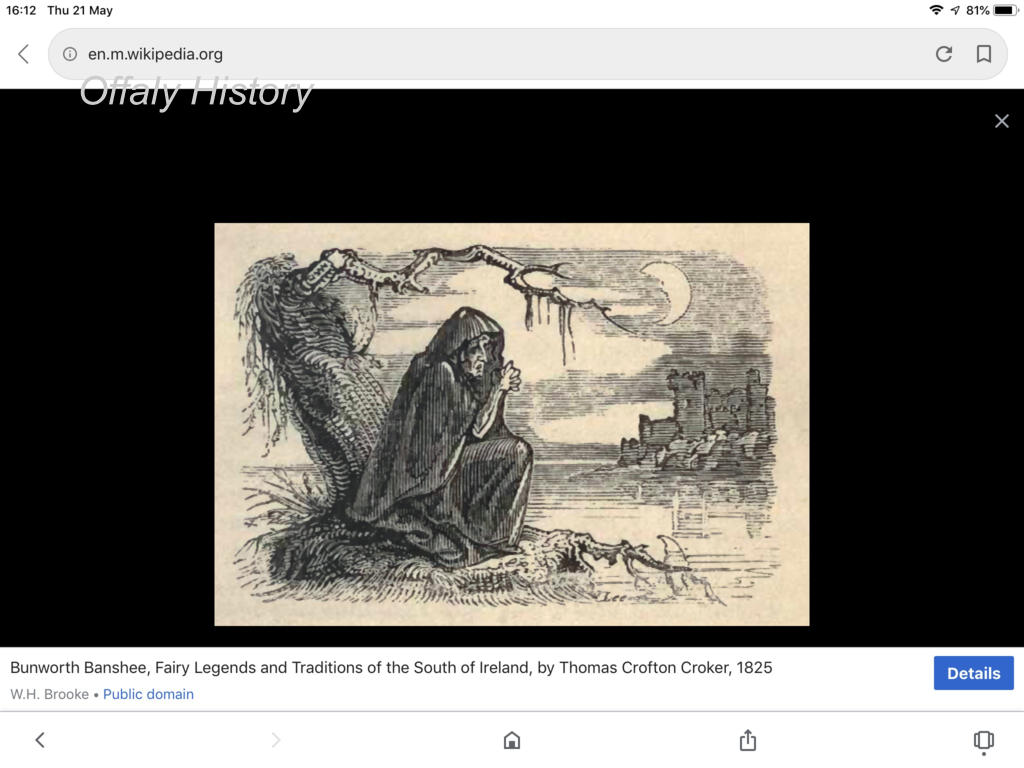
The story I wish to relate deals with an earlier time, from the early 50s, and I hope to recreate an image of the funeral process back then in west Offaly. It was a time when the medical condition of a sick person or indeed a visit by a doctor to such a person was not the only omen that death was imminent. A much more reliable harbinger of such an event was when a report came in, that the `banshee` had been heard. My grandfather, Michael Claffey originally from Bloomhill, near Ballinahown, totally believed in the banshee. He was a well-read literate man, yet if someone was ill in the parish, he would not show much concern until it was reported that the cry of the banshee had been heard. Once that occurred, it was good night Vienna, as far as he was concerned. He would then just wait for the inevitable, which from my memory always seemed to happen.
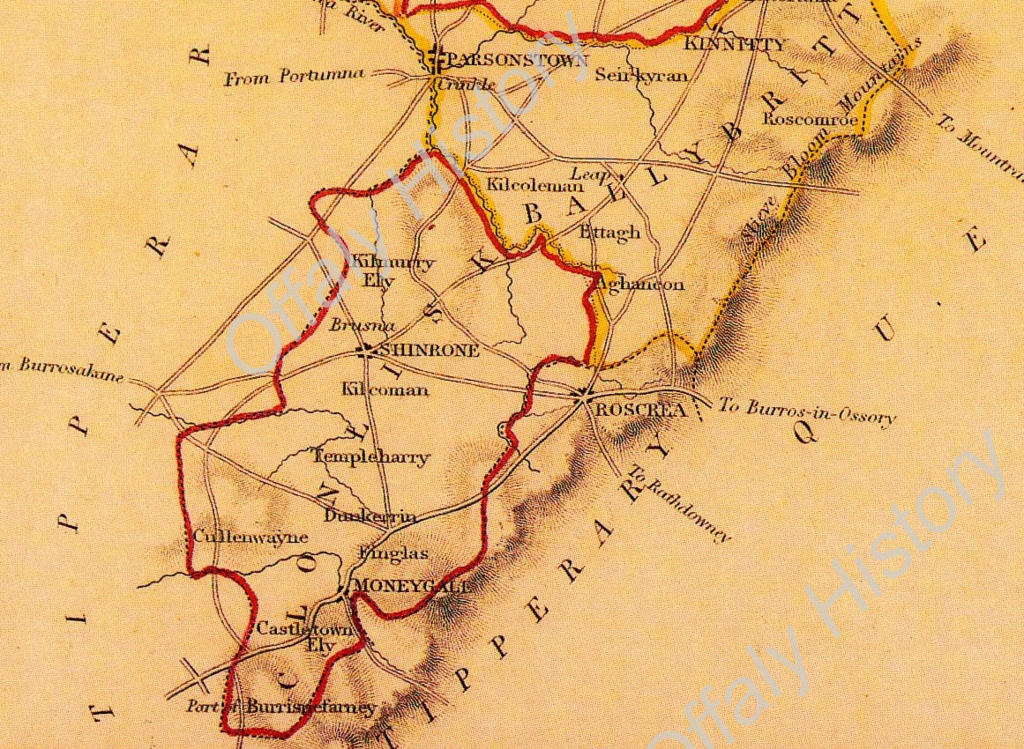
A document in the National Library of Ireland sheds important light on the fate of the inhabitants of a part of county Offaly during the years of the Great Famine. Here the names and circumstances of almost 500 people in the village of Shinrone and its hinterland are included on a register for relief, which was provided during the summer and autumn of 1846. Among the names may well be an ancestor of Barack Obama, 44th President of the United States of America. While Obama’s Irish heritage has been well documented in the past, not least during his visit to Ireland in 2011, few descriptions survive of how the Great Famine directly impacted the Kearney families and their community. It is hoped that this document will be transcribed and made available in Offaly Heritage in the near future.
Diaries offer a fascinating glimpse into history through the personal accounts of people who lived through war, famine, disease, revolution and other events of huge social disruption. Along with contemporary correspondence, personal diaries help to flesh out the bare facts of history with human experience, where otherwise official records are the only historical source. Find out how you can help us to record the history of the 2020 Covid-19 pandemic in Offaly and join a long line of Offaly diarists who have shaped our understanding of the past. (more…)
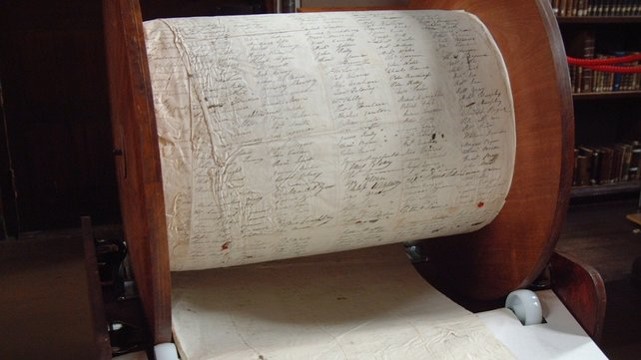
1. The Morpeth Roll (Courtesy of Castle Howard Archives)
The Morpeth testimonial roll comprises a farewell address signed by approximately 250,000 people (according to contemporary sources) on 652 individual sheets of paper. These sheets were subsequently joined together to create a continuous length of paper, approximately 412 meters in length (over three times the length of Croke Park), which was rolled onto a mahogany spool. It was presented to Lord Morpeth at the Royal Exchange, Dublin, in September 1841 following his defeat in the 1841 general election which consequently led to his departure as Chief Secretary of Ireland. For many years the testimonial roll remained hidden away in a basement at Castle Howard, Yorkshire, but it is now on loan at Maynooth University thanks to the generosity of Simon Howard, owner of Castle Howard and the efforts of Professor Christopher Ridgway, Curator and Professor Terence Dooley, Director of the Centre for the Study of Historic Irish Houses & Estates. This unique document has huge research potential, whether looked at as a pre-Famine census substitute, a family heirloom, a genealogy resource or a politically motivated document in its own right. Moreover, it has the potential to provide a unique insight into Irish life, society and politics in pre-Famine Ireland. As a pre-Famine census substitute it is unparalleled and its importance is multiplied by the scarcity of census material from this period. The document also provides empirical evidence of mass political involvement.


 offalyhistoryblog