
The year 2024 was another good year for publications on Offaly history with overviews of County Offaly towns, books on Tullamore, Birr and a musician from Killeigh who acquired fame in the United States. We also had Cloneygowan, canals, peat, a Feehan bibliography and natural history.
(more…)Category: Historic Towns
-
Tullamore in the Sixties launch – pictures capturing the period. Blog No 678, 7th Dec 2024
Tullamore in the Sixties was launched to great acclaim on 6 December. Most of the contributors living in Ireland participated in the proceedings with three to five minute talks. The book was launched by architect, town planner and artist Fergal MacCabe. A few of his own watercolours grace the contents of this 450 page book with extensive essays (from 18 writers) and 350 pictures. The book is available from Offaly History Centre, Bury Quay, Tullamore and Midland Books and the pop up at Bridge Centre. It can also be ordered on line.
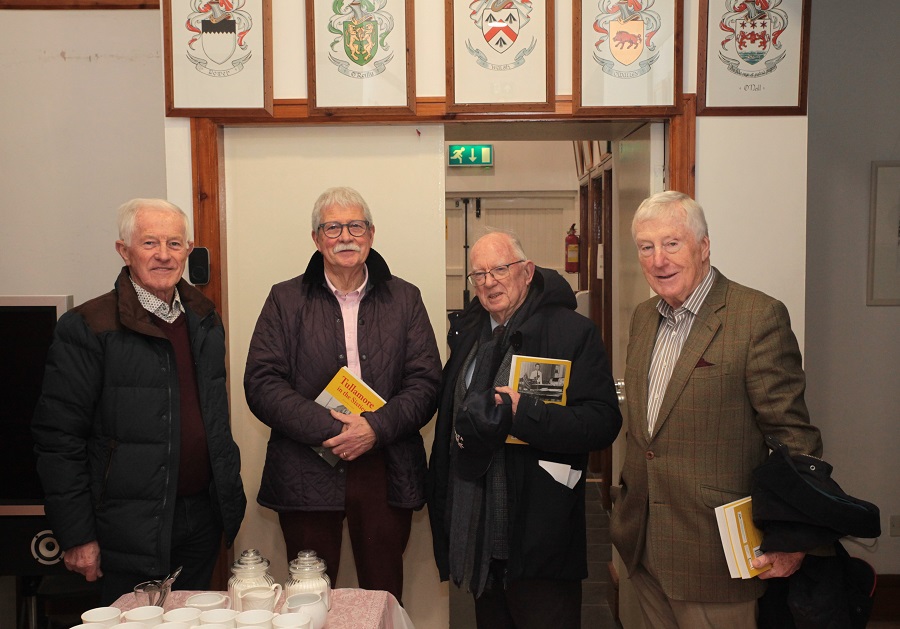
Some of the contributors to Tullamore in the Sixties Some of the pictures capture the period:
(more…)
-
Tullamore in the Sixties. A new book of essays on Tullamore in an eventful decade, just published. Blog No 674, 29th Nov 2024
This volume of essays brings together the contributions of eighteen people who kept a keen eye on developments in Tullamore in the 1960s. Perhaps none more so than the late Joe Kenny who came to Tullamore in the 1950s as a vocational schoolteacher and was held in high esteem for his sound judgement and abilities as an impartial chairman. In that capacity he was the inaugural president of Tullamore Credit Union in 1963. Fergal MacCabe, as a Tullamore native, with a professional life in architecture and town planning in Dublin, brings a unique contribution by way of his recollections of Tullamore in the 1950s and his review of the first town plan of the 1960s. The same can be said of Vincent Hussey as a planning officer with Offaly County Council with his recollections of Tullamore since the 1960s. Niall Sweeney, an engineer and former Offaly County Manager, takes a close look at the provision of public infrastructure in Tullamore over the period from the 1960s to 2014. The late Jack Taaffe, as town clerk in Tullamore in 1970–72 demonstrates just how underfunded urban authorities were in those years. He went on to become county manager in Westmeath presiding over the progress of the county from 1981 to 1988. Michael Byrne looks at the history of business in Tullamore and sought to cover the principal enterprises of the 1960s in manufacturing, distribution, shopping, entertainment and dancing. Noel Guerin, as a former employee of ‘the bacon factory’, was able to write of a company that employed up to 100 people in Tullamore over forty years and made the name of the town famous for the Tullamore sausage. Ronnie Colton, from his own extensive involvement in the motor business brings a knowledge from the garage floor and sales yard that few others can match.
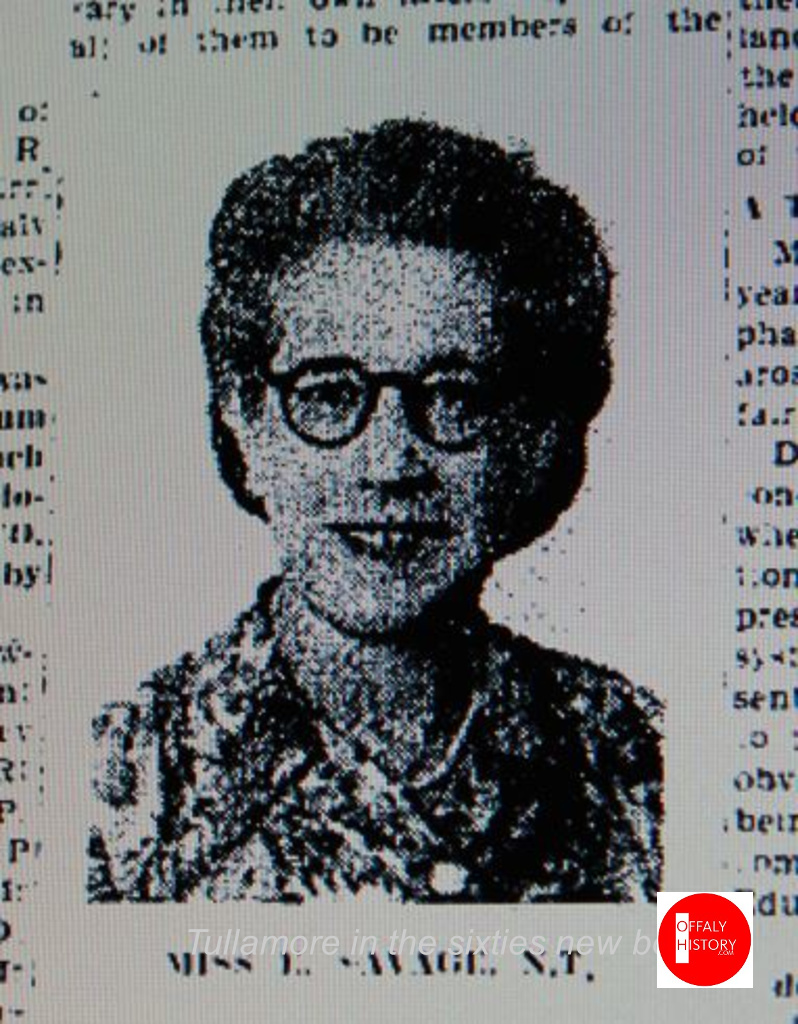
Miss Savage, a well-loved teacher in the Mercy primary school Alan Mahon, as the grandson of an innovative cinema proprietor, recalls two cinemas in Tullamore whose cultural contribution is perhaps forgotten now but was all important to the people of Tullamore and district over a period of sixty or seventy years, if one takes it from the commencement of the Foresters cinema (later the Grand Central) in 1914.
Sport, so important to so many, brings us to the essay by Kevin Corrigan who looks at a formative decade leading on to the GAA Senior Football All-Ireland victories in the 1970s. Kevin had the challenging job of reducing to a short essay what could fill twenty books were one to address in detail each of the sporting activities that came to the forefront in the sixties.
(more…)
-
22 Bussing in the Midlands from Tullamore to Birr, Banagher and back again: Lennox Robinson (1886–1958) on tour in the early Fifties. No 22 in the Offaly History Anniversaries Series. Blog No 671, 20th Nov 2024
At one time I didn’t think, but now I definitely do think, that the pleasantest way of seeing Ireland is from a seat in a bus. I do not mean one of those eight-day bus tours, conducted and excellent and comfortable as they may be, I mean the couple of hours spent bussing from one country town to another. [So announced Lennox Robinson in an article first published in the Irish Press and later in his compilation I sometimes think (Dublin, 1956). He would possibly have been amused to know that bussing has another meaning nowadays when students get together in a college dorm. Robinson was not inspired by some of the women who joined his Tullamore to Banagher and Birr bus. Now read on.]
If you travel in a friend’s car, you are cribbed and confined, he or she has to make talk with you and you have to return the ball of conversation; a train nearly always looks for and finds, the most poor and uninteresting country to travel through, and when it reaches an interesting town, Portarlington, for instance, is careful to stop a mile away from the place, John Gilpinish.
But a country bus swirls along, is very swift, and yet can be leisurely, picks up a parcel here and delivers a bundle of papers there.

We are, back in the old coaching days : the conductor knows everyone-or nearly everyone-and has a friendly word for each on-comer or down-getter. He sets down Mrs. Maloney at the Cross and helps an old Jack who is off to spend the day, his pension-day, in the town: yet he can be severe and inexorable on the question of accepting bikes.
I am beginning slowly to fall in love with the midlands slowly, because there is nothing tempestuous or flashy about them. The vivacity of Kerry and Donegal, the cuteness of Cork and Antrim-these are lacking, and instead there is a lovely autumn-afternoon placidity, golden and Veronese-woman-like atmosphere. The very names of sleepy; they are bees in August Lime-trees: Birr, Clogher, Ferbane, Clara, Mountrath.
(more…)
-
From ‘Tay Lane’ to a new Aldi store in Tullamore town centre. The four layers of development since 1790 – just 234 years ago. No 23 in the Offaly History Anniversaries Series By Michael Byrne. Blog No 669, 13th Nov 2024
Very soon now Tullamore will have a new Aldi Store at Tay Lane/O’Connell Street, Tullamore. This is the company’s second store in the town/The first was opened in 2000 at Cloncollog and preceded Tesco in 2004 (who once occupied the adjoining Tay Lane site and are near neighbours of Aldi at Cloncollog). Lidl and Dunnes already have two stores each in Tullamore and now Aldi will join this grouping with an investment in Tay Lane of close on €20 million when all expenses are taken into account.

Tea Lane (‘Tay’ Lane) is a popular old street name in Tullamore and most people seem to know that it was the area from the Al Conroy Printing Works (now again Stella Press under Brian Conroy) as far as the Offaly History Centre on the corner of Bury Quay and the former bonded warehouse (the Tullamore DEW Old Bonded Warehouse, 2000–20) and since December 2022 the Old Warehouse bar and restaurant (proprietor Shane Lowry). The name was in existence as early as 1821. The northern part of the lane was called the Old Fair Fields on a 1791 lease map. More changes are now in hand with the opening of a new Aldi store in late November 2024, following on the demolition of all the Irish Mist warehouses (erected from 1970 to 1985) and the great oats store of 1929. Irish Mist and Williams constituted the third layer. The first was that of long gardens from Patrick Street to almost the canal bank and before the canal (1801) the old fair fields. The second was the Williams buildings on these lands post 1897 and before their demolition for the new Irish Mist buildings of 1970-1985. Now Aldi will provide the fourth layer.
(more…)
-
21 ‘Rambling Jack’, Ned Holohan, a ‘knight of the road’ (died 1931) recalled in this article of 1961 by the late Alo O’ Brennan, War of Independence activist and late manager of the Tullamore Labour Exchange, and Pat Fanning, Offaly journalist, with a poem from Athlone. No 21 in the Offaly History Anniversaries Series. Blog No 666, 2nd Nov 2024
In his entertaining reminiscences last week, John Freyne laments the “Vanishing Knights” and incidentally recalls a Prince among them, the sightless Edward Holohan, better known over a great part of Ireland as “Rambling Jack.”
Mr Freyne tells of the respect and affection, with which this famous wandering minstrel was held in Moate. It was only symptomatic of the esteem-amounting almost to veneration in which he was held in the many counties, that he traversed twice each year, from his native Limerick of the rich pastures, to the shores of Lough Sheelin. A noble hearted Fenian himself, Ned Holohan was a living link with ’67 [The Fenian Rising of 1867] and everything that Fenianism stood for. He was born at Darnstown, near Killmallock, on the way to Bruree in 1839, and he died there on 27th December, 1931 in his 92nd year. He lost his eyesight in the attack on Killmallock Police Barracks in 1867 and his famous old fiddle, which up to then, had been his amusement, became for him his means of livelihood. His herculean physical strength failed, one brown October day, on the main road between Birr and Banagher, while making his way to the later town. He was removed to the old County Hospital at Tullamore where he was among real kind-hearted friends, many of whom still survive. He recovered and took up his permanent abode in Tullamore where he lived until shortly before his death. He returned to his beloved Limerick to die on the spot where he was born. No Irishman did more than Ned Holohan in a humble way, without pension, fee, or reward of any king to tend the Phoenix flame of Irish nationality. He was one of the real old Fenian stock, staunch and true, an inspiring rebel to the end.
(more…)
-
20 Uptown Clara, a hive of activity from 200 years ago. Looking at Clara’s old families. No 20 in the Anniversaries Series. By Maurice G Egan. Blog No 665, 30th oct 2024
Recently, I walked Clara’s Main Street and was again reminded of its relative short length and the relatively small size of its adjoining, almost hidden, Market Square. A square and street where much trade, barter and banter, laughter, disagreements, or agreements on family member marriages, and heated discussions on political reform, occurred on a regular basis for hundreds of years.
Many local hostelries were frequented, where typically a farmer and his wife and family would come to settle bills, visit the local medic for advice, or attend religious services. Today the square is modernly paved, almost hidden and its well-maintained former Market House now tucked away from the passing motorised traffic. Sadly, as in the case of many Irish provincial towns several old buildings have fallen into a state of disrepair and exude an aura of reduced circumstances.
Back in 1826, Clara’s Main Street and Market Square was a hive of activity and was where many notable families conducted their commercial business and resided upstairs. As I strolled the street and looked above the ground floor level of today’s shop fronts, I wondered who were these former resident families and what ever became of some of them?
Clearly, this is just a chosen snapshot of some Clara families, and I would be keenly interested to hear from family members of their stories from those days’ past.
(more…)
-
15 Tullamore and Geashill railway stations, 170 years of the Portarlington to Tullamore line, marked this 2 October 2024. By Peter Burke. No 15 in the Anniversaries Series by Offaly History. Blog No 657, 2nd October 2024
The railway line from Portarlington to Tullamore was opened on 2 October 1854. It was a quiet affair, but the commencement of the line was to mean significant growth in the years that followed. This was particularly so from 1857 when the extension to Athlone and Galway was completed.
The act to enable the line to be commenced was passed in 1847, but no action was taken until 1851. The connection to Tullamore was part of the line of the Great Southern and Western Railway (GSWR) while that to the west via Mullingar was backed by the Midland and Great Western Railway (MGWR).
(more…)
-
8 Families of Cormac Street, Tullamore in the early 1900s. All was Victorian respectability to the front of the street but with a ‘cabin suburb’ and a prison close by. A contribution to the Living in Towns series supported by the Heritage Council. By Michael Byrne and Offaly History. Blog No 648, 31st August 2024
We have looked at the houses in Cormac Street and will soon follow up with the jail and courthouse reviews. In this article we want to look at the families of Cormac Street in the early 1900s. In the c. 41 residences in the street in 1901 were about 326 people. About 250 were RC and about 60 were C of I and Others. It was a street of contrasts with overall good housing on the main street, poor housing in Wellington Barracks and sixty and upwards in the prison. Of the total number in 1901 98 were in the prison, 85 of whom were confined there and 13 were staff living in the building There were four prison officer families in the jail lawn houses: Alexander Spence (2 people in the house – himself as a widower and his daughter), a prison officer; Michael Curtin (8 in the house), a prison warder; James Creane (11 in the house, including 9 children), a prison warder; Alexander McCullagh, prison warder (2 in the house).
The houses on the street were as to 11 in the first class with the rest in the second class. The highest concentration of 1st class houses was on the terrace on the east side of the street bookended by Dr Ridley and William Adams (GV 3 to GV 14 as per maps in earlier blogs). There were no 3rd or 4th class houses on the street, but is should be remembered that the two-room cottages in Wellington Barracks (later Coleman’s Place Lane) were all described as being in the second class.
(more…)
 offalyhistoryblog