Castle Street, Birr comprises a mix of about thirty commercial and residential properties close to the Camcor river to the south, Main Street and the old parish church to the north, and to the west Birr Castle. On the east at the Market Place or Market Square the street opens into Main Street, Bridge Street and from the 1880s into the new Brendan Street. The market house stood from the 1670s where the memorial to the Manchester Martyrs was placed in 1894. Surprisingly, when the market house was taken down in the late 1700s it was not replaced with a new building in a less disruptive location.[1] The new courthouse and jail of c. 1809 took care of the legal functions, while two plots were reserved in Castle Street for the markets.
Neville’s Atlas of the 3,000-acre estate at Philipstown in 1786 has not before been seen by the public and has probably not been consulted for fifty years. The surveyor was Arthur Richards Neville who was Dublin City Surveyor, 1801-1828 and he prepared the map on the instructions of the Molesworth Estate, the owner of 3,000 acres including the town of Daingean. Neville was in practice as a land surveyor from the 1780s or earlier. He succeeded RICHARD BURLEIGH WORTHINGTON as City Surveyor in 1801. He retained the post until his death in 1828 when he was succeeded by his son ARTHUR NEVILLE(Dictionary of Irish Architects online). The map is 154×128 cm and is 20 perch to the inch, taking in almost 3,000 statute acres and 130 land holdings. The map was conserved with the support of a grant from the Heritage Council. The map was donated to Offaly Archives in 2022. Our thanks to Arnold Horner for his assistance.
The abolition of Tullamore Town Council in 2014 evoked many memories for me of my years covering that body and its predecessor, Tullamore Urban District Council (UDC) from 1988 to 2007 for the Offaly Express, and for a year and a half before that for the Offaly Independent. I also covered a number of meetings as a freelancer for the Express following my ill-fated return from England.
When I first covered the council, I had the advantage of knowing all the councillors. Six of those early councillors are now deceased – Ernie McGuire and Lar Byrne of Labour, Billy Bracken of Fine Gael (FG), Ann Fox of Fianna Fáil (FF) and independent representatives May Keeley (who, in 1974, was the first woman ever elected as a councillor in Tullamore) and Anne O’Toole.
A contribution to Tullamore 400 and the Living in Towns initiative of the Heritage Council. Sit down and have a cup of tea with this blog!
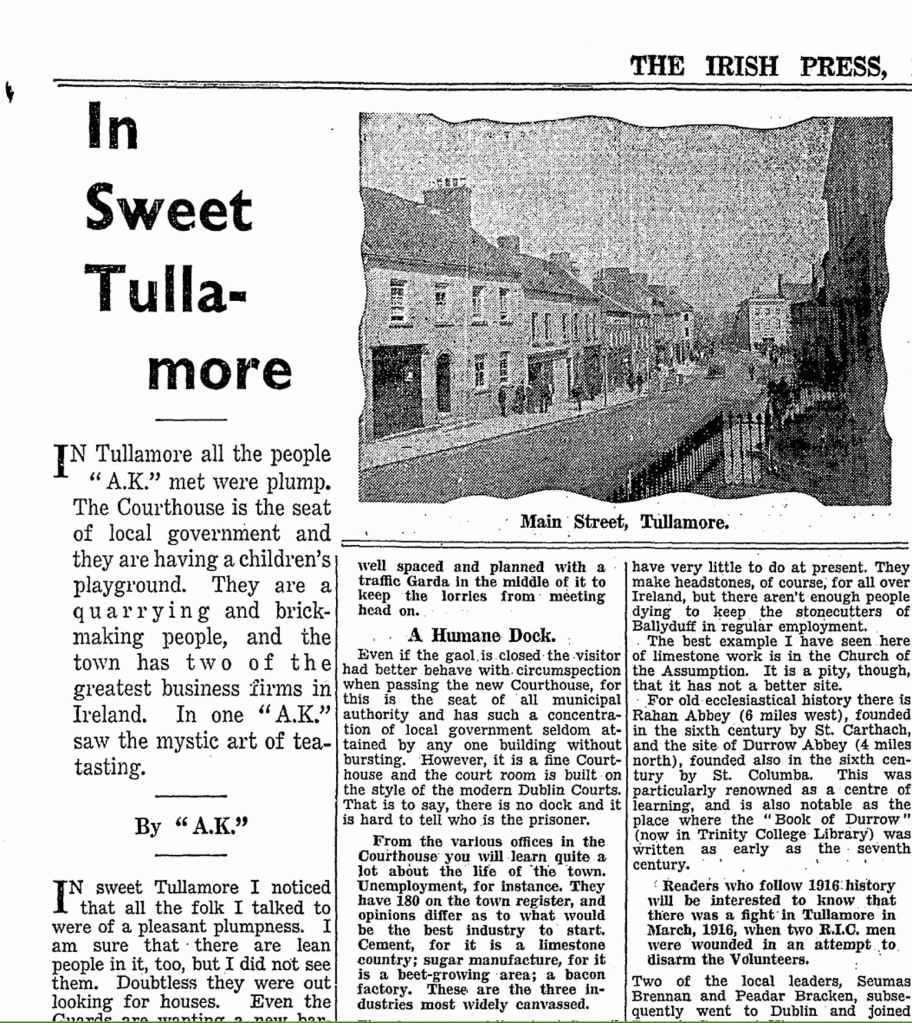
A visit by an Irish Press journalist to Tullamore in 1933 provided a nice puff for the Williams tea business and its brand Red Cup Tea. At the time Williams provided regular advertising in the Irish Press for its tea and Edmund Williams (d. 1948) was a founder director of Irish Press. D.E. Williams’ interest in tea can be traced back to 1895. In the Chronicle and the rest of the local press for February 1895 advertisements appeared in connection with the opening of a wholesale tea business by Daniel E. Williams. In a comment the Chronicle stated that most of the blending was done in London where D.E.W. had larger stores than hitherto. The draft 1917 accounts for DEW Ltd show sales at £8,324. This had risen to £13,807 by 1923. The business was much expanded in the 1930s led by the blender, a Mr O’Shea.
From the Irish Press, 5 May 1933. The picture is from an old postcard rather than sending a photographer.(more…)
Dr William Moran, a distinguished man of letters and former parish priest of Tullamore (1949–65), published the article below in 1962 and in the same year as his pamphlet on the history of Tullamore. In many ways it was a seminal overview that has not as yet been superseded.[1] Material has of course been published by the late Sister Dolores Walsh on the history of the Mercy schools in Tullamore while others have written of the Presentation schools in Rahan and Birr, Mercy Birr, Mount St Joseph, Tullabeg College, vocational schools in county Offaly including Tullamore, and primary schools in Durrow (See Irishhistoryonline and the OH Library catalogue online for guidance). Dr Moran’s strongly held and trenchantly expressed views come across in this piece.
Sometime in the 1830s, the architect William Murray (1789-1849), best known for designing mental hospitals all around Ireland, presented a quick outline of a new public square in Tullamore which would be bounded on three sides by fine houses and dominated on the fourth by the imposing portico of the recently erected County Courthouse.
The title of his drawing’ Thoughts for a Square at Tullamore, Ireland facing the Courthouse to be called ‘The Beaujolais’ suggests that it was not an actual commission but more likely a broad brush and quickly executed response to a remark by Lady Beaujolais Bury the wife of the local grandee, perhaps exchanged at a social gathering. Architects do this a lot to get business and Murray may have been trying to reconnect commercially with the family who had given his cousin Francis Johnston such valuable and prestigious commissions as Charleville Forest and St Catherine’s Church.
Of course Murray’s elegant scheme was never realised and was to be the last proposal for a civic design set piece in Tullamore for some time. In the 1950s, the urban planner Frank Gibney suggested the creation of a parkland setting for the Church of the Assumption but this notion was eventually shelved and for the following seventy years no further interventions which would combine coherent built form with public benefits were to be advanced and the planning of the town remained firmly in the hands of engineers whose principal spatial concern was the accommodation of the motor car.


 offalyhistoryblog