As the decade of centenaries draws to a close, one centenary not on the government’s list of official commemorations is the 1922 visit to Ireland of the Hon. Hugh Mahon, a former cabinet minister in the Australian government. Nevertheless, at a local level, the people of County Offaly may find more than a passing interest in this event from one hundred years ago.
Born in 1857 at Killurin, six kilometres south of Tullamore, Mahon was forced to leave his native land in 1882 and emigrate to Australia to avoid being arrested for his activities in the Land League. Forty years later he returned to Ireland for the first time, visiting family and friends in and around Tullamore. The years in between had been eventful for Mahon, leading to one of the most contentious episodes in Australia’s political history. And the return visit to his homeland also was not without controversy.
The summer of 1873 was marked in Tullamore with a great outpouring of support for the coming of age of Charles William Francis, the fourth earl of Charleville (1852–74). He had been an orphan for fourteen years and taken care of by his uncle Alfred Bury (1829–75). The fourth earl’s parents, Charles William George and Arabella Case, had both died at a young age in 1857 (countess of Charleville) and 1859 (the third earl). He was only 37 and left five young children of which the fourth earl was born 16 May 1852. His sister had been killed in an accident on the stairwell at Charleville Castle in 1861 and his younger brother John died in 1872 when only 21. Now the young earl had reached his maturity and his 21st year. He could mark the occasion with his two sisters Lady Katherine and Lady Emily. The celebrations ought to have been on 16 May 1873 but the party had been deferred for a few weeks so that the coming of age could be celebrated at the same time as the marriage of Lady Katherine to Captain Hutton A.D.C. The celebration in the town with triumphal arches and fireworks was the last such for the earls of Charleville. Over the period from 1782 to 1873 there had been three such Welcomes from the Tenantry. Lady Emily inherited Charleville under the will of the fourth earl who died in 1874 aged only 22. Emily came into possession on the death of her uncle Alfred in 1875 childless. She was still a minor and there was no official welcome. Lady Emily married Captain Kenneth Howard in 1881 but was a widow by 1885. The Land War began in 1879–80 and cast a shadow over landlord and tenant relationships permanently. Lady Emily died in 1931 and the estate passed to her only surviving child Lt Col. Kenneth Howard Bury (died 1963 aged 80).
The address of Dr Michael Moorhead in his capacity as chairman of the town commissioners at the celebration dinner in 1873 is replete with irony given that the young earl died in a little over a year after on a fishing and hunting trip near New York.
Thomas Armstrong, son of Andrew Armstrong and Lucy Charnock, was born on 22nd August 1702 and when he retired from his position as First Director of his Majesty’s Engineers, Chief Engineer of Minorca and Senior Engineer in the service, purchased the estate of Moorock and built a house there. He died in 1747, unmarried and the estate passed to his brother Warneford Armstrong.
On the 9th October 1793, Warneford Armstrong (1699- 1780) made a lease agreement for three lives and thirty one years of the House, Gardens and Land of Moorock to Richard Holmes, a gentleman of an old King’s County family based in nearby Prospect House. The 390 acres had been leased to James and John Reamsbottom. In 1795 Warnesford Armstrong demised the whole estate of Moorock to Richard Holmes of Prospect House for “lives renewable forever”.
The memorial to the Offaly Volunteers who fought in the War of Independence was unveiled on the lawn of the county courthouse, Tullamore in 1953. It was Peadar Bracken (1887–1961) former OC Offaly Brigade and from 1922-3 the Tullamore district court clerk who ensured that the IRA Volunteer monument was placed on the lawn of the courthouse. Besides, a site in O’Connor Square was not an option from 1926 when the war memorial was completed. Given that it was principally to the Tullamore courthouse that the feared judges of the assizes would arrive it has strong symbolism. The Volunteer monument was completed in 1939 but not unveiled until 1953 due to the difference between the Free Staters (National Army) and the Republicans.
Memorial to members of the Old IRA at the county courthouse, Tullamore
As noted in an earlier article in Offalyhistoryblog the last of the assizes was held in July 1921 with Judge Wiley presiding and a large force of military to protect him as the symbol of the British state. Now with the marking the 100th anniversary of the Treaty and the departure of Crown forces from Ireland it seems appropriate to look again at the twice-annual display of British power in the assize towns of Ireland.
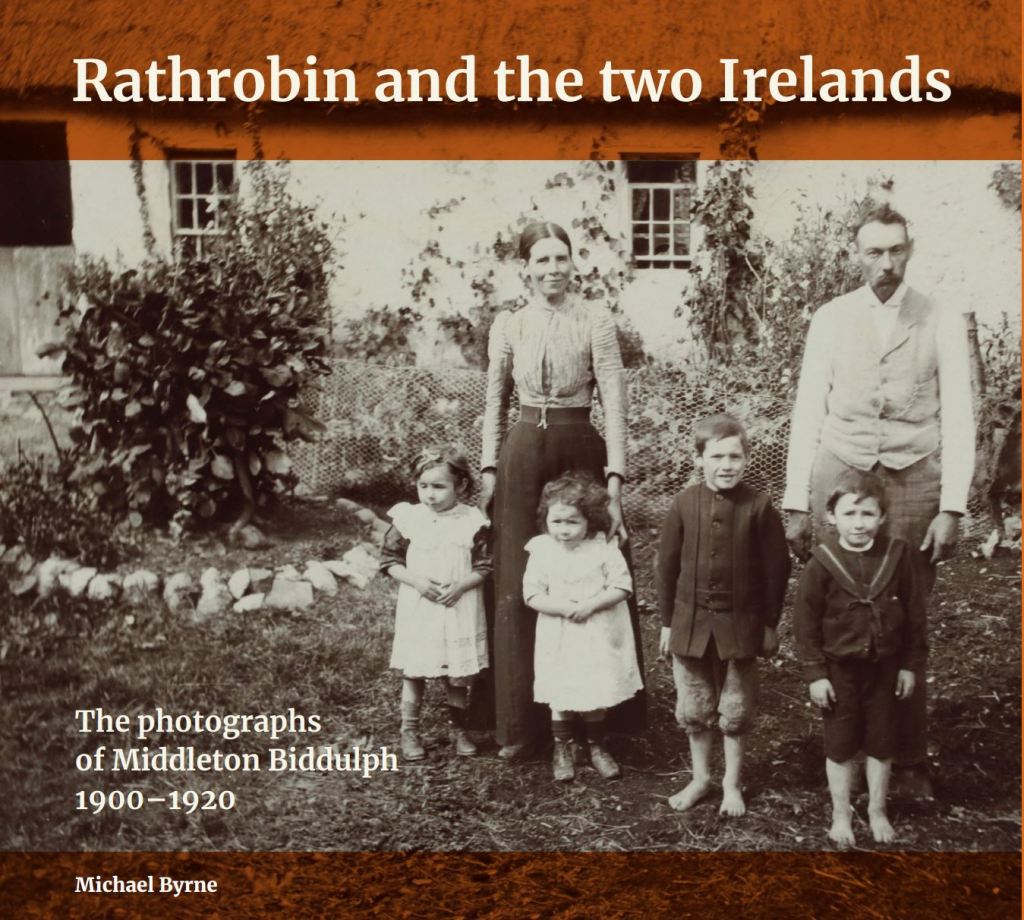
Rathrobin is a book that keeps on giving. Its 250 Biddulph photographs from the 1870s to 1920s, all carefully captioned, depict the two Irelands – unionist and nationalist, Catholic and Protestant, landed and cabbage garden. What is interesting about the photographs taken by Colonel Biddulph (1849-1926, of Rathrobin near Mountbolus) are the nuances. He was of the lesser gentry, was a tenant of the Petty Lansdownes, and was keenly aware of the plantations of the 1550s to the 1650s. He appreciated the needs of the farm labourers and was decent to his own tenants, indoor staff and farm workers. His entire estate was not much more than 1,000 acres. Biddulph’s circle was also the lesser gentry and those who served it such as land agents, bankers and clergy. The Catholic Protestant divide was strong but landed Catholic families did mix in Biddulph’s set, but not merchants or traders (even if very rich). Biddulph had an empathy with his farm workers and their families and sought their advancement. Many local families were photographed, together with the farming activities of his own employees.
All the books here can be purchased from Offaly History (Bury Quay, Tullamore and online) and at Midland Books, Tullamore. You can also view/ borrow at Offaly Libraries and consult at Offaly History Centre.
Rathrobin and the two Irelands: the photographs of Middleton Biddulph, 1900-1920. Michael Byrne (Offaly History, Tullamore, 2021), 330 pages, 280×240, hardcover, €24.99.
Rathrobin is a book that keeps on giving. Its 250 Biddulph photographs from the 1870s to 1920s, all carefully captioned, depict the two Irelands – unionist and nationalist, Catholic and Protestant, landed and cabbage garden. What is interesting about the pictures of Colonel Biddulph (1849-1926) of Rathrobin near Mountbolus are the nuances. He was of the lesser gentry, was a tenant of the Petty Lansdownes, and was well aware of the Plantations of the 16th and 17th centuries. He appreciated the needs of the farm labourers and was decent to his own tenants, staff and farm workers. His entire estate was not much more than a 1,000 acres. Biddulph’s circle was also the lesser gentry and those who served it such as land agents, bankers and clergy. The Catholic Protestant divide was strong but landed Catholic families did mix in Bidduph’s set, but not merchants or traders (even if very rich). Biddulph had an empathy with his farm workers and their families and sought their advancement. Many local families were photographed, together with the farming activities of his own employees.
Biddulph’s story, and that of his associates and friends, is illustrated by a selection of over 300 pictures in all, of which 250 are from the Biddulph Collection in Offaly Archives, and fifty more to illustrate the introductory essay and provide the all-important context. The essay and the photographs provide a more nuanced understanding of Ireland in the revolutionary period of 1900–23. Biddulph’s wonderful house at Rathrobin that he had so carefully ‘restored’, and all his farm improvements, were lost in the Civil War in 1923. Many other big houses from Ashford, to Ballyfin, Durrow, Brookfield, Screggan Manor and Charleville are also recorded in this volume. Some such as Brockley Park in Laois are now gone thereby making this an important work of record. The photographs by Middleton Biddulph were taken at a crucial moment in Ireland’s history. Their publication now could not come at a better time. Rathrobin is the portrait of one small estate and Killoughy parish in Offaly from the 1650s to the 1920s, but the story is of national interest. T.E. Lawrence spoke of the Arab Revolt, perhaps in Ireland we can talk of the Irish Revolt and not the full circle Revolution. You decide.
Rathrobin was supported by the Decade of Commemorations Unit in the Department of Tourism, Culture, Arts, Gaeltacht, Sport and Media
While perusing some late 19th century newspapers a reference to The National Indemnity Fund 1888 caught my eye. The object of this fund was to provide an indemnity for Parnell against an Order for costs in the event of him loosing a defamation action against the Times.
This fund received contributions from virtually every parish in Ireland, and also from outside Ireland. I found records of fundraising events in England, Scotland, U.S.A., New Zealand, Australia and elsewhere.
However, I was more interested in the small contributions made by the ordinary people of Ireland, the vast majority of whom would not have been in any way well off. They would have been tenant farmers who lived a very precarious life due to their lack of security of tenure and volatile rents. Reflecting their means some the contributions are very small reminding us of the story of the widow`s mite in the gospel of St. Mark.
I was very pleased to find contributions from my own neck of the wood in west Offaly. I found a fascinating letter from Michael Reddy of Shannonbridge in the Freeman’s Journal of 26th October 1888.
The Midland Tribune and King’s County Vindicator was first published at Birr on 15th September, 1881. The aim of its promoters, three Birr Catholic priests of the Killaloe diocese, was to provide a ‘thoroughly independent organ of popular opinion in a district hitherto without the semblance of national journalism’. In politics it declared itself as a supporter of Home Rule. Its tone would be Catholic while at the same time endeavouring to promote ‘the union of Irishmen of every class and creed.’ On the land question the Tribune adopted the programme of the Land League and on education the views of the Catholic hierarchy
Seamus Dooley, Geoff Oakley, the late Dorothy Oakely and an NUJ function in Tullamore in recent years. Geoff was editor of the Tullamore Tribune from 1978 to 1994. Seamus was a well-known reporter with the newspaper.
The Tribunewas founded in what is generally considered the most exciting decade of the nineteenth century. The 1880s saw the development of the most powerful democratic movement in Irish history, based at first on the struggle of tenant farmers to wrest the land they tilled from the landlords and later the right of Ireland to manage her own affairs. These twin aims, Home Rule and a solution to the land question were welded together into a popular mass movement led by Parnell, Davitt, and O’Brien. But, in the 1880s the masses came on the political stage as leading players rather than as extras.
The administration of law in Ireland in 1914–19 was pervasive with petty sessions’ courts across the county in the smallest villages and towns. These were attended to by paid resident magistrates and on a voluntary basis by local gentry and merchants, both Protestant and Catholic, who had been deemed suitable by Dublin Castle for the conferring of a commission of justice of the peace. After 1916 it was becoming a doubtful honour and many nationalists, including P.J. Egan of Tullamore (chairman of the town council 1916-24 and managing director of a large business), resigned the commission when the War of Independence in 1919-21 intensified. The country had been subject to the Defence of the Realm Act (DORA) since 1914 but it was not much invoked in Offaly before 1916 and the civil courts of petty sessions, quarter sessions and assizes (usually held in Tullamore, but often held in Birr from mid-1916 to 1921) continued in the county. The Sinn Féin courts will be the subject of a later blog.
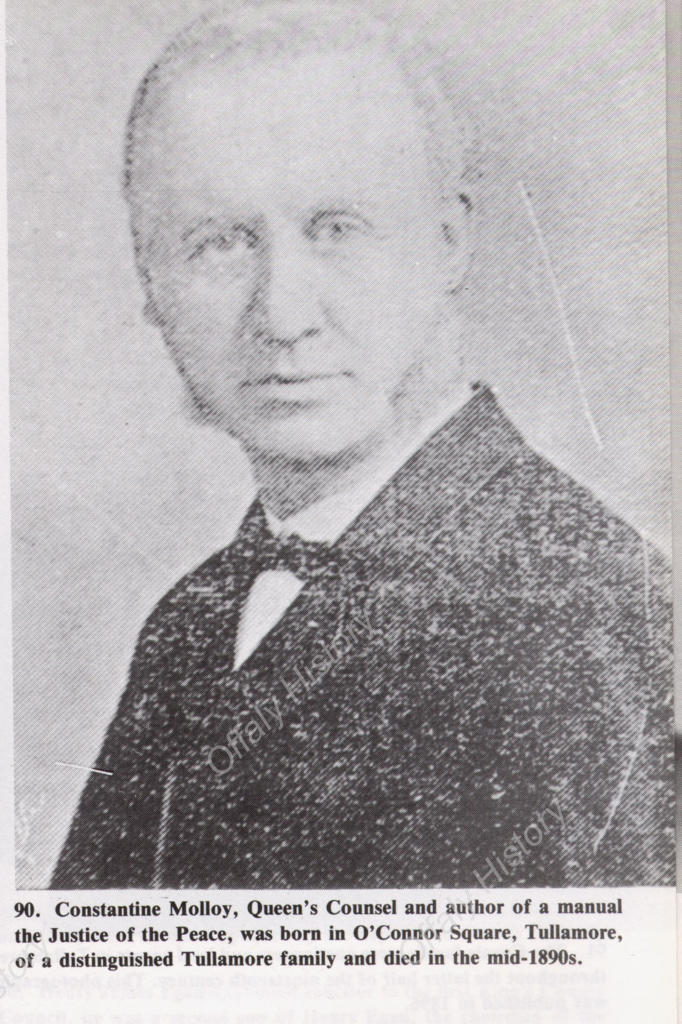
The Molloy family in Tullamore have distinguished antecedents and can include among their number two of the town’s most prominent citizens in the 1820s to the 1840s, Michael Molloy and Anthony Molloy. Michael Molloy founded the Tullamore Distillery in 1829 and from it came the Bernard Daly distillery and that of Tullamore DEW. Michael Molloy was a patron of schools and of the new Mercy convent of 1838-40. The family were the owners of Tullamore up to the 1620s and were the principal landowning family in the baronies of Ballycowan, Ballyboy and Eglish until the Jacobite and Cromwellian plantations. Some such as Charles Molloy had extensive landholdings at Greatwood in Killoughy up to the 1850s. Constantine is a recurring name in the family and one of our regular contributors to this blog, Cosney Molloy, is proud to be called after an early king of Cornwall. Kilcormac and Rahan are strongholds of the family.



 offalyhistoryblog