
When Richard B. Sanders, the county surveyor (today a county engineer) for King’s County, died in Cumberland Square, Birr in 1900 he left an estate of the value of £30,000. This would have been enough to build 300 council ‘cottages’ in those days when smaller houses such as those of in Cappaneale, Birr and Davitt Street, Tullamore could be built for £100 each. Sanders was an Antrim man and was born in 1845. He had involved another Birr resident, also from Antrim, the solicitor Archibald Christie, in the making of his will. Albeit in the worst possible way by asking him to be a witness but without having given him any instructions. Both were neighbours in Cumberland Square (as it then was, now Emmet Square). Both of them would have been under the watchful eye of John Wright, the editor of the King’s County Chronicle and resident of Cumberland House. Nearby was the Ormond Club of which we can assume both Christie and Sanders were members and perhaps also of the Birr Masons, then going strong.
(more…)Category: Legal history
-
The Terror of Tullamore Gaol. By Maurice Egan. Blog No 450, 24th Dec 2022
Introduction
One hundred and thirty five years ago on Christmas eve 1887, one of the two ‘Heroes of Tullamore’, John Mandeville was released from Tullamore Gaol in wretched physical condition. Mandeville who farmed two hundred acres and was chairman of Mitchelstown Board of Guardians and his fellow Irish National Land League member William O’Brien, born in Mallow, and MP for northeast Cork were imprisoned first at Cork gaol on 31 October and two days later were transferred by train and incarcerated at Tullamore gaol. Earlier on 9 September, after an 8,000-strong demonstration led by John Dillon MP, three estate tenants were shot dead (John Shinnick, Michael Lonergan and John Casey) by police at the town’s courthouse where O’Brien had been brought for trial with Mandeville on charges of incitement at the Kingston Estate under a new Coercion Act. This event became known as the Mitchelstown Massacre. Mandeville, a tall burly man was singled out on instruction for particularly callous and brutal treatment at Tullamore gaol. He died six months after his release and an inquest held to establish the cause of his death concluded it was as a result of his maltreatments at Tullamore gaol. Before he died, he described the gaol conditions in letters to his wife and friend Sydney Halifax.
(more…)
-
The burning of Tullamore courthouse, jail and barracks by the anti-Treaty IRA on 20 July 1922. By Michael Byrne. Blog No 401, 20th July 2022
Contributed by Offaly History to mark the Decade of Centenaries
We saw in previous articles in this series the lead up to the civil war notwithstanding the outcome of the general election in June in which the vote was substantially in favour of supporting the acceptance of the Anglo-Irish Treaty of December 1921. In Laois-Offaly all four pro-Treaty candidates were elected with Labour, who preferred to look at the social rather than the Treaty question securing almost fifty percent of the vote. But among the soldiers of the IRA, particularly in Offaly, there was a reluctance to accept the Treaty outcome. Some were of the view that the people would follow where the military led.
The burning of Tullamore courthouse, jail and the former military barracks (in Barrack Street, now Patrick Street) on 20 July 1922 was one of those momentous historic occasions the impact of which had an almost a numbing effect on the people of Tullamore and the county. The completion of these buildings in 1716, 1830 and 1835 were all major steps in the progress of Tullamore. Now all were destroyed in one night for no tangible military benefit by the departing Republican IRA.
(more…)
-
Healthcare in Ireland – pre and post Partition. By Sylvia Turner, Blog No 400, 16th July 2022
Since the early 18th century public healthcare in Ireland had been funded by voluntary donations. The first hospitals in Ireland were founded in the 1720s. The dispensary doctor was formally established by legislation in 1805 under an Act of Parliament. The amount from voluntary donations was matched by county grand juries from local taxation. The Poor Law Act of 1838 improved the distribution of dispensaries and divided Ireland into 130 administrative units known as Poor Law Unions, with their own workhouse, governed by the Poor Law Guardians, who were elected by the local rate payers.
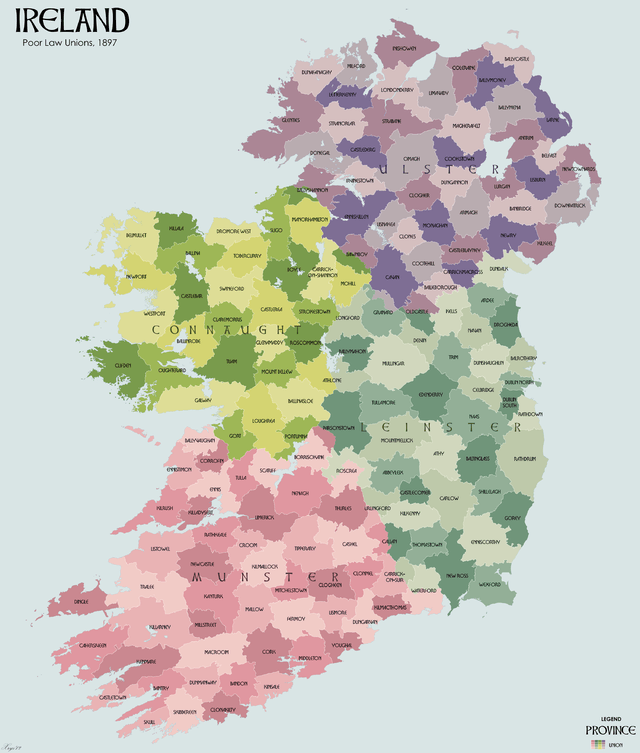
The Poor law unions at the end of the nineteenth century. Courtesy Wiki Commons The dispensary doctor became the mainstay of healthcare in rural Ireland as many people lived too far from medical help in workhouses. The position of the dispensaries was clarified in the 1851 Medical Charities Act, which introduced a state-funded dispensary system to provide free medical aid to the poor. These were to be funded from local taxation and were subsidised by the Poor Law Commission. To attend the dispensary, a person needed to have a colour-coded ticket, dispensed by the committee. The Poor Law Commission was replaced by the Local Government Board in 1872.
(more…)
-
Building Offaly’s courthouses and prisons in the eighteenth and nineteenth centuries. Blog No 398, 9th July 2022
Dr Richard Butler will showcase the building of Offaly’s courthouses and prisons in the years between roughly 1750 and 1850 in a lecture at Offaly History Centre, Bury Quay, Tullamore and via Zoom on Tuesday 12 July 2022. The presentation will place individual buildings in Tullamore, Birr, Daingean and elsewhere in the context of changing political and social events throughout Ireland in these years, highlighting local agendas alongside those of the British administration in Ireland. Illustrated with historic architectural drawings, old and new photographs, the lecture will also highlight schemes that were never built as it traces the ways in which the appearance of Offaly’s towns was transformed in these years by new public architecture. The lecture will incorporate new research on Offaly’s history undertaken in recent years by historians based in the county such as Michael Byrne alongside volumes such as Andrew Tierney’s new Buildings of Ireland guide for Central Leinster and the speaker’s recently published book, Building the Irish Courthouse and Prison: A Political History (Cork University Press, 2020).
(more…)
-
The 1922 general election in Laois-Offaly. By Michael Byrne, Blog No 391, 15th June 2022
The 16th of June 2022 marks two important anniversaries. The first is the centenary of Ulysses, but the second was the all-important vote on the Treaty held on the same day. The outcome in Ireland of the latter event was eagerly awaited. This election was the first to be held in the new Free State, the first held under the PR electoral system, and the first to be contested by the parties which, in modified forms, were to dominate subsequent Irish politics at least up to 2011. The 1918 election has already been the subject of a blog on Offalyhistoryblog and was a clear win in Offaly and the country for Sinn Féin. This blog is part of our contribution to the #decade of centenaries. We plan more over the summer to include the departure of the British army from Offaly barracks, the lead up to the civil war in Offaly, bank robberies, the burning of the county courthouse, jail and barracks, noted personalities in Offaly in 1922. If you wish to help please email us with your suggestions/contribution. info@offalyhistory.com
The 1922 election was a fight out between the pro-treatyites and the Republicans led by de Valera, but the pact between Collins and de Valera came to grief before election day. Some had looked to the Labour Party to stand aside in 1922, as they had done in 1918, or to vote with the pro-treatyites. Nowhere was the wisdom of Labour going its own way better demonstrated that in the new Laois-Offaly four-seat constituency where William Davin came in as the big winner with more than two quotas. Given its performance in later general elections why did the anti-treatyites not field a candidate? Sean Robbins of Clara had topped the poll in the 1920 county council election and Sinn Féin’s ideologue in Offaly and organiser, T.M. Russell, had come second. Russell, to answer part of the question, had departed the local scene in October 1920 and was in favour of the Treaty. Sean McGuinness, the local IRA battalion commander, was another possible anti-treatyite candidate and he was elected in 1923, but declined to take his seat because of the oath of allegiance. He secured 5,572 votes in 1923.
(more…)
-
The grant of Tullamore in 1622 to Sir John Moore of Croghan: the 400th anniversary of the beginning of township in Tullamore. By Michael Byrne, Blog No 376, 23rd April 2022
Tullamore is a well-preserved town and is the county town of Offaly since an act of parliament in 1832 displaced Philipstown (Daingean) which had been the county town since the shiring of Offaly as part of the new colonial government policies in 1557. The new county to be known as King’s County was then comprised of the baronies reflecting the Gaelic lordships of the O’Connors and that of the O Dempseys. The king in question was none other than Philip II of Spain married at that time to the tragic Queen Mary of England (1553–58) hence the new forts of Philipstown and Maryborough (Portlaoise). The county was extended about 1570 to include the territory of the O Molloys (now to be the baronies of Ballycowan, Ballyboy and Eglish) and also that of the Foxes in Kilcoursey and the MacCoghlans in what would be called Garrycastle. In 1605 the territory of the O Carrolls (to form the baronies of Ballybritt and Clonlisk) was added, as also was the parish of Clonmacnoise (1638) at the behest of Terence Coghlan of Kilcolgan. Those looking for an exciting seventeenth-century history for Tullamore will be disappointed as the surviving evidence of town growth in that troubled century is thin. This week we continue to series to mark the 400th anniversary of Tullamore as a town.
(more…)
-
Moorock House, Ballycumber: the first Big House burned in Offaly in the 1919–23 period. By Eamon Larkin, Blog No 372, 9th April 2022
Thomas Armstrong, son of Andrew Armstrong and Lucy Charnock, was born on 22nd August 1702 and when he retired from his position as First Director of his Majesty’s Engineers, Chief Engineer of Minorca and Senior Engineer in the service, purchased the estate of Moorock and built a house there. He died in 1747, unmarried and the estate passed to his brother Warneford Armstrong.
On the 9th October 1793, Warneford Armstrong (1699- 1780) made a lease agreement for three lives and thirty one years of the House, Gardens and Land of Moorock to Richard Holmes, a gentleman of an old King’s County family based in nearby Prospect House. The 390 acres had been leased to James and John Reamsbottom. In 1795 Warnesford Armstrong demised the whole estate of Moorock to Richard Holmes of Prospect House for “lives renewable forever”.
(more…)
-
How did the word `Shinroneism` enter the lexicon? A story of police corruption in Shinrone in the 1840s and a poem from Birr poet John de Jean Frazer. By Pádraig Turley, Blog No 369, 30th March 2022
While reading the poems of the Birr poet John de Jean Frazer recently I came across this satirical poem `The Gallant Police of Shinrone` which raised my curiosity levels a bit. You can read more about the Birr-born poet in a article issued on OffalyHistoryblog on 23 March to mark the 170th anniversary of the death of Frazer.
The following is the text of the poem:
THE GALLANT POLICE OF SHINRONE
Air- `The Widow Malone.`
Oh! The gallant police of Shinrone!
`Tis they have a knack of their own,
To find beyond doubt,
The Ribbonmen out!
Oh! They are the props of the throne,
Alone,
The gallant police of Shinrone`!
(more…)
 offalyhistoryblog