Over the years, Tullamore has been known as ’Towllaghmore’,‘Tullaghmore’ or ‘Tullymore’ -all anglicizations of ‘Tulach Mhór’ and most likely deriving from the high land to the south of the river. By the middle of the 19th c. the name of the now extensive town had morphed into ‘Tullamoore’- reflecting the influence of the Moore and later the Bury families and their ownership of all the lands around.
As urban developers, these skilled entrepreneurs with cultural pretensions reached their highest point during the overlordship between 1785 and 1835 of Charles William Bury, the first Earl of Charleville. Whether motivated by commercial considerations, a desire for social prestige and the admiration of his peers or by pure aesthetic sensibility, the development of Tullamore as promoted by Charles William, resulted in a coherent urban form which survived without much amendment into the middle of the 20th c., largely still exists today and will influence any future reconfiguration of the town centre.
There’s no shortage of very ordinary towns in Ireland but Tullamore certainly isn’t one of them. How could it be? After all it has its proud legacy as one of the original trading and transport hubs on the Grand canal from its arrival in the town in 1798. That early advantage over competing centres like Birr and Daingean was reinforced with the coming of the railway in 1854, allowing Tullamore to build on its status as an important transport hub and retail, administrative and merchant centre. On this basis, the town maintained at least the appearance of prosperity up to the present era. This early pre-eminence is reflected in the town’s exceptionally fine architectural legacy including an assemblage of late Georgian town houses, the civic space at O’Connor Square and individual gems such as the Tullamore Dew Whiskey Heritage Centre along with J.B. Keane’s Neo-Classical Courthouse.
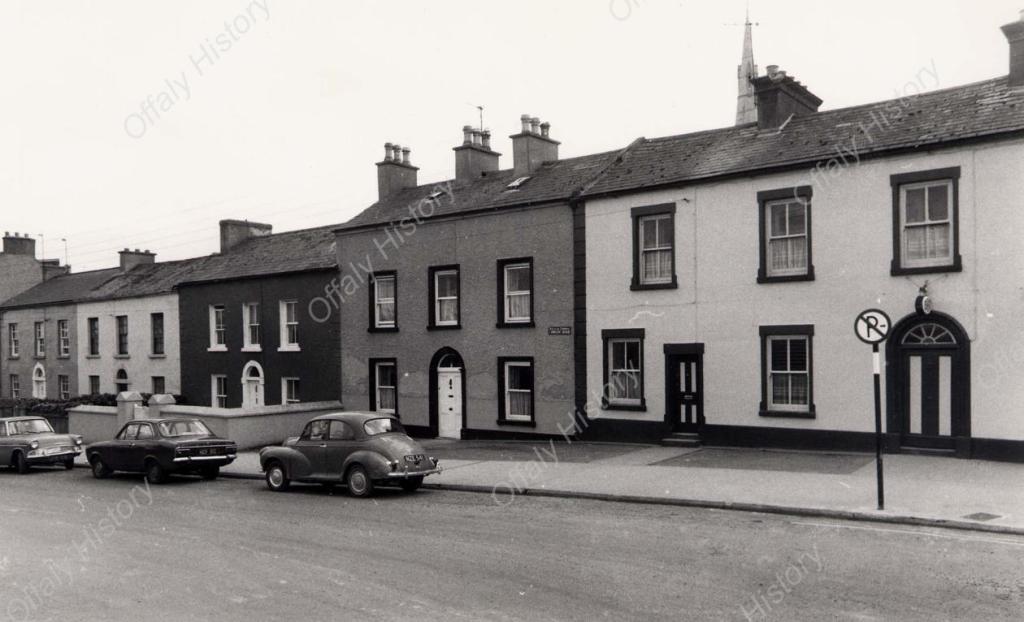
Late Georgian Terrace at Bury Quay/Convent Road, Tullamore. Mid1970s
So, while future prospects are certainly influenced by the legacy of the past, for urban centres like Tullamore factors such as economic performance and civic leadership will figure as the more immediate drivers.
While Daingean celebrates the completion of its new Sports Centre it is good to look back to how things were 100 years ago. The country is currently celebrating and remembering what have become popularly known as the Revolutionary years or era spanning the timescale 1913–23. These years witnessed the formation of the Irish Volunteers in 1913, the Howth Gun Running in 1914, as well as the Easter Rising, the growth of Sinn Féin, and the formation of the first Dáil in 1919. The events of this time are finally capped off with the War of Independence (1919–21), the signing of the Anglo-Irish Treaty in December 1921, and the calamitous Civil War (1922–31) which followed. During this period also, the Great War (1914–18) and the Spanish Flu epidemic had varying degrees of impact on the life of the country. There is no doubt that this train of events combined had a great impact on almost all GAA clubs then in existence. Some clubs fared better than others, for example, during the years in question Killeigh captured two Senior football titles while Rhode who had won only one title to date, captured three in six years. For Daingean however, these years brought no titles in any grade.
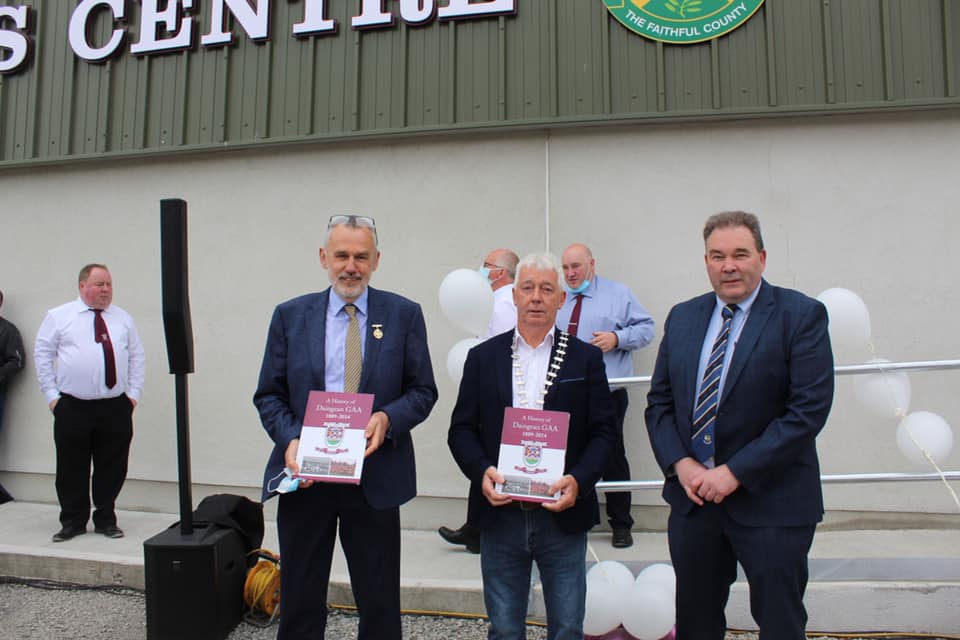
At the recent opening of the Daingean GAA Sports Centre. All pictures courtesy of Daingean GAA Club.(more…)
For many the habit of reading started with the local library and has never left us. Recollections of the several libraries we have had in Tullamore remind us that so far as reading and comfort goes we have never had it so good. This is the time to recall the first public library in Tullamore started in May 1921, just 100 years ago. For that we have to thank an unsung hero E. J. Delahunty, a native of Clonmel, who was in charge of technical education in the county from 1904 to 1930 and died in 1931. He organized the first ‘students’ union’ in Tullamore and a superb lecture series on the great issues of the day in the 1916–21 period, and with mostly well-known speakers with a national reputation. The Midland Tribune gave the opening of the library an editorial and regretted that the lecture series had to be abandoned that year. Delahunty was shrewd and had the Tribune editor, Seamus Pike, on side. Another unsung hero of the revolutionary decade was Revd John Humphreys, a Tullamore-based Presbyterian minister, and great advocate for technical education. These are three people who need to be included in the Offaly Dictionary of Biography.
Long, long ago, a rocky outcrop on the bed of the river allowed local farmers to herd their livestock across to graze on the small hill on its southern bank. Over time, longer distance routes began to converge on the ford and a small village grew up to cater for travellers, an inn to change horses perhaps, a blacksmith possibly, but this is all conjectural as no traces or records remain.
In 1609 the soldier/settler John Moore bought a half share in the nearby but now long vanished castle and watermill of the Molloys and began to hold an annual fair. By the late 17th. century, ‘Tullymore’ as the old maps called it, was most likely a rural scene of some thatched cottages, an unpaved track and maybe one or two substantial houses (illus.).
A conjectural view of Tullamore in the 1620s when it was said to have a castle watermill and ten cabins. The castle was in ruins by the 1630s but the town then had two watermills on the river.
In time the ford was replaced by a bridge. This gave the small village a certain strategic importance, so in 1716, a military outpost was established to guard it. The security this brought and the provisioning needs of its garrison, attracted new settlers whose residences and businesses were facilitated by the ability of the river to receive household and commercial waste and provide a source of raw material and power. Soon, several flour mills, tanneries, breweries, distilleries and a linen industry had been established. Downstream of the bridge, the river channel was diverted into a large semi-circle, creating a mill stream to power even more industries.
James Lyle Stirling was born 16 May 1858 to Thomas Lyle and Anne Stirling of Tullamore. He was a business man who ran several businesses in Tullamore, between the years of 1880 and 1898, and is best remembered for his mineral water manufacturing company.
His father, Thomas Lyle Stirling, was a brewer and merchant in King’s County, who ran most of his business in Church St., Tullamore. He was also an active Tullamore town Commissioner and sometime acted as an agent for Mary Anne Locke of Locke’s Distillery Kilbeggan. Thomas Lyle Stirling married Anne Jane, daughter of William and Catherine Commins of Cappincur, Tullamore, they had six children, all born in Tullamore except the youngest, Thomas who was born in Dublin. The children were Margaret (born 1857), James Lyle (1858), William (1860), Catherine (1862), Isabella Elizabeth (1863) and Thomas (1866).
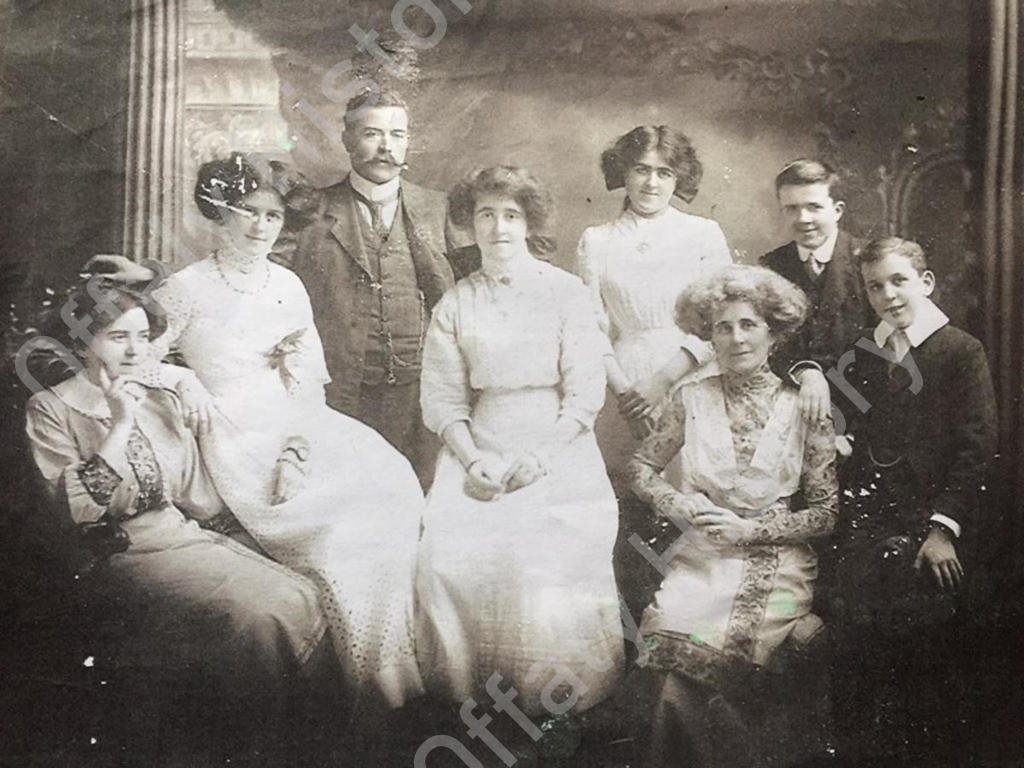
James Lyle Sterlingand family
Anne Jane, James’s mother died shortly after Thomas was born in 1866 and his father Thomas remarried later the same year to Helena Reamsbottom, widow of Thomas Reamsbottom Esq. of Bellair Lodge, after she had lost a child and her husband early that year. Thomas Lyle and Helena Stirling, now married, lived in Bellair Lodge, Ferbane, and they went on to have two more children: Elizabeth Helena (born c.1869) and Thomas Francis Lyle (1872). In 1876 Thomas Lyle died, leaving a young James as his heir. As James was too young to take charge of his businesses, his estate was run by his executors, John Tarleton and Constantine Quirke. It would be another four years in 1880 before Stirling was old enough to take over his father’s business.
James Lyle Stirling married in Dublin to Gertrude Bridget Murphy (born c.1864), a daughter of Patrick Murphy a trader from Athy, Co. Kildare. They had six children at Church Road, Tullamore: Genevieve, Mary Margaret (born 1888), Eithel Mary (1889), Blanche Loretto Lyle (1891), Ida Mary Gertrude (1892), Joseph Allen (1893), and Raymond Gordon (1896). The family later moved out to Cloonagh House, just outside Tullamore.
This week we return after almost four years to view the interior of one of the finest of the town houses in Tullamore. High Street and O’Connor Square were the premier streets in Tullamore from the 1750s and contain important buildings that give Tullamore an edge with its architectural heritage. Young on his Tour remarked on the fine houses here as early as 1770. Good work is being done at the former Kilroy house in High Street, now the home of Tanya Ross and George Ross This house of two storeys over a basement was built in 1786. We in Offaly History hope that more in our county will take on the task of restoring all that was distinctive and showed to advantage our native craftsmen. O’Connor Square is improving as is High Street, Cormac Street, Store Street, Deane Place and Convent Road. Full marks to Tanya and George Ross and thanks to Louse Dockery and House and Home for allowing us to reproduce this article from the magazine’s Jan/Feb 2021 issue, editor Ciara Elliot and Photographer: Philip Lauterbach . Our congratulations to all the local suppliers mentioned in this article. Take a bow one and all, but especially to Tanya Ross and George Ross. When was the first article on a house in Offaly? It was possibly Shepherd’s Wood (then the home of Desmond Williams and Brenda Williams) in 1958. Country Life featured important articles on Charleville Forest in 1962 and Birr Castle in 1965. We hope to add to this list in future blogs.
There is so little of the undercurrent and gossip of a town in a local newspaper and yet we rely on them so much to tell us ‘what really happened’. Will we ever know from the reportage? We are grateful to have the lately published witness statements in the Depositions of 1642–53, or those in the pension records of the 1916–23 conflict. Yet we are advised to be cautious in using such records. What we do know of what ‘right-thinking people’ were saying about sexual morality in Birr, during the years of the First World War, we have from a sermon preached in Birr Catholic church in November 1917. It was one of the Birr curates who was the most outspoken while the then recently appointed 65-year old parish priest of Birr, Canon Ryan, had little to say. Or if he had it was not recorded. ‘Delicate’ subjects then as now, were seldom spoken of from the pulpit or the newsroom except in generalisations. In the case of the Laois-Offaly depositions it has taken over 300 years for the sworn affidavits to reach the public arena. For the witness statements provided by War of Independence veterans near enough sixty years. Is it any wonder that court cases with their mostly contemporary renditions are so popular? It is the same with sermons that touch on local sexual life – the subject being almost taboo except in the abstract. Seldom spoken of in the church and hardly ever recorded in the local news media before 1970. The press reports of court case evidence can be more satisfying as contemporary first-hand accounts, but for the public and no less for the judges, it can often be hard to know what the real story is. The reports of public morality debates or pulpit declamations in the years before and after 1922 are hugely important in helping to understand the concern (and who was raising it) over unmarried mothers and their children that would feed away, as if an unspoken of cancer in society, over the years from 1922 to the early 1970s.
It’s six months now since William Grant announced the closing of the old Bonded Warehouse Visitor Centre at Bury Quay, Tullamore. The company that makes the world-famous and second largest selling Irish whiskey, Tullamore DEW is going to concentrate its energies on a new visitor centre at the 2014-17 purpose-built Tullamore DEW distillery at Clonminch and understandably so.
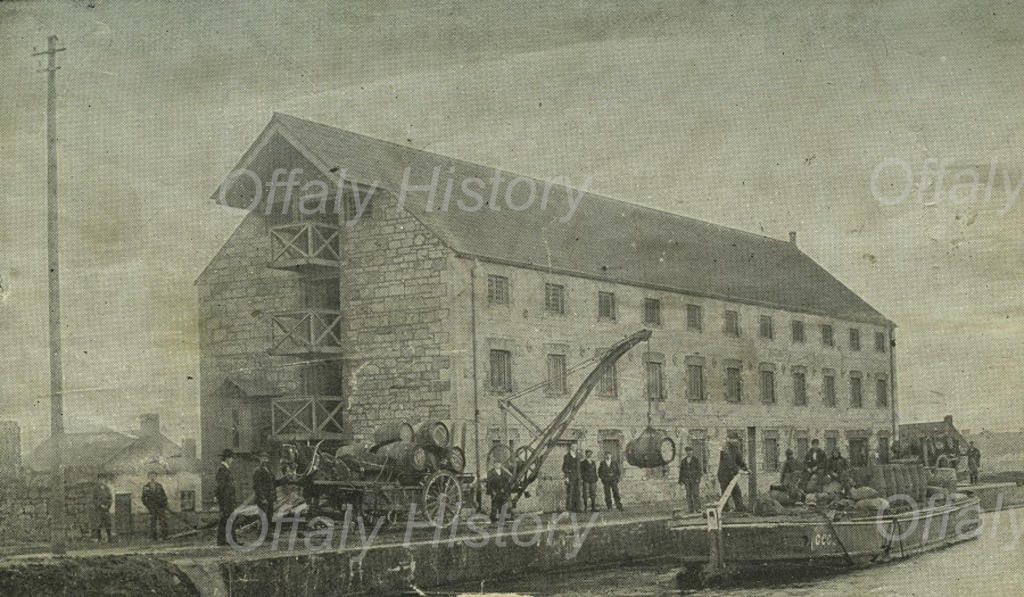
D E Williams’ 1897 warehouse
The idea of a visitor centre at Bury Quay was conceived in the early1990s as a way of attracting visitors to Tullamore town. Tullamore had been designated an industrial heritage town in 1990 and EC tourism funds were available. The idea that a new distillery would open in Tullamore was not on the radar. Thanks to the work of Irish Mist (Bill Jaffray), Cantrell & Cochrane (owners of the DEW brand from 1993 to 2010), Tullamore Town Council and Offaly History the idea came to fruition in the year 2000 and the visitor centre was opened. C & C had put in about £500,000 plus the building (the late Frank McGovern and Tony O’Brien being the captains here), Bord Failte £300,000 and the council the balance with the total costs at £1.2m. This included a liquor licence for £90,000. Two County Managers and a Town Clerk played great developmental roles to ensure it was successfully completed as did the staff and franchisees subsequently.
The first hotel constructed in Tullamore in 1786 cost £200. The second in 1801 about £4,5,00. Even by multiplying by 200 for the cost of living today, this expenditure was light in the context of the three new hotels in Tullamore in 1997- 2008 which may possibly represent a total expenditure of €25 million for 270 beds. And yet the canal hotel of 1801 was a major investment and may have never made a return to the Grand Canal Company. The need for it disappeared within five years of its construction. By contrast the deprecated Bury Arms (Hayes/Phoenix Arms) in the centre of town was in business for over 200 years.
The Bury Arms (later Hayes Hotel) erected in 1786, demolished 2000. From the Hanly Collection Offaly History. This view in the late 1950s.
The first hotel (that we know of) to be constructed in Tullamore was the Bury Arms Hotel (later the Phoenix Arms, demolished 2000, now Boots Pharmacy), erected in 1786 as an inn for Tullamore at a cost to the landlord, Charles William Bury, of £200. We know that in 1798 it had 13 beds for letting. The hotel was first leased to John Tydd at a yearly rent of £20. John Tydd and his son Benjamin were both dead by 1798 at which point the innkeeper was one Mr Doherty. Captain William Evans, who had been a director of the Grand Canal Company until c.1796, but remained with the Company providing engineering advice until 1805, was critical of the Bury Hotel on his visit there in 1798. His departure from the company in 1805, possibly following soon after the completion of the works to Shannon Harbour in 1804. Notwithstanding Evans’ criticism of the Bury Arms hotel Sir Richard Colt Hore who stayed at the hotel in 1806 wrote: ‘At Tullamore I found a good inn and accommodation at Doherty’s (the Bury, later Charleville Arms) near the Bridge’ (Tour, p. 32). The hotel had changed its name in line with that of the ennobling of the town’s landlord who became Lord Tullamore in 1797, Viscount Charleville in 1800 and earl of Charleville in 1806. It should be mentioned that there was at least one earlier inn in Tullamore, that of Hugh Clough in the 1760s and other smaller hotels post 1800.