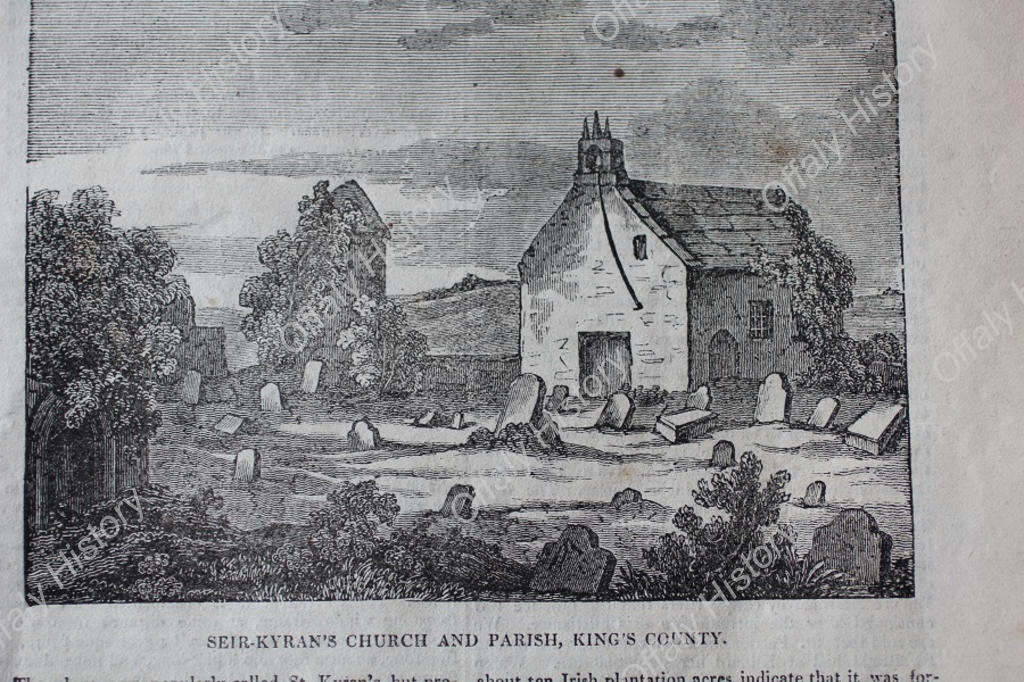
John O’Donovan was in Birr in early 1838 and having obtained a copy of The Picture (1826) by Thomas Lalor Cooke thought better of him as a scholar, but one subject to some foolish ideas after the school of Charles Vallancey. O’Donovan identified Cooke as ‘B’ in the Penny Journal articles he wrote and one of these was on the monastery of Seir Kieran at Clareen. It is interesting to compare the article in the 1834 issue of the DublinPenny Journal with that in the 1875 publication. Also of interest is to take into account the manuscript annotations to the Picture of 1826, now in Birr Castle Archives. And if that was not enough Cooke has letters and other MS sources in the RIA, NLI and the National Archives. In his letters of 1850 to the Cork antiquarian, John Windle (now in RIA) he tells Windle that he was the author under the pseudonym ‘B’ of articles in the Penny Journal and under his own initials of articles in the Dublin Evening Post. Despite the published work of George Petrie on the Round Towers (1833 and 1845) Cooke continued to put forward the Vallancey-style notion that the origin of the round towers lay in early times and were temples of fire.
The origin of Lynally as a religious centre can be traced to Colmán who founded a monastery here in the seventh century. His death is recorded in 611. Colmán himself was from Connor in modern day county Antrim. His family were of the Dál Sailni clan who ruled the area around Connor. According to an early Latin life of Colmán, it was St. Columcille who requested that a site be granted to Colmán for a monastery and as a result Aed Sláine (d.604) granted him Lynally.
Three ‘Lives’ of St. Colmán have come down to us, two in Latin and one in Irish. It should be pointed out that these so called ‘Lives’ are not biographies. Written long after the saint’s death the so called lives are in fact glorified fictional accounts of the saint’s life designed to justify property claims or political allegiances of his foundation by linking them to purported events in the founder’s life. Thus the close relationship between Lynally and St. Columcille’s foundation at Durrow is depicted in the lives by tales of friendly encounters between Colmán and Columcille. We have already seen how the early life of Colmán credits the founding donation of the site of Lynally to the request of Columcille while a later Irish Life even claims that Columcille’s sister was Colman’s aunt.
Please see an invitation from the community in Lemanaghan about two events this Saturday 12 August as part of Heritage Week. We are publishing early this week as part of our Heritage Week Specials from 12 to 20 August. So keep in touch with us on Social Media and do call to Offaly History Centre and Offaly Archives as part of next week’s 2023 programme.
The community of Lemanagahan extend a special invitation to you for a truly remarkable event – the book launch of “The Annals of Clonmacnoise” where the links with Lemanaghan will be discussed by the author Nollaig Ó Muraíle. Event Details: Date: Saturday, August 12th, 2023 Time: 2:30 PM Venue: The Granary, Boher, Ballycumber, Offaly, N35NX30 [beside St. Manchans Church]
“The Annals of Clonmacnoise” is a meticulously compiled chronicle that offers a panoramic view of Ireland’s past. Through its pages, you’ll be transported to a world of ancient tales, historical intrigue, and cultural treasures that have shaped the very essence of our heritage.
When Christians arrived in Ireland and started to write about the country they found an island of Gaelic kingdoms, perhaps up to 150, that was dynastic and the political organisation was based on the tuath. The tuath was the bedrock of the Gaelic political system and is described as a small kingdom. Most of what we know now has been gleaned from the Irish Law Tracts, commonly known as the Brehon Laws. Other written sources include the Hero and Saga Tales.
In 1120 Turlough O’Connor, high-king of Ireland, built a ‘principal’ bridge on the River Shannon at a place called Áth Cróich. Recent study has proven that this is an earlier name for Banagher.
SIR MATHEW DE RENZY (1577-1635)
Sir Mathew De Renzy writing in December 1620 about West Offaly with particular reference to roads and passageways made two clear statements regarding a major crossing point on the River Shannon at Banagher and how there was practical and convenient access to the West and Galway from that location.
1. ‘At the Benghar there ought a towne or a good fort to be made, to keep that passage of the Shannon, for that in no other place can come any horsemen near the river to take passage out of Connaught but only here, by reason of the impediments of the bogs and woods; from this passage it is but 30 or 34 miles to Galway all hard and fair ground.
2. At Banagher ‘…to be no more than about 30 miles (from the Shannon at Ahcro or Benghar to) to Galway over the Shannon, all hard and faire ground
Both these references leave no doubt that there was a major crossing point at Banagher in the 1620s. More importantly the second quote equates Banagher with a place called Ahcro (Áth Cróich). This information was crucial to the recent acceptance by the Locus placenames project (Locus) that the two places are synonymous. Consequently, in future editions of their definitive dictionary of Irish placenames, Banagher and Áth Cróich will be recorded as one and the same place. The implication of this decision is that it requires a major revision of Banagher’s early history.
Contributed by Offaly History to mark the occasion
The new book, St Manchan’s Shrine, by Griffin Murray and Kevin O’Dwyer was launched to great acclaim by the CEO of the Heritage Council Virginia Teehan on Friday 21 October 2022 at Offaly History Centre, Tullamore before a large and distinguished audience. Proceedings began at 5 30 p.m. with Amanda Pedlow ably acting as chair and introducing the four speakers. First was the author of the text Griffin Murray, followed by silversmith and photographer Kevin O’Dwyer. The County Offaly CE Anna Marie Delaney skillfully chartered the progress being made in regard to the county’s heritage while CEO Virginia Teehan paid tribute to the county for its wide-ranging involvement in heritage projects and availing of the funding available. The new Offaly Archives was a leading case but one among many successful projects undertaken. Another is that of the funding received to create the post of a biodiversity officer. Offaly has demonstrated its ability to secure funding for projects and that was a reflection of the work being done in the county. Ms Teehan congratulated the authors, Griffin Murray and Kevin O’Dwyer, on a job well done. Yet another exemplar.
This week we welcome Ronan Healy, a new contributor to our series of articleson Offaly History. We are pleased to have his contribution and invite our readers to put the hand to the churn and write for the series.
In the townland of Strawberry Hill lies a cross-slab with a history that has generated a number of different theories but no definitive answer. This cross-slab is indistinct in the landscape. You would easily drive or walk past it without even noticing it. However this simple piece of stone has a history, folklore and decoration that suggests it is much more than a simple stone on the side of the road. This blog post will look at the history of the cross-slab, previous research on the slab and some suggestions for the future preservation of the cross-slab.
John Dolan writes about Seir Kieran in part 2 on Seir Kieran this week. John was born in Tullamore, now retired, and has a degree in Archaeology and Celtic Civilisation. He speaks regularly to historical societies in Dublin. Seir Kieran is the ‘island parish’ in Offaly belonging to the diocese of Ossory. Our blog articles are brought to you twice weekly during these weeks of the plague to hopefully provide some inner peace through historical inquiry. You now have 183 to chose from and you can join the 150,000 views since 2016. If you would like to write for us email us at info@offalyhistory.com.
Seir Kieran from a drawing in the Dublin Penny Journal of 1834
Lives of the Saints
The Lives were generally written hundreds of years after the death of the saints and usually by people who had never met them. The format adopted by the Irish hagiographers followed that of the Life of St. Martin of Tours. These Lives were considerably removed from the texts written in the early churches, what we have today are later copies. Folklore, stories and religious/political inferences had been handed down orally over generations before the first Life was written.
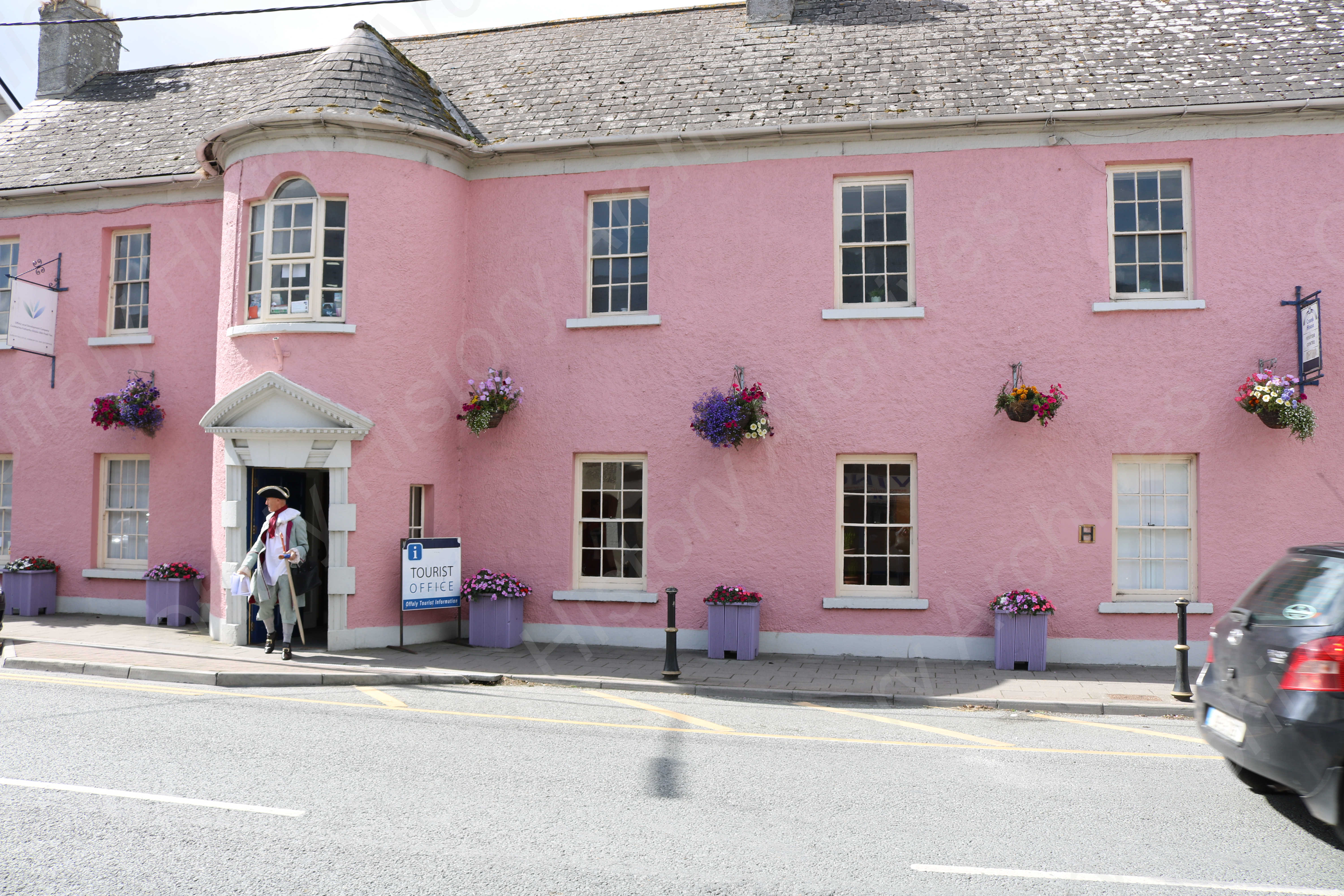
So it’s Heritage Week and Saturday 25 August 2018 was given over to a tour of the West Offaly castles in the company of Kieran Keenaghan and James Scully. It was a full day starting at the lovely Crank House, Banagher at 10. a.m. This house is a tourist facility and a community endeavour from a community co-operative society. Banagher needs all the support it can get in the form of incentives and tax relief schemes to bring the older houses, including the Shannon Hotel, back into use. (more…)
Some background reading for our outing on 8 July, Sunday, to Kilcormac and Ballyboy
Meet in grounds of Catholic church at 3 pm (ample parking) The historic sites of Kilcormac and Ballyboy to include the Catholic church, the parochial grounds, the Mercy Convent, Bord na Mona housing and on to Ballyboy, the village, church, cemetery and old hall concluding with refreshments in Dan and Molly’s celebrated historic pub at 5 p.m. Our thanks to Agnes Gorman, John Butterfield and the other history enthusiasts in the historic barony of Ballyboy. A few members of the committee will be at Offaly History Centre from 2 15 p.m. until 2.30 p.m. for members needing a lift. (more…)


 offalyhistoryblog