“Some of old stonies will hold their heads high, and carry with them to the grave the feeling that they have left their mark on many a church, and on many a building, and that in years to come, there will be people to admire the work they have left behind them, as we of this generation respect and understand the work of the men of long ago. All men hope for praise of some sort, and it is a nice thing to see a man smile when he knows you are in earnest in liking his work. We become children again, and are mightily pleased with ourselves and want to show that we can do even better.”
From the book Stone Mad by Seamus Murphy, stone carver, 1966.
In this article, I write about some of the fine buildings and monuments in other parts of Ireland built using limestone from the Ballyduff quarries. There is a section on aspects of the lives of stoneworkers in Tullamore in the 19th century, and finally I have a look at a couple of Tullamore families that were prominent in stoneworking over long time periods.
On the 1809 map of King’s County by William Larkin, one can easily fail to spot the tiny T-shaped symbol about 1 mile northwest of the town of Tullamore. There is no description to inform the reader what the object represents. Its shape and its location, however, leave no doubt as to what it symbolizes. It is the first post-Reformation Catholic church in the parish of Tullamore. Erected in 1775 in the townland of Ballyduff, the chapel’s out of the way location some distance from the town of Tullamore seems peculiar today. Another look at the 1809 map provides at least a partial clue to its location. Not more than about a hundred metres from the chapel is a quarry, probably one of the earliest limestone quarries to be opened in the area and almost certainly the source of the stone of which the chapel was built. The chapel was presumably built by the workers and tradesmen of the local quarries. Today the ruins of the Ballyduff chapel are located in the middle of the Axis Business Park accessed from the Clara Rd.
Our architectural heritage may be defined as those structures which by their very great beauty, important historical connotations or unique scientific value contribute to creating a memorable experience.
To be frank, the town centre of Tullamore contains few buildings or spaces which meet these criteria but it does have its own distinct local qualities and is a decent if unpretentious town whose stock of late 18th and early 19th c. buildings are worthy of consideration.
Yet, over the past eighty years many fine buildings which contributed to the architectural heritage of Tullamore have been lost. The removal of the Tarleton House in 1936 radically changed the spatial character of O’Connor Square. The Grand Canal Hotel which closed the vista on the Daingean Road and the wonderful Tudor style castellated Mercy Convent were removed in the 1960s and early 1970s. The architectural quality of both the former Charleville Estate office by Richard Castle and the facade of D.E. William’s shop on Patrick Street by Michael Scott was compromised and the wonderful Modernist Ritz Cinema partially demolished. The landscaped setting of the County Hospital was built over. Many original shop fronts were replaced.
As Andrew Tierney has observed in his ‘Buildings of Leinster’ a lot of the original features of Protected Structures around the town have now been removed or insensitively altered.
The building behind the Mr Price facade in High Street, dating to about 1750. This picture in 1959(more…)
There’s no shortage of very ordinary towns in Ireland but Tullamore certainly isn’t one of them. How could it be? After all it has its proud legacy as one of the original trading and transport hubs on the Grand canal from its arrival in the town in 1798. That early advantage over competing centres like Birr and Daingean was reinforced with the coming of the railway in 1854, allowing Tullamore to build on its status as an important transport hub and retail, administrative and merchant centre. On this basis, the town maintained at least the appearance of prosperity up to the present era. This early pre-eminence is reflected in the town’s exceptionally fine architectural legacy including an assemblage of late Georgian town houses, the civic space at O’Connor Square and individual gems such as the Tullamore Dew Whiskey Heritage Centre along with J.B. Keane’s Neo-Classical Courthouse.
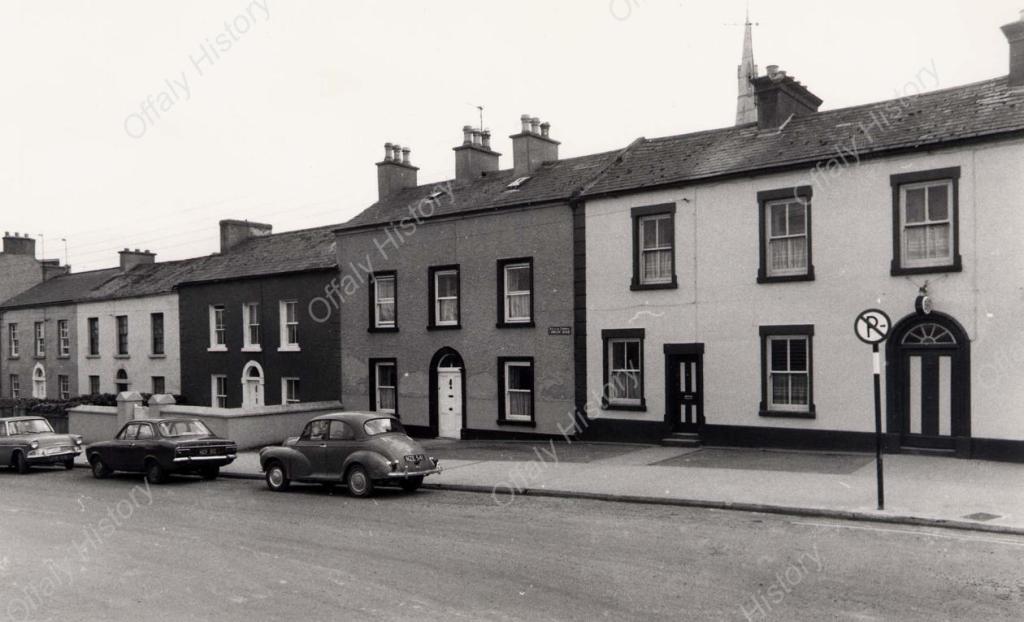
Late Georgian Terrace at Bury Quay/Convent Road, Tullamore. Mid1970s
So, while future prospects are certainly influenced by the legacy of the past, for urban centres like Tullamore factors such as economic performance and civic leadership will figure as the more immediate drivers.
We posted this blog on 21 April 2021 and reproduce it today to mark the passing of John Flanagan, the well-known builder and advocate for Tullamore and County Offaly. Up to that time we seldom wrote a blog on a living person but we made an exception for John Flanagan, the modest man from the Meelaghans, Puttaghan and New Road, Tullamore who has invested his whole life (so far) in making Tullamore a better place for people to live, work, bank and even pray in. We in Offaly History occupy offices at Bury Quay rebuilt for us in 1991-2 by the John Flanagan firm and now we also occupy Offaly Archives, another Flanagan development located at Axis Business Park, Tullamore. Perhaps his greatest achievement was the building of Tullamore Court Hotel. Great in that it was against the odds and had been talked about in Tullamore for thirty years but nothing was done.
As long ago as 1977 the Midland Tribune in a review of Tanyard Industrial Estate commented that John Flanagan was a man whose vision and initiative has given the Tanyard its new lease of industrial life. John Flanagan had by then been 24 years a-building so successfully that John Flanagan and Sons Ltd. was one of the best known contracting firms in the Midlands.
He purchased the Tanyard from Messrs. P. and H. Egan in the late 1960s, established his own offices there (modest of course with no frills) and almost immediately set about using some of the six-acre site to provide facilities for other local people to set up business and projects of various kinds. Some of the buildings on the property were suitable for conversion to new usage but John Flanagan also embarked on his own programme of factory construction. He subsequently purchased other premises in the same area from Messrs Tarleton. With about eleven firms thriving in the Tanyard already, about 3³/8 acres remain available for further development and Mr. Flanagan will be ready to respond to demand as it arises. The whole area was redeveloped in the 1990s and is now emerging as a retail sector in Tullamore, well adapted to the changing economy.
John Flanagan extreme right and beside him is loyal foreman, the late Jim Larkin – in late 1984 after the fire of 31 10 1983 at Tullamore Church.
While his industrial estate has been steadily expanding, so too had his own business as a contractor. In the 1970s his major undertaking included construction of R.T.E transmitting Station at Ballycommon; Tullamore Vocational School; the Post Office in Portlaoise; Farm Centres in Edenderry and Portlaoise; Housing Carlow (a scheme of 57 houses); factories for Messrs Paul and Vincent; in Tullamore and Irish Cables, Athlone.
The old Tanyard Lane c 1996 with the first block of apartments on the right completed and a new carpark under construction
Jobs in hands in the late 1970s included a scheme of 40 houses in Clara for Offaly County Council; the Bank of Ireland premises at Bridge St. O’Connor Sq., a Welfare Home in Edenderry; reconstruction work at St. Loman’s Hospital, Mullingar.
‘Mr Flanagan – who incidentally is Chairman of Banagher Concrete was actively in recent formation of a Chamber of Commerce in Tullamore and is the inaugural President of a body which is expected to make a very significant impact on the industrial and commercial life of the town and district.’
James Lyle Stirling was born 16 May 1858 to Thomas Lyle and Anne Stirling of Tullamore. He was a business man who ran several businesses in Tullamore, between the years of 1880 and 1898, and is best remembered for his mineral water manufacturing company.
His father, Thomas Lyle Stirling, was a brewer and merchant in King’s County, who ran most of his business in Church St., Tullamore. He was also an active Tullamore town Commissioner and sometime acted as an agent for Mary Anne Locke of Locke’s Distillery Kilbeggan. Thomas Lyle Stirling married Anne Jane, daughter of William and Catherine Commins of Cappincur, Tullamore, they had six children, all born in Tullamore except the youngest, Thomas who was born in Dublin. The children were Margaret (born 1857), James Lyle (1858), William (1860), Catherine (1862), Isabella Elizabeth (1863) and Thomas (1866).
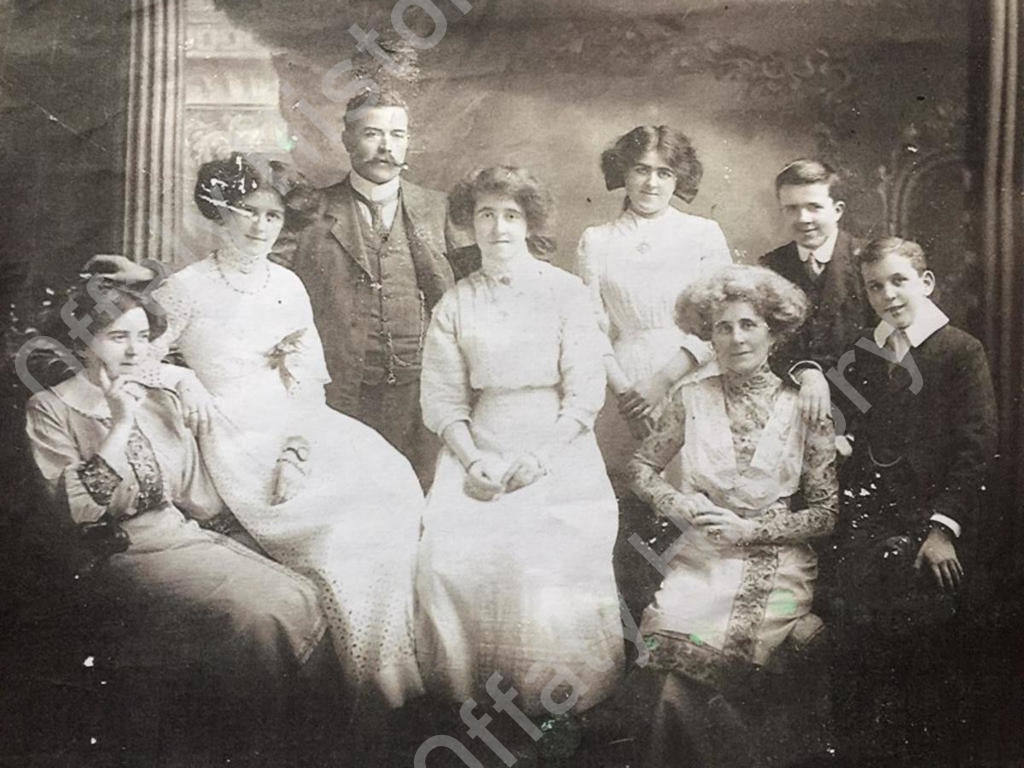
James Lyle Sterlingand family
Anne Jane, James’s mother died shortly after Thomas was born in 1866 and his father Thomas remarried later the same year to Helena Reamsbottom, widow of Thomas Reamsbottom Esq. of Bellair Lodge, after she had lost a child and her husband early that year. Thomas Lyle and Helena Stirling, now married, lived in Bellair Lodge, Ferbane, and they went on to have two more children: Elizabeth Helena (born c.1869) and Thomas Francis Lyle (1872). In 1876 Thomas Lyle died, leaving a young James as his heir. As James was too young to take charge of his businesses, his estate was run by his executors, John Tarleton and Constantine Quirke. It would be another four years in 1880 before Stirling was old enough to take over his father’s business.
James Lyle Stirling married in Dublin to Gertrude Bridget Murphy (born c.1864), a daughter of Patrick Murphy a trader from Athy, Co. Kildare. They had six children at Church Road, Tullamore: Genevieve, Mary Margaret (born 1888), Eithel Mary (1889), Blanche Loretto Lyle (1891), Ida Mary Gertrude (1892), Joseph Allen (1893), and Raymond Gordon (1896). The family later moved out to Cloonagh House, just outside Tullamore.
Clara’s engagement with the textile industry may go back 100 years before the Goodbody jute factory. As one of the smaller towns and villages in the county places such as Clara, Ferbane, Kilcormac and Shinrone are less clearly associated with the early plantations by contrast with Daingean, Tullamore and Birr. Clara was prosperous in the 1770s and from the weakening of textiles in the 1820s must have suffered a good deal until the hand loom business progressed after the mid-1850s and the jute factory from the mid-1860s.The Goodbody firm continued as a prosperous concern for another hundred years. Clara was the only town in Offaly to see expansion of its population in the second half of the nineteenth century. And so in the economic cycle it may be that the post 1820s to the 1860s were lean years as has been the period since the 1970s. These are generalisations and will need to be revised in the context of detailed research on Clara businesses, employment, housing and infrastructure.
I started collecting bottles a little over a year ago, interested in their origins and local history. I’ve picked a small collection of the type of breweriana bottles that were used in the day to day lives of the people of Tullamore and surrounding towns in the late 19th and early 20th century. I’ve provided a brief description of the types of bottles I’ve mentioned. Most of the dates provided are approximate and offered with the best knowledge I have at this moment. As I get more accurate information, the dates will be reviewed. I started off with some basic background information on bottles.
Carbonised mineral bottle It is widely known amongst bottle collectors that Joseph Priestly discovered how to make carbonised mineral water in 1772. It was prepared by dissolving carbon dioxide in water. By 1860, it had become easier to manufacture and was being flavoured with fruit syrups, lemons and limes. It was retailed by grocers, wine and spirit merchants, as well as chemists. At first the new drink was stored in earthenware bottles, but the gas escaped through the skin and so the drink became flat. Manufacturers switched to glass bottles. However, corks were still used to seal the carbonised mineral water drinks, and if they were allowed to dry out, they tended to loosen which allowed the gas to escape. If the bottles were stored on their side, this was less likely to happen.
Offaly History intended to have a walk on 26 December 2020 through the historic Lloyd Town Park, Tullamore, but had to cancel due to the imposition of the third wave of restrictions since March 2020 designed to reduce the impact of the Covid-19 virus. An historic year and one we will be glad to see the back of. After fifty-years of mostly progress since the 1960s we have become accustomed to the shock of change for the worst since the banking crisis and the bail-out. Now it’s the Covid-19 virus and in the background climate change, and in Offaly the end of the bogs – so much a part of growth in Offaly from the 1950s. Today we are visiting the Lloyd town park, Kilcruttin, Tullamore and reflecting on its historical features and change in the landscape of the area and the town of Tullamore since the 1700s.
The park area in 1838 on the six-inch scale with Water Lane, gazebo and the new courthouse and jail. A second Methodist church was located in Crow/Tara Street from the 1820s to 1877. The landscaped gardens of Acres Hall can be seen on Charleville Street, now Cormac Street.(more…)
The old floor malting process for hundreds of years ceased in Tullamore in 1969. Cover pic is of Water Lane now entrance to Main Street, Tullamore. Courtesy of Fergal MacCabe.
The Williams company of Tullamore (1884–1996) was in the malting business from 1892. Other Tullamore firms included Egan, Tarleton and B. Daly, the Tullamore distillery. In this article Michael Power tells his story. This piece was first published in Jip-cat, pig’s head, petticoats and combinations: our lives, our times in Tullamore and surrounding districts; editor Feargal Kenny. Tullamore: Tullamore Active Retirement Association, 2002 (available from Offaly History Centre).
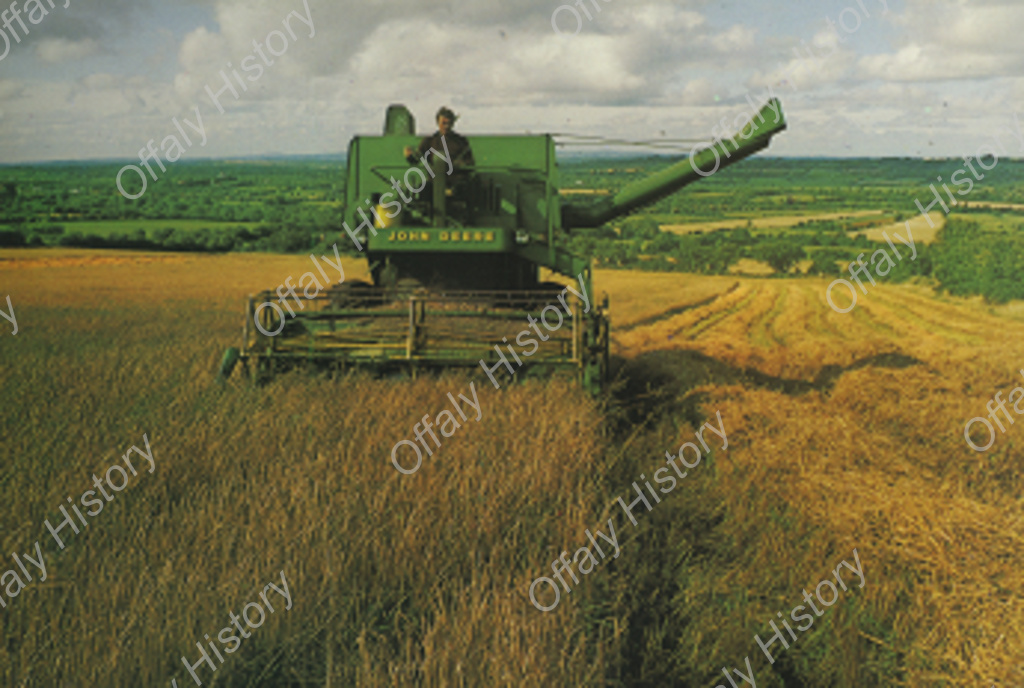
Modernisation of agriculture in the 1970s
As a seasonal worker in the Maltings, you started in September when the harvest came in and wound up in May when the malting was over. I became a permanent worker [at Williams/B Daly/Tullamore Distillery [in 1932 and remained there for fifty years. The work was hard, labouring work, carrying sacks, working in the malthouse, screening malt and barley and carrying sacks of grain.






 offalyhistoryblog