The oral story of Offaly people in the Offaly History Centre sound archives collection. 21 October 2024, 8 p.m. Offaly History Centre, Bury Quay Tullamore, R35 Y5V.
The presentation by Aidan Barry will consist of the following: – An overview of the oral history resources available at Offaly History and how to access them. – Commemorating the work of Maurice O Keefe (RIP) at Irish Life and Lore and Albert Fitzgerald (RIP) at — – Midlands103 and also the late James Kenny of Clara Bridge, Tullamore. – Listening to samples from the Oral History collection at Offaly History – Recording Oral History and editing recordings – Transcribing Oral recordings using the latest technology
Sean Robbins was born at Erry, Clara in 1892. After his father’s death he was raised by his mother Mary, a domestic servant. Robbins worked as a labourer in Clara’s main employer the Goodbody Jute factory.
Involved in amateur dramatics, in 1911 he played the role of a United Irish General in a patriotic play ‘Wolfe Tone’ staged by the local players group. A noted athlete, he competed in 220- and 440-yard races across Leinster. Having won a junior football medal with Clara in 1911, he went on to represent Offaly at senior level. Away from the field of play, he was club committee member, assisting men like Jim Rafter in the promotion of Gaelic games in the town. A well-known referee, Rafter dedication to the role, saw him described by historian James Clarke the as ‘The Knight of the Whistle’.
Friday 9am to 5pm – Discover Birr Castle Demesne by taking on the engineering trail through the gardens and science centre.
Friday 7pm – Welcome reception with tea and sandwiches followed by opening lecture(1) – 8pm. Note: All lectures in Birr Theatre and Arts Centre
8.00pm Lady Alicia Clements – Introduction to the Engineering Weekend Festival
8.15pm John Burgess – The Parsons Families of the 19th Century
Saturday – 10.00am Lecture (2) – Power on Land
Brian Leddin TD – Chair of the Joint Oireachtas Committee on Climate Action – Welcome and Opening Remarks
Geoff Horseman (Formerly Head of Turbine-Generator Engineering at Parsons and Chief Turbine Engineer at Siemens Newcastle-Upon-Tyne) – Evolution of the Parsons Land Steam Turbine
Saturday – 11.30am guided discovery tour in Birr Castle Gardens to visit (Please note to wear non-slip footwear and outdoor gear for walking on garden trails):
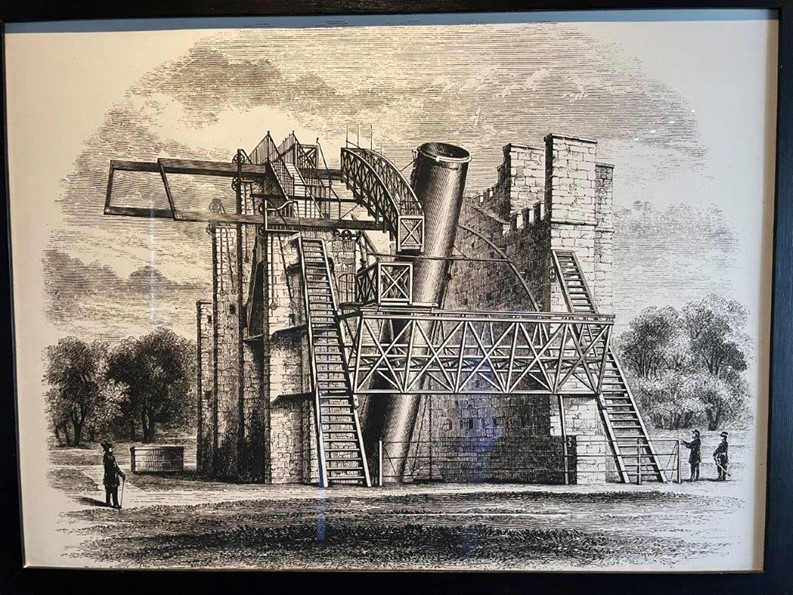
The Leviathan and LOFAR Telescopes – Peter Gallagher or Joe McCauley
The refurbished suspension bridge,
Rejuvenated hydro-electric turbine, and
The secret of the lake’s ingenious water level management system.
Saturday – 1.15pm Lunch at the Kellys Bar
Saturday – 2.30pm Lecture (3) – Power at Sea
2.30pm Ian Whitehead – Turbinia – a daring venture in marine propulsion
3.00pm Geoff Horseman – Engines of the First Giant Turbine Passenger Liners
4.00pm Jody Power – Marine Propulsion Steam Turbines – A Personal Journey
A recess of 2 hours from 4.30pm to regroup at 6.30pm in John’s Hall
Saturday – 6.30 pm Exhibition in John’s Hall, Birr.
8.00 pm Dinner in Doolys Hotel
Sunday – 10am – Lecture (4) – Power to Change
10.00am – Benita Stoney – The Stoney family collaboration and achievements
10.45am – Una O’Grady – Renewable Energy in the Midlands – Wind, Water and Stars
11.30am – Stephen Grant – Engineering at a time of change – 21st to 19th Centuries parallels to inform a paradigm shift in addressing climate change
Violet Magan (aged 48), a sister of Shaen Magan, was acting as land agent to Colonel Biddulph of Rathrobin, Mountbolus, Tullamore and had continued to run the estate business of after the burning of Rathrobin House in April 1923. She was born in 1876 and was well known in the midlands as a volunteer worker with the Irish Agricultural Organisation Society ((I.A.O.S.) and went everywhere on her bicycle. Colonel Biddulph departed Ireland in a hurry in June 1921. It was soon after the killing of two RIC men in an ambush at Kinnitty. At the end of June there took place the killing of two brothers at Coolacrease near Cadamstown over land or over obstruction of the IRA or being alleged informers. The jury is out on this, but it can be said that many of the big house burnings were in the interest of securing for distribution the remaining demesne and home farmlands of the once big landlords. The Biddulph brothers of Kinnitty and Mountbolus had up to 2000 acres most of which they farmed themselves. Colonel Biddulph had about 700 acres and gave good employment in the area and was popular with his workers and tenants. His brother Assheton of Kinnitty had died in 1916 and the lands were in course of being sold in 1921-22. Shaen Magan was the husband of Kathleen Biddulph, the favourite niece of Col. Biddulph was was childless.
The new Foresters’ building, erected in 1902–3, worked well for four years but things went badly against the Forsters with a fire in the clubhouse in Harbour Street in July 1907. The Tullamore blaze which was detailed in the last blog article ‘has destroyed what was probably one of the finest Forester Halls in the provinces. And what makes the occurrence all the more lamentable is the fact that it had been built only four years. The only consoling circumstance connected with the affair is that the premises were fully insured. Portion of Mr James O’Brien scenery and a hamper containing (it is said) £20 worth of effects, were converted into ashes; and the dramatic company were unable to continue their week’s engagement. But on Friday night an entertainment was given in the Courthouse, by kind permission of the sub-sheriff, and proved an immense financial success. Mr O’Brien is one of the most famous comedians in Ireland, and it was very regrettable that, considering this was the first town he visited on his enterprising tour he should have been so badly handicapped. There is no other hall in Town where a play, or even a concert could be conveniently held, so that the towns people will be deprived of such amusement for some time.’[1]
The railway line from Portarlington to Tullamore was opened on 2 October 1854. It was a quiet affair, but the commencement of the line was to mean significant growth in the years that followed. This was particularly so from 1857 when the extension to Athlone and Galway was completed.
The act to enable the line to be commenced was passed in 1847, but no action was taken until 1851. The connection to Tullamore was part of the line of the Great Southern and Western Railway (GSWR) while that to the west via Mullingar was backed by the Midland and Great Western Railway (MGWR).
The registration of motor vehicles began in 1904 and the early registers are now in Offaly Archives. In the period from 1904 to 1923 about 820 motorised vehicles were registered in Offaly. This would include motorised bicycles and some registrations from other counties. In the first year 14 motor cars and 20 motor cycles were registered in Offaly.[1] The Birr-based King’s County Chronicle published the first list in 1909 of 68 registered motor vehicles and commented:
In view of the fact that motoring has come to stay it will be of interest to publish a list of gentry in the King’s County, whose means have enabled them to add this new form of locomotion to their personal luxuries. Through the courtesy of Mr. C.P. Kingston, Secretary of the King’s County Council, we are enabled to place the full list before the readers. C indicates the four-wheel coach, and B the bike petrol machine. The code letters for this County are I.R. …. It should be added that there are several local owners in Birr not in this return whose registration is entered in other counties, for example:- Mr. Dunn-Pattison, I.K. 113; Dr. W.A. Morton, I.K., 357; J.W. Nolans, V.S. 8243; Captain Dalrymple, 10, 187; H. Gairdner, R.I. 853; Dr. D’Alton, R.I. 846; G.A. Lee, I.K. 236; J. Green, I.K. 237; C. Ludgate, R.I., 488; Captain Cowan, R.I., 542.[2]
In March 2024 we published two articles in this series by Aidan Doyle marking the 125th anniversary of the founding of the Tullamore branch of the Irish National Foresters (I.N.F) and the 100th anniversary of the opening of its new cinema in Market Square. As was noted in a Midland Tribune article forty years ago[1] the Irish National Foresters Benefit Society is an organisation about which most people know very little about although the Tullamore (Conn of the Hundred Battles) branch has been part and parcel of the town since 1899. Even less would know of it now save that some its members appear in the annual St Patrick’s Day Parade. In August 1984 the Tullamore branch received a special award at the I.N.F. National Convention to mark its development since it was founded in Tullamore in 1899. The I.N.F. may be the fourth oldest organisation in Tullamore after the Freemasons (1759), GAA Tullamore (1888) and the Tullamore Golf Club of 1895-6.
The political machinations surrounding the transfer of the assizes (since the 1920s the High Court on circuit) to Tullamore, involving as it did the passing of an Act of Parliament in 1832 declaring it to be the place of the assizes (read county town) in place of Daingean (Philipstown) is a story in itself that goes back to when Daingean was created the county town as part of the Laois Offaly plantation project of the new colonists in the mid sixteenth century.
Just 100 years ago the closure of Tullamore prison was announced effective twelve months later. That was a legal formality as the prison had been severely damaged in the burning of July 1922 and by the extensive looting that followed. The town was without an effective police force since December 1921 and the new Civic Guard was not fully established in the town until May 1923. There had been sightings of them from September 1922 but the proposed new police barracks in the former county infirmary in Church Street was not ready due it being occupied by TB patients who were to be moved to Birr.


 offalyhistoryblog