
The grand jury system in Ireland was a precursor to the county council or local authority system we know today, and the records generated by the grand jury and its offices reveal the history of towns, cities and boroughs all over Ireland. Unfortunately this body of records suffered significant losses during the twentieth century. On 25 May 2021, Beyond2022:Virtual Record Treasury of Ireland in association with Local Authority Archivists and Records Managers (LGARM) hosted a research showcase to mark the centenary of the burning of the Custom House during the War of Independence, an event which resulted in the destruction of the archive of the Local Government Board for Ireland. This event was echoed just over a year later with the destruction of the Public Record Office of Ireland at the beginning of the Civil War and whose losses in terms of documentary destruction is being valiantly and virtually rebuilt by the Beyond2022 team. The top floor of the PRO was where the grand jury records from all over the country were kept and ultimately perished during that terrible fire. Between the fire in the Custom House and the more well known 1922 PRO(I) fire, vast quantities of records relating to local government were destroyed.
(more…)Category: Subjects
-
The 1821 census and the town of Birr: exciting opportunities for exploration of town, family and social history 200 years ago. By Michael Byrne. Blog No 290, 26th May 2021
Birr sometimes called Parsonstown
In the Pigot directory of 1824 Birr was described ‘as far the most considerable of any of the towns in the King’s County. It is situated on the river Birr [Camcor], and adorned with a fine castle, built by the family of the Parsons, the residence of the second earl of Rosse, the proprietor of the town. This town it was said has since been rebuilt by the present earl’. Birr was the leading town in the county from the 1620s until the 1840s but began to loose out because of the lack of an easy and direct link with Dublin, and it being that bit more distant from the capital and less central for local administration. The decline would accelerate after 1900 with the loss of political and administrative influence. By the 1820s Birr had new Protestant and Catholic churches (the latter nearing completion at the time of the census and the publishing of the Pigot directory), two Methodist chapels and a Quakers’ meeting house. The charitable institutions of Birr, were a fever hospital and dispensary, supported by county grants and annual subscriptions; a Sunday school for children of all denominations; a free school for boys, and another for girls. Birr had a gaol and a courthouse (from c. 1803), where the sessions were held four times a year. The prisoners were sent to Philipstown, which was the county town until 1835 for trial for serious crimes. From 1830 when the new gaol was built in Tullamore Birr prison was more a holding centre only. The ruins of the old church near the castle wall are still visible. One mile from the town were the barracks, ‘a large and elegant building, capable of holding three regiments of soldiers’. Birr has two large distilleries and two breweries, which, it was said, gave employment to the poor of the town.
(more…)
-
Babies, Beggars and Belligerents: A Case Study of Unidentified Death Records in Co. Donegal, 1870-1950. By Megan McAuley, the Offaly History/P. and H. Egan scholarship winner for 2021-2023 at Maynooth University. Blog No 289, 22nd May 2021
William Dudley Wordsworth accurately noted in his 1876 study of the Dublin Foundling Hospital that: ‘dead children, like drowned sailors, tell no tales’. The same can be said in the context of this analysis of Civil Death Records in County Donegal where unidentified (those registered as deceased without a known forename or surname) infant deaths occurred in their hundreds. This study was inspired by an article in Irish Historical Studies called ‘Registered ‘Unknown’ Infant Fatalities in Ireland, 1916-32: Gender and Power’ by O’Halpin and Breathnach, where the evidence suggests that many unidentified infant fatalities were homicides that occurred as a result of deliberate action, or inaction, i.e., infanticide. This is also true in the case of Donegal from 1870-1950, as the vast majority of unidentified death records belonged to infants, many of whom unfortunately died in suspicious circumstances. Wordsworth’s ‘drowned sailors’ too make an appearance in this set of records and can illuminate local communities’ experiences of Irish neutrality during the Emergency. Unidentified death records also shed light on another marginal group of society: mendicants. This cohort would have been familiar faces to many on the streets of Donegal, but utterly nameless to most, especially when they died. Similar studies could, and should, be undertaken in other counties, such as County Offaly, to further illuminate the ‘unknown’, marginalised or the forgotten in Irish society.
In January 1864 it became obligatory to register all births, marriages, and deaths with the local authorities. Not all deaths, natural and unnatural, however, came to official notice, as popular understanding of the law pertaining to Civil Registration was poor. It can be assumed that the deaths of many people of all ages remained unregistered, particularly in rural areas, for some time after the law was passed. Registrations were collated according to Superintendent Registrar’s Districts. 350 unidentified deaths were recorded in total in the districts of Ballyshannon, Donegal, Dunfanaghy, Glenties, Inishowen, Letterkenny, Londonderry, Milford, Strabane, Stranorlar and Castlederg. Of the death records, 196 were infants and 104 were adults. The remaining 84 death records could not be identified by age. Of the 196 infants, 162 were regarded as suspicious, such that an inquest was held by the local Coroner.
The illegitimate status of a child was a common motivation for infanticide in nineteenth and twentieth Ireland, due to the societal stigma associated with pregnancy and childbirth out of wedlock (for further reading, see Rattigan and Farrell). Pursual of this crime through the courts could only occur, however, if the infant was identified and a suspect detained through police enquiry. This leads the historian to probe a number of questions regarding the Donegal case: How many infant bodies were never recovered, particularly due to quick decomposition, from the rural landscape? Of those that were, how many new-borns were never identified and thus the perpetrator escaped a court trial? It is important, however, not to lay all of the blame on women who committed infant murder. They too were victims of a patriarchal society which valued familial landholding over the life of an apparently illegitimate child.
(more…)
-
The story of John de Jean Frazer, a somewhat forgotten poet from Birr. By Pádraig Turley. Blog No 288, 19th May 2021
When the well-known musical historian Terry Moylan drew my attention to the Offaly poet John de Jean Frazer, I was forced to confess I had never heard of him, much to my shame. I made enquiries about him and surprisingly few had knowledge of him. Shannonbridge native, James Killeen, currently resident in Illinois, was able to tell me that Master John Lane, who taught in Shannonbridge National School, was aware of him and mentioned him. He always referred to him as Frazer, finding the de Jean a bit much. James also told that Francis Reddy, the son of Michael Reddy M.P. used to enthuse about the Nationalistic poetry of Frazer.
The object of this Blog is to rescue from the mists of time the name and career of this significant Birr poet. Writing in the first half of the 19th century John de Jean Frazer, has left a considerable body of work. His work is hard to source outside the major libraries and college archives.
This is a shame, as his poetry has not been published in a sole collection for a long time. It would be wonderful if this Blog were to give an impetus to someone to undertake such a project, as I feel his writings should be more readily available.

The questions I shall try to answer are, who was he, where did he hail from, what are his most notable works, what were his politics, his religion and his family details.
He is said to have been born and reared in Parsonstown, now Birr, King`s County, however like a lot of things about him there is a degree of uncertainty. On the 100th anniversary of his passing in 1952 The Westmeath Independent did a piece where it said tradition claimed he was from Moystown, near Clonony Castle. There is also a suggesting that he may have been from near Ferbane, guess his poem `Brosna`s Bank` lend a bit of credit to all these claims.
There is some conjecture as to the exact year he was born. We know his date of death was 23rd March 1852, at which time he is recorded as being 48 years old, suggesting he was born in 1804. The current Birr Tourism Brochure gives his year of birth as 1804. However ` A Compendium of Irish Biography 1878` by Alfred Webb gives his date of birth as 1809. Webb also gives his year of death as 1849 which we know is incorrect, so it seems Webb may have needed a better editor. I am inclined to accept the 1804 figure, especially as I discovered his wife was born in 1800.
He is believed to come from a Presbyterian family, but unfortunately records of Presbyterian births/baptisms for Birr only commence in 1854. His family were said to be from Huguenot stock. I have been unable to unearth details of his parents.
(more…)
-
Saint Manchan’s Shrine – Art and Devotion in 12th Century Ireland. Blog No 287, 15th May 2021
‘A rich and dazzling Celtic bewilderment, a perpetual challenge to the eyes and a perpetual delight.’ T.D. Kendrick (Archaeologia 86, 1936)
Saint Manchan’s shrine is one of the most remarkable survivals from Ireland’s medieval past, having been safely kept and venerated in the same locality since its creation in the early twelfth century. This masterpiece of medieval art is now proudly and reverently displayed in the rural parish church of Boher in County Offaly, not far from its original home at the ancient church site of Lemanaghan. St Manchan’s shrine is a gabled-reliquary, taking the shape of steeply pitched roof or tent, and is fitted with carrying rings, which enabled it to be carried in procession by two bearers using poles. It is not only the largest reliquary surviving from medieval Ireland but is also the only remaining example of its type. It enshrines what are believed to be the bones of its eponymous saint, St Manchan, whose death is recorded in AD 664.
(more…)
-
Mercy Nuns, Tullamore: pragmatic women in a time of change. By Declan McSweeney. Blog No 286,12th May 2021
The role of religious orders in Irish society is a subject which frequently arouses passionate debate and, like many other debates, often generates more heat than light as extreme positions are taken, with members of orders seen as either saints or demons. The sisters of the Tullamore Mercy Convent are held in high esteem for their educational and charitable work and have always been willing to learn and to adapt with changing times.
The Sisters of Mercy have had a presence in Tullamore since 1836, when the original sisters came on the flyboat from Portobello down the Grand Canal, from the mother house in Dublin’s Baggot Street, founded by Catherine McAuley.
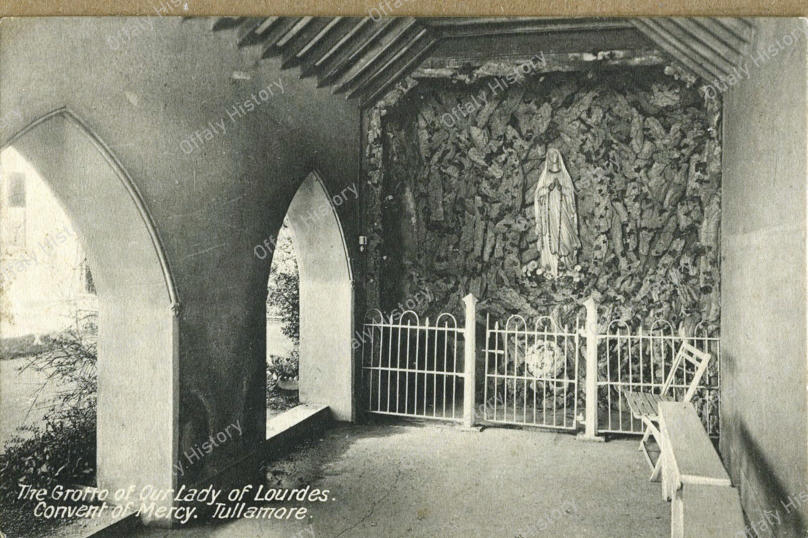
A favourite in the month of May during the rosary processions in Tullamore convent St Joseph’s Convent was the first foundation outside Dublin by an order which was to become the largest order of women religious in the English-speaking world.
Brought to Tullamore at the request of the then parish priest, Father O’Rafferty, it went on to play a major role in local history, as well as to found convents in other locations.
In writing about the order, I am conscious of my own dealings with it as a young boy, having attended the old St Joseph’s NS (where St Philomena’s is now located) from 1965-68. In those days, the norm was that boys attended there for the first three years of schooling, until First Communion, when they departed either for Scoil Bhríde or, as in my own case, to the primary school then run by the Christian Brothers in Coláiste Choilm.
The girls then continued for another year or two until moving to St Philomena’s, which was then based in Harbour Street, in what is now St Mary’s Youth and Community Centre.
I have good memories of the four nuns who taught me in St Joseph’s – the late Sister Bernadette Nevin was my first teacher in Junior Infants, and she was followed by Sister Scholastica (now Sister Kathleen), Sister Regina (who later moved to teach in the USA) and Sister Columba (now Sister Nuala).
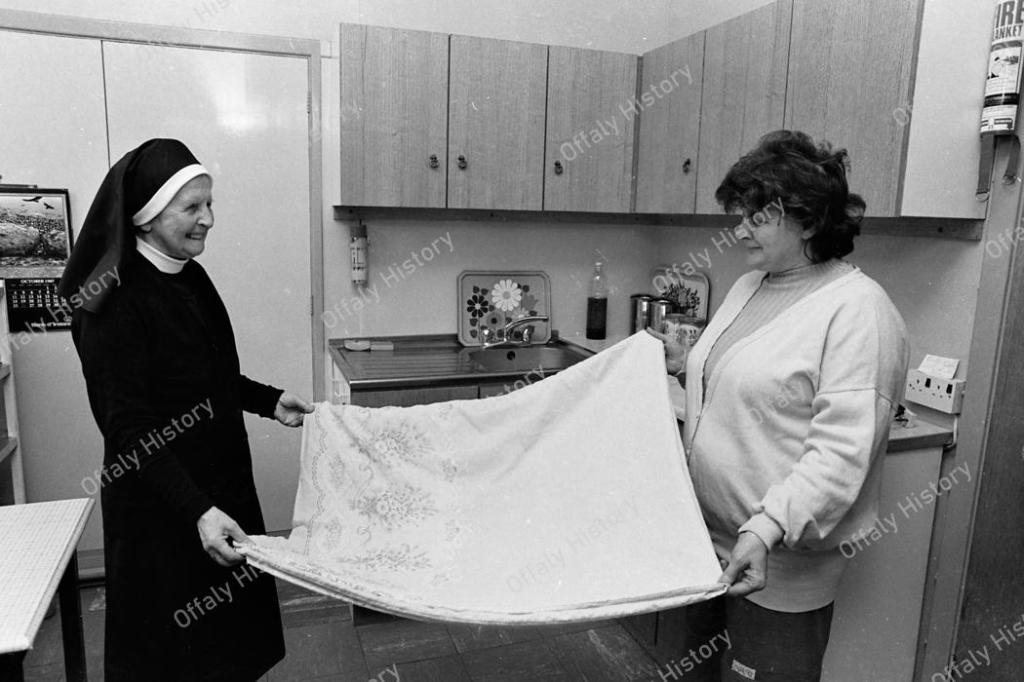
Sr Bernadette, teacher to so many in her early years I cannot presume to speak on behalf of my female counterparts regarding their memories at more senior primary and secondary classes, that is something they would have to outline themselves. During my schooldays and for many years thereafter, the Sisters of Mercy ran three primary schools in Tullamore – in addition to St Joseph’s and St Philomena’s, they ran Scoil Mhuire on the other side of the town – in addition to the Sacred Heart School, the only all-female secondary school in Offaly.
In addition to such a major role in education, I am conscious of their involvement as nurses in the local hospital, where a separate convent, the Sacred Heart convent, long existed, as well as their work in Riada House and its predecessor, the old County Home.
One also thinks of the order’s legacy in terms of setting up the Day Care Centre at Whitehall, the old launderette on Convent Road and of course involvement in the development of youth services and work with Travellers.

The convent (1836-41) and the first girls’ secondary school of 1911 at Convent Road By the late 1980s, the effect of declining vocations was already beginning to be felt – the appointment towards the end of that decade of Ann Cooney as the first lay head at St Philomena’s was followed by that of Geraldine Byrne at St Joseph’s in 1992 and Máire McRedmond at Scoil Mhuire in 1999. At secondary level, Sheila McManamly became first lay principal at the Sacred Heart School in 1991, when Sister Ann O’Neill kept her promise to do no more than six years as head following the retirement of the late Sister Dolores Walsh.

Second level girls at Tullamore convent in 1914 St Joseph’s Convent has been linked to a number of foundations away from Tullamore – in addition to the Kilcormac convent, which has closed in recent years (with the remaining sisters moved to Tullamore), it is worth noting the role in founding convents in Derry and in Costa Mesa in Orange County, California.
Sisters from Tullamore have also served in Zambia and Kenya as well as Iceland.
With the remaining sisters predominantly elderly, the time will come when few will be aware of their work, but the legacy remains in schools and youth services. Those of us of a certain generation are well aware of the great work done by Sisters Ann and Genny, among others, in the youth services, and the order’s generosity in donating the old St Philomena’s to become the Youth Centre in 1980.
We also remember the work of Sister Veronica Gilsenan in helping bereaved families, as well as her work with Travellers and others in need – at a personal level, I recall her going to see my father when he was dying in Our Lady’s Hospice in Dublin in 1990.

Sister Veronica and friends about 1990 In assessing their work, we have to remember that they often reflected the mores of their time and as sisters aged, they often re-evaluated positions they previously took for granted.
From conversations I had with sisters down the years, I could see they were quite pragmatic in coming to terms with the changing position of women and the adjustments in social mores.
-
Crannógs in County Offaly. By John Dolan. Blog No 285, 8th May 2021
While Offaly has a huge range of Early Christian church and monastic sites it would not have been noted for crannogs, unlike its neighbour in Co. Westmeath. Surprisingly, Offaly has 13 crannog sites recorded in the National Monuments database, however they are in many ways different from the usual picture of the small, man-made island in a lake. Many of these crannogs are located close to natural esker and drumlin routeways and survive as wetland settlements in or close to bogs. One third of Offaly is covered by peatland.
Crannogs in Ireland.
The name crannog is obviously the Irish names of ‘crann’ for tree and ‘óg’ in this case referring to small and not young. But we will see that ‘small tree’ does not account for the size and scale of wood used in the construction of these lake dwellings which are generally in open bodies of water.
There is no agreed figure for the number of crannogs in Ireland. Some have suggested 1,200 over the whole country while others take the number over 2,000! Crannogs were constructed in the sixth and seventh centuries and occupied and used up to the end of the seventeenth century. As a monument in the landscape that has changed considerably with the reduction in water, lake and river levels, along with the drying out of the bogs since the Middle Ages, it is only by accident that a new crannog is discovered. (more…)
-
An Englishman’s walk through Birr, Kilcormac and Tullamore in mid-1921, as the War of Independence intensified. By Michael Byrne. Blog No 284, 1st May 2021
An Englishman, Wilfrid Ewart (1892-1922), walked from Cork through the Irish midlands to Belfast during the War of Independence in April-May 1921. His book A Journey in Ireland 1921 (London, April 1922) was his account of that dangerous journey through the Irish heartland. Ewart commenced his journey on 18 April 1921 and finished it on 10 May. How did he escape abduction or shooting as an English spy? He might have come close to meeting death near the Blue Ball. Ewart was born in 1892 and died in 1922 – the year of the publication of his book, killed by a stray bullet in Mexico city on New Year’s Eve 1922. So Ewart lived dangerously as is clear from his passage through County Offaly the year before his death. His account is one of the best we have of feelings in Birr during the height of the War of Independence and on the eve of the killings at Kinnitty and Coolacrease, not to mention so called spys.

The jacket of the first edition of 1922 Ewart was possibly near death at the Blue Ball and surprisingly escaped that fate. He must have had great connections and credentials from both sides in the War of Independence to escape a violent death. He was surprised at how normal life was in Birr and contrasted the scene with the situation in Tullamore, where curfew had lately been imposed. Shots had been fired at the RIC and Black and Tans in the town of Tullamore in early April and one volunteer killed. In making the trip Ewart was out to discover for himself just what justification there was (if any) for British actions in Ireland.
In Birr Ewart met Archdeacon John Ryan who succeeded in 1917 on the death of Dean Scanlan in December 1916 and was parish priest there for 31 years until his death at the age of 96 in 1948. Ewart in his 1921 interview with Ryan described him as:
One of the most picturesque personalities I came across in this part of Ireland was Archdeacon Ryan, of Birr. Indeed, there was not a little in common between this fragile-looking, shy-mannered and unworldly priest and the steel-fibred leaders of Sinn Fein whom I had talked with in Cork. There was the same – how shall one say? – delicate adjustment of mind, softness of voice and manner, strain of poetry, faint perfume of idealism which mollifies, or appears to, the rigid nationalism.
Ewart went on to note that Archdeacon Ryan considered the IRA to be motivated by pure patriotism. Ewart in his interview with John Dooly did focus on the immediate cause of Dooly’s removal from the chair of the King’s County Council in June 1918, but perhaps ought to have got a lot more. The change in public mood in the county did not affect Dooly’s standing in Birr and he continued to be elected as chair of the Birr Urban District Council up to his death in 1924, a record of twenty-four years. Ewart met three other people perhaps including the agent to the Rosse estate. What was emphasised was how law abiding the town was. The county was at that time outside of the martial law area and the markets were functioning. In neither Birr (nor Tullamore, though described as hotter that Birr politically) did Sinn Féin have an outright victory in the urban elections.
(more…)
-
Marking the opening of the first public library in Tullamore: May 1921. By Michael Byrne. Blog No 283, 28th April 2021
For many the habit of reading started with the local library and has never left us. Recollections of the several libraries we have had in Tullamore remind us that so far as reading and comfort goes we have never had it so good. This is the time to recall the first public library in Tullamore started in May 1921, just 100 years ago. For that we have to thank an unsung hero E. J. Delahunty, a native of Clonmel, who was in charge of technical education in the county from 1904 to 1930 and died in 1931. He organized the first ‘students’ union’ in Tullamore and a superb lecture series on the great issues of the day in the 1916–21 period, and with mostly well-known speakers with a national reputation. The Midland Tribune gave the opening of the library an editorial and regretted that the lecture series had to be abandoned that year. Delahunty was shrewd and had the Tribune editor, Seamus Pike, on side. Another unsung hero of the revolutionary decade was Revd John Humphreys, a Tullamore-based Presbyterian minister, and great advocate for technical education. These are three people who need to be included in the Offaly Dictionary of Biography.
(more…)
-
Inspired by Water: Four Conjectural Views of a Past and Future Tullamore. By Fergal MacCabe. Blog No 282, 24th April 2021
A Village by a Ford
Water created Tullamore and will form its future.
Long, long ago, a rocky outcrop on the bed of the river allowed local farmers to herd their livestock across to graze on the small hill on its southern bank. Over time, longer distance routes began to converge on the ford and a small village grew up to cater for travellers, an inn to change horses perhaps, a blacksmith possibly, but this is all conjectural as no traces or records remain.
In 1609 the soldier/settler John Moore bought a half share in the nearby but now long vanished castle and watermill of the Molloys and began to hold an annual fair. By the late 17th. century, ‘Tullymore’ as the old maps called it, was most likely a rural scene of some thatched cottages, an unpaved track and maybe one or two substantial houses (illus.).

A conjectural view of Tullamore in the 1620s when it was said to have a castle watermill and ten cabins. The castle was in ruins by the 1630s but the town then had two watermills on the river. In time the ford was replaced by a bridge. This gave the small village a certain strategic importance, so in 1716, a military outpost was established to guard it. The security this brought and the provisioning needs of its garrison, attracted new settlers whose residences and businesses were facilitated by the ability of the river to receive household and commercial waste and provide a source of raw material and power. Soon, several flour mills, tanneries, breweries, distilleries and a linen industry had been established. Downstream of the bridge, the river channel was diverted into a large semi-circle, creating a mill stream to power even more industries.
(more…)
 offalyhistoryblog