There is so little of the undercurrent and gossip of a town in a local newspaper and yet we rely on them so much to tell us ‘what really happened’. Will we ever know from the reportage? We are grateful to have the lately published witness statements in the Depositions of 1642–53, or those in the pension records of the 1916–23 conflict. Yet we are advised to be cautious in using such records. What we do know of what ‘right-thinking people’ were saying about sexual morality in Birr, during the years of the First World War, we have from a sermon preached in Birr Catholic church in November 1917. It was one of the Birr curates who was the most outspoken while the then recently appointed 65-year old parish priest of Birr, Canon Ryan, had little to say. Or if he had it was not recorded. ‘Delicate’ subjects then as now, were seldom spoken of from the pulpit or the newsroom except in generalisations. In the case of the Laois-Offaly depositions it has taken over 300 years for the sworn affidavits to reach the public arena. For the witness statements provided by War of Independence veterans near enough sixty years. Is it any wonder that court cases with their mostly contemporary renditions are so popular? It is the same with sermons that touch on local sexual life – the subject being almost taboo except in the abstract. Seldom spoken of in the church and hardly ever recorded in the local news media before 1970. The press reports of court case evidence can be more satisfying as contemporary first-hand accounts, but for the public and no less for the judges, it can often be hard to know what the real story is. The reports of public morality debates or pulpit declamations in the years before and after 1922 are hugely important in helping to understand the concern (and who was raising it) over unmarried mothers and their children that would feed away, as if an unspoken of cancer in society, over the years from 1922 to the early 1970s.
We welcome this week Dr Diarmuid Wheeler on an important subject for Ireland and for the midlands, being the colonial experiment known as the Leix-Offaly Plantation. For those interested in the Decade of the Centenaries, the resurgence of interest in the Irish language, 1916 and the War of Independence, knowing the roots of the conflict is essential. The fort of Philipstown would soon be adopted as the county town for the new King’s County of the 1550s. The courts of assize to display the might and power of English law continued to be held in King’s County until 1921 while the name of the county was changed only in 1920 to Offaly. The Civil War of 1922–3 would witness the burning of houses such as Ballyburly, owned by the Wakely family, who had come to Ireland as soldier settlers in the time of Elizabeth.
Dr Wheeler will give his lecture on the Leix-Offaly Plantation to Offaly History from his home in the United States on Monday night 22 March at 7.30 p.m. Email us at info@offalyhistory.com with the subject heading ‘Zoom Wheeler’ for the access code [Ed.]
The beginnings of the midlands colonial project can be traced back to the early sixteenth century when the Tudor government, who firmly believed that Ireland rightfully belonged to the English crown and that the country’s keeping was essential to England’s overall safety, sought to restore the island to its twelfth century “conquered” state from which the crown hoped to profit. Brendan Bradshaw argues that the Tudors and the Old English of Ireland were heavily influenced by Renaissance humanism that encouraged them to bring reform to Ireland. But the administration lacked significant knowledge and experience of the country, particularly during Henry VIII’s reign and quickly realised that reforming the island would take significantly more military and financial resources than they had anticipated. By the final years of the 1530s, it was apparent that a certain degree of coercion and military force would be necessary to bring about wide scale reform. Yet the Tudors were also aware that they could not employ outright force to achieve their objectives, lacking the necessary resources to do so. Instead, the Tudor administration recognised that they would need to accommodate the natives of Ireland, at least somewhat, in order to make their aspiration a reality.
Clara’s engagement with the textile industry may go back 100 years before the Goodbody jute factory. As one of the smaller towns and villages in the county places such as Clara, Ferbane, Kilcormac and Shinrone are less clearly associated with the early plantations by contrast with Daingean, Tullamore and Birr. Clara was prosperous in the 1770s and from the weakening of textiles in the 1820s must have suffered a good deal until the hand loom business progressed after the mid-1850s and the jute factory from the mid-1860s.The Goodbody firm continued as a prosperous concern for another hundred years. Clara was the only town in Offaly to see expansion of its population in the second half of the nineteenth century. And so in the economic cycle it may be that the post 1820s to the 1860s were lean years as has been the period since the 1970s. These are generalisations and will need to be revised in the context of detailed research on Clara businesses, employment, housing and infrastructure.
A big welcome to Martin Moore this week as a new contributor to Offaly History blog and with a new topic. A big thanks also for the work of the sports historians in the county including the late John McKenna on association football in Tullamore in the 20th century.Martin is preparing an article for Offaly Heritage 12 (forthcoming later in the year).
Recent research into the origins of association football in Ireland has demonstrated that Offaly was – for a brief period – a centre of early soccer activity, involving one of the first soccer teams in Ireland. The traditional understanding is that soccer was consciously ‘introduced’ to Belfast in 1878, from where the game eventually spread around the rest of the island. The real story, however, is not quite so straightforward. We now know that soccer was played in other parts of Ireland before 1878 and Offaly, Tipperary and Sligo were centres where the code was played in the late 1870s and early 1880s, though it failed to take root and was not sustained.
The report of the Commission of Investigation into the mother-and-baby homes has received huge coverage in the British media, reflecting, no doubt, the number of survivors of the homes who settled in Britain. This is the third and final blog looking at this important report for Irish social history in the 20th century. Here Declan McSweeney looks at the reception of the Report in Britain
It is a reminder of the days when so many Irishwomen were referred to as ‘PFI’ (Pregnant From Ireland). One of the most shocking aspects of the report was the reference to women who had moved to cities like London or Liverpool and were effectively kidnapped by their families and forced back to hellish institutions, as outlined here: Mother and Baby Homes: State paid for 2,400 pregnant women to be repatriated from England
Mother and Baby Homes: State paid for 2,400 pregnant women to be repatri… Aoife Moore and Elaine Loughlin Many pregnant single women that travelled to Britain found it was less welcoming than they had hoped
It is also a salutary reminder of the fact that Britain, for all its faults, has long been a haven for Irish people from ill-treatment of one kind or another.
The recent announcement by the Irish Government of its Diaspora Strategy has featured a recognition that many were effectively forced out of Ireland down the years.
I started collecting bottles a little over a year ago, interested in their origins and local history. I’ve picked a small collection of the type of breweriana bottles that were used in the day to day lives of the people of Tullamore and surrounding towns in the late 19th and early 20th century. I’ve provided a brief description of the types of bottles I’ve mentioned. Most of the dates provided are approximate and offered with the best knowledge I have at this moment. As I get more accurate information, the dates will be reviewed. I started off with some basic background information on bottles.
Carbonised mineral bottle It is widely known amongst bottle collectors that Joseph Priestly discovered how to make carbonised mineral water in 1772. It was prepared by dissolving carbon dioxide in water. By 1860, it had become easier to manufacture and was being flavoured with fruit syrups, lemons and limes. It was retailed by grocers, wine and spirit merchants, as well as chemists. At first the new drink was stored in earthenware bottles, but the gas escaped through the skin and so the drink became flat. Manufacturers switched to glass bottles. However, corks were still used to seal the carbonised mineral water drinks, and if they were allowed to dry out, they tended to loosen which allowed the gas to escape. If the bottles were stored on their side, this was less likely to happen.
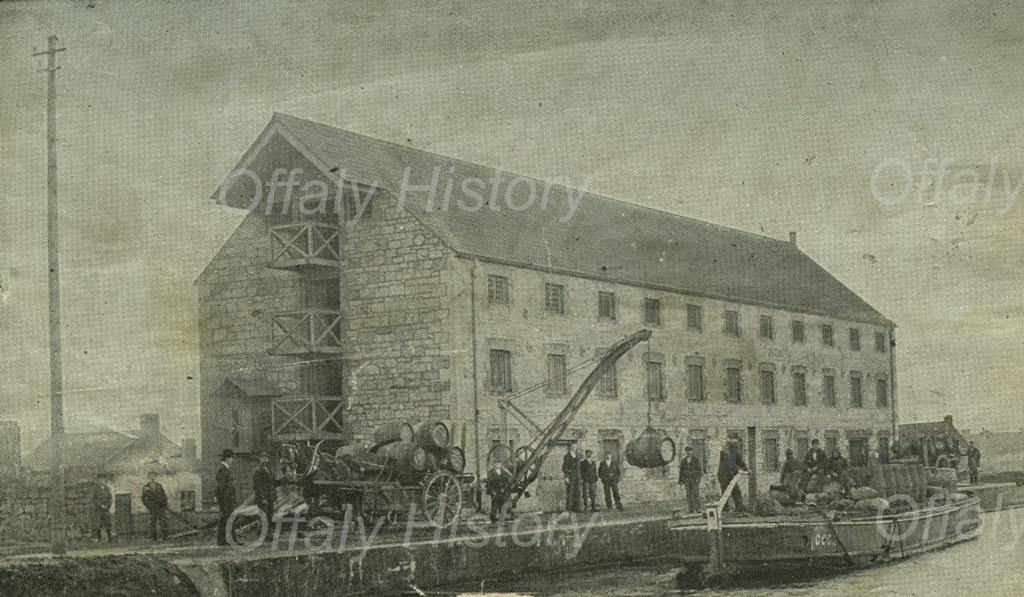
It’s six months now since William Grant announced the closing of the old Bonded Warehouse Visitor Centre at Bury Quay, Tullamore. The company that makes the world-famous and second largest selling Irish whiskey, Tullamore DEW is going to concentrate its energies on a new visitor centre at the 2014-17 purpose-built Tullamore DEW distillery at Clonminch and understandably so.
D E Williams’ 1897 warehouse
The idea of a visitor centre at Bury Quay was conceived in the early1990s as a way of attracting visitors to Tullamore town. Tullamore had been designated an industrial heritage town in 1990 and EC tourism funds were available. The idea that a new distillery would open in Tullamore was not on the radar. Thanks to the work of Irish Mist (Bill Jaffray), Cantrell & Cochrane (owners of the DEW brand from 1993 to 2010), Tullamore Town Council and Offaly History the idea came to fruition in the year 2000 and the visitor centre was opened. C & C had put in about £500,000 plus the building (the late Frank McGovern and Tony O’Brien being the captains here), Bord Failte £300,000 and the council the balance with the total costs at £1.2m. This included a liquor licence for £90,000. Two County Managers and a Town Clerk played great developmental roles to ensure it was successfully completed as did the staff and franchisees subsequently.
It is unclear where the idea for a Round Tower came from, little research has been carried out on their origins. There were a few examples of cylindrical towers in northern Italy, the Basilica of San Vitale in Ravenna is an example. European churches had started to connect bell towers and crypts to their churches between the 900 – 1,100AD. These towers were built stand-alone and later joined to other church buildings. But European bell towers were nearly all rectangular.
What was happening in Ireland?
In Ireland churches continued to be built as small rectangular buildings, single celled with one doorway and perhaps a window or two. Irish church buildings changed from wood to stone during the 8th century. However, monasteries blossomed as locations of education, agriculture, metal and wood working, vellum production, with their skills retained in-house or shared with other church establishments. External trade and travel with Europe were a regular occurrence. Most monasteries had wealthy, secular sponsors who were frequently related to the abbot or bishop. Monasteries also acquired lands and other riches e.g., wealth from pilgrimages and relics.
Round Towers enhanced the prestige and wealth of the monastery as they created a huge visual impact. Round Towers were to see and be seen, similar to some of the buildings built in the time of the Celtic Tiger. (more…)
Archives in Offaly covering the War of Independence period are varied and interesting. This blog will give a short overview of archival material in Offaly Archives in collections of local government records and private papers, drawn from both the collections of Offaly County Library and Offaly History. Links will be provided to online descriptions and digitised resources on the online catalogue offalyarchives.com This will also include links to the catalogue of the Rosse Papers at Birr Castle, another local repository of important source material.
Local government archives, such as the records of the county council and of the urban and rural district councils, record the massive political change following the establishment of Dáil Éireann in January 1919. By the time the local elections of 1920 were held, Sinn Féin had the majority of seats on the County Council. King’s County Council was renamed Offaly County Council in June 1920 and allegiance to the new Dáil was ratified by many of the district councils, e.g. Tullamore Rural District Council recorded the following motion on 2 October 1920: (more…)
Shannonbridge A History of Raghra c.1600-c.1900 was published in 2019. Research for it began many years ago when I decided to learn more about my family and family home in Shannonbridge, County Offaly. That interest spread to other houses in the village. When Brendan Ryan and I decided to write a book about Shannonbridge I concentrated on the genealogy of those who lived there in the past. Gradually the history and stories of families emerged. My main goal in writing the book was to pull the names of the people of Shannonbridge out of the past. Sometimes we found interesting stories but often we just learned their names and the bare facts of their lives. However it felt wonderful to put those names in a book, to prove those people had been there, to acknowledge their existence. They all played a part in the story of a village. Oh, they had hard lives! And yet, many survived and thrived. Their descendants span the globe. What struck me most in learning about them was that often their stay in the village was short-lived. Many of the families who settled in the village only stayed for a generation or two and are long gone now. Keeping track of people moving in and out was a challenge.


 offalyhistoryblog