
Back in 2014 I was an intern in the Heritage Office in Offaly County Council. I compiled a database of all known post 1700 burial grounds in the county. Compiling the database required thorough desk and field based research. During fieldwork I visited 170 of the 187 burial grounds I recorded. While visiting these places I noted many interesting and unusual features, some of which are the basis for this blog post. The list is of course subjective. There are certainly more interesting and unique features waiting to be discovered in Offaly burial grounds. (more…)
Category: Subjects
-
Mrs King, John Plunkett Joly, William Davis and…You! Diary-writing in Offaly in the 19th century and a 21st century call for historians of the pandemic. Blog no 192, 25th April 2020
Diaries offer a fascinating glimpse into history through the personal accounts of people who lived through war, famine, disease, revolution and other events of huge social disruption. Along with contemporary correspondence, personal diaries help to flesh out the bare facts of history with human experience, where otherwise official records are the only historical source. Find out how you can help us to record the history of the 2020 Covid-19 pandemic in Offaly and join a long line of Offaly diarists who have shaped our understanding of the past. (more…)
-
RSA1 members visit Durrow, Tihilly, Rahan, Lynally and Killeigh in Monastic Offaly in 1896. Michael Byrne, Blog No 190, 18th April 2020
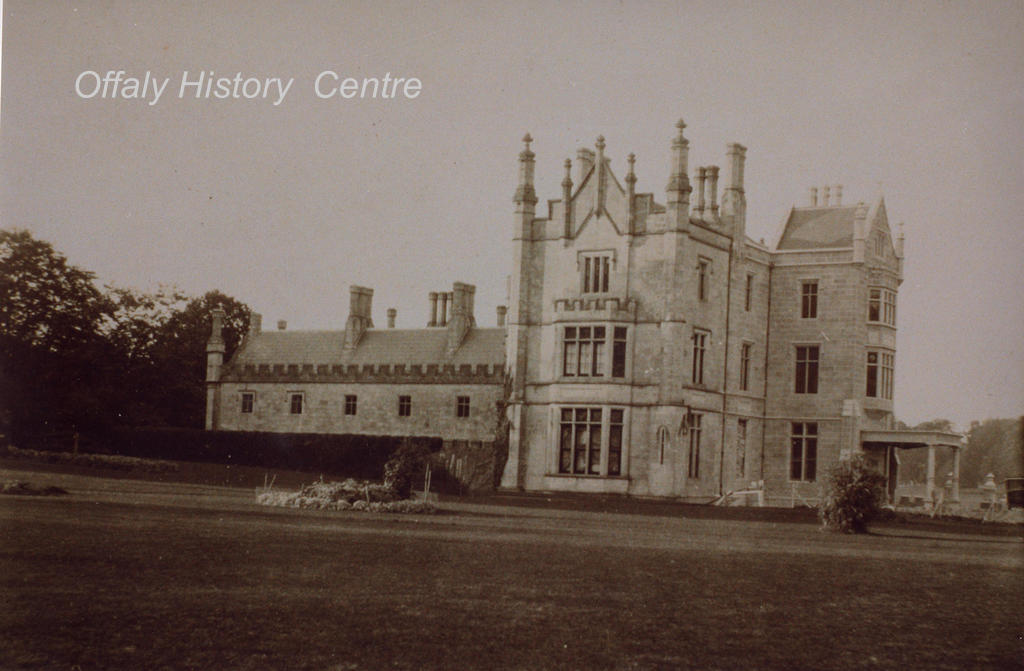
Durrow Abbey in 1914. The First World War had just started. Leaving to one side the work of the Ordnance Survey in the 1830s, the work of Petrie at Clonmacnois, and that of Cooke at Birr in 1826 and 1875, the references to and work done or written up on the historical sites of north Offaly in the nineteenth century are hard to come by. Fr Cogan published historical material on the Offaly parishes in the diocese of Meath in his three-volume work, 1862-1870; Thomas Stanley corresponded with the Royal Society of Antiquaries (RSAI) in 1869 in regard to the nine-hole stone or bullaun at the Meelaghans while Stanley Coote contributed an illustration of Ballycowan Castle for the Memorials of the Dead – a published record from the 1880s to the 1930s of selected tombstone inscriptions in Ireland and in County Offaly.
-
Local history: ‘gone to pot’ or some remarks on Goss Ware/crested china by John Stocks Powell. Blog No 189, 15th April 2020

Home Rule/Rome Rule. A china mug with a portrait of Pope Pius X (1903-14) who
increased the devotionalism of the Catholic church, who promulgated the Ne Temere
decree concerning the children of mixed marriages, whose orders on the role of women in
church music (1903) was commented on by the Morkan sisters in James Joyce’s story ‘The
Dead’, and who oversaw the excommunication of Fr. George Tyrrell (1861-1909) on a
charge of heresy, whose childhood had been spent at Dangan’s Farm between
Portarlington and Mountmellick. He also enjoined the admission of children to regular
communion at the age of reason.
(Autobiography … of George Tyrrell, 2 vols. 1912, p.20-22)We welcome a new contributor to the blog this week with this article by John Stocks Powell. Enjoy and remember we have almost 190 articles to read at http://www.offalyhistoryblog. Like to get it each week and share to your friends.
There is a hierarchy of sources for the historian, local historians and those with the wider landscapes. The principal material is the written word; evidences from the time, written archives, and later written published assessments such as county histories, church memoirs, Ph.D. studies gone to print. On-line developments have made for more in quantity, and more exciting revelations, from the checking of dates on Wikipedia, or the digitised sources such as Irish and British newspapers online, and directories. Yet we know the old cliché that history is written by the winners, and that is especially true when trying to write about the history of the losers, the poor, and the illiterate. Every source has its importance.
-
Fr Michael Kelly of Tullamore and Zambia is honoured on a new stamp. His reflections this Easter 2020. Inspired by Shelley’s lines -“O wind, if winter comes, can spring be far behind?” Blog No 188, 12 April 2020
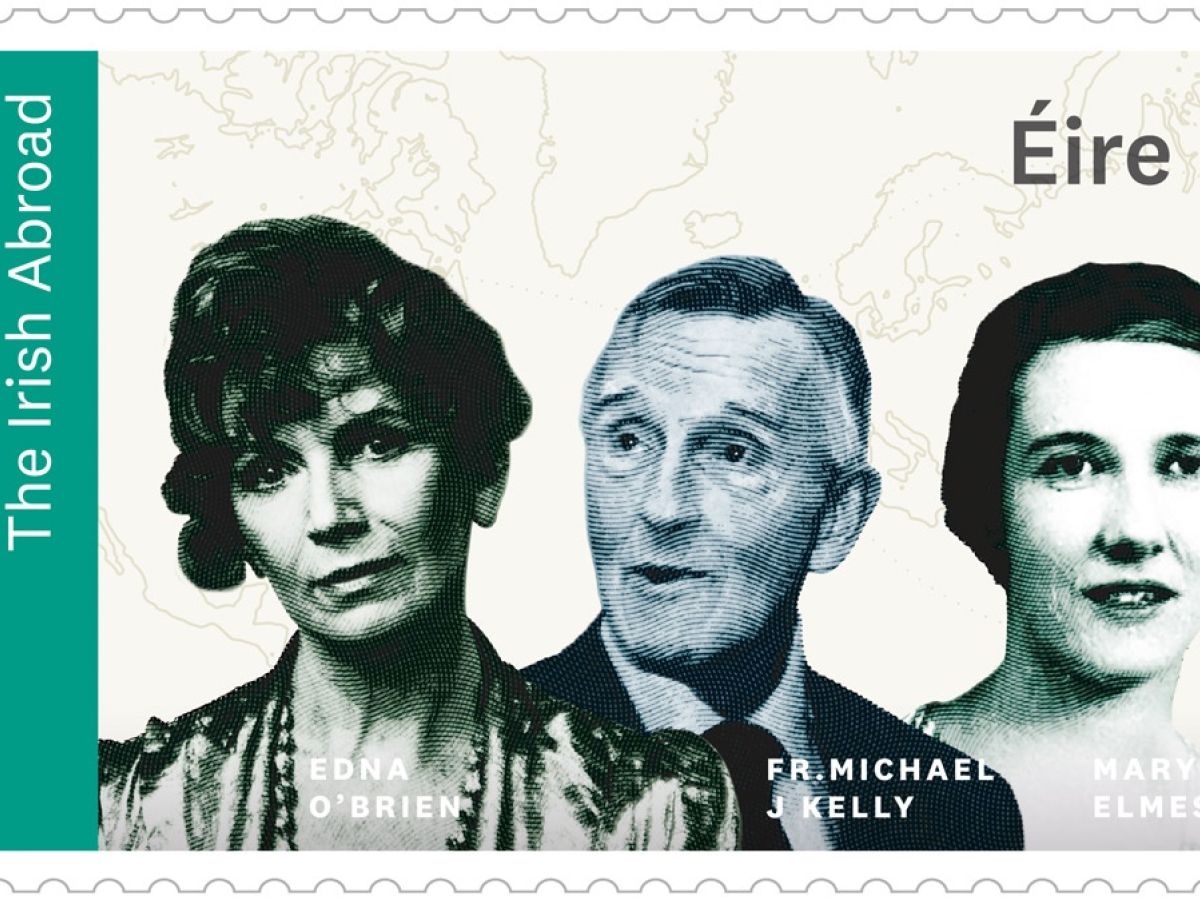
Fr Michael Kelly features on the stamp alongside two other Irish emigrants: the accomplished author and Tuamgraney, County Clare-born Edna O’Brien and Mary Elmes (1908-2002) from Cork, the humanitarian worker particularly renowned for saving the lives of 200 Jewish children in France during the Holocaust. We are bringing you a special Easter Sunday blog to celebrate the work of Fr Michael Kelly, the Tullamore man who appears on a new Irish stamp marking the work of emigrants and providing his personal reflection at this time. Fr Kelly has been in the Jesuit ministry for 65 years working in Zambia. His family lived in O’Connor Square and his father was a director of P. & H. Egan, Tullamore. Two of his brothers were also with the Jesuits. Fr Michael writes of the current virus difficulties and reflects on his time growing up in Tullamore. (more…)
-
Uncovering Pre-Famine Offaly using the Morpeth Roll. Ciarán Reilly. Blog No 187, 11th April 2020

1. The Morpeth Roll (Courtesy of Castle Howard Archives) The Morpeth testimonial roll comprises a farewell address signed by approximately 250,000 people (according to contemporary sources) on 652 individual sheets of paper. These sheets were subsequently joined together to create a continuous length of paper, approximately 412 meters in length (over three times the length of Croke Park), which was rolled onto a mahogany spool. It was presented to Lord Morpeth at the Royal Exchange, Dublin, in September 1841 following his defeat in the 1841 general election which consequently led to his departure as Chief Secretary of Ireland. For many years the testimonial roll remained hidden away in a basement at Castle Howard, Yorkshire, but it is now on loan at Maynooth University thanks to the generosity of Simon Howard, owner of Castle Howard and the efforts of Professor Christopher Ridgway, Curator and Professor Terence Dooley, Director of the Centre for the Study of Historic Irish Houses & Estates. This unique document has huge research potential, whether looked at as a pre-Famine census substitute, a family heirloom, a genealogy resource or a politically motivated document in its own right. Moreover, it has the potential to provide a unique insight into Irish life, society and politics in pre-Famine Ireland. As a pre-Famine census substitute it is unparalleled and its importance is multiplied by the scarcity of census material from this period. The document also provides empirical evidence of mass political involvement.
-
A Birr Letter’s Untold Story: Hugh Leonard of Crinkill. By Stephen Callaghan. Blog No 186, 8th April 2020
Today it is all too easy to take modern technology and communication for granted. When was the last time you remember sitting down to attentively write an important letter with pen and paper? It might be fair to say that letter writing has become a dying art form. For Hugh Leonard 168 years ago this letter was important in the hope of claiming battle and prize money owed to his late son, William, who died in India in 1849. This blog post examines the contents of this letter. (more…)
-
DRAYTON VILLA, CLARA: ‘a handsome residence, a good home neatly furnished’. By Michael Goodbody. Blog No 185, 4th April 2020
It was lately announced that Drayton Villa, Clara and some lands adjoining are to be acquired by Offaly County Council for public purposes. Offaly History asked Michael Goodbody to contribute this piece on the story of this important house. He is currently working on ‘One Hundred years of Clara History’ to be published later this year and from a preview we can say that it will represent an important contribution to the story of Clara from the 1840s to the 1940s. Thanks to Michael Goodbody for the article and the pictures. We have added the subheadings.

Drayton Villa (courtesy Stephen Williamson) Drayton Villa, built by Lewis Frederick Goodbody in the mid-nineteenth century, is largely untouched by more recent additions and alterations, so that many of its original features are intact. The main block of three bays, with a basement underneath, dates from 1849. There can be no disputing this date for it is recorded by Lydia Goodbody – future sister-in-law of Lewis – in her diary entries for that year.
-
Seir Kieran, County Offaly by John Dolan. Part 2. Blog No 184, 2nd April 2020
John Dolan writes about Seir Kieran in part 2 on Seir Kieran this week. John was born in Tullamore, now retired, and has a degree in Archaeology and Celtic Civilisation. He speaks regularly to historical societies in Dublin. Seir Kieran is the ‘island parish’ in Offaly belonging to the diocese of Ossory. Our blog articles are brought to you twice weekly during these weeks of the plague to hopefully provide some inner peace through historical inquiry. You now have 183 to chose from and you can join the 150,000 views since 2016. If you would like to write for us email us at info@offalyhistory.com.

Seir Kieran from a drawing in the Dublin Penny Journal of 1834 Lives of the Saints
The Lives were generally written hundreds of years after the death of the saints and usually by people who had never met them. The format adopted by the Irish hagiographers followed that of the Life of St. Martin of Tours. These Lives were considerably removed from the texts written in the early churches, what we have today are later copies. Folklore, stories and religious/political inferences had been handed down orally over generations before the first Life was written.
 offalyhistoryblog