Bog butters are large white or yellow waxy deposits regularly discovered within the peat bogs of Ireland and Scotland. They represent an extraordinary survival of prehistoric and later agricultural products, comprising the largest deposits of fat found anywhere in nature. Often found in wooden containers or wrapped in animal bladders, they are considered to have been buried intentionally by past farming communities. While previous analysis has determined that Irish bog butters derive from dairy fat, their precise characterisation could not be achieved due to chemical compositional alterations during burial in subsequent years. They generally produce a distinctive, pungent and offensive smell.
The largest Irish example weighed 23kg (50lbs) from a find in the Galtee Mountains in 1826. Bog Butter is primarily held in the National Museum with some held by local museums.
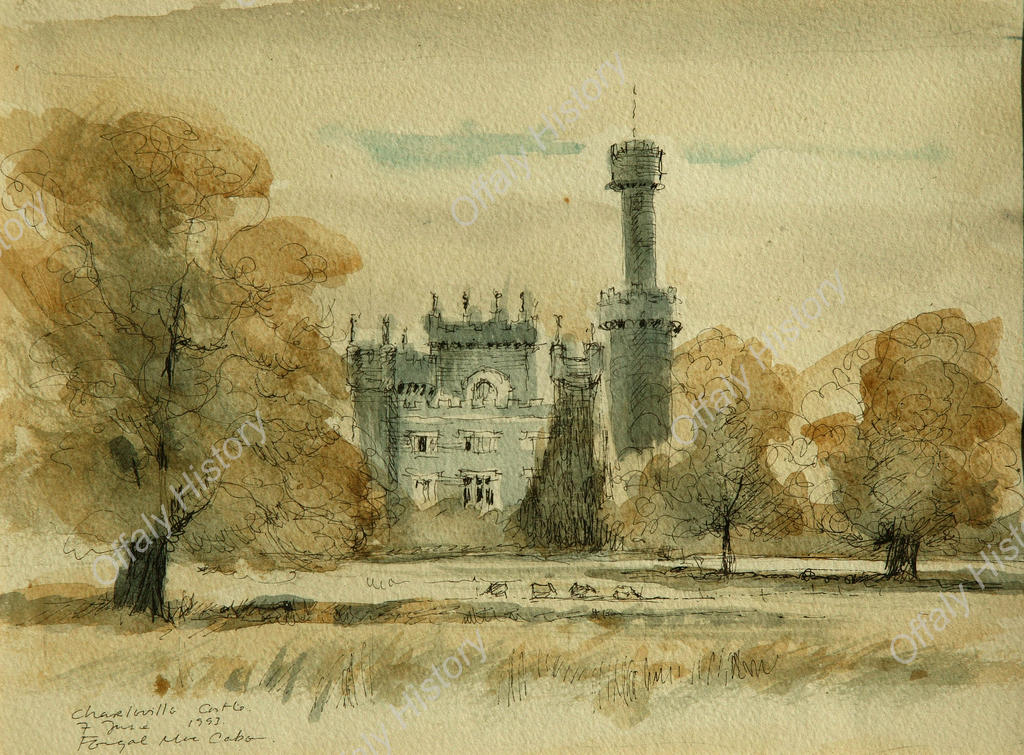
Charleville from the east by Fergal MacCabe, architect. From essays in honour of Maurice Craig.
The prayer book of Lady Beaujolois Bury of Charleville Castle, Tullamore was donated to the Offaly History Centre by the late Jane Williams some years ago. Like some family bibles it contains on two of the blank pages scraps of the family lineage of her ladyship and her siblings, the third and fifth earls of Charleville. The information recorded agrees with what is provided in Burke’s Irish Family Records (1976 edition), but like every family there is more to it than the bland recital of names and dates. Lady Beaujolois Bury (1824–1903) was the talented daughter of the second countess of Charleville (1803–48) and granddaughter of Lady Charlotte Susan Maria Campbell. Her Bury in-laws, the first earl and countess, were the builders of the great castle, known as Charleville Forest, and which was commenced in 1800 and completed in 1812. According to Mark Girouard it is ‘perhaps the finest Gothic Revival Castle in Ireland’.
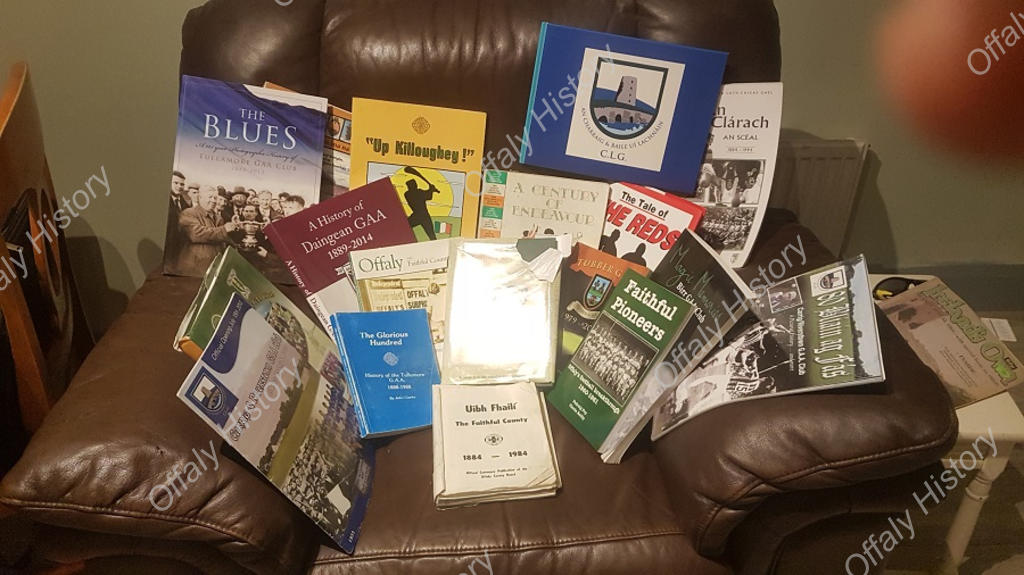
Offaly GAA blessed with some great club history publications: sources for Offaly history and society, no. 7. GAA is very fortunate to have a number of fabulous club history publications at its disposal. Clubs such as Clara, Daingean, Edenderry, Kilcormac/Killoughey, Seir Kieran and Tullamore have produced particularly comprehensive and detailed club histories and their value to members is immense.
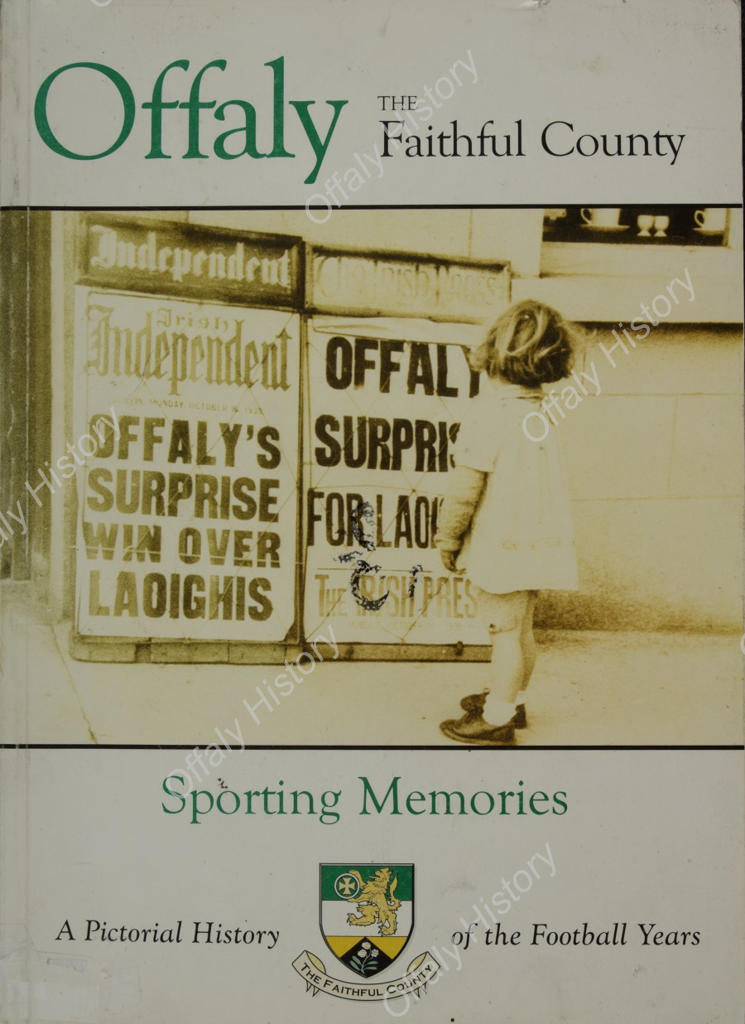
I have started research earlier this year on my latest project, a comprehensive, detailed history of Offaly GAA. It is a very big undertaking with a huge volume of research required before you even consider putting pen to paper. It will be a three year plus project and trying to get a picture of all eras and factors in the growth of the GAA in Offaly is quite daunting.
My aim is to do a proper history of Offaly GAA, one that transcends its mere sporting contribution to the county. To a very large degree, the GAA successes from the 1960s through to the 2000s contributed greatly to the well-being of Offaly as a county and provided its own distinct unique identity. Whether you have any interest in sport, GAA doesn’t float your boat or you prefer other sporting codes, the importance and contribution of the national games to Offaly simply can’t be understated.
On June 15th 1991, I climbed a locked gate marked Bloomville, just as the rain stopped and the sun came out. There were some lovely beeches, but no sign of a house. I then spotted two ancient chestnuts, and it was only then that I could see the house in the distance.
It was a case of love at first sight, with everything sparkling in the sunshine, and I wondered why the agent’s advertisement had not included a photograph. Only when I approached the house could I understand the reason. The traditional roses (still flourishing 29 years later) looked pretty, but, close up, the house looked very neglected.
Written and compiled by John Wright- owner/editor of the King’s County Chronicle, Birr, from 1872 until his death in 1915 – the book was published early in 1890 as ‘The King’s County Directory’. His son Archie succeeded and died in 1954. Increasingly, over the intervening years, it has been treasured as an invaluable source of reference for local historians but it has long been out of print and only a few copies remain extant. It was reprinted in 1989 now in hard back form, in a facsimile edition which reproduces its 368 pages – including 24 pages of advertisements and a number of drawings of noteworthy buildings. Since then it has also been made available on CD.
Over the past few months I have been finalizing a book on the memorials in Saint Rynagh’s Graveyard in Banagher. For some time now the recording of the transcriptions has been complete but the decision to add a description of each memorial has absorbed more time than intended. It has however been a most rewarding task because now when I visit other graveyards I look at memorials with a more trained eye and with greater awareness of the skills and talents of the stonecutters. This has fostered a greater appreciation of the decorative carvings and lettering styles which are abundant throughout County Offaly. It has also prompted greater recognition of unusual features such as ligatures, mirrored letters, ampersands and other hallmarks of a vernacular style. Above all it has stimulated a resolve to publicize those monuments which are unique whether it be for the occupational or funerary symbols portrayed on them or that they are fine examples of a particular stonecutter. Tombstones which have a dedication of literary merit or those which carry symbols of the Passion of Our Lord will also be a focus of attention.
In December 1968 Thomas [Tommy] Dunne received the tribute of a soldier’s burial from surviving I.R.A comrades in Offaly and the army in Annaharvey graveyard, near Tullamore.
Thomas Dunne grew up in Ballinagar (between Daingean and Tullamore) along with his siblings Mary, Richard, Margaret and James in the late 1800s. Their father was Tommy and their mother was Anne Brien from nearby Clonmore. Tommy was in his time a leading member of the local Fenian movement and came to Ballinagar from Rathfeston during the time Trench was the land agent for Lord Digby. The family tradition was that Tommy was about 27 at the time and by all accounts was a fine strapping young man. A family of Dunne’s owned the farm at the time, they were relatives of Tommy’s, but because they were all females and because of the impossible situation of that time, they were about to throw up the farm. Trench had someone in mind for the farm but Tommy took it over. One day Trench arrived on the farm and spent a while staring and trying to unsettle the young Dunne. Then Trench spoke “I see you have come Dunne.” “Yes” was the firm reply. Trench then said “On account your family has been here for so long I will let you stay, but instead of the rent being 7 shillings and sixpence an acre it will now be 30 shillings an acre.” This left it nearly impossible to farm but he managed. This incident took place shortly after the infamous evictions on the Geashill estate, where it was reported that the evicted tenants of Geashill filled the streets of Tullamore. A lot of these tenants went on a ship called Erin go bragh to Australia which was charted by a Fr Dunne from Daingean who raised funds for this purpose. He was possibly a relation of the Ballinagar Dunnes.
Who were the Egans and where did they come from? What national and international impact did they have on nineteenth century Irish political reform? How did they become successful lawyers and businesspeople? For many years, my cousin David and I would pose and tease out these and many other unanswered questions. Too often the anecdotal and evidential answers were vague at best and often hearsay or random recollections from family members. We both eventually concluded that there was enough intrigue to pique our interest into doing proper research on the period of social history of the 1800s and early 1900s. We discovered a treasure trove of fascinating stories which we felt warranted publishing.
Why write this book now, one may ask? The surviving older Egan generation have fond memories of the days past and several of them learned the business of business and held their first jobs in the family firm. Many local people also retain fond memories of the firm and the employment offered to themselves and their antecedents. (more…)
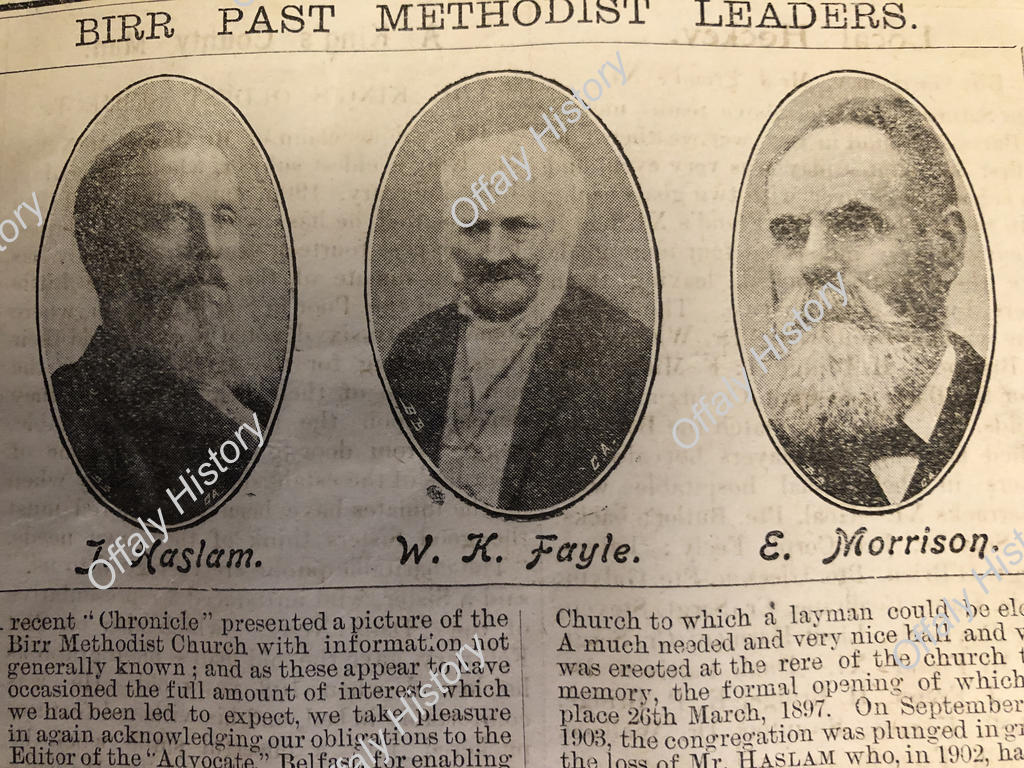
A 1906 review of some leading Birr Methodists from the Chronicle
This year marks the 200th anniversary of the laying of the foundation stone of the Birr Methodist church in Emmet Street (formerly Cumberland Street) in Birr. However the communities in Birr and Tullamore are much older and date back to the 1760s In this short piece we can only look at some of the sources. It is important because Methodists like the Quakers made a distinct economic and social contribution to the well-being of the towns and villages where their churches were associated. One has only to reflect on families in Birr and Tullamore such as Fayle, Haslam, Morrison, Lumley, Bradley, Burgess and more.
Louis Darcy, former Offaly county hurler, another altar boy rostered for Ned Doorley’s funeral
WE are glad to bring you the second part of Pádraig Turley’s piece this August 1 2020. We have reached 55,000 views for our stories this year so far. The same as the entire of last year. You can see all 212 stories on http://www.offalyhistoryblog and there is a shortcut to them at http://www.offalyhistory.com You do not need to be on Facebook to view. Why not contribute and send to info@offalyhistory.com.
FUNERAL OF NED DOORLEY:
The story of the funeral of Ned is one worth relating. This is a story I was always aware of, but was inclined to take it with a grain of salt. However, recently I received a communication from Shannonbridge native James Killeen, currently residing in Illinois, which virtually tallied with the version I had. Ned was the last survivor of the Doorley family when he died in Tullamore Hospital. My uncle Joseph Claffey and the undertaker Kieran Flannery volunteered to go to Tullamore, to pick up the corpse. James tells me that he and Louis Darcy (former Offaly county hurler)and Leslie Price were the altar boys rostered to be on duty to assist the Parish Priest Fr. Frank Donoghue, who having served in Brooklyn, NY, liked things to be done pronto.
The funeral was expected in Shannonbridge at 8.00 p.m. Everything was ready and in order, candles blazing. It did not arrive at 8.00 p.m. or indeed 9.00 p.m. or 10.00 p.m. Needless to say Fr. Donoghue was getting very edgy. There was no sound or sight of the funeral. James tells me that post war traffic in the area was about one motorized vehicle every forty minutes. So in the silence one could hear a car approaching from as far as Moystown, a distance of 9 km. Sometime after midnight James says, one could hear the grinding of the old 14.9 hp Ford engine somewhere around Blackwater, about 2 km away. On arrival Kieran Flannery, the undertaker announced they had a breakdown in Ferbane, and as it was a Sunday night, they had difficulty sourcing the part.