
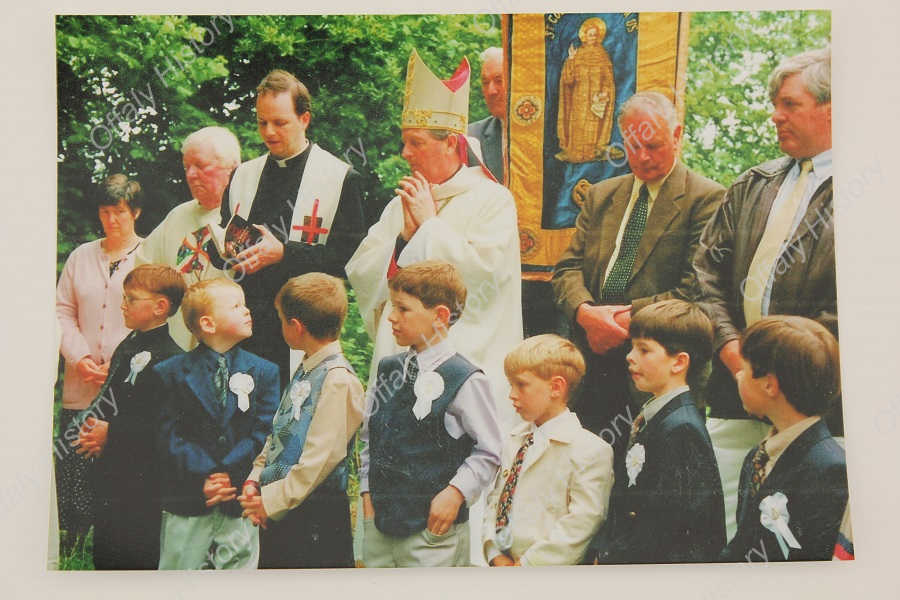
Columba, son of Eithne, daughter of Mac Naue, and Fedelmid mac Ferguso, is one of the most important Irish saints, and the strength of his saint’s cult in the centuries after his death on June 9th, 597 attests to this. Columba, or Colmcille, meaning the dove of the church, was born around 520 as a prominent member of the Cenél Conaill, This was a branch of the northern Uí Néill, a powerful dynastic grouping tracing its origins back to Niall of the Nine Hostages and based in north-western Ireland (Tír Chonaill takes its name from the Cenél Conaill). Columba’s influence extended into political matters as well as the religious sphere, but he is remembered as a monastic saint above all else. Like most early Irish saints, he was never formally canonised.
Category: Subjects
-
Saint Columba, June 9th and the monastery of Durrow . ‘To every cow her calf, so to every book its copy.’ By Sarah McCann. Blog No 137, 8th June 2019
-
OFFALY’S LITERARY ASSOCIATIONS: No. 4, Anthony Trollope and Banagher. Michael Byrne. Blog No 136, 1st June 2019

Banagher in 1820 from a drawing by George Petrie with the old bridge, barracks and mill. Banagher, County Offaly has associations with two well-known writers of the nineteenth century – Anthony Trollope and Charlotte Bronte. Up to recent years nothing by way of notice of this was to be found in Banagher, but that has all changed as Banagher, now hard pressed along its main street, looks again to embrace tourism in a way that it did so well in the nineteenth century and in the 1960s. The rescue of Crank House was a great feat, but the challenges are growing.
Many have tackled Trollope’s Life, but none immersed himself so much in Banagher as the late James Pope Hennessy. John McCourt in his 2015 study of Trollope Writing the Frontier: Anthony Trollope between Britain and Ireland ‘offers an in-depth exploration of Trollope’s time in Ireland as a rising Post Office official, contextualising his considerable output of Irish novels and short stories and his ongoing interest in the country, its people, and its always complicated relationship with Britain’.
-
Sir Charles Parsons of Birr and his company C. A. Parsons and Company in Newcastle, by Ruth Baldesera. Blog No 135, 25th May 2019
Ruth Baldesera is Quality Engineer at CAP Works, Newcastle, Tyne and Wear, where Sir Charles Parsons (1854-1931), son of the 3rd Earl of Rosse, founded his world famous engineering works. Sir Charles is best-known for inventing the steam turbine which revolutionised marine transportation and the mass production of electricity. Over the past few years Ruth has spearheaded a heritage project in Newcastle dedicated to the achievements of Sir Charles Parsons and in this article she outlines the scope and outcome of the project.
The Factory
Sir Charles Algernon Parsons “…the first Engineer to use a steam turbine to produce large amounts of power for electricity generation and driving ships”.
In 1889, Charles Parsons established C. A. Parsons & Company in Heaton, Newcastle, to produce turbo generators to his design. In the same year he set up the Newcastle and District Electric Lighting Company (DisCo) and in 1890, DisCo opened Forth Banks Power Station, the first power station in the world to generate electricity using steam turbo generators. (more…)
-
A whiskey distilleries trail for Tullamore: a first draft. Michael Byrne. Blog No 134, 18th May 2019
Tullamore is still to this day a vibrant and friendly Irish market town which has never lost sight of its commercial heritage. It’s one of the very few Irish towns that still preserves that friendly main street social-commercial atmosphere that I spoke about earlier. Today, The Bridge House is one of the largest town centre hotels in the midlands and it is really great to see the way that the modern owners show their appreciation of the past by maintaining the look and utility of the building facade.
With Egan’s and Tullamore D.E.W.‘s combined influence still so visible in today’s town, surely it is only a matter of time before a whiskey savvy historian develops a Tullamore Town Whiskey Walking Tour. (Stuart McNamara in a recent blog on Egan’s whiskey).Tullamore has its town guides and an app but, as yet, no whiskey trail. What with over 50,000 visitors to Tullamore DEW Old Bonded Warehouse every year it would be good to assist those visitors to see other parts of Tullamore connected with the story of Tullamore’s whiskey traditions. The commercial heritage of Tullamore is closely linked with the town’s malting, brewing and distilling history.
-
Tullamore CBS/Coláiste Choilm: Remembering Brother ‘Spud’ Murphy, the collected writings of former students, and a reunion dinner of the 1969 and 1970 Leaving Certificate class for 7 June 2019. By Michael Byrne. Blog no 132, 4th May 2019
It is good to see an initiative on the part of Coláiste Choilm, Tullamore (1912- in progress) and, in particular, Ray O’Donovan and his team of students building a special collection of books in the school library written by former students of the school. It will throw up surprises not just for the current cohort, but indeed for old boys as well. The collection was unveiled in the school on Friday evening 17 May by Conor Brady who was a pupil in the school until the untimely death of his father in 1962 and his subsequent departure for the Cistercian College, Roscrea. Conor has always been a great champion of Tullamore.
The first school history was published in 1962 but has not been updated. It will be a difficult task to do other than list all the students and teachers. Giving a flavour of the school as distinct from a recital of classes over the years can be contentious. The formation of this library is a step in the right direction. Collecting the memories of those who were in the school in the 1950s and 1960s would be good.
Lots of 1969 faces there from a pic taken perhaps in 1967 and arranged by the only school photographer Sean Breatnach, back left. The recently deceased John O’Beirne second left in front row. Reunion of the boys of the 1969 and 1970 classes
It was Pat Hennessy formerly of Patrick Street, Tullamore (retired from Foreign Affairs and ambassador to several countries including Israel, Italy and UAE), who recently suggested that a get together of the boys of the 1969 and 1970 Leaving Certificate classes be held by way of a 50th anniversary. A date has now been fixed for the Tullamore Court Hotel on Friday 7 June at 7 p.m.
-
Ballyduff Church, Tullamore where mass is again celebrated after a gap of over 200 years. By Offaly History. Blog No 130, 20th April 2019
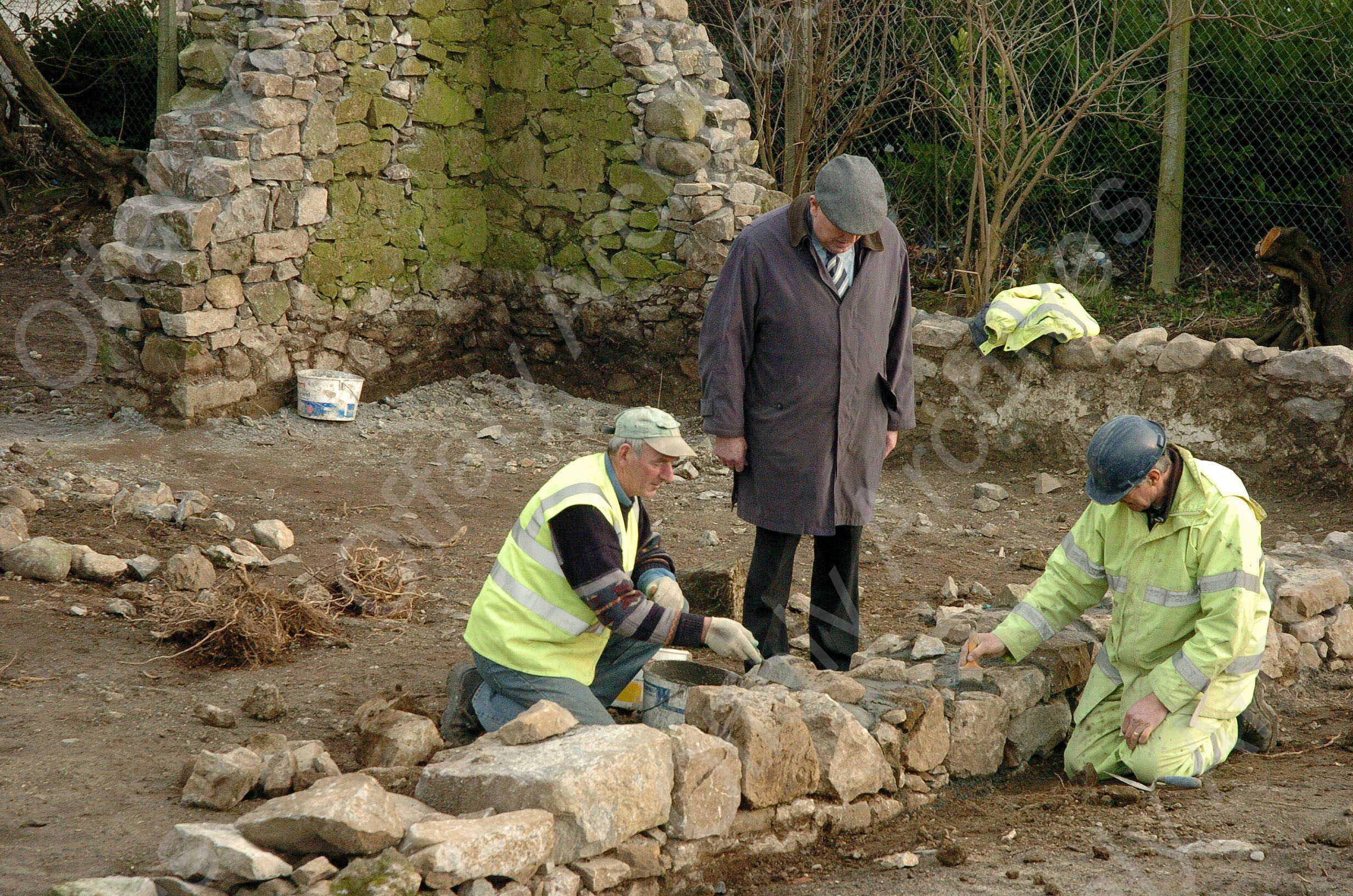
John Flanagan, builder overseeing the restoration work at BallyduffThe old Catholic church at Ballyduff was erected in 1775 and was the first post-Reformation church in Tullamore parish. It was erected in the remote townland of Ballyduff near the centre of Tullamore parish to minimise upset to the authorities at a time when the Penal Laws were still in force. It appears to have been on the boundary of the Coote estate at Srah and that of the Herbert estate (later Norbury) at Durrow –again designed so as to minimize upset to the authorities.
Now the ruin old church is the location for the celebration of a vigil mass early on Easter Sunday morning.
-
Francis Hitchcock’s War: Stand To, A Diary of the Trenches and its legacy. By Ruth Barton. Blog No 129, 13th April 2019
I first came to Lt Col Francis Clere Hitchcock, OBE, MC via his brother Reginald (Rex). I was writing my biography (Rex Ingram: Visionary Director of the Hollywood Screen) about the older Hitchcock, and soon realised that one of the defining influences on his life and work was his close relationship with his brother.

Kinnitty Village about 1910 The Hitchcock family and Kinnitty
The Hitchcocks were born in Dublin, Rex on 18 January 1893, Frank on 15 March 1896. The family moved to Nenagh in 1898, to Borrisokane in 1901, and to Kinnitty in 1903. Their father, Rev. Hitchcock, was a Church of Ireland rector, whose appointment to Kinnitty was prompted by concerns for the health of his delicate wife. Kathleen. Rev. Hitchcock was a man of firm character; alongside his normal parochial duties he was an aficionado of military affairs. He wrote numerous books, some on predictable ecclesiastical matters, others in the vein of the Cultural Revival celebrating old Irish folktales and a pre-colonial past of magic and superstition. He was also a keen boxer, and rigged up a boxing ring in the stables of the rectory at Kinnitty to toughen up the boys. Kathleen, by contrast, was artistic and dreamy, much loved in the parish for her caring manner. Her early death in 1908, when the boys were barely in their teens, threw a pall over the Hitchcock home that Rex for one never fully recovered from. She left behind a material legacy, too, the wonderful wooden carvings on the panels of the pulpit in the Church of Ireland.
-
Mapping Offaly Specially contributed for Offaly History. Blog No 128, 6th April 2019
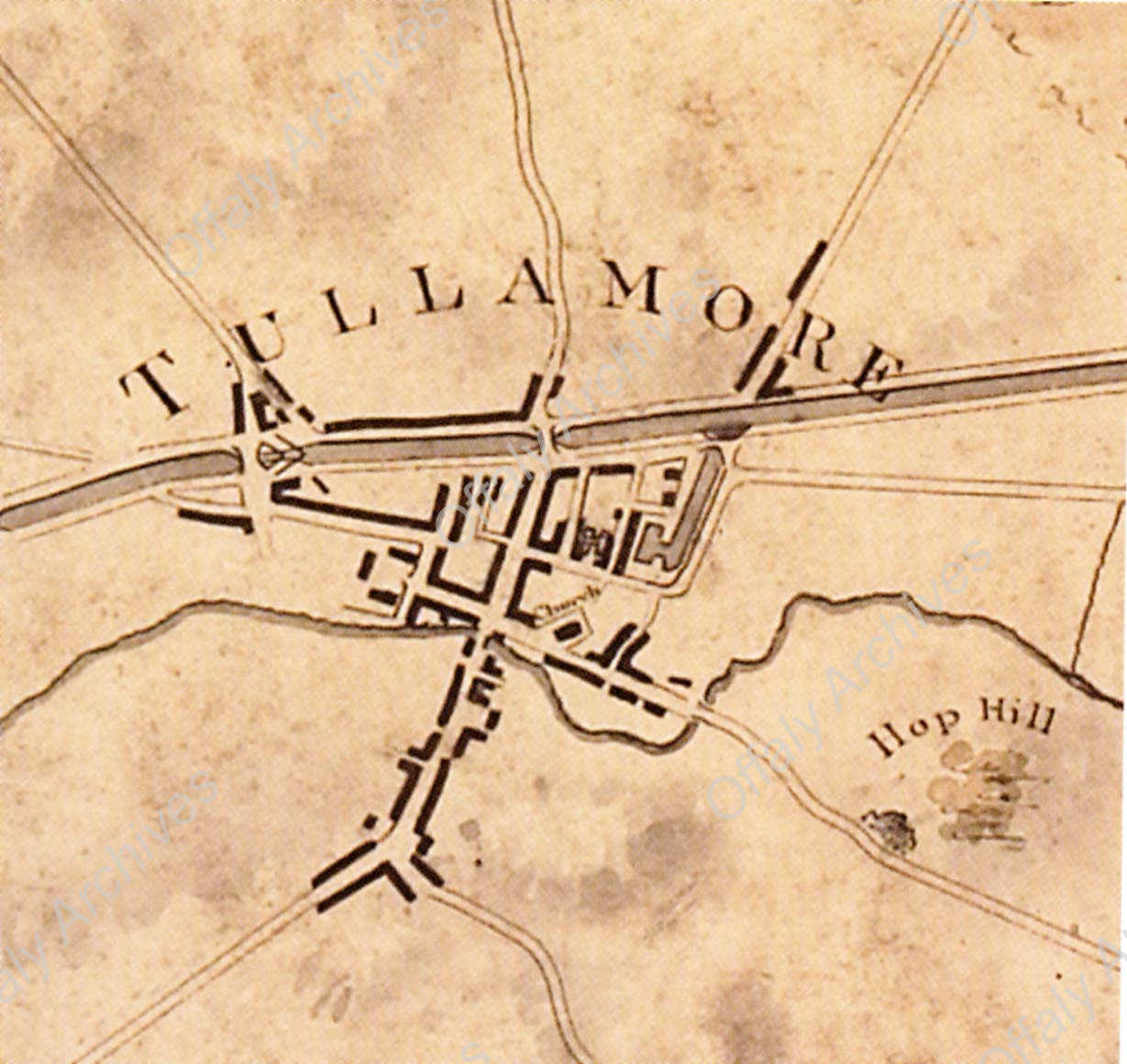
Tullamore from the William Larkin map of 1809. The church had not yet been built at Hop Hill. For Offaly History Mapping Offaly began as a project to map the archaeological sites in Offaly in the mid-1970s. The state archaeological survey was in progress but nothing had been published and some members of the society decided to embark on a project they knew little about but were excited about the prospects. The then president of the Society, Monsignor Denis Clarke, allowed a sum of £50 out of the Society’s savings of £120 to buy a full set of the county ordnance maps of 47 sheets at £1 each from the Stationery Office. This was almost half of the society’s capital and led to the quiet resignation of Society secretary Fr Conor McGreevy. When he saw that the young students joining up at that time were serious he came back to his history flock and went on to publish a history of Killoughy with the PP of Kilcormac. (more…)
-
Ballinagar fifty years ago by John Malone of Ballinagar Historical Society. Blog No 127, 30th March 2019
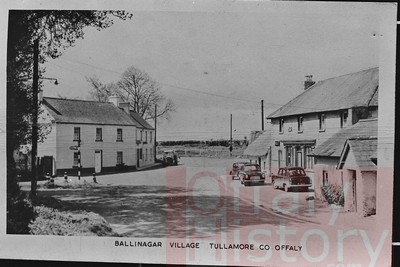
Ballinagar 50 years ago was a much smaller place than it is now. There were no housing estates, no streetlights or footpaths. There was a row of cottages on the Geashill road and a few houses in the village. Close by was a church and a run-down hall which was the old school. The school was a two- roomed school with a prefab at the back. There was a shop and a post office where Coco heat is now and beyond the school on the Cappincur road was the ruins of an old hall. Across from the school was the schoolmaster’s house. Opposite the church was a thatched house. There were a few thatched houses just outside the village. There was no cemetery or football pitch. There were the two sets of pumpsticks, one on the Geashill road and the other on the Killeigh road. There was the remains of an old forge on top of what is now called Crowley’s lane and there was another forge at Ballycommon cross called Gorman’s forge. There was no water or sewage scheme at the time but there were a couple of pumps in the village where people got their water.
-
The Papers of St Stanislaus College, Tullabeg. By Damien Burke and Lisa Shortall. Blog No 126, 23rd March 2019
Offaly Archives is pleased to announce the publication of the catalogue of the Papers of St Stanislaus College, Tullabeg, the result of a collaboration with the Irish Jesuit Archives, Leeson St, Dublin, where the papers are permanently housed. This blog outlines the history of the college at Tullabeg, the scope of what is contained in the archives and how to access the online catalogue.
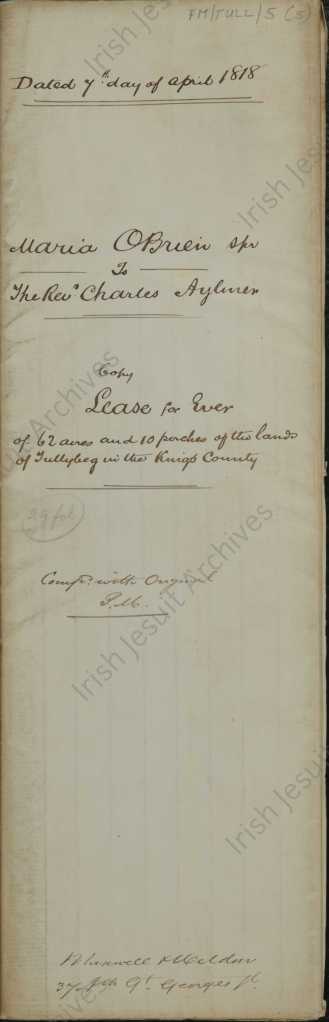
The Jesuit community at Tullabeg (St Stanislaus College), Offaly was established in 1818, four years after they were restored as an order. Tullabeg was initially intended to function as a novitiate (training centre for Irish Jesuits) and a suitable site was offered in 1815 by Ms Marie O’Brien (1765-1827), of Rahan Lodge. She had also helped the Presentation Sisters establish a convent nearby at Killina. When the Tullabeg building was complete, the idea of novitiate was abandoned and the new foundation served as a feeder school for Clongowes Wood College, Kildare. Tullabeg rarely counted more than forty pupils, all of them below early teens and the pace of life was unhurried. Drama, debates and sport (gravel football and cricket) were encouraged, and facilities followed. The appointment of Fr William Delany SJ (1835-1924) as rector, transformed the College educationally. Pupils were matriculated and examined successfully for BA degrees at the University of London, and later at the Jesuit-run University College, Dublin.
(more…)
 offalyhistoryblog