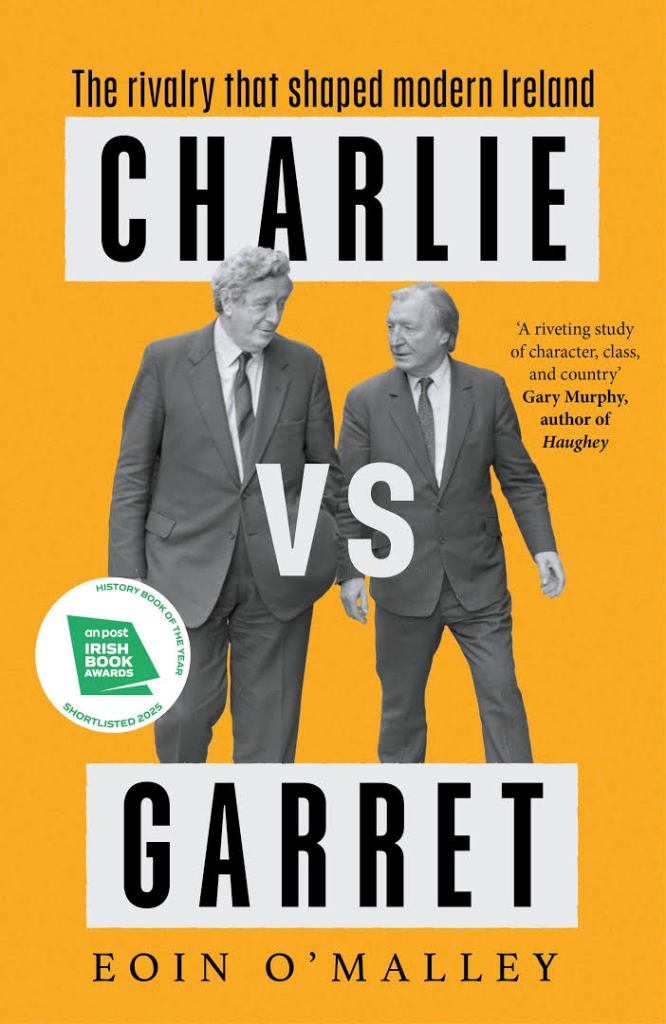
Today we mark the 100th anniversary of the birth of that hugely popular politician Garret FitzGerald. An intellectual in politics he was greatly respected in Ireland, Britain and Europe. Recent estimates such as that of Eoin O’Malley’s Charlie vs Garrett (2025) have not been so flattering to his handling of the economy in the 1980s. And yet his achievements and those of John Bruton have underestimated their roles in bringing peace to Northern Ireland.
FitzGerald, according to the DIB life by Patrick Maume (summarised here) was one of the most influential Irish political figures of the late twentieth century, known for his intellectualism, his commitment to European integration, and his efforts to modernise Irish society. Born in Dublin to the prominent revolutionary and cabinet minister Desmond FitzGerald and his wife Mabel McConnell, Garret grew up in a household steeped in politics, culture, and international connections. His parents’ mixed religious backgrounds—his father Catholic, his mother Protestant—shaped his lifelong interest in reconciling Irish identities and overcoming sectarian divides.
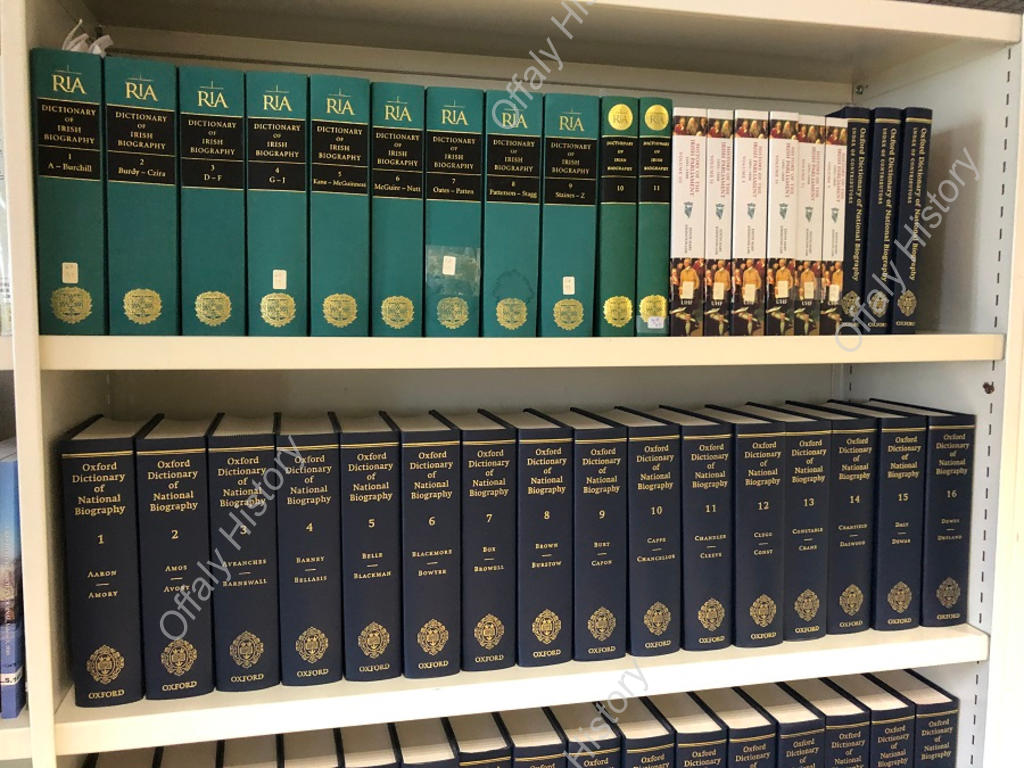
The DIB (above in green binding) runs to eleven printed volumes and is now online and free to use – a wonderful resource.Pic from Offaly History Centre.(more…)
Timothy Daniel Sullivan MP published Prison Poems; or Lays of Tullamore in 1888, printed by The Nation at 90 Middle Abbey Street, Dublin. What are these about? What made Sullivan write them?
[Before moving to that we wish to congratulate the authors on the issue of the new annotated edition of Prison Poems; or Lays of Tullamore from Terry Moylan and Pádraig Turley and published by Offaly History with the support of the Decade of Commemorations funding. The book is now on sale and is available from Offaly History Bury Quay and online at www.offalyhistory.com. Ed.]
These were written during a most tempestuous, unsettled, tumultuous decade in Irish history, the 1880s. The Land War was at its height under the leadership of Charles S. Parnell. The campaign for Home Rule had turned to dust. William Ewart Gladstone the British Prime Minister had brought forward a Home Rule Bill in 1886, which by today`s criteria might appear modest, but for its time was seen as revolutionary. This set off alarm bells which would do irreparable damage to the ruling Liberal Party.
As this year is the fiftieth anniversary of the death of Eamon de Valera it is probably a good time to recount meeting this towering (literally) but often controversial figure.
It would now appear to have been discontinued, but in those days the newspapers regularly printed a sort of Court Circular announcing the official engagements of Uachtarán na hÉireann. Dev’s visitors seemed to be drawn almost exclusively from visiting American priests and nuns, so in 1970 I wrote him a rather provocative letter accusing him of being out of touch with ordinary Irish people – especially go ahead modern youngsters such as myself and my wife Brid. How could he possibly know what was happening in the real world!
The year 2024 saw the local and general elections held and, of course, voting was by secret ballot. The polling centres of 2024 were remarkably quiet as if one were attending confession in a quiet corner of a church. Long gone were the days when a glass of Birr or Banagher or Bernie Daly’s Tullamore whiskey would be proffered by candidates or their agents to thirsty voters. The right of secret ballot extends back to 1872 and the Ballot Act. Before that time voting was in public and held in the towns in Offaly of Tullamore, Birr and Philipstown (Daingean).The Birr-based Chronicle newspaper had thought to describe the polling booth as the voter having to go ‘behind a screen, a la Punch and Judy mode, and there make the sign of the cross with a pencil on the voting paper opposite the names of the favourite men’. This was 50 years before the STV (single transferable vote was used in parliamentary elections in 1922 (see note 5 below) The Chronicle had noted in 1872 the emergence of the polling districts and the practice before 1872 in parliamentary elections:
Formerly, [before 1800] the county sent six members to the Irish Parliament, two for the county at large, and two for each of the boroughs, Philipstown and Banagher; but since the Union its representation has been limited to the two members for the county, and in 1836 the number of registered votes amounted to 1700. The election under the new Ballot Act will, of necessity, assume a different form, and will not be confined to Tullamore, Parsonstown and Philipstown.
As we wait the outcome of the General Election today (30 Nov. 2024) we could look back to 1969 when Offaly returned three TDs in the five-seater Laois Offaly Constituency.[1]
How many in Offaly did not vote yesterday? We should recall that between 1885 and 1922 there was no opportunity to vote in North Offaly save in the Adams- Graham by-election of 1914 when Graham won by 79 votes as an unofficial candidate not backed by the Irish Parliamentary Party.
For the 1969 general election the slogan was ‘Let’s back Jack’. It was a campaign in which Fianna Fáil ran five candidates and secured three seats in Laois-Offaly. Tom Enright of Fine Gael picked up the O’Higgins seat. None of the winning candidates was from Tullamore. It was a reflection of the fact that Fianna Fáil (F.F.) back to the late 1920s, was strongest in Clara, Ferbane and west Offaly. In the event Offaly secured three new TDs and a first for the towns of Clara and Birr where Ber Cowen (F.F.) and Tom Enright (F.G.) were elected while Ger Connolly of Bracknagh was elected for F.F., having been added to the ticket. Fianna Fáil, with the help of some adroit redrawing of boundaries, secured two more seats than they had in 1965, and Labour had set itself against a coalition. Fianna Fáil won 51.7 of the seats with 45.7 per cent of the votes.[2]
Recently, I walked Clara’s Main Street and was again reminded of its relative short length and the relatively small size of its adjoining, almost hidden, Market Square. A square and street where much trade, barter and banter, laughter, disagreements, or agreements on family member marriages, and heated discussions on political reform, occurred on a regular basis for hundreds of years.
Many local hostelries were frequented, where typically a farmer and his wife and family would come to settle bills, visit the local medic for advice, or attend religious services. Today the square is modernly paved, almost hidden and its well-maintained former Market House now tucked away from the passing motorised traffic. Sadly, as in the case of many Irish provincial towns several old buildings have fallen into a state of disrepair and exude an aura of reduced circumstances.
Back in 1826, Clara’s Main Street and Market Square was a hive of activity and was where many notable families conducted their commercial business and resided upstairs. As I strolled the street and looked above the ground floor level of today’s shop fronts, I wondered who were these former resident families and what ever became of some of them?
Clearly, this is just a chosen snapshot of some Clara families, and I would be keenly interested to hear from family members of their stories from those days’ past.
The weather was bad when Joseph Hutchinson arrived in Tullamore. For 22 years Hutchinson had dedicated himself to the Irish National Foresters and as a result a small mutual aid society founded by 18 men in Dublin, had spread across the globe and recruited over 20,000 members in Ireland. On Sunday 9 April 1899, Hutchinson had come to the midlands to recruit some more members and establish the first INF branch in King’s County. His visit that day would have profound repercussions for Tullamore, but it had its roots in the north of England.
The death of Ger Connolly at Droimnin Nursing Home, Stradbally on 25th January 2024 marks the end of an era in the political life of County Offaly.
Aged 86 Gerard C (Ger) Connolly was a former Fianna Fáil councillor, TD and Minister of State who might best be described as the great survivor of Offaly politics, with an unbroken record as TD from 1969 until his retirement in 1997. He was witness to and an important figure in some of the most turbulent times in Irish politics, as a devoted supporter of Charles J Haughey during the Eighties.
His entry onto the national stage and his electoral record mark him out as one of the most significant figures in a five seat constituency with no shortage of political titans including a former Taoiseach and three former cabinet ministers.
Colourful, engaging and often provocative in political debates Ger Connolly was hugely popular throughout the constituency, securing first preference across traditional party boundaries, especially in North Offaly. He loved the cut and thrust of politics and his one liners and bot mots, delivered with theatrical flair, often enlivened debates in Offaly County Council and Dáil Eireann.
He was also a diligent constituency worker and as Minister of State made a significant contribution to the implementation of new policies on urban renewal and inner city development.
Strongly supportive of the construction industry and a firm believer in encouraging private sector development he relished his role as Minister of State at the Department of the Environment. He had a reputation as a decisive Minister of State and enjoyed good relations with civil servants, often surprising those who might have initially mistaken his mischievous smile and faux distain for detail.
There is a popular saying in politics sometimes attributed to Ronald Reagan ‘When you’re explaining, you’re losing
History often involves explaining, but in recent times I’ve regularly watched people’s eyes glaze over as I described my latest research project.
Q: What’s it called.
A: ‘A Revolution in Profiles’.
Q: What’s it about.
A: Its about Offaly in the Revolutionary Decade.
Q: Okay. How many words in it?
A: Over 60,000, but it’s divided into profiles, each about 600 words long
Q: Is it a book?
A: No, it’s a website with over 100 different profiles of people from the period.
Q: So, it’s a blog?
A: Not really, it’s modelled on the RIA’s Dictionary of Biography.
Q: How much are you charging for It?
A: No, there’s no charge. Access is completely free. The RIA provided a bursary to build the website as part of the Decade of Centenaries programme, but anyone can view the profiles and there’s no fee.
At this stage the questioner runs the entire gamut of emotions from confusion, disbelief, pity and finally suspicion. ‘If its free there must be a catch’.
If we’re lucky the conversation shifts to the height of the Shannon or which senior clubs are still looking for a hurling manager, if not it peters out into a prolonged awkward silence.
‘I’ll tell what it’s not’
The site is not a definitive history of Offaly in the revolutionary period. That will come later, written by others more qualified to do so. It is a reference tool designed to educate on and simulate interest in Offaly’s revolutionary story. In time perhaps it may provide other researchers with a foundation from which a deeper understanding of the era might be developed. One of the ways it aims to do so is providing readers with the opportunity to compare and contrast different people from the period.
Don’t tell, show me!
Mark Twain reportedly once said ‘Don’t just say the old lady screamed. Bring her on and let her scream!’ Having struggled to explain the site, I usually take a leaf out of Twains book an give an example. Offaly History have been kind enough to host two profiles from the site dealing two elected officials.
The People’s Choice
Between 1918 until 1923 the constituencies of Kings County and Laois-Offaly were represented by Dr. Patrick McCartan. A leading member of the Irish Republican Brotherhood from Tyrone; McCartan spent most of those years on diplomatic missions to the United States and the Soviet Union.
Meanwhile Hugh Mahon from Killurn outside Tullamore sat as a Labor representative in the Australian Parliament until his expulsion in 1920. His ejection was carried out in response to Mahon’s public condemnation of the British Empire in the aftermath of the death of Terence MacSwiney on hunger strike in Brixton prison.
Mahon and McCartan’s biographies are among 30 extra profiles which will be added to the site over the next year, but for now the focus centres on two other parliamentary representatives from Offaly, representing two different traditions. Frank Bulfin and Sir Robert Woods.
Frank Bulfin
Frank Bulfin was born in 1874 at Derrinlough, where his parents William and Ellen Bulfin (nee Grogan) owned a large farm.
His uncle Patrick Bulfin acted as Lord Mayor of Dublin and a cousin General Edward. S. Bulfin served with distinction in the British Army during the Boer and Great Wars. In 1900 it was reported that Frank’s brother, J.V. Bulfin had died while serving with the Rimington Guides in the Boer War. Frank and his brother Joe (who was later associated with Clonony and Edenderry) were keen agriculturists. During the Ranch War both men were vocal advocates for small farmers and imprisoned for their involvement in cattle driving.
Frank’s uncle Fr. Vincent Grogan served as provincial of the Passionist order in Argentina. The South American connection was to have important ramifications for the family, as Frank’s older brother William emigrated to Argentina where he enjoyed considerable success and eventually became owner of the Southern Cross newspaper. On his return to Ireland, William Bulfin helped to stabilise the Derrinlough farms finances, wrote a popular nationalist travel book Rambles in Erin, promoted the Gaelic League and political movements of his friend Arthur Griffith. William died aged 45 in 1910.
William’s son Eamon attended St Enda’s school and fought under his former teacher Patrick Pearse in 1916 Rising.
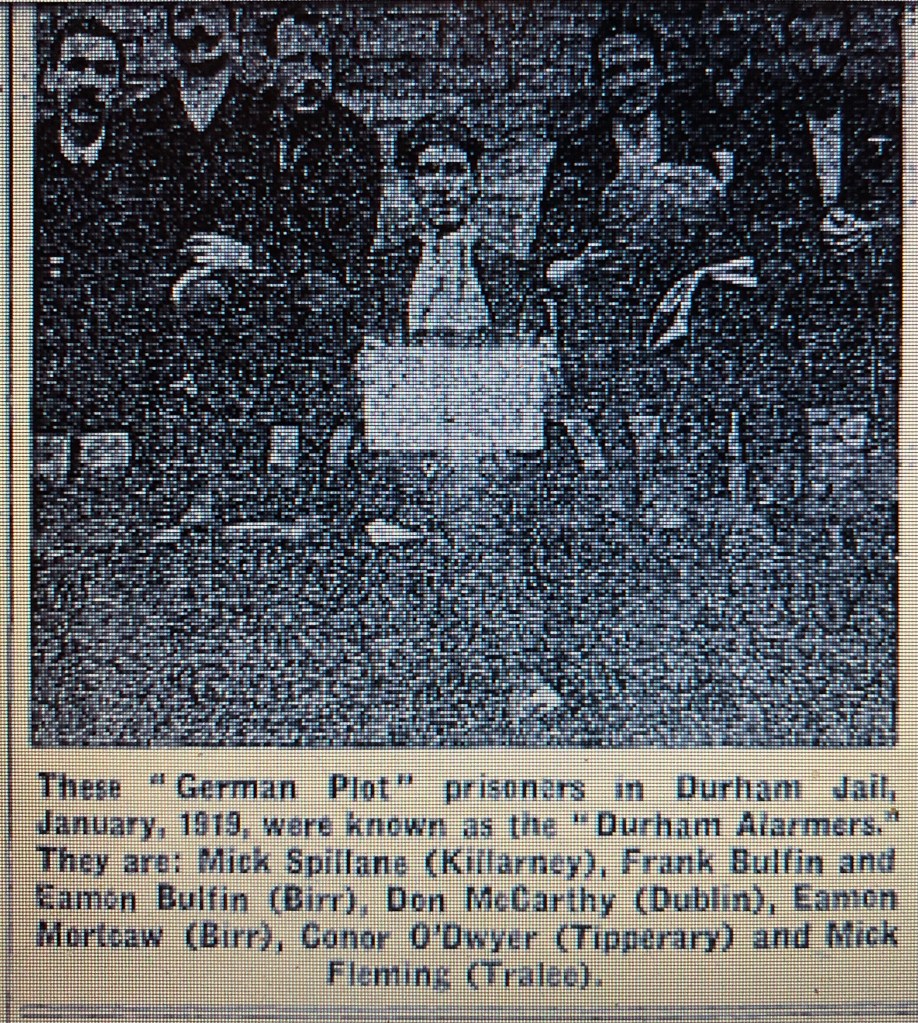
Following the release of republican prisoners from internment in late 1916, Eamon and Frank were involved in establishing the republican movement in south Offaly. They were arrested as part of the German Plot in the Summer of 1918 and imprisoned in Durham Gaol. Eamon was later deported to Argentina where he acted as an emissary for the republic during the War of Independence.
On his release from prison Frank Bulfin returned to Derrinlough, where he was involved in sheltering Sean Treacy, Seamus Robinson, Sean Hogan and Dan Breen during the summer of 1920. The so called ‘Big Four’ were on the run following shootings at Soloheadbeg and Knocklong.
Nominated as one of four Sinn Féin candidates, Bulfin was elected unopposed in the Laois-Offaly constituency at the 1921 general election. Arrested and interned at the Curragh, he was released with other TDs in August following the arrangement of the Truce.
Bulfin did not take a high-profile stance during the Treaty Debates but voted to accept the agreement. He was re-elected in the pact election. His nephew Eamon opposed the treaty but took no part in the Civil War following his return from South America and Frank’s niece, Catalina ‘Kid’ Bulfin a member of Cumman na mBan went on to marry well known anti-treaty republican Sean MacBride.
In August of 1922, Frank Bulfin was one of the pall bearers who carried Arthur Griffith’s coffin.
Although he rarely spoke in the Dáil, Bulfin continued to vote with the Cosgrave Government throughout the Civil War. In a statement to the Bureau of Military History Ernest Blythe suggested that because of republican intimidation, Bulfin attempted to resign his seat, but after the intercession of armed Free State Intelligence officers was convinced…
‘It might be more dangerous to resign from the dail than stay in it’. (1)
The veracity of Blythe’s story is difficult to authenticate.
Addressing an election meeting in July 1923 Bulfin commented…
‘Many unpleasant things we have had to do —many very distasteful decisions had to bemade, but we never sought popularity at the expense of the real interests of the nation’. (2)
After his re-election, rifts appeared in Cumann na nGaedheal. Bulfin did not support the Army Munity of 1924. Nevertheless, he was understanding of those who left the party at that time to establish the National Group and critical of some in the cabinet whom he felt were self-important and drifting too far from the party’s roots in Sinn Féin commenting …
‘Let these people not get their heads swelled. Greater men than they, Griffith and Collins, had to be done without.’ (3)
At local level his electoral machine was considered ineffective, and he lost his seat in 1927.
In the 1930’s Bulfin moved to Barrysbrook, Croghan close to his mother’s birthplace and farmed there until his death in 1951. He was buried at Rhode cemetery.
Sir Robert Henry Woods
Robert Henry Woods was born at Tullamore in 1865. His father Christopher and mother Dorothea (Lowe) operated a shop and held property in the town.
Sir Robert Woods
Educated at Wesley College and Trinity, he qualified as a doctor. An expert on the ear, nose and throat; Woods was considered a world leading physician. President of the Royal College of Surgeons he was knighted for his services to medicine in 1913.
His son Thornley died in 1916 while serving with British Army in Flanders.
In 1918 general election Woods was elected to Westminster for the National University constituency, a seat held until 1917 by Edward Carson.
Elected as an Independent Unionist, Woods was a moderate in personality and politics. He did not take up his seat at the first meeting of the Dail in January 1919. However, unlike other unionist MPs he did send a formal reply to decline his invitation to attend.
In July 1921 he was part of a delegation of southern Unionists who met with Eamon de Valera in the Mansion House Conference which facilitated the announcement of the Truce.
A rare contributor at Westminster, he made his last speech there in the aftermath of the signing of the Treaty when he told the House of Commons…
‘I hope the Prime Minister will permit me to offer him my congratulations on having brought this Conference to so successful a conclusion. If I may say so without offence, he has done a big thing, and he has done it in a big way. The Unionists in the South of Ireland have received the news of this agreement with feelings of satisfaction that can only be appreciated by those who have lived there in recent years, and perhaps by those who have got imagination to visualise what would have happened had these negotiations fallen through. I think I am correct in saying that the majority of Southern Unionists have for a long time seen that there was no other possibility of settlement of the age-long struggle, and the healing of this Irish sore, except through a Conference… I believe that the end of this Agreement will be an accession of strength, not only to Ireland herself, but to the peace and the prosperity of the world at large, and particularly of that great community of nations of which Ireland will, in the future, herself form an integral part.’ (4)
His last political intervention was an unsuccessful run for the Senate in 1925.
A collector of antique furniture, he was also musical enthusiast, president of the Dublin Zoological Society he donated several animals to the Zoo following trips to Asia.
Robert Woods died at his home in Marino in September 1938 and was buried at Deansgrange Cemetery. At his own request the funeral service was private and attended only by his immediate family and household staff.
On his death the Irish Independent commented…
‘Although a Unionist, his liberal and free-minded attitude on all Irish questions was very marked. Rather abrupt and unconventional in manner, the late Sir Robert was a man with a big heart. He was charming in private conversation and his humour was never hurtful, while his wit was always kind. He was extremely popular with his professional colleagues and was ever helpful to the young men attending’ his school. Physically a splendid type of Irishman, he was a familiar figure in Dublin, his broad shoulders, well-shaped head and rugged- features arresting attention.’ (5)
In the last blog we noted that the August 1923 General Election in Laois-Offaly was remarkably peaceful given that the civil war had only ended in May. Offaly was still strong in support for the Republicans as was clear from the fact they gained two seats, but, of course, were committed to not entering the Dáil. Labour’s William Davin continued to have a strong vote but not nearly so much as in June 1922. Tullamore’ Patrick Egan gained a seat on Labour transfers. Egan polled only 9 per cent of the first preferences.[1] In Laois-Offaly the Republicans outpolled Cumann na nGaedheal, but the latter won the by-election of 1926 created by the disqualification of Republican John or Séan McGuinness.[2] Overall Cumann na nGaedheal secured 38.9 per cent of the 1923 vote as to anti-Treaty Sinn Féin’s 27.4 per cent.[3] The Sinn Féin vote was secured in difficult circumstances with many still in prison or in hiding. As Joe Lee recorded the outcome was a resounding success for anti-Treaty Sinn Féin and a loss for Labour. Cumann na nGaedheal secured 63 seats, but that was a gain of only five in a Dáil enlarged from 128 to 153 seats. This was the election in which the franchise was extended to all women over the age of 21, thereby expanding the electorate from 1.37 million in 1918 to 1.72 million in 1923.


 offalyhistoryblog