
You might wonder what was Library Hall used for before being transformed into 15 apartments in about 1995 with a new block of ten to the rear (PD 2824). Yes, some will recall when it was the county library and the happy hours borrowing books and perhaps sitting in the large windows or close to its pot-bellied stove in winter. That was almost fifty years ago. From 1923 to 1927 the building served as the first garda station in Tullamore. And before that: yes, it was the county infirmary or county hospital from 1788 to 1921. How many beds? It had 50 and thirty were generally in use. Budget was £2000 per annum by 1920. That might get you ‘a procedure’ now or a very ‘short stay’.
(more…)Category: pubs and entertainment
-
The leasing of plots or sites for building in Church Street, Tullamore from Lord Charleville to his tenants, 1786–1830s. Part 2. By Michael Byrne and Offaly History. In the Offaly History series on Church Street, Tullamore: houses, businesses and families, over 300 years. No 9 in the 2025 Living in towns series prepared with the support of the Heritage Council. Blog No 751, 27th Sept 2025
Table 1: Buildings erected in Church Street, Tullamore from 1726 to 1924
Here we present a summary of the discussion in the last blog on the leasing of Church Street. GV 1 was up to 2000 the old Hayes’ Hotel erected in 1785-6 and having a long garden as far as the Methodist church. Beyond the church is the terrace of 13 houses, the former infirmary and five smaller houses to the river.
On the north east side were two smaller leaseholds and the Charleville School.

To follow things see the 1838 map, that of 1890, the leaseholders map and the Griffith Valuation map. Enjoy!

The OS six-inch 1838 map of Church St 
The Griffith valuation map for most of Church Street of 1854. It can be viewed on Ask About Ireland site. A handy summary of the Valuation of 1854 with notes by MB
Griffith val. 1854 No. Street Date of construction Lessee Immediate lessor in GV 1854 Lease details GV 1 Church Street GV 1 to 5a 1785, or may be a reconstruction in that year– Reps John Tydd in respect of GV 1 to 5a, for ever John Towers Lease for ever of frontage from Bridge Street to Methodist church of the hotel site on Church Street SW GV 2 Church St House on hotel plot Sublease to Henry Mulholland as in GV George Ridley Ridley succeeded Tydd, Towers and Doherty GV 3 do do Sublease to Michael Delaney as in GV do part of hotel lands GV 4 Sublease to John Lynam as in GV John Tidd part of hotel lands GV 5 Sublease to Mary Lynam as in GV John Tidd part of hotel lands GV 6 Pt of garden of Cuddihy below May predate Cuddihy lease of 1805 Henry Manly of Charleville Sq The haggard garden carved from the Cuddehy plots south of Methodist church GV 7 Church Street GV 6 and 7 1788 Methodist church site in place of destroyed preaching house in Bride’s (Swaddling) Lane. GV 6 is garden behind preaching house and haggard in Tarletons no 6 Charleville Sq No lease sighted for church, 33 ft in front. The haggard was part of Charleville Square House up to late 1930s GV 8 Church Street GV 1805 plus Lease to Michael Cuddehy, Lord Charleville’s mapping surveyor, 1805 of three plots 96 ft in front by 248 sq ft containing 0.1.15 , plot 1 Lyddon. House with two front doors. Let from Revd R.T. Tracey Copy lease with map in OA. Yard at no. 6 part of Cuddehy leasehold and sublet to Manly of GV 6 O’Connor Square GV 9 Church St GV do Cuddehy plot 1 Revd William Molloy House with two front doors. Let from Revd R.T. Tracey GV 10 Church St do Cuddehy plot 2 Sublease to Thomas Stanley (Book Stanley, antiquarian) features in RSAI jn GV11 Church St do Cuddehy plot 3 Miss Catherine Cuddy immediate lessor Christopher Woods, distiller GV 12 Church St do Plot 4 in the terrace to Charles Warren, 32 ft in front. Richard Warren immediate lessor GV let to Miss Turpin GV 13 Church Street do Plot to Darby Hyland, 32 ft in front Abigal McDonnell Let to Revd R. F. Tracey GV 1854 GV 14 Church Street Plot to Daniel Warren, 32 ft in front Mrs Daly Let to Mrs Anne McDonnell GV 1854 GV15 Church Street 3 Plots, 1 to George Slator 96 ft Reps Revd Nath. Slater GV 1854 Thomas Briscoe GV 16 Church Street 3 Plots, 2 to George Slator 96 ft do Francis Dorman GV 17 Church Street 3 Plots,3 to George Slator 96 ft do James H. Marshall GV 18 Church Street 3 Plots,3 to George Slator 96 ft do William W. Philips GV 19 Church Street 2 plot 1 plots to Robert Belton, Wm K. Fawcett GV Vacant, related to Michael Molloy d. 1846, the distiller and Anthony M. died 1851. GV 20 Church St 2 plots 2 to Robert Belton, temporary barrack do GV Vacant GV 21 Church Street 1788 3 plots 2 to Robert Belton, temporary barrack do The third house on two plots GV James Reilly GV 22 Church Street 1788 No lease King’s County infirmary 86 ft in front Held from head landlord the earl of Charleville GV 23 Church Street Mrs Jordan original lessee Held from Thomas Duggan Occupier GV John Pilkington GV 24 Church Street Samuel Woods Held from earl of Charleville Occupier GV Christopher Woods GV 25 Church Street Held from Elizabeth Woods do Occupier GV Christopher Woods GV 26 Church Street do do Occupier GV George Whitten GV 27 Church Street Pound and House see pic with this blog Held from earl of Charleville Occupier GV Christopher Woods GV 28 Church Street 1869 vacant and later Feehan fowl store, now part of a new 2025 terrace in yard do Occupier GV Thomas Clooney GV 29 Church Street Mary Lynam Occupier GV Charles Crowley GV 30 Church Street Mary Lynam Occupier GV Maurice Summers GV 31 Church Street GV School house and yard, opened 1811 Held from earl of Charleville. The female school was in Henry/O’Carroll Street Charleville Schol boys, on the former Fair Green plots fronting Henry St GV 32-49 and Market Lane 1-12 Late Robert Belton George Slater for ever 398 ft in front in 1854 Thomas F. Slater 17 houses, and one office building let to Sterling. This holding included the 12 cabins in Market Lane or Church Lane (Pike’s Lane) valued each in the range of 10s to 15s. From Sterling to Henry Street incl Market Lane. Nos 48 and 49 let to Thomas Sterling by T F Slater and part sublet to James Byrne GV 50 Church St Mr Sterling A plot occupied by Thomas Sterling from earl of Charleville and probably formed part of the curtilage of the 1726 church Laneway not rated Garden [now Market Lane access to The Cornmarket Earl of Charleville In GV called Corn Market Lane GV 1 Church St but from Market Square Meat Market (Shambles) Do. Tolls of shambles and corn market let to Robert Willis by 1854. In 1843 with Sterling. Site with part of the Michael Byrne plot of the 1726-1815 church GV 51 Church St Michael Byrne plot 1 Immediate lessor John Perry GV occupier Thomas Magill, much later Morris drapery GV 52 Church St Michael Byrne plot 2 GV occupier John and A Warren GV 53-57 Church Street and 1 Columcille Street Church St 44’ 6 inch to William Street and 192 ft to Church St (180 ft by lease) Immediate lessor John Slater from earl of Charleville Five houses held by John Slator GV 1854 occupiers – Atkins, Duggan, Little, Irwin and Nugent, valued in range of £4. 10s. to £8. 10s. 
Church St on the five-foot scale, surveyed 1885-90. 
The Griffith map of 1854 – available on Ask about Ireland.com Thanks to the Heritage Council for support to Offaly History in preparing this article.

-
Church Street, Tullamore: houses, businesses and families, over 300 years: the well-known Hayes’ Hotel (Phoenix Arms), now Boots Pharmacy. By Michael Byrne and Offaly History. No 2 in the 2025 Living in Towns series prepared with the support of the Heritage Council. Blog No 738, 9th August 2025
It is strange that we should start with the most modern of buildings in Tullamore completed in 2001 and since 2015 Boots Pharmacy. Prior to that it was Menarys fashion and homeware and opened in 2001 as #1 Bar and Restaurant. It is the newest of the new buildings in the town and replaced one of the oldest – Hayes’ Hotel. The hotel was built in 1785 as a new hotel for Tullamore but was perhaps a refurbishment and not a new build.
The building is in a strategic location with four streets intersecting and was known for many years as Hayes’ Cross. The original building was L-plan in shape not unlike no 3 in O’Connor Square (the insurance brokers) and its neighbour south of the river Flynn’s bakery, also L-plan until street widening in 1938 removed the two front rooms to Bridge Street. The hotel was on the south-west corner of the narrow part of Church Street – the oldest part dating back to at least 1726 when the first Protestant church was built in what was later the Shambles and market south of the Foresters Hall, now as to the ground floor a Thai restaurant.
(more…)
-
Another brisk walk this Saturday in Tullamore to visit Harbour Street and the Canal Quarter. Tullamore Tour Saturday 12 July, 11 a.m. to 12 30 p.m. to include Harbour Street, Deane Place, Market Square, Gas Works Lane, Canal Harbour, O’Carroll Street, Store Street, Benburb Street and Chapel Lane. Blog No 729, 9th July 2025
Walk around Tullamore’s canal quarter with Michael Byrne as guide. Find out where was Charles Street, Deane Place and Gas Works Lane. Where did Lord Tullamore live before the family moved to Charleville in 1740. When did the canal arrive. Was there a barracks there before that? Where was Pentland’s Distillery. Who was the Thomas in Thomas Street? Find out where the largest meeting in Tullamore was held and why. Take care and thanks to our yellow-jacketed stewards Shaun and Pat and to Helen and friends for assistance with the teas.
We meet at Offaly History Centre, Bury Quay (beside new Aldi and Tullamore Old Warehouse restaurant) for ease of parking from 10 30 a.m. All are welcome and the tour is free. Tea/Coffee/scones available from Offaly History Centre from 10. 30 a.m. Bathrooms available. We walk to Harbour Street through the new Aldi car park (over the former Williams oats store and Irish Mist warehouses and into Offally (sic) Street or Wheelwright Lane).
Harbour Street
Developed over the period from 1800 to 1825 it could be described as the opening to the canal quarter facilitating access to the new streets at Deane Place, Market Square, Chapel Street, Store Street, Gas Works Lane and O’Carroll Street. Surprisingly for such a great artery it was never an important trading street. The harbour takes up much of the eastern end of the street together with the great distillery of the 1820s – now the Granary apartments. The original name here was Charles Street and this can be seen carved in stone on the corner with O’Carroll Street.
(more…)
-
Christopher Maye of Tullamore and Mullingar: a man for others and loved by all. An appreciation Article , Offaly History. Blog No 717, 31st May 2025
It is rare that it can be said of a businessman that he was loved by all. In the case of Christy Maye it is true he held the loyalty, respect and love of all who came to know him, whether as an employee, customer, supplier or competitor. He was a successful businessman, builder, hotelier but above all an entertainer. And more than that he was a great leader in the Tullamore community without ever wanting thanks or recognition. This was best exhibited in his championing and leading the Tullamore Show since he largely founded it in 1991, inspired at the time by the Mullingar Show. He was a member of the Tullamore Lions Club since it started in Tullamore fifty years ago.
(more…)
-
Tullamore in the Sixties. A new book of essays on Tullamore in an eventful decade, just published. Blog No 674, 29th Nov 2024
This volume of essays brings together the contributions of eighteen people who kept a keen eye on developments in Tullamore in the 1960s. Perhaps none more so than the late Joe Kenny who came to Tullamore in the 1950s as a vocational schoolteacher and was held in high esteem for his sound judgement and abilities as an impartial chairman. In that capacity he was the inaugural president of Tullamore Credit Union in 1963. Fergal MacCabe, as a Tullamore native, with a professional life in architecture and town planning in Dublin, brings a unique contribution by way of his recollections of Tullamore in the 1950s and his review of the first town plan of the 1960s. The same can be said of Vincent Hussey as a planning officer with Offaly County Council with his recollections of Tullamore since the 1960s. Niall Sweeney, an engineer and former Offaly County Manager, takes a close look at the provision of public infrastructure in Tullamore over the period from the 1960s to 2014. The late Jack Taaffe, as town clerk in Tullamore in 1970–72 demonstrates just how underfunded urban authorities were in those years. He went on to become county manager in Westmeath presiding over the progress of the county from 1981 to 1988. Michael Byrne looks at the history of business in Tullamore and sought to cover the principal enterprises of the 1960s in manufacturing, distribution, shopping, entertainment and dancing. Noel Guerin, as a former employee of ‘the bacon factory’, was able to write of a company that employed up to 100 people in Tullamore over forty years and made the name of the town famous for the Tullamore sausage. Ronnie Colton, from his own extensive involvement in the motor business brings a knowledge from the garage floor and sales yard that few others can match.
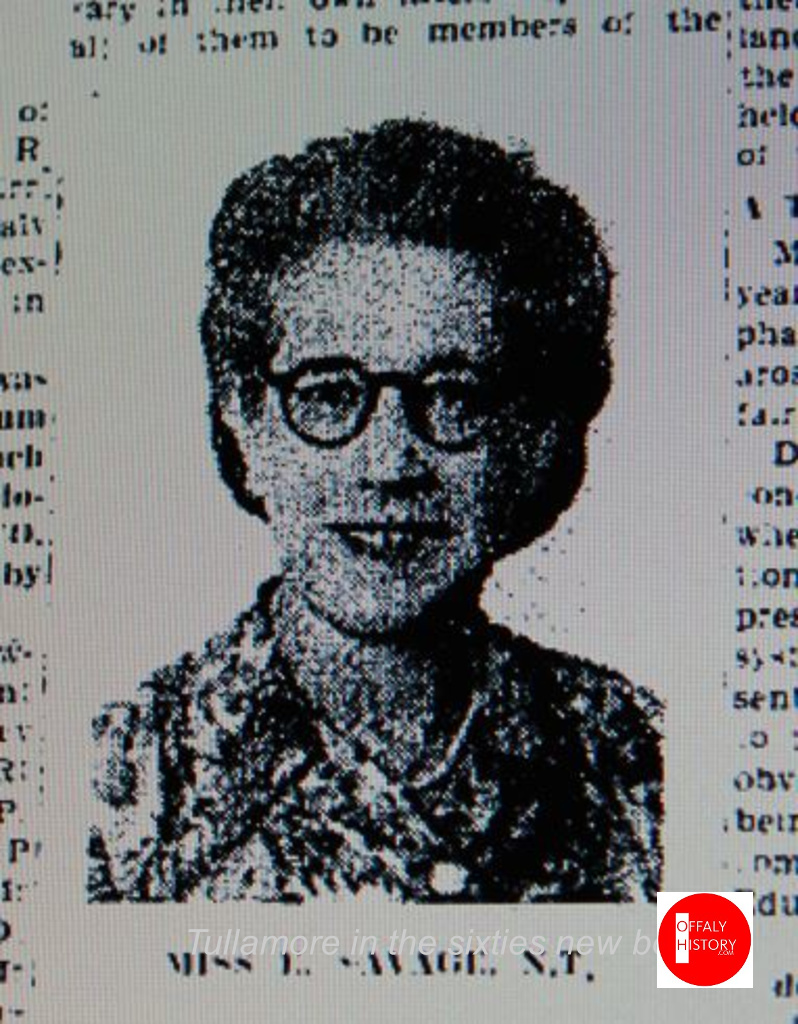
Miss Savage, a well-loved teacher in the Mercy primary school Alan Mahon, as the grandson of an innovative cinema proprietor, recalls two cinemas in Tullamore whose cultural contribution is perhaps forgotten now but was all important to the people of Tullamore and district over a period of sixty or seventy years, if one takes it from the commencement of the Foresters cinema (later the Grand Central) in 1914.
Sport, so important to so many, brings us to the essay by Kevin Corrigan who looks at a formative decade leading on to the GAA Senior Football All-Ireland victories in the 1970s. Kevin had the challenging job of reducing to a short essay what could fill twenty books were one to address in detail each of the sporting activities that came to the forefront in the sixties.
(more…)
-
Memories of Offaly: celebrating the mix of rural and urban life in the 1960s and 1970s by Killina, Rahan man Aidan Grennan. Blog No 667, 6th Nov 2024
Memories of Offaly can best be described as opening a diary into life in Co Offaly, over the last 50 or 60 years. The author of the book is Aidan Grennan, from Killina, Rahan. Aidan is to be congratulated on his second book. Both books are available from Offaly History Centre and online at http://www.offalyhistory.com
‘It is a nostalgic glimpse into the people and events in the county within my own life-time’ said Aidan. He commented: ‘I think it’s important now and then, to take a look-back over the years. I love nostalgia’, though we have to live in the present.
(more…)
-
13 Tullamore Irish National Foresters: One of the oldest organisations in Tullamore. A photo-essay to mark the 125th anniversary, looking at the first 25 years from 1899 to 1924. No. 13 in the Anniversaries Series by Michael Byrne and Offaly History. Part One. Blog No 655, 25th Sept 2024
In March 2024 we published two articles in this series by Aidan Doyle marking the 125th anniversary of the founding of the Tullamore branch of the Irish National Foresters (I.N.F) and the 100th anniversary of the opening of its new cinema in Market Square. As was noted in a Midland Tribune article forty years ago[1] the Irish National Foresters Benefit Society is an organisation about which most people know very little about although the Tullamore (Conn of the Hundred Battles) branch has been part and parcel of the town since 1899. Even less would know of it now save that some its members appear in the annual St Patrick’s Day Parade. In August 1984 the Tullamore branch received a special award at the I.N.F. National Convention to mark its development since it was founded in Tullamore in 1899. The I.N.F. may be the fourth oldest organisation in Tullamore after the Freemasons (1759), GAA Tullamore (1888) and the Tullamore Golf Club of 1895-6.
(more…)
-
Tullamore and the Irish National Foresters 1899-2024. By Aidan Doyle, Part 2, concluded. [We are marking the 100th anniversary of the re-opening the new hall, cinema and club rooms on the eve of St Patrick’s Day 1924 and the 125th anniversary of the founding of the Tullamore branch in April 1899.] Blog No 586, 15th March 2024
In March 1914 the Foresters Hall played host to meeting called organise the Irish Volunteers in the district. Following the outbreak of the Great War and the resulting divisions within nationalism, the Tullamore Corps of the National Volunteers gathered at the Foresters Hall to reaffirm their support for John Redmond. The Foresters branch secretary James Hayes joined the 5th Lancers in early 1916.
In December 1915, the Ideal Cinema was the venue for a screening of ‘Joan of Arc’ in aid of the Red Cross. Two months later, the Urban Council arranged a reception at the hall to present an address to captain Edward Sherlock after the Rahan man was awarded a military cross for his actions on the Western Front. As late as February 1918, the hall hosted a lecture by Henry Hanna KC on ‘The Pals (7th Dublin Fusiliers) at Suvla Bay’ in aid of the Leinster Regiments Prisoner of War fund. Nevertheless, by then the Foresters and their hall had come to be associated extreme nationalism in the mind of some within the police.

A programme for the Foresters in 1916 At a show the hall in on St Patricks Day 1917, a twelve-year-old girl Lena McGinley dressed in a ‘Green, White and Yellow’ costume performed a poem dealing with the 1916 Rising entitled ‘Vengeance’. As a result, sergeant Henry Cronin had the concert organisers James O’ Connor and Edward O’Carroll charged under the Defence of the Realm Act (DORA) for ‘attempting to cause disaffection among the civilian population ‘. On their conviction O’Connor and O’Carroll refused to be bound to peace and were instead imprisoned in Mountjoy.
(more…)
-
16 Those Canal Days at Shannon Harbour in the 1950s recalled by Gerry Devery. No 16 in the Grand Canal Offaly series. Blog No 571, 31st Jan 2024

This evocative piece of writing, describing childhood in Shannon Harbour in the 1950s by Gerry Devery, Cuba Avenue, Banagher won for him the prestigious 1st prize, Autobiographical section in the Writers’ Week, Listowel, Co. Kerry in May 1991. It is one of my many interesting articles over the years in the Banagher Review.[1] Our thanks to Gerry Devery for permission to publish this stylish piece on the terminus of the Grand Canal in County Offaly
Where the murky, still waters of the Grand Canal join the majestic River Shannon in the heart of the midlands, lies a small village; Shannon Harbour. Here I was born. This once vibrant and prosperous little place, is now quiet and silent with only a few inhabitants and its ghostly ruins to betray its past.
I spent the first fifteen years of my life, in an enormous old house, right by the edge of the canal. My memories of those times, when all life revolved around the village and the canal are very fond ones, it was the beginning of the fifties then and although life was pretty hard for my parents, neither I nor my three brothers and sisters realised this until much later in life. Looking back now I can understand what a difficult job it was to rear seven children within a few feet of the canal bank.
(more…)
 offalyhistoryblog