The following appreciation piece is based on an interview with Sr. Genny by Albert Fitzgerald on Midlands 103’s Life and Times programme recorded in 2007. You can listen to the full recording on Voices of Offaly which is accessible from the homepage of Offaly History website (www.offalyhistory.com)
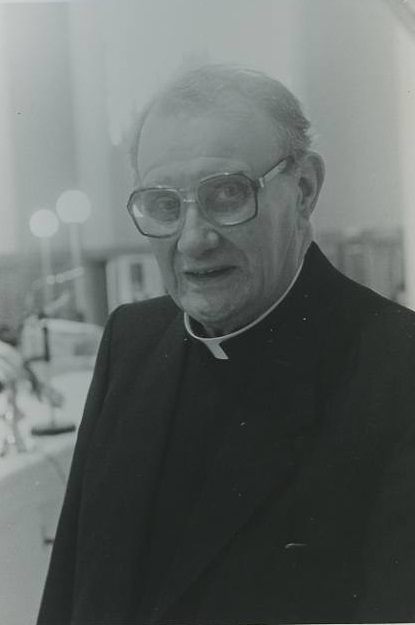
On Saturday 3rd of October 2026, the community of Tullamore, County Offaly, and the wider Sisters of Mercy family bid a solemn and heartfelt farewell to Sister Genevieve Hassey—known affectionately to generations of students, parishioners, colleagues, and friends simply as Sr. Genny. Though born Philomena Hassey in Freshford, County Kilkenny, her life’s work, her warm smile, and her untiring spirit became inextricably woven into the fabric of Tullamore over more than seven decades. To write an appreciation of Sr. Genny is to recall a life marked by joy, resilience, dedicated service to youth and parish, an open-minded approach to education, and an enduring faith that touched countless lives.
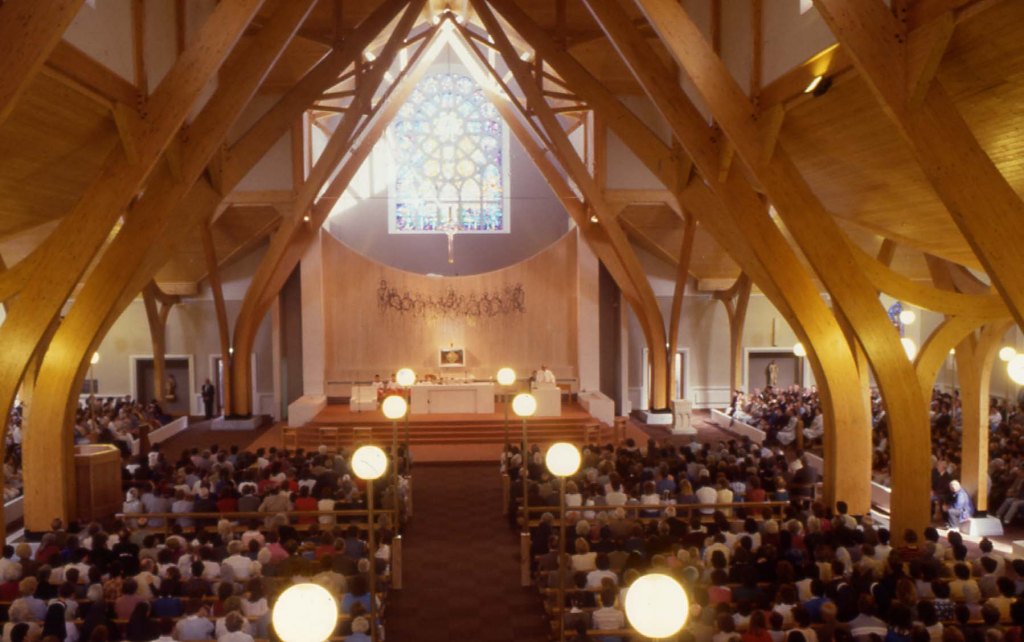
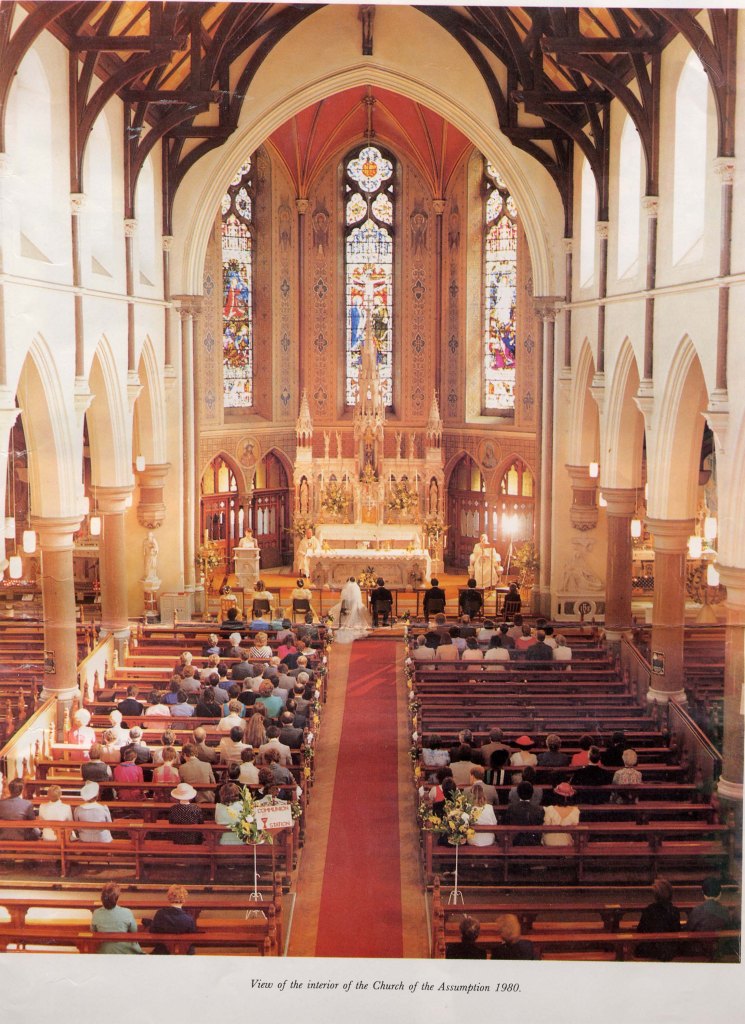
One of the saddest events in Tullamore history was the destruction of the 1906 Church of the Assumption by fire in the early hours of 31 October 1983. By morning all that remained was a burnt-out shell and the spire which survived. It is ironic that in the opening of Heritage Week 2026 Tullamore is also marking the 40th anniversary of the opening of the new and third church on the same site at Harbour and Chapel Street, Tullamore. Another example of the Phoenix at work in Tullamore over the past 250 years.
The new Catholic church, Tullamore completed for 15 August 1986.The interior of the 1906-83 church
The background to the fire was well documented in several publications and resulted from a break-in and carelessness in not reporting a small fire that had been started by the lighting of a candle near a confessional curtain after the church had been closed and locked at 8.30 p.m. By 2.00 a.m. the building was gutted and gone with it were all the improvements since the late 1960s including the great refurbished organ and the well varnished pitch pine. It was a great tragedy for the parish.
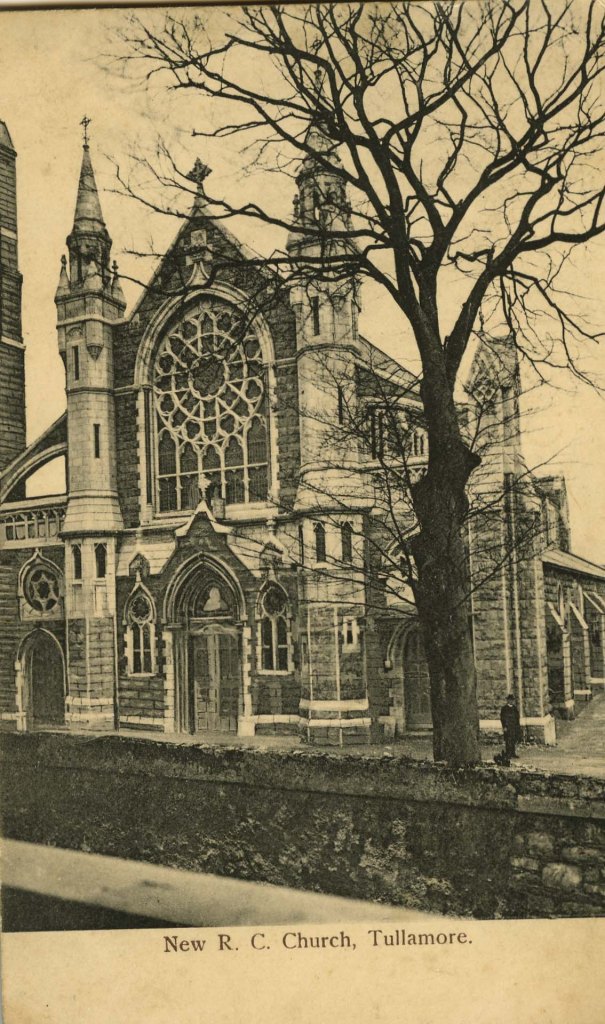
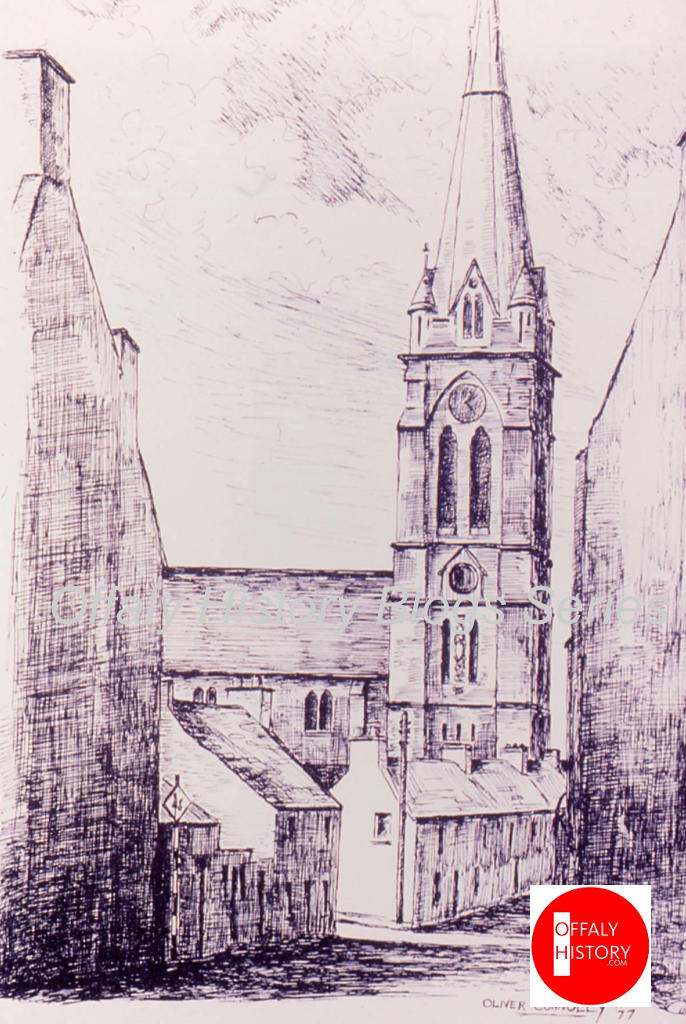
The detail from the west front of the Hague McNamara church of 1906. This picture probably early 1906.Chapel St and the church in 1977. Courtesy of Oliver Connolly.
The building was deemed too unsafe to permit investigation of the causes of the fire, and as a result important and never-to-be replaced architectural features were taken down. Whether the stone could have been salvaged was contested by at least one architectural historian. The question of building a second church in Tullamore, which had been on the agenda in some shape since the mid-1960s, was now solved by a decision to build a new and larger church on the existing site in keeping, in so far as this was possible, with the old church. Edward N. Smith and Partners, architects, were selected by the then parish priest, Fr Fallon, to design the new church (there was no competition).
Fr Fallon took charge of the operation to built the new church.The historic first mass in the new church was celebrated on Saturday 9 August at 10.00 am. It was a deeply emotional occasion for the parishioners and clergy. Parishioners bade farewell on the previous Sunday to the temporary mass centres of almost three years standing in the case of Vocational School, St Mary’s Hall and the Tullamore Harriers, and seven years in respect of the G.A.A. centre. Fr Fallon’s first words on the Saturday morning ‘My dear people of Tullamore, Welcome Home’
The architect’s brief was to re-build the church in such a way as to ‘retain or regain as much as possible of the character of the old church but in a modern idiom’. This was next to impossible to achieve. He reused much of the old stonework especially on the Chapel Street side and went for a contemporary interior. What was lost of the Gothic exterior and interior was replaced in the self-finished timber ceilings and laminated structural frames of the interior. Full restoration of the exterior was not possible on expense grounds in the 1980s.
Miss Fallon of Robbins Limited and a friend – all great church people of the 1900s to the 1980s
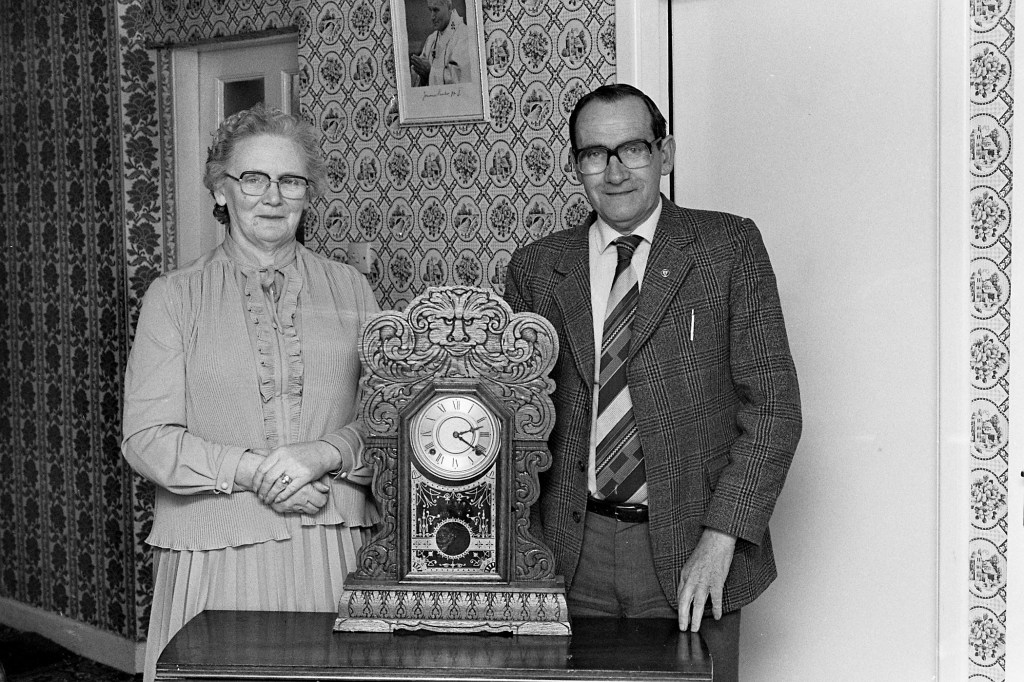
John Dunne (Sacristan) and Mrs Dunne at retirement. He opened the church at 7 30 Mon to Friday and at 6 a.m. on Good Fridays.
For many the most attractive feature of the new church was the warm and modern interior with its timber spans. John Flanagan & Sons Limited, the Tullamore-based building firm, was appointed builders and work began in October 1984 and was completed for the opening of the present and third church on the Harbour Street site in August 1986. For almost three years masses were said at the Tullamore GAA Centre, Tullamore Vocational School gym, Scoil Mhuire, Tullamore Harriers Pavilion and St Mary’s Hall. Weddings were generally in Durrow and a few were held in St Catherine’s Church of Ireland church.
William Ralph
Fundraising for the new building had started almost immediately after the fire and a sum of £700,000 was raised through donations, raffles and special events. The chairman of the Finance Committee was William Ralph, who was a corporate director of the Williams Group. The experience of Williams trained directors and managers would benefit not only Tullamore Parish but also Tullamore Credit Union and could be seen in the shrewd management of money. A sum of £2.85m was eventually paid by the state in settlement of the malicious damages claim and part of this amount had, in the meantime, been advanced by the insurer, Church & General. That sum combined with the donations earned for the parish over £600,000 in investment income. Ralph believed in working from cash flow and in trying to maintain capital and use interest to fund projects. It worked because some of the more expensive stonework features were not restored and as result the parish was left with about £1m which was placed in a Trust Fund for the ongoing maintenance of the new church. In the mid-1990s the High Court confirmed that the money could only be used for this specific purpose which accorded with the intention of the donors and could not be called on to fund broader charitable proposals. The Trust Fund has continued to benefit Tullamore parish in that way and is managed by local trustees with the benefit of professional advice.
Donation of an organ by the Lutheran church in Copenhagen
In 1994 a sum of £90,000 was paid from the Trust for the installation of the organ donated by the Lutheran cathedral church in Copenhagen. The organ was built by one of the world’s leading organ building firms, Th. Frobenius of Lyngby (Copenhagen), in 1965 for the great cathedral church of Denmark’s capital city. The organ obviously needed a new case to fit the gallery dimensions of Tullamore’s fine new church. This was designed and built by the Frobenius firm with the work carried out by a team of three Frobenius craftsmen. The net result was that Tullamore now has the largest mechanical action church organ in Ireland, and the sole example in the country of the Frobenius firm’s renowned skill and craftsmanship. The organ was inaugurated in a gala concert on 10 May, 1995. Tullamore’s requirements for an organ at that time and their request to Prof. Gerard Gillen, NUI Maynooth, to assist them in securing an instrument, brought about a remarkable series of coincidences which resulted in the organ’s installation in Tullamore in the latter months of 1994. A Tullamore International Summer Organ Series (TISOS) of concerts was inaugurated in 1999 and has continued since. This series would not be possible without the help of Professor Gillen.
Fr Fallon and his team of curates
While in a sense things worked out well Tullamore lost its Hague-McNamara designed church of 1906 and the strain of the decision-making over three years affected the health of Fr Fallon and he died just three years later, aged 70, in 1989.
During his time in Tullamore Fr Fallon had among his curates some very popular men. He had the benefit of John Charles O’Reilly until his transfer in 1981 and also of Edward Daly who was a curate in Tullamore from 1970 to 1979. Fr Daly was later transferred to Kilcormac as parish priest. Seamus Giles (later PP in Castletown, d. 2013) was a curate in the Tullamore parish from 1965 to 1974 and was popular with young people because of his easy way of connecting with the trends of the late 1960s and 1970s. Another man who had a lot of experience of Tullamore was Joe Gleeson who had been a curate for a short time in 1958 and again from 1966 to 1976. A native of Kilcormac parish he was transferred at about the same time as Fr Fallon was appointed to Tullamore. Fr Colm Savage was in the parish from 1972 to 1983 and worked closely with the Tullamore Vocational School.
Probably best known in the late 1970s and early 1980s was Michael Lynn. He had been in Peru for ten years and had a close affinity with the ordinary person, and the Travellers at the several halting sites. This was helped by his cycling about the town in a leisurely way, something that gave him more immediate contact with parishioners than is possible in a motor car. He was curate in the parish of Tullamore from 1975 to 1986. His commitment to the social dimension of the Church mission found another outlet as a member of the Education Committee of the Tullamore Credit Union. In this he was unusual as unlike in other places in Ireland this important local organisation had no other clerical activist since the days of Fr Fintan Cassidy as a founding director (1963-64). Fr Lynn celebrated twenty-five years as a priest in 1985 and told those present that in the large class from which he was ordained in June 1960 62 were still in the priesthood. ‘The man on the bike’ the Tullamore Tribune called him when he departed Tullamore to serve as PP in Duleek in 1988.
Fr Sean McGearty spent ten years in Tullamore from 1979 to 1989. He was on loan from Adelaide, Australia and during his time in Tullamore made a singular contribution to the development of family history in Ireland through his appreciation of the importance of the Catholic parish registers and the need to index and conserve them. He was the inspiration for the setting up of the Offaly Historical and Archaeological Society family history project which in the 1980s was the host for the country-wide development of the Irish Family History Society and the Irish Family History Foundation. He made a valuable photographic record of the course of building of the new church over the period 1984 to 1986. His colleague, Fr Tom Mullen, came to Tullamore in the same year as Fr McGearty and from late 1983 to 1985 led the fundraising drive for the new church. He was appointed as parish priest of Kilcormac in 1985. Fr Philip O’Connor served in the parish from 1984 to 1988 as did Fr David Hanratty from 1984 to 1985. In the year before Fr Fallon’s death, Fr Dermot Farrell, was appointed to the parish and remained for two years. His forte was in administration and he went on to serve as vice-president and president of Maynooth College and later as parish priest of Trim. He is now Archbishop of Dublin.
John Flanagan, the builder, looking at work on the old Ballyduff Catholic church of 1775.
February marked the 80th anniversary of the Battle of Manila. Fought in the closing months of World War II, the operation to liberate the Philippine capital from Japanese tyranny turned into a massive slaughter of 100,000 non-combatants and the destruction of that beautiful city. Not widely known is that among those killed were five Irish Columban fathers who were based in the parish of Malate in Manila. One of them was Fr. Patrick Kelly from William Street in Tullamore. The others were Regional Superior, Fr. John Henaghan from Louisburgh, Co. Mayo; Fr. John Lalor from Cork; Fr. Peter Fallon from Dunmore, Co. Galway; and Fr. Joseph Monaghan from Banbridge, Co. Down.
On December 8th, 1941, just hours after they bombed Pearl Harbour in Hawaii, Japanese troops invaded the Philippine Islands. The defending forces, under General Douglas MacArthur, consisted of American and Filipino troops. Inexperienced and ill-prepared for battle, they retreated to the Bataan Peninsula, leaving Manila, the capital, undefended. By January 2nd, 1942, an advance column of Japanese soldiers had entered the city. Thus began a brutal three-year occupation of the islands.
Sometimes researching history is like trying to make a jigsaw that’s missing too many pieces. Sometimes, someone throws a few pieces from a different jigsaw in, just to complicate matters even more. This one such story.
New Arrivals in the neat little town
In May 1896 the Midland Tribune reported…
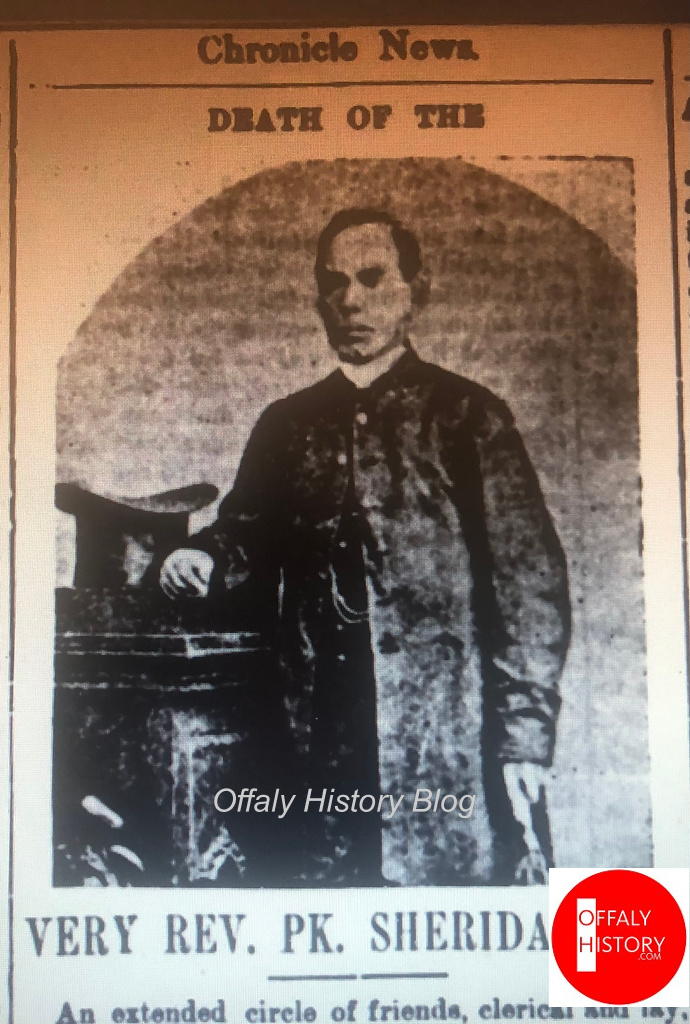
‘Tuesday last was celebrated by great festivity and rejoicing at Ferbane, the occasion being the arrival of four Sisters of the Order of St. Joseph to found a Convent in the neat little town. The nuns came at the invitation of the esteemed Parish Priest, Very Rev. Canon Sheridan who had prepared for their accommodation in the large vacant building beside the Brusna Bridge’
A Priest and his Parish
Canon Patrick Sherdian was a man who got things done, but he liked things done his way. Ordained in 1855 and stationed at Ferbane from 1875 until his death in 1899, the Canon interested himself in every aspect of his parishioners’ lives. His time in Ferbane was occasioned by conflict, be it with some members of the local home rule organisation, the Board of Guardians or his own curates. Nevertheless, his achievements were substantial. In 1894, he led the successful campaign to save the Clara to Banagher Railway branch line. Having built a national school in High Street, he set out to construct the Church of the Immaculate Conception at Ferbane. Work progressed quickly and the Canon set to work on raising the estimated £7,000 required to complete the job. To accomplish this, he organised a massive raffle and a Grand Bazaar to be held on the last week of May in 1897.
The late Girvan McKay/Garbhan MacAoidh, who died recently at the age of 94, was Presbyterian Minister in Tullamore and Mountmellick from 1983-96 and made a huge contribution to the local community. After retirement, he and his wife Máire continued to reside at Clonminch, Tullamore. A service in his memory was held at the Presbyterian Church, Tullamore on Saturday 13 January 2024.
Our thoughts are with her and their sons Ruairidh, Conall and Somhairle and their families.
He was a distinctive figure within the Presbyterian Church in Ireland (PCI) due to his never having lived in Northern Ireland, in contrast to the great majority of that church’s ministers.
Ireland has been associated with the loss of its people through migration for centuries. The analyses by the Central Statistics Office identifies that the famine of 1845 – 52 led to a peak in migration and changed the country’s demographic, political, and cultural landscape. Related themes of endemic poverty and religious intolerance were reasons why others left Ireland’s shores trying to find a better life. Literacy rates in 1841 were 47% but by 1911 had risen to 88%. Limited literacy hindered emigrants maintaining contact. Migration could mean that when someone left, they were gone for good and it was unlikely they would ever again speak to or see friends or family back home. Apart from emigration, Irish demographic anomalies, such as late marriage and large families led to people being dislocated from their families. The age gap between parents, particularly fathers, and children was frequently such that being orphaned in childhood was common. Often, there was also a large age gap between older and younger siblings, with the latter hardly knowing brothers or sisters who had left home or emigrated while they were still in infancy. [i]
This context helps me to understand a phrase my mother used when she reminisced about her family life with three sisters and parents, growing up in the Midlands as workers at the ‘big houses’. They would join friends and listen to fiddle playing in the evening occasionally. When I asked her about someone she had described and what happened to them, she would sometimes say ‘Oh, he just walked’ often adding ‘it was very common then’.
St Catherine’s Church, 1815. This is the second article to mark the successful Heritage Week 2023. The new St Catherine’s Church was designed by Francis Johnston and was built in the Gothic style with a Latin cross plan, side-aisles, a tower in the west and a crypt at the east end for the burial place of the Bury family. Its situation on Hophill makes it an impressive landmark in Tullamore. Hophill is a glacial mound which rises steeply to a height of about fifty feet above the land around it. It is not clear how the mound acquired its name or when. The earliest known reference to the hill occurs in a lease of 1748. There is a local story that the spoil for digging out the new lake at Charleville was used to construct the site for the new church. While this is not true perhaps some materials were used which gave credence to this story. Originally more pointed, the hill is a natural one.
To mark Heritage Week 2023 we have two articles on St Catherine’s Church, Hop Hill, Tullamore. This week the background from the 1700s to the completion of the new church in 1815. When coming to Tullamore by boat or rail the two most prominent sites to greet the visitor are the spire of the Catholic church completed in 1906 and that of St Catherine’s church, built on the mound known as Hop Hill and completed in August 1815.
We take the presence of the Cof I churches of St Catherine’s, Clara, Shinrone, Geashill, Edenderry and St Brendan’s in Birr (to name a few) for granted. The upkeep is great and the contributors few.More will need to be done to structure support for the upkeep of these buildings.
A Francis Johnston plan with the burial crypt of c. 1808-10. Courtesy of the Irish Architectural Archive
Hop Hill site a brave choice
The Hop Hill site was a brave choice as there was work to be done to make it suitable for building and the adjoining ground was soft and prone to flood, especially in the years before the two Brosna drainage schemes of 1850 and 1950. The Tullamore town landlord, Charles William Bury (1764-1835), had reserved the large distillery plot (now the Granary apartments in Market Square) for a church, from about 1800 to 1806. In the latter year then rector, Ponsonby Gouldsbury, and the vestry opted for the Hop Hill site and the new church was largely completed in August 1815. Soon after the old church off Church Street, erected in 1726, was demolished and the site of the church and, possibly an adjoining graveyard, were used for the Shambles or meat market and the remaining land incorporated into the new Market Square or Corn Market. The new Bachelors Walk was worked on from about 1812 as an attractive avenue to the new church from the High Street and from the town’s owner’s new residence, Charleville Castle. The architect for the church was Francis Johnston and for the new avenue, or Bachelors Walk was John Claudius Loudon, the distinguished landscape architect and designer of demesnes.
The young Charles William Bury when aged 28 and just seven years into his estate. He married in 1798 and died in 1835. His best years were up to the completion of the castle. He contributed about £4,000 of the £8,000 it cost to build St Catherine’s.(more…)
The ‘Second Reformation’ initiated by Magee was marked by:
An exhibition charting the development of the ‘Second Reformation’, one of the most significant periods of nineteenth-century Ireland, is currently running in Birr Library and is open to the public. Furthermore, a public lecture by Dr Ciarán McCabe (QUB) in Birr Library on Wednesday 5 April (at 6.30pm) will discuss the ‘Second Reformation’ (including the infamous Birr Crotty Schism) and the development of the exhibition.
Brother Pat Guidera S.J. (born 1900, died 1992) was a familiar figure in Tullamore over a period of forty-two years from his transfer to Tullabeg College in 1948 up to its closure in 1990. Today the old college is falling to ruin. Many will recall its very good order up to the 1990s and thereafter it was used in part as a nursing home. Brother Guidera wrote a short ‘Story of my life’ in 1991 and this is an extract from that now very scarce memoir – of which there is a copy in Offaly Archives (courtesy of the Irish Jesuit Archives). The college was opened in 1818 and several volumes have been published on its history but few as intimate as that of Bro. Guidera. His memoir is interesting also for the marked distinctions in the religious orders between those fully ordained and those who were effectively providing support services in the college or convent. Brother Guidera was a carpenter cum painter and many will remember him carrying the usual large carton of cigarettes in the town for his colleagues in the college. His recollections of life in the Rahan area show the value of personal histories so why not give it a go.