As mentioned earlier there are many histories of hurling in recent times, particularly county and local club histories. A major and broad history of hurling, Scéal na hIomána was produced by Brother Liam Ó Caithnia in Irish and was published in 1980, but was left largely unappreciated for decades. Ó Caithnia’s history was an exhaustive work, the definitive historical account, written initially as an academic thesis, 826 pages long, written in dense Irish with a small print font and included references and appendixes. Over a dozen mentions of Co. Offaly are to be found in the Scéal.
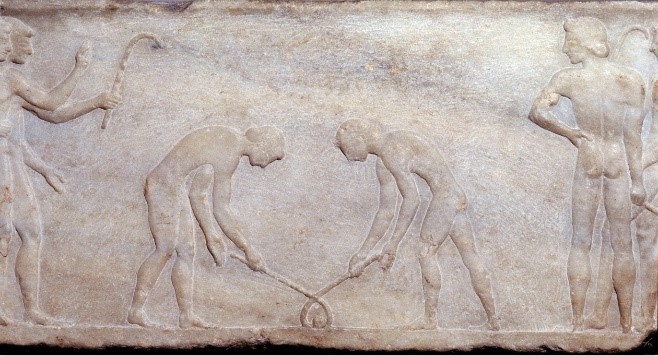
The story of people hitting a ball with a stick is a story which is told everywhere, from Iceland to Ethiopia to the Far East and across to the Aztecs. Look at lacrosse played by the American Indians, the stick and ball games played by the Mongols, the Berber stick and ball game played on the sands of the desert. The Irish game of hurling is a modern variant of a theme which is written through history, across millennia.
Players with two sticks and ball. Greek National Museum, Athens.
There are plenty of books that cover the history of hurling in Ireland. The public library system has most of them. Along with a general history of hurling that are also many histories that are specific to individual counties, particularly parishes and clubs.
Oliver Connolly must be one of the best-known artists in the midlands given that he has taught art to thousands of children and adults largely drawn from the wider Tullamore area for over forty years. Practising very much as a topographical artist it is a pleasure to include his work in this series.
Oliver Connolly was kind enough to make available a series of drawings of the buildings of Tullamore for the publication A walk through Tullamore issued in December 1979. Now long out of print it was the first historical study of an Offaly town to provide illustrations by an artist since Thomas Lalor Cooke issued his Picture of Parsonstown (Birr) in 1826. We have already featured that book in this series.
One Wednesday morning in November 2013, as I painstakingly ascended several flights of stairs to reach the summit of the Offaly Adult Education building in Tullamore to inquire about the Leaving Certificate subjects of History and English, my mind raced at breakneck speed—not out of excitement for the prospect of taking the course, but in search of a plausible excuse to leave the building as soon as possible and avoid any interaction! This was the last place I wanted to be, but relentless pressure from my ex-wife, Orla, forced me to bite the bullet and investigate the prospect of returning to education. Orla displayed foresight as she observed something within me that she believed could thrive in the classroom environment. Unsurprisingly, I disagreed! I was more familiar with the confines of the construction industry! But to appease her, I agreed to ask about the course, with no intention of signing up! Nonetheless, my cunning plan was shattered faster than the speed of light when I was offered a place starting that same Wednesday morning. A sense of shock and horror enveloped me. Firstly, I was six weeks late beginning the course, and secondly, I had to walk into a room of students, most younger than me!
Polo traces its origins to the game of Chovgan, an equestrian team sport played by the aristocracy of the Persian Empire. It spread across Asia evolving along the way. By the 1400s it had arrived in India, supposedly introduced during the Muslim conquests of the subcontinent. During the Mughal period polo was dubbed the ‘Sport of Kings’ and the emperor Jalal ud-din Akbar introduced a set of rules governing the sport in the 1560s. In 1859, British soldiers and tea planters serving in India established the Calcutta Polo Club and the game was quickly introduced to Britain. When Carlow hosted Ireland’s first polo match in 1872, the local press referred to it as ‘Hurling on Horseback’. A year later the All-Ireland Polo Club was founded, with its grounds at the Nine Acres in the Phoenix Park. In 1875 the Hurlingham Polo Committee in London drew up a set of rules which would shape the polo in the century which followed. In the same year polo had migrated once again and in time the scions of Argentina’s richest families would establish that countries position as the global powerhouse of the game.
The current success of the Irish rugby side owes much in the opinion of many people to the success of our four provincial sides in the various competitions that are open to them. Yet when one thinks of Inter Provincial competitions, it is the GAA Railway Cups that most older followers of sport remember with great fondness. Sadly these competitions were last played for in 2016, and don’t seem like resuming at any time in the near future. The popularity of the games which were usually played at final stage on St. Patrick’s Day reached a height in 1954 when a crowd of 49,023 attended the final that year in Croke Park. The events were still popular despite lower attendances into the next two decades but a dramatic decline in those travelling to the final took place in the 1980s. A number of reasons can be put forward for this trend including the decision to televise the final from 1962, the growth in popularity of the club championship since 1971, as well as the greater and ever growing emphasis on individual county training regimes over the last 50 years or so.
In the history of the GAA, Inter Provincial competitions have had three distinct phases. The first was known as the Railway Shield and began in 1905 when the Great South and Western Railway Company provided two shields for the winners of the competition. A rather strange rule included in the competition was that the first team to win the shield in two consecutive years, or three times in total, would be deemed the outright holder of the trophy. Not surprisingly, the football version only lasted three years in total as Munster won the 1906 and 1907 deciders after Leinster had captured the inaugural title in 1905. The hurling title lasted a little longer and resulted in a play-off to decide the outright winners in 1908 which Leinster won.
Sometimes researching history is like trying to make a jigsaw that’s missing too many pieces. Sometimes, someone throws a few pieces from a different jigsaw in, just to complicate matters even more. This one such story.
New Arrivals in the neat little town
In May 1896 the Midland Tribune reported…
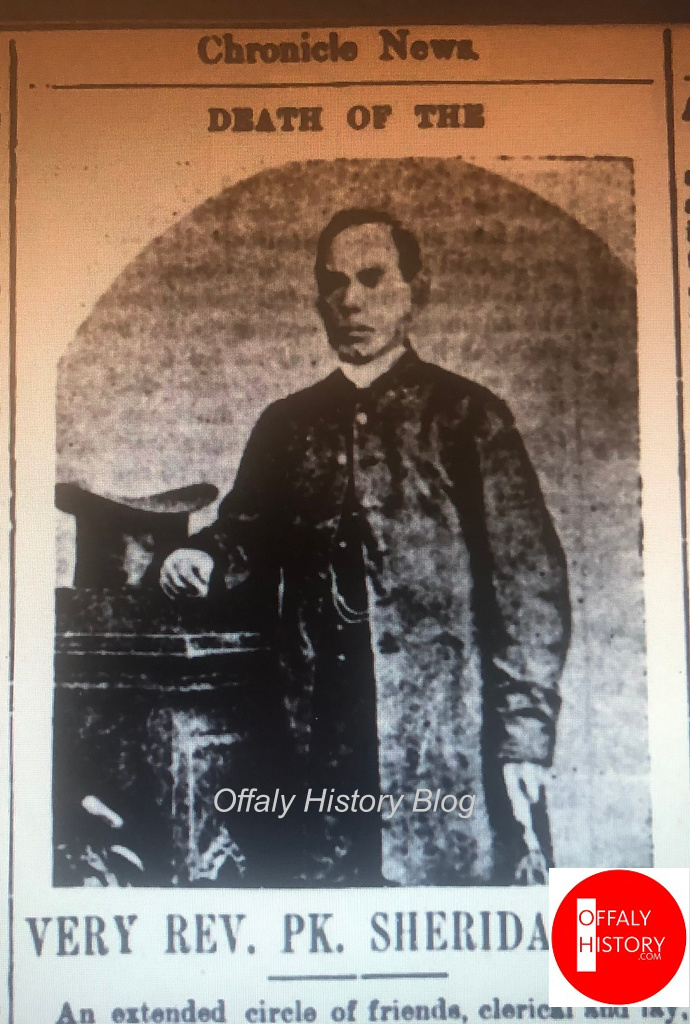
‘Tuesday last was celebrated by great festivity and rejoicing at Ferbane, the occasion being the arrival of four Sisters of the Order of St. Joseph to found a Convent in the neat little town. The nuns came at the invitation of the esteemed Parish Priest, Very Rev. Canon Sheridan who had prepared for their accommodation in the large vacant building beside the Brusna Bridge’
A Priest and his Parish
Canon Patrick Sherdian was a man who got things done, but he liked things done his way. Ordained in 1855 and stationed at Ferbane from 1875 until his death in 1899, the Canon interested himself in every aspect of his parishioners’ lives. His time in Ferbane was occasioned by conflict, be it with some members of the local home rule organisation, the Board of Guardians or his own curates. Nevertheless, his achievements were substantial. In 1894, he led the successful campaign to save the Clara to Banagher Railway branch line. Having built a national school in High Street, he set out to construct the Church of the Immaculate Conception at Ferbane. Work progressed quickly and the Canon set to work on raising the estimated £7,000 required to complete the job. To accomplish this, he organised a massive raffle and a Grand Bazaar to be held on the last week of May in 1897.
On the morning of Sunday October 12th 1924, two excursion trains from Birr and Tullamore bringing approximately 1000 Offaly supporters left the county for Croke Park in Dublin. As the Birr train pulled into Ballybrophy, a large train full of Cork supporters was seen in waiting. However, as the Offaly train was placed in front of its Cork counterpart for departure, one excited Faithful supporter prophetically exclaimed, ‘Gosh we’re ahead of Cork, we’ll be that way all day’. His enthusiasm was greeted with the response ‘we hope so’, as the Midland Tribune (MT) reporter who witnessed the event noted the contrast in the Cork supporters who seemed unable for a moment to countenance ‘the idea of defeat’, while the Offaly supporters were travelling more ‘in hope’ of victory but with the knowledge that their team which had come through a long campaign ‘were determined to fight in every ounce of their strength’ to land the county’s first national title.
The growth of the soccer club and the rugby club from the mid-1960s led to increased pressure on the grounds such that from time-to-time fixture lists had to be substantially revised so that a pitch would be available. The soccer club enjoyed a tremendous burst of success right through the 1960s while the rugby club was fielding a 2nd XV from the mid-1960s. It was this pressure on the resources at Spollanstown that, more than anything else, led to the dissolution of the Sports Club in 1971. But a secondary factor was the collapse of the carnivals and marquee dancing as a profitable venture from 1966. Thereafter for some five years substantial revenue was earned from Saturday night dancing. These Saturday night hops were largely the responsibility of the rugby club and the profits generated made the argument for independence irresistible. In January 1968 the rugby committee noted that the Sports Club had had a disastrous year financially and would be down £300 but for the profit of £540 from the Saturday night dances. The view of the meeting was that the rugby club wanted a home of its own even if this meant leaving Spollanstown. Soon after the Sports Club met and agreed to dispose of the bungalow built for the caretaker adjacent to the grounds for the sum of £2,650 to pay off the liabilities of the trustees.
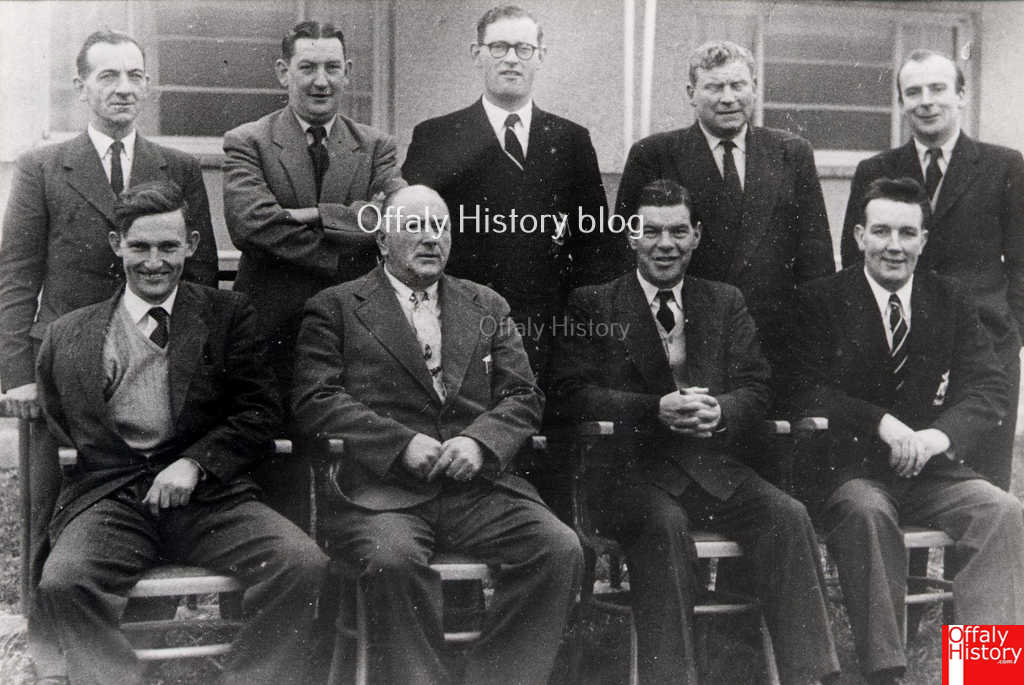
First trustees of the Tullamore Rugby and Soccer Club, 1956. Back row: T. Kelly, G. Smyth, H.L. Egan, W. Champ, D. Kilroy; front row: Terry Adams, W. Stephens, J. Kilroy, O. McGlinchey.(more…)

 offalyhistoryblog