The rugby grounds at Spollanstown have been used for sporting activity in Tullamore for over 140 years. The establishing of the Spollanstown sports field is rooted in the difficult situation in the 1880s when the land war was at its height, the home rule movement was advancing steadily and, increasingly, sporting activities reflected the deep political and religious divide in the country.
Kilbeggan team in 1927-28. Birr was able to affiliate to IRFU in 1887 and Tullamore in 1937(more…)
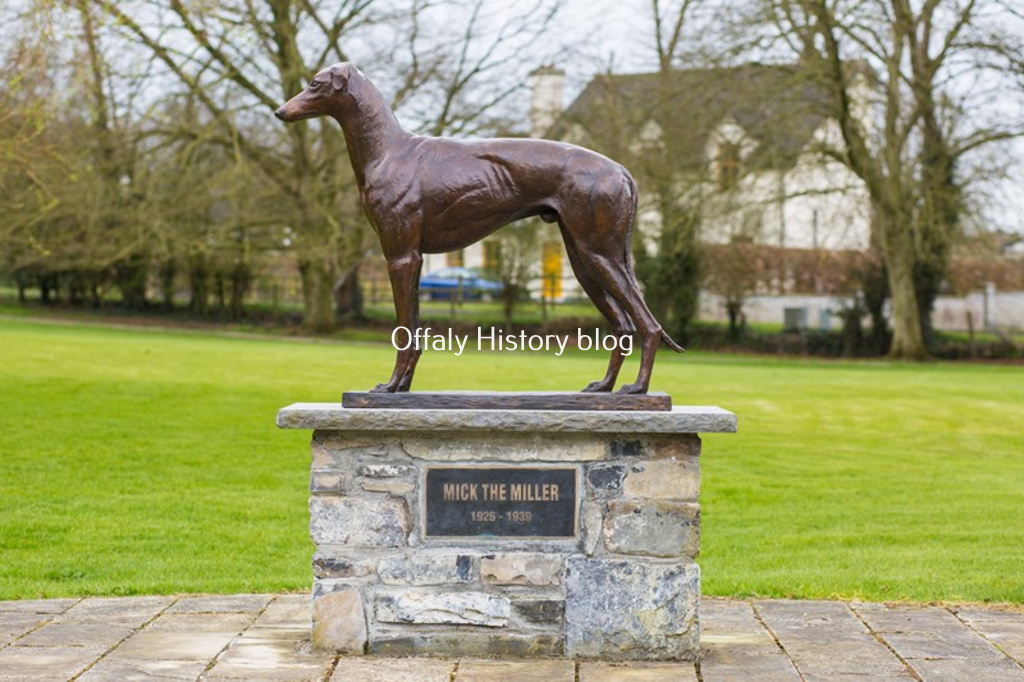
1. Sculpture of Mick the Miller by artist Elizabeth O`Kane on Killeigh village green.
Mick the Miller was the first great star of greyhound stadium racing in Britain. Born in Killeigh, Co Offaly in 1926, he had a successful Irish career before he began racing in England in 1929. By the time he retired in 1931 he had won 5 classics including the English Derby twice, the Cesarewich, the St Leger and also the Welsh Derby. He was the first greyhound to win the English Derby twice in succession and the first greyhound in the world to win 19 races in a row (both records remained unequallled for over 40 years). He won 51 of his 68 races, finished out of the top 2 positions only 6 times and also won 10 of his 13 one-on-one matches. His total prizemoney was £9,017 (€485,000 in today`s money) and he won 18 silver and 6 gold trophies. Mick equalled 2 track records and set 7 new ones (6 of which were also new world records).
He was a very exciting dog to watch and people flocked in their thousands to see him run.
Irish Sporting Lives (Royal Irish Academy, 2022) brings to life sixty figures who in their individual ways illustrate the drama and diversity of Irish sporting history.
This collection of biographical essays draws from the Dictionary of Irish Biography (DIB) and spans 200 years from the early nineteenth century. It is edited by DIB researchers Terry Clavin and Turlough O’Riordan, with an introductory essay by former Tullamore GAA clubman and Offaly Gaelic football coach, Ireland’s foremost sports historian, Professor Paul Rouse.
The biographies in Irish Sporting Lives encompass serial winners and glorious losers, heroes and villains, role models and rogues, enduring legends and forgotten or overlooked greats. Trailblazing women feature prominently, and their stories highlight the adversity they had to overcome in pursuing their sporting dreams. Aside from household names such as George Best, Jack Kyle, Christy Ring, Lady Heath, Alex Higgins and Jack Charlton, the volume will also inform readers about less well-known but equally fascinating figures. These include Vere Goold, the only Wimbledon tennis finalist ever convicted of murder; Dave Gallaher, New Zealand’s most revered rugby captain; and Martin Sheridan, the winner of nine Olympic medals for the USA.
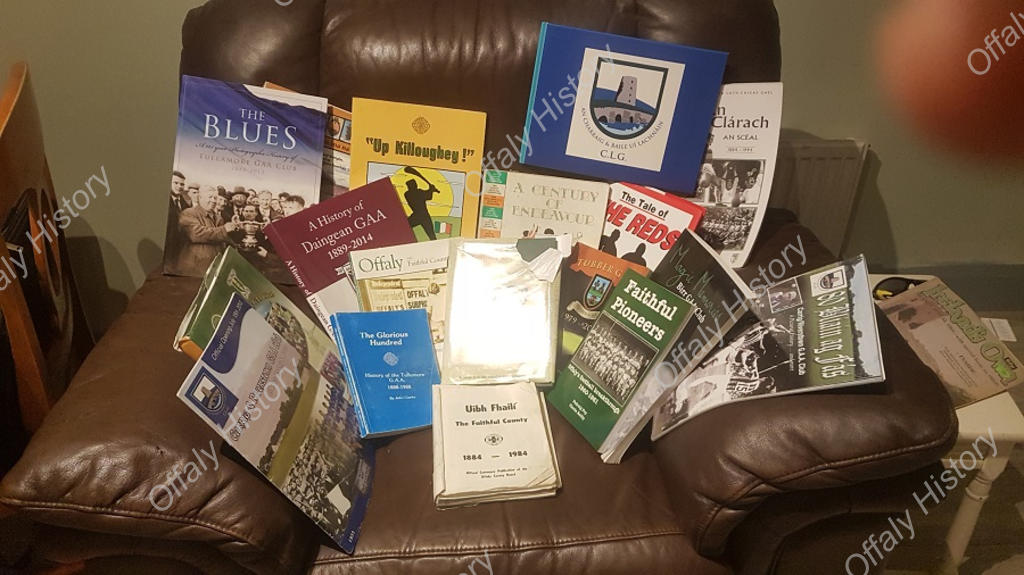
Offaly GAA is very fortunate to have a number of fabulous club history publications at its disposal, not to mention a myriad of other book. Clubs such as Clara, Daingean, Edenderry, Kilcormac/Killoughey, Seir Kieran and Tullamore have produced particularly comprehensive and detailed club histories and their value to members is immense.
I started research last year on my latest project, a comprehensive, detailed history of Offaly GAA. It is a very big undertaking with a huge volume of research required before you even consider putting pen to paper. It will be a three year plus project and trying to get a picture of all eras and factors in the growth of the GAA in Offaly is quite daunting.
My aim is to do a proper history of Offaly GAA, one that transcends its mere sporting contribution to the county. To a very large degree, the GAA successes from the 1960s through to the 2000s contributed greatly to the well-being of Offaly and helped give the county its own distinct, unique and powerful identity. Whether you have any interest in sport, GAA doesn’t float your boat or you prefer other sporting codes, the importance and contribution of the national games to Offaly simply can’t be understated.
Followers of Gaelic games in Offaly will no doubt be familiar with Raheen’s G.A.A. grounds, just outside the village of Geashill. The grounds were once known as ‘The Lawn’ where stood the gate house to Alderborough house. In the early 1900s Alderborough house was the headquarters of the famous Reamsbottom garden nurseries, one of the largest in Europe and renowned worldwide for its anemones, the most famous of which was the St Bridget’s which won numerous prizes in shows such as the Chelsea Flower Show. At that time also a Gaelic football team trained and played their matches on the lawn and other fields in Geashill including P. Finlay’s field in Bawnmore, which became both feared and respected, not alone in Offaly but throughout Leinster.
Offaly History welcomes this contribution from Pat Nolan and is delighted to be able to include it in our Fifty Blogs for the Decade of Centenaries. This story, and much more, will soon be uploaded to our new Decade of Centenaries platform on www.offalyhistory.com. The portrait is from chapter one of Pat Nolan’s ‘The Furlongs – The Story of a Remarkable Family’, published by Ballpoint Press in 2014. Our thanks to Pat and his publisher.
At around midday on a Thursday afternoon in July 1921, up to 20 IRA members parked their bicycles not far from New Ross post office. A number of them surrounded the building on all sides while others filed inside, dressed in their civilian clothes and without any form of disguise. The staff had just finished sorting the morning mail and the town was relatively quiet. At first they didn’t pay any heed to the men, presuming they were linesmen – post office officials who had charge of the telegraph system. However, when they drew out their revolvers and yelled “hands up” the innocence of the staff’s initial impression was laid bare.
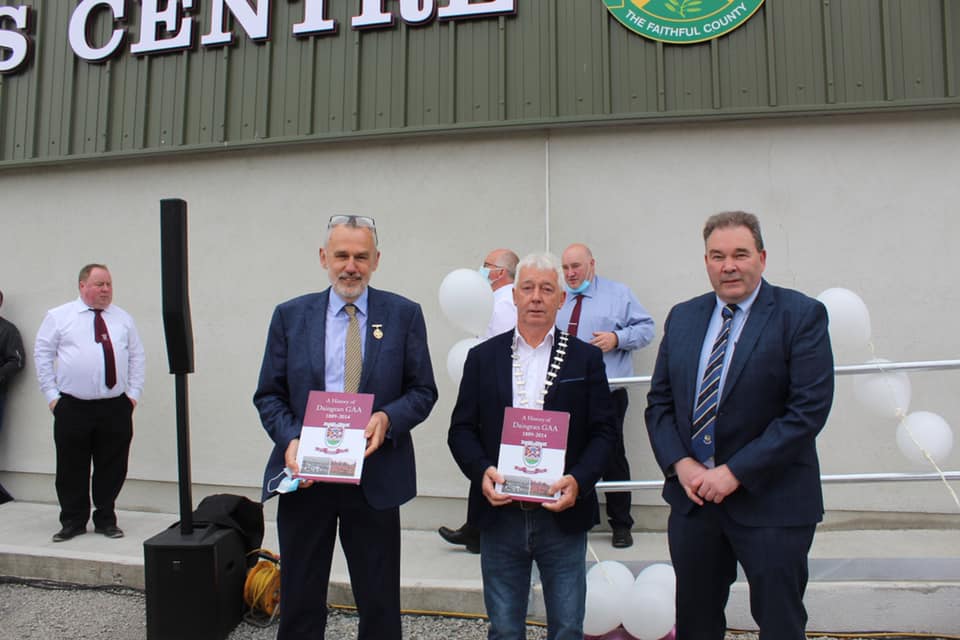
While Daingean celebrates the completion of its new Sports Centre it is good to look back to how things were 100 years ago. The country is currently celebrating and remembering what have become popularly known as the Revolutionary years or era spanning the timescale 1913–23. These years witnessed the formation of the Irish Volunteers in 1913, the Howth Gun Running in 1914, as well as the Easter Rising, the growth of Sinn Féin, and the formation of the first Dáil in 1919. The events of this time are finally capped off with the War of Independence (1919–21), the signing of the Anglo-Irish Treaty in December 1921, and the calamitous Civil War (1922–31) which followed. During this period also, the Great War (1914–18) and the Spanish Flu epidemic had varying degrees of impact on the life of the country. There is no doubt that this train of events combined had a great impact on almost all GAA clubs then in existence. Some clubs fared better than others, for example, during the years in question Killeigh captured two Senior football titles while Rhode who had won only one title to date, captured three in six years. For Daingean however, these years brought no titles in any grade.
At the recent opening of the Daingean GAA Sports Centre. All pictures courtesy of Daingean GAA Club.(more…)
A big welcome to Martin Moore this week as a new contributor to Offaly History blog and with a new topic. A big thanks also for the work of the sports historians in the county including the late John McKenna on association football in Tullamore in the 20th century.Martin is preparing an article for Offaly Heritage 12 (forthcoming later in the year).
Recent research into the origins of association football in Ireland has demonstrated that Offaly was – for a brief period – a centre of early soccer activity, involving one of the first soccer teams in Ireland. The traditional understanding is that soccer was consciously ‘introduced’ to Belfast in 1878, from where the game eventually spread around the rest of the island. The real story, however, is not quite so straightforward. We now know that soccer was played in other parts of Ireland before 1878 and Offaly, Tipperary and Sligo were centres where the code was played in the late 1870s and early 1880s, though it failed to take root and was not sustained.
Offaly GAA blessed with some great club history publications: sources for Offaly history and society, no. 7. GAA is very fortunate to have a number of fabulous club history publications at its disposal. Clubs such as Clara, Daingean, Edenderry, Kilcormac/Killoughey, Seir Kieran and Tullamore have produced particularly comprehensive and detailed club histories and their value to members is immense.
I have started research earlier this year on my latest project, a comprehensive, detailed history of Offaly GAA. It is a very big undertaking with a huge volume of research required before you even consider putting pen to paper. It will be a three year plus project and trying to get a picture of all eras and factors in the growth of the GAA in Offaly is quite daunting.
My aim is to do a proper history of Offaly GAA, one that transcends its mere sporting contribution to the county. To a very large degree, the GAA successes from the 1960s through to the 2000s contributed greatly to the well-being of Offaly as a county and provided its own distinct unique identity. Whether you have any interest in sport, GAA doesn’t float your boat or you prefer other sporting codes, the importance and contribution of the national games to Offaly simply can’t be understated.
Louis Darcy, former Offaly county hurler, another altar boy rostered for Ned Doorley’s funeral
WE are glad to bring you the second part of Pádraig Turley’s piece this August 1 2020. We have reached 55,000 views for our stories this year so far. The same as the entire of last year. You can see all 212 stories on http://www.offalyhistoryblog and there is a shortcut to them at http://www.offalyhistory.com You do not need to be on Facebook to view. Why not contribute and send to info@offalyhistory.com.
FUNERAL OF NED DOORLEY:
The story of the funeral of Ned is one worth relating. This is a story I was always aware of, but was inclined to take it with a grain of salt. However, recently I received a communication from Shannonbridge native James Killeen, currently residing in Illinois, which virtually tallied with the version I had. Ned was the last survivor of the Doorley family when he died in Tullamore Hospital. My uncle Joseph Claffey and the undertaker Kieran Flannery volunteered to go to Tullamore, to pick up the corpse. James tells me that he and Louis Darcy (former Offaly county hurler)and Leslie Price were the altar boys rostered to be on duty to assist the Parish Priest Fr. Frank Donoghue, who having served in Brooklyn, NY, liked things to be done pronto.
The funeral was expected in Shannonbridge at 8.00 p.m. Everything was ready and in order, candles blazing. It did not arrive at 8.00 p.m. or indeed 9.00 p.m. or 10.00 p.m. Needless to say Fr. Donoghue was getting very edgy. There was no sound or sight of the funeral. James tells me that post war traffic in the area was about one motorized vehicle every forty minutes. So in the silence one could hear a car approaching from as far as Moystown, a distance of 9 km. Sometime after midnight James says, one could hear the grinding of the old 14.9 hp Ford engine somewhere around Blackwater, about 2 km away. On arrival Kieran Flannery, the undertaker announced they had a breakdown in Ferbane, and as it was a Sunday night, they had difficulty sourcing the part.



 offalyhistoryblog