One Wednesday morning in November 2013, as I painstakingly ascended several flights of stairs to reach the summit of the Offaly Adult Education building in Tullamore to inquire about the Leaving Certificate subjects of History and English, my mind raced at breakneck speed—not out of excitement for the prospect of taking the course, but in search of a plausible excuse to leave the building as soon as possible and avoid any interaction! This was the last place I wanted to be, but relentless pressure from my ex-wife, Orla, forced me to bite the bullet and investigate the prospect of returning to education. Orla displayed foresight as she observed something within me that she believed could thrive in the classroom environment. Unsurprisingly, I disagreed! I was more familiar with the confines of the construction industry! But to appease her, I agreed to ask about the course, with no intention of signing up! Nonetheless, my cunning plan was shattered faster than the speed of light when I was offered a place starting that same Wednesday morning. A sense of shock and horror enveloped me. Firstly, I was six weeks late beginning the course, and secondly, I had to walk into a room of students, most younger than me!
The recently announced sale on 11 March 2025 by Noonans of Mayfair of the Jutland medals of Tullamore man Arthur Craig (assumed Waller in 1920 on inheritance) is a reminder of the fact that despite being an inland county Offaly (King’s County up to 1920) has a significant association with the Royal Navy through the celebrated achievements of Birr-born Charles Parsons (1854–1951), of Dreadnought fame; Birr-born Sir Frederick Charles Dreyer (1878–1956), the expert in naval gunnery; and Tullamore-born Alexander Percival McMullen (1885–1916) who was killed at the Battle of Jutland in 1916. The Birr men could have lost the war in an afternoon! Both McMullen and Craig were associated with St Catherine’s, Tullamore – the first of an old Tullamore family who emigrated to Canada in 1910, and Craig as a son of the rector of the parish from 1869 to 1902. His brother succeeded in 1902 and was parish rector up to his death in 1929.
Friday 9am to 5pm – Discover Birr Castle Demesne by taking on the engineering trail through the gardens and science centre.
Friday 7pm – Welcome reception with tea and sandwiches followed by opening lecture(1) – 8pm. Note: All lectures in Birr Theatre and Arts Centre
8.00pm Lady Alicia Clements – Introduction to the Engineering Weekend Festival
8.15pm John Burgess – The Parsons Families of the 19th Century
Saturday – 10.00am Lecture (2) – Power on Land
Brian Leddin TD – Chair of the Joint Oireachtas Committee on Climate Action – Welcome and Opening Remarks
Geoff Horseman (Formerly Head of Turbine-Generator Engineering at Parsons and Chief Turbine Engineer at Siemens Newcastle-Upon-Tyne) – Evolution of the Parsons Land Steam Turbine
Saturday – 11.30am guided discovery tour in Birr Castle Gardens to visit (Please note to wear non-slip footwear and outdoor gear for walking on garden trails):
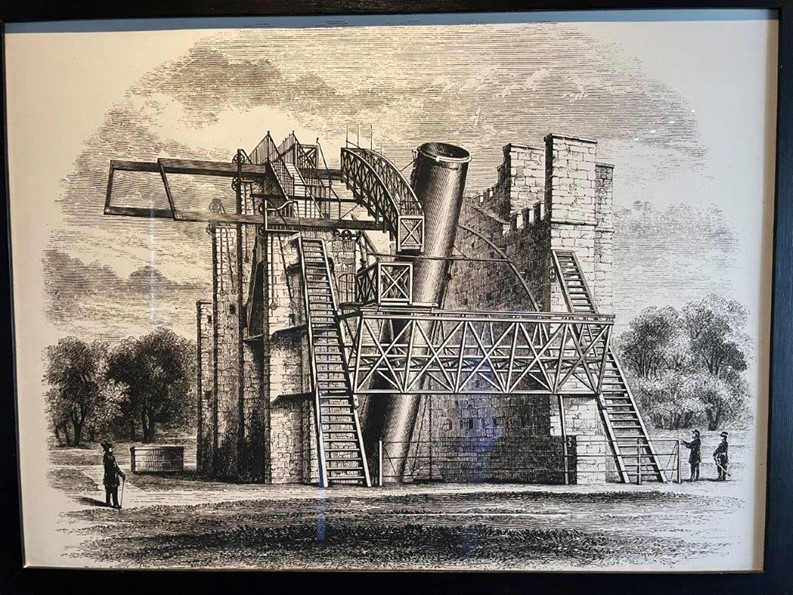
The Leviathan and LOFAR Telescopes – Peter Gallagher or Joe McCauley
The refurbished suspension bridge,
Rejuvenated hydro-electric turbine, and
The secret of the lake’s ingenious water level management system.
Saturday – 1.15pm Lunch at the Kellys Bar
Saturday – 2.30pm Lecture (3) – Power at Sea
2.30pm Ian Whitehead – Turbinia – a daring venture in marine propulsion
3.00pm Geoff Horseman – Engines of the First Giant Turbine Passenger Liners
4.00pm Jody Power – Marine Propulsion Steam Turbines – A Personal Journey
A recess of 2 hours from 4.30pm to regroup at 6.30pm in John’s Hall
Saturday – 6.30 pm Exhibition in John’s Hall, Birr.
8.00 pm Dinner in Doolys Hotel
Sunday – 10am – Lecture (4) – Power to Change
10.00am – Benita Stoney – The Stoney family collaboration and achievements
10.45am – Una O’Grady – Renewable Energy in the Midlands – Wind, Water and Stars
11.30am – Stephen Grant – Engineering at a time of change – 21st to 19th Centuries parallels to inform a paradigm shift in addressing climate change
This article is not about the fashionable ‘Chopped’ clean food eateries. Instead, it concerns what was fed to our horses, in particular, before World War 1. That was a time of increasing use of motorised transport and less of horse-drawn vehicles. It was in 1904 that Motor Registration was introduced in Ireland, the War began in August 1914 and by 1924 the Goodbody Chop business in Tullamore was gone. Now read on in this our new Anniversaries Series. Our thanks to Michael Goodbody for this contribution to our blog series. You can find almost 650 articles about Offaly History on our website, http://www.offalyhistory.com. If you wish to write an article contact info@offalyhistory.com. Our blogs get 2,000 views per week.
Nineteenth century towns and cities were alive with the bustle and noise of people going about their daily business. Sometimes overlooked are the thousands of horses that were needed to support all this activity. Before the invention of the motor car horsepower was what drew cabs, coaches, heavy goods carts and light passenger vehicles. A city such as Dublin probably contained up to 20,000 horses and ponies.[1]
The bumper volume of essays (list below) in Offaly and the Great War (Offaly History, 2018) can now be accessed free online at www.offalyhistory.com thanks to the Decade of Centenaries. The book of 28 essays is also available in hardcopy from Offaly History for just €20. In all over 50 articles free to download. Go to the Decade of Centenaries on the offalyhistory.com website.
When the great historian and first ‘telly don’ A.J.P. Taylor published his short history of the First World War just in time for the remembrance days of over fifty years ago he wrote that the war reshaped the political order in Europe. That its memorials stood in every town and village and that the real hero of the war was the Unknown Soldier.
There is a popular saying in politics sometimes attributed to Ronald Reagan ‘When you’re explaining, you’re losing
History often involves explaining, but in recent times I’ve regularly watched people’s eyes glaze over as I described my latest research project.
Q: What’s it called.
A: ‘A Revolution in Profiles’.
Q: What’s it about.
A: Its about Offaly in the Revolutionary Decade.
Q: Okay. How many words in it?
A: Over 60,000, but it’s divided into profiles, each about 600 words long
Q: Is it a book?
A: No, it’s a website with over 100 different profiles of people from the period.
Q: So, it’s a blog?
A: Not really, it’s modelled on the RIA’s Dictionary of Biography.
Q: How much are you charging for It?
A: No, there’s no charge. Access is completely free. The RIA provided a bursary to build the website as part of the Decade of Centenaries programme, but anyone can view the profiles and there’s no fee.
At this stage the questioner runs the entire gamut of emotions from confusion, disbelief, pity and finally suspicion. ‘If its free there must be a catch’.
If we’re lucky the conversation shifts to the height of the Shannon or which senior clubs are still looking for a hurling manager, if not it peters out into a prolonged awkward silence.
‘I’ll tell what it’s not’
The site is not a definitive history of Offaly in the revolutionary period. That will come later, written by others more qualified to do so. It is a reference tool designed to educate on and simulate interest in Offaly’s revolutionary story. In time perhaps it may provide other researchers with a foundation from which a deeper understanding of the era might be developed. One of the ways it aims to do so is providing readers with the opportunity to compare and contrast different people from the period.
Don’t tell, show me!
Mark Twain reportedly once said ‘Don’t just say the old lady screamed. Bring her on and let her scream!’ Having struggled to explain the site, I usually take a leaf out of Twains book an give an example. Offaly History have been kind enough to host two profiles from the site dealing two elected officials.
The People’s Choice
Between 1918 until 1923 the constituencies of Kings County and Laois-Offaly were represented by Dr. Patrick McCartan. A leading member of the Irish Republican Brotherhood from Tyrone; McCartan spent most of those years on diplomatic missions to the United States and the Soviet Union.
Meanwhile Hugh Mahon from Killurn outside Tullamore sat as a Labor representative in the Australian Parliament until his expulsion in 1920. His ejection was carried out in response to Mahon’s public condemnation of the British Empire in the aftermath of the death of Terence MacSwiney on hunger strike in Brixton prison.
Mahon and McCartan’s biographies are among 30 extra profiles which will be added to the site over the next year, but for now the focus centres on two other parliamentary representatives from Offaly, representing two different traditions. Frank Bulfin and Sir Robert Woods.
Frank Bulfin
Frank Bulfin was born in 1874 at Derrinlough, where his parents William and Ellen Bulfin (nee Grogan) owned a large farm.
His uncle Patrick Bulfin acted as Lord Mayor of Dublin and a cousin General Edward. S. Bulfin served with distinction in the British Army during the Boer and Great Wars. In 1900 it was reported that Frank’s brother, J.V. Bulfin had died while serving with the Rimington Guides in the Boer War. Frank and his brother Joe (who was later associated with Clonony and Edenderry) were keen agriculturists. During the Ranch War both men were vocal advocates for small farmers and imprisoned for their involvement in cattle driving.
Frank’s uncle Fr. Vincent Grogan served as provincial of the Passionist order in Argentina. The South American connection was to have important ramifications for the family, as Frank’s older brother William emigrated to Argentina where he enjoyed considerable success and eventually became owner of the Southern Cross newspaper. On his return to Ireland, William Bulfin helped to stabilise the Derrinlough farms finances, wrote a popular nationalist travel book Rambles in Erin, promoted the Gaelic League and political movements of his friend Arthur Griffith. William died aged 45 in 1910.
William’s son Eamon attended St Enda’s school and fought under his former teacher Patrick Pearse in 1916 Rising.
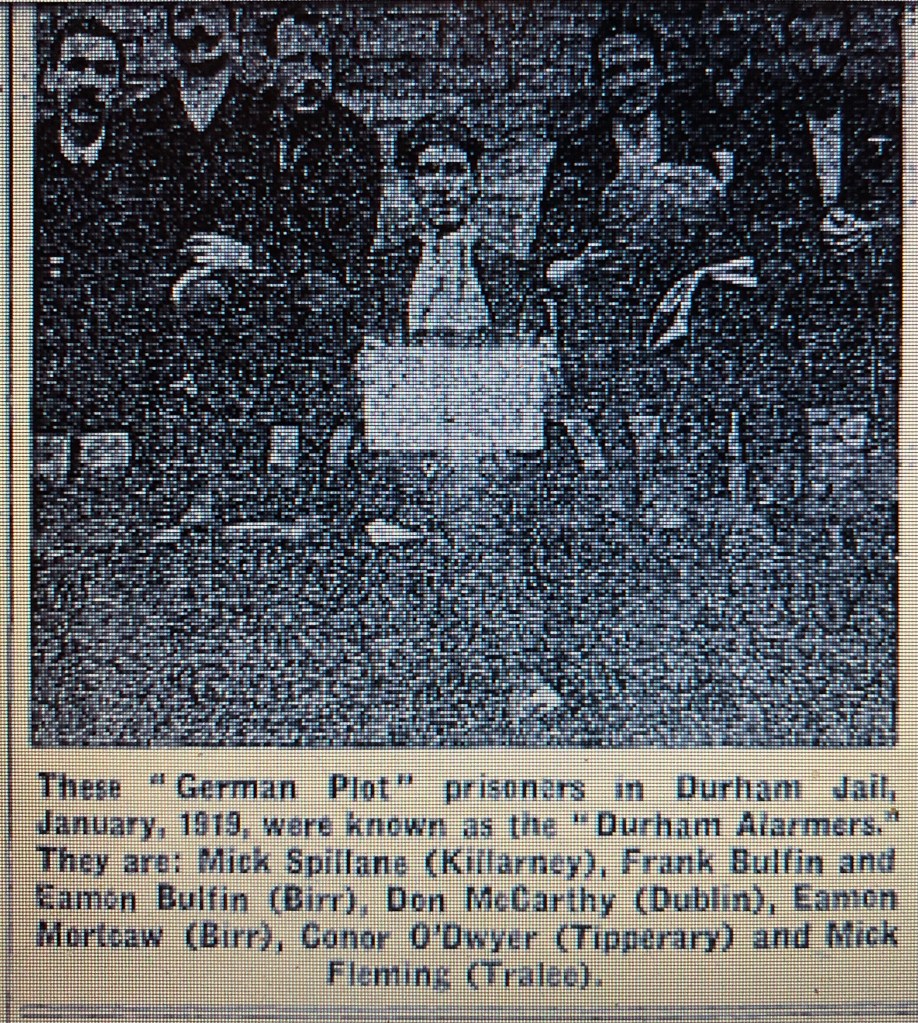
Following the release of republican prisoners from internment in late 1916, Eamon and Frank were involved in establishing the republican movement in south Offaly. They were arrested as part of the German Plot in the Summer of 1918 and imprisoned in Durham Gaol. Eamon was later deported to Argentina where he acted as an emissary for the republic during the War of Independence.
On his release from prison Frank Bulfin returned to Derrinlough, where he was involved in sheltering Sean Treacy, Seamus Robinson, Sean Hogan and Dan Breen during the summer of 1920. The so called ‘Big Four’ were on the run following shootings at Soloheadbeg and Knocklong.
Nominated as one of four Sinn Féin candidates, Bulfin was elected unopposed in the Laois-Offaly constituency at the 1921 general election. Arrested and interned at the Curragh, he was released with other TDs in August following the arrangement of the Truce.
Bulfin did not take a high-profile stance during the Treaty Debates but voted to accept the agreement. He was re-elected in the pact election. His nephew Eamon opposed the treaty but took no part in the Civil War following his return from South America and Frank’s niece, Catalina ‘Kid’ Bulfin a member of Cumman na mBan went on to marry well known anti-treaty republican Sean MacBride.
In August of 1922, Frank Bulfin was one of the pall bearers who carried Arthur Griffith’s coffin.
Although he rarely spoke in the Dáil, Bulfin continued to vote with the Cosgrave Government throughout the Civil War. In a statement to the Bureau of Military History Ernest Blythe suggested that because of republican intimidation, Bulfin attempted to resign his seat, but after the intercession of armed Free State Intelligence officers was convinced…
‘It might be more dangerous to resign from the dail than stay in it’. (1)
The veracity of Blythe’s story is difficult to authenticate.
Addressing an election meeting in July 1923 Bulfin commented…
‘Many unpleasant things we have had to do —many very distasteful decisions had to bemade, but we never sought popularity at the expense of the real interests of the nation’. (2)
After his re-election, rifts appeared in Cumann na nGaedheal. Bulfin did not support the Army Munity of 1924. Nevertheless, he was understanding of those who left the party at that time to establish the National Group and critical of some in the cabinet whom he felt were self-important and drifting too far from the party’s roots in Sinn Féin commenting …
‘Let these people not get their heads swelled. Greater men than they, Griffith and Collins, had to be done without.’ (3)
At local level his electoral machine was considered ineffective, and he lost his seat in 1927.
In the 1930’s Bulfin moved to Barrysbrook, Croghan close to his mother’s birthplace and farmed there until his death in 1951. He was buried at Rhode cemetery.
Sir Robert Henry Woods
Robert Henry Woods was born at Tullamore in 1865. His father Christopher and mother Dorothea (Lowe) operated a shop and held property in the town.
Sir Robert Woods
Educated at Wesley College and Trinity, he qualified as a doctor. An expert on the ear, nose and throat; Woods was considered a world leading physician. President of the Royal College of Surgeons he was knighted for his services to medicine in 1913.
His son Thornley died in 1916 while serving with British Army in Flanders.
In 1918 general election Woods was elected to Westminster for the National University constituency, a seat held until 1917 by Edward Carson.
Elected as an Independent Unionist, Woods was a moderate in personality and politics. He did not take up his seat at the first meeting of the Dail in January 1919. However, unlike other unionist MPs he did send a formal reply to decline his invitation to attend.
In July 1921 he was part of a delegation of southern Unionists who met with Eamon de Valera in the Mansion House Conference which facilitated the announcement of the Truce.
A rare contributor at Westminster, he made his last speech there in the aftermath of the signing of the Treaty when he told the House of Commons…
‘I hope the Prime Minister will permit me to offer him my congratulations on having brought this Conference to so successful a conclusion. If I may say so without offence, he has done a big thing, and he has done it in a big way. The Unionists in the South of Ireland have received the news of this agreement with feelings of satisfaction that can only be appreciated by those who have lived there in recent years, and perhaps by those who have got imagination to visualise what would have happened had these negotiations fallen through. I think I am correct in saying that the majority of Southern Unionists have for a long time seen that there was no other possibility of settlement of the age-long struggle, and the healing of this Irish sore, except through a Conference… I believe that the end of this Agreement will be an accession of strength, not only to Ireland herself, but to the peace and the prosperity of the world at large, and particularly of that great community of nations of which Ireland will, in the future, herself form an integral part.’ (4)
His last political intervention was an unsuccessful run for the Senate in 1925.
A collector of antique furniture, he was also musical enthusiast, president of the Dublin Zoological Society he donated several animals to the Zoo following trips to Asia.
Robert Woods died at his home in Marino in September 1938 and was buried at Deansgrange Cemetery. At his own request the funeral service was private and attended only by his immediate family and household staff.
On his death the Irish Independent commented…
‘Although a Unionist, his liberal and free-minded attitude on all Irish questions was very marked. Rather abrupt and unconventional in manner, the late Sir Robert was a man with a big heart. He was charming in private conversation and his humour was never hurtful, while his wit was always kind. He was extremely popular with his professional colleagues and was ever helpful to the young men attending’ his school. Physically a splendid type of Irishman, he was a familiar figure in Dublin, his broad shoulders, well-shaped head and rugged- features arresting attention.’ (5)
Father Grogan was born on June 14th, 1873, in Brocca, Screggan County in Offaly. His parents were Joseph Grogan and Mary Molloy. He received his early education at Mucklagh National School, Saint Columbus School, Tullamore and Saint Finian’s College Navan. At the solicitation of his uncle, the Reverend, Anthony J. Molloy of the New York Archdiocese, came to the United States and was admitted to Saint Joseph Seminary then located in Troy, New York. He continued his studies there and at the new St. John’s Seminary in Dunwoody, where he was ordained on May 27th, 1899. He celebrated his first mass at Saint Peter’s church in Yonkers, NY, where his uncle was the Past
His first assignment was to Rosendale, NY for one year. He was transferred to the Mission of Our Lady of the Rosary, where he remained uninterruptedly serving as assistant until 1922.
The growth of middle-class housing after 1900 may be said to have begun with the building of four ‘villas’ at Clonminch in 1909 by Charles P. Kingston, the then county secretary to King’s County Council. It was preceded earlier by the substantial house of Daniel E. Williams completed at Dew Park in 1900. Were it not for the war and the scarcity of materials we might have seen more housing in the 1916–23 period. However, there was a further scarcity of building materials and high prices in the early 1920s and it was not until about 1930 that middle-class housing began to grow again and almost entirely on Charleville Road and Clonminch the period prior to the Second World War. After a slow start in the late 1920s council housing was constructed in earnest from 1933–4 and up to 1940, resuming again in the late 1940s (see my earlier blog).
As the decade of centenaries draws to a close, one centenary not on the government’s list of official commemorations is the 1922 visit to Ireland of the Hon. Hugh Mahon, a former cabinet minister in the Australian government. Nevertheless, at a local level, the people of County Offaly may find more than a passing interest in this event from one hundred years ago.
Born in 1857 at Killurin, six kilometres south of Tullamore, Mahon was forced to leave his native land in 1882 and emigrate to Australia to avoid being arrested for his activities in the Land League. Forty years later he returned to Ireland for the first time, visiting family and friends in and around Tullamore. The years in between had been eventful for Mahon, leading to one of the most contentious episodes in Australia’s political history. And the return visit to his homeland also was not without controversy.
The summer of 1873 was marked in Tullamore with a great outpouring of support for the coming of age of Charles William Francis, the fourth earl of Charleville (1852–74). He had been an orphan for fourteen years and taken care of by his uncle Alfred Bury (1829–75). The fourth earl’s parents, Charles William George and Arabella Case, had both died at a young age in 1857 (countess of Charleville) and 1859 (the third earl). He was only 37 and left five young children of which the fourth earl was born 16 May 1852. His sister had been killed in an accident on the stairwell at Charleville Castle in 1861 and his younger brother John died in 1872 when only 21. Now the young earl had reached his maturity and his 21st year. He could mark the occasion with his two sisters Lady Katherine and Lady Emily. The celebrations ought to have been on 16 May 1873 but the party had been deferred for a few weeks so that the coming of age could be celebrated at the same time as the marriage of Lady Katherine to Captain Hutton A.D.C. The celebration in the town with triumphal arches and fireworks was the last such for the earls of Charleville. Over the period from 1782 to 1873 there had been three such Welcomes from the Tenantry. Lady Emily inherited Charleville under the will of the fourth earl who died in 1874 aged only 22. Emily came into possession on the death of her uncle Alfred in 1875 childless. She was still a minor and there was no official welcome. Lady Emily married Captain Kenneth Howard in 1881 but was a widow by 1885. The Land War began in 1879–80 and cast a shadow over landlord and tenant relationships permanently. Lady Emily died in 1931 and the estate passed to her only surviving child Lt Col. Kenneth Howard Bury (died 1963 aged 80).
The address of Dr Michael Moorhead in his capacity as chairman of the town commissioners at the celebration dinner in 1873 is replete with irony given that the young earl died in a little over a year after on a fishing and hunting trip near New York.


 offalyhistoryblog