The story of Alderborough Nursery, Geashill is a must have for delightful summer reading. This book tells the story of Reamsbottom & Co., Alderborough and West Drayton, and the development of the Alderborough strain of the St Brigid Anemone which made it famous around the world. Geashill was for decades at the center of Irish horticulture with an international reputation for the quality of its plants. Alderborough Nursery competed with the best nurseries in the world, winning awards, medals and accolades from judges and gardening publications. From 1890 to the 1980’s Anemones and a wide range of plants were exported from Geashill. Archives of all the important horticultural shows in Ireland and Britain record that Reamsbottom & Co. exhibited their produce and won prizes, particularly for their St. Brigid Anemones. By 1907, Reamsbottom & Co., had won 33 medals for Alderborough St. Brigid Anemones, including four gold. [This is a beautiful book and adds to the growing Geashill library of attractive volumes reaching a wide and enthusiastic market.]
On Monday 21 February 2022 Offaly History will host a public lecture on the photographic work of Middleton Westenra Biddulph (1849–1926) of Rathrobin, Tullamore. The lecture will also be streamed via Zoom and will start at 8 p.m. at/from Offaly History Centre. Biddulph’s photographs of Offaly and midlands interest together with Big Houses in Ireland have been published in Michael Byrne, Rathrobin and the two Irelands (Tullamore, 2021).For the link to Zoom email info@offalyhistory.com. There is no charge.
The new large format book has over 300 photographs with context and captions and is available for €25 in hardback. The publication was supported by the Decade of Centenaries and took fourteen months to prepare.
Middleton Westenra Biddulph was born on 17 August 1849 at Rathrobin, Mountbolus, King’s County. He was one of six children and the eldest surviving son of Francis Marsh Biddulph (1802–1868) and Lucy Bickerstaff (d. 1896). She was born in Preston, Lancashire and they married in 1845 when F.M.B. was 45 and Lucy 24.[1] The Bickerstaff connection was to be an important one for the surviving sons of F.M.B. and led to a substantial inheritance in the 1890s for Middleton W. Biddulph (M.W.B.) and his brother Assheton who lived at Moneyguyneen, Kinnitty. F.M.B. was of a large family of eleven children. All were girls save their one surviving brother. F.M.B. lived with at least three of his sisters at Rathrobin, few of whom married and at least three emigrated to Australia or the United States.
In person and online. For link email info@offalyhistory.com(more…)
In the aftermath of the Anglo-Irish Treaty Birr Barracks in Offaly was one of the first to be evacuated by the British military. It was also the largest in the county. Stephen Callaghan takes up the story.
Wednesday, 2 February 2022 marked the centenary anniversary of the departure of the Leinster Regiment from Birr Barracks. A historically significant event which little is known about. The signing of the Anglo-Irish Treaty in December 1921 effectively saw the withdrawal of the British Army from Ireland which would take place over the coming months, with British military barracks around the country being handed over to the newly created National Army. This mass exodus included the Leinster Regiment depot staff based in Birr Barracks, which it had called home for the past 41 years.
King’s County Infirmary was established under the reign of King George III with the passing of the Irish County Infirmaries Act of 1765. This act enabled the creation of infirmaries in thirty Irish counties. During the redevelopment of Tullamore town by the Earl of Charleville, a new infirmary building was erected in 1788 on Church Street and was further extended in 1812.
The County Infirmaries Act was enacted to provide healthcare to the poor which fulfilled the eighteenth century philanthropic ideals of the landed gentry who supported these institutions through donations and subscriptions. King’s County Infirmary was supported by an income consisting of parliamentary funds, grand jury presentments, governor subscriptions, donations, and patient fees. The infirmary was managed by a Board of Governors who paid subscriptions for their position on the board which gave them absolute control over the infirmary including staff appointments and patient admissions. Governors were made up of local gentry and landowners such as the Earl of Rosse, Lord Digby, and prominent business owners such as the Goodbody family.
While surviving records are limited, the Board meeting minute books provide a colourful insight into the running of an infirmary in late 19th and early 20th century Ireland. The Infirmary’s Surgeon, Dr James Ridley, was linked to a scandal that pervaded the county in 1887 and 1888. Ridley, who also acted as one of the Tullamore jail physicians was reported to have died by suicide on the morning he was due to give evidence at the inquest into the death of John Mandeville, a national league activist. Mandeville who was imprisoned under the Irish Crimes Act of 1887 was subject to harsh and cruel punishment at the hands of his jailors and died shortly after his release from prison.
During the summer of 1908 the 4th Earl and Countess of Rosse made their customary journey to London in order to enjoy the society ‘season.’ Sadly, this was to be their final visit together, for although the sixty-seven-year-old Earl had been in declining health for some time, soon after they returned to Birr Castle his condition began to deteriorate markedly, so much so that by Saturday 29 August he could no longer be rallied. He died later that same evening, with his wife present to the end.
What would the future hold for the dowager Countess of Rosse? She had been mistress of Birr Castle for almost four decades, having arrived in Ireland newly-married when barely eighteen years-of-age in 1870. In common with her mother-in-law, Mary Rosse (née Field), Frances Cassandra Harvey Hawke had come from a wealthy Yorkshire family, being the only child of the 4th Baron Hawke of Towton. She too had inherited property from her father – two country estates, the largest being Womersley – which naturally brought with them a measure of responsibility. However, the Earl had quickly allayed any local fears that the couple might be lured away to England. At a banquet held in his honour at the then Dooly’s Royal Arms Hotel shortly after their honeymoon, he reassured the assembled dignitaries of his firm intention to remain among them. A successful marriage requires both parties to adjust to their changed circumstances, but the Earl’s pledge meant that Cassandra’s life was destined to undergo by far the more radical transformation. Although not yet formally ‘out’ in society, she would be required to settle in a country about which she initially understood very little and find her place within an entirely new social circle.
Rathrobin is a book that keeps on giving. Its 250 Biddulph photographs from the 1870s to 1920s, all carefully captioned, depict the two Irelands – unionist and nationalist, Catholic and Protestant, landed and cabbage garden. What is interesting about the photographs taken by Colonel Biddulph (1849-1926, of Rathrobin near Mountbolus) are the nuances. He was of the lesser gentry, was a tenant of the Petty Lansdownes, and was keenly aware of the plantations of the 1550s to the 1650s. He appreciated the needs of the farm labourers and was decent to his own tenants, indoor staff and farm workers. His entire estate was not much more than 1,000 acres. Biddulph’s circle was also the lesser gentry and those who served it such as land agents, bankers and clergy. The Catholic Protestant divide was strong but landed Catholic families did mix in Biddulph’s set, but not merchants or traders (even if very rich). Biddulph had an empathy with his farm workers and their families and sought their advancement. Many local families were photographed, together with the farming activities of his own employees.
Take the good and bad in life as it comes; be satisfied with your fate; if you find yourself in an argument, get out of it as quickly as possible. This was the philosophy of Mr Michael Coughlin (or Coughlan), of Rapp, Tullamore, who celebrated his 107th birthday in November 1929. I am told by Offaly History that he was the oldest man to die in Tullamore in the history of record keeping. He and his wife ‘who is nearing her century, have based 80 years of married life on this happiness recipe and he guarantees that if this advice is followed it will bring contentment to thousands of married couples.’ News of their recipe for ’80 years of marriage and never having quarreled’ went around the world and is said to have featured in Ripley’s Believe it or Not. Michael Coughlin was a native of Eglish and had worked for Malachy Scally as a gardener at Moore Hall, Tullamore in his later years. Rapp is the road to Tyrrellspass from the canal at Whitehall and was the main road from Tullamore to Westmeath until the canal was completed in 1798. Housing there was decimated in the Famine years.
In mid-December we publish a book by Maurice Egan, ‘Merchants, Medics, and the Military Commerce and Architecture’ It provides an exciting insight on the social history of Ireland from 1875 to 1925, as seen through the lives of influential Irish families. We are now taking orders and expect to be able to fill them from 13 December. You can order online or call to Offaly History at Bury Quay and at Midland Books in High Street, Tullamore. Email info@offalyhistory.com
…..The soft and dreary midlands, with their tame canals,
Wallow between sea and sea, remote from adventure….’
‘Dublin Made Me’ Donagh MacDonagh
Lumcloon
Once a month, my uncle Billy Holohan who was the Assistant County Engineer for West Offaly, would come to Tullamore to report to his superior, the County Engineer Tom Duggan, in the courthouse.
After the meeting he would sometimes pick me up from my mother’s house in Clonminch and bring me to stay with himself and his wife Nell in Gallen Lodge in Ferbane. The highlight of the journey, for both of us, was an inspection of the progress on the construction of the two cooling towers of Lumcloon Power Station.
We watched as immense rings of slim, angled columns emerged and were tied together by large circular bands to form the base from which the structures would rise. Over the next few years we marvelled at the gradual ascent of the elegantly modulated shapes, first curving inwards and then subtly outwards to form a lip. Billy tried to explain to me the structural engineering concepts behind the design, but as a small boy I could only marvel at the height and sheer scale of the undertaking.
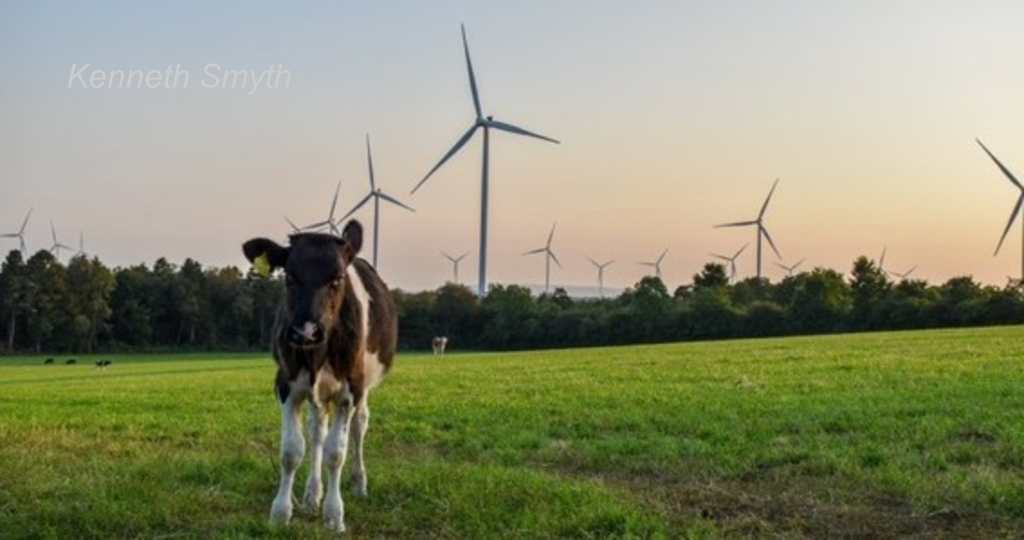
An impression of the proposed mills at Leamanaghan. Very high and very prolific. Our thanks to Kenneth Smyth for this picture.
Leamanaghan Castle
Unusually for an engineer, Billy had a deep interest in history. He brought me along on his site inspections and introduced me to Clonmacnoise and Sier Kieran. His favourite stop on our return journey to Tullamore was Leamanaghan where we roamed amongst the remains of the Monastery. He delighted in showing me the hoof mark inside the gate of the school which marked the passage of St Manchan’s stolen cow and then brought me over the fields to St Mella’s Kell which I still believe is one of the most romantic spots in Ireland.
Lemanaghan Castle, top left. This was where the Annals of Clonmacnoise was completed. The castle was demolished in the 1950s as was Kilcolgan nearby to provide filler. Courtesy of Offaly Archives
Then in 1959, in an act which was deeply symbolic of Ireland in that peculiar time between economic stagnation and rapid growth, Leamanaghan Castle was bulldozed to provide hardcore for works at Lumcloon Power Station. The Castle, which was derelict but still substantial, had been the ancestral home of the Mac Coghlans. Cardinal Rinuccini had stayed there (or more likely nearby Kilcolgan, also demolished) during his time as Papal Nuncio to the Confederation of Kilkenny and the Annals of Clonmacnoise were translated into English in the house. I was dumbfounded but hadn’t the courage to ask Billy whether it was the ESB or the County Council who were responsible.
Cooling towers of the old economy, so succesful for Offaly from the 1950s to the 2000s in regard to employment.
The Cooling Towers
The cooling towers were completed and over the years, became part of the public perception of the Midland landscape.
Driving westwards you knew you were approaching Kildare and Offaly when the Allenwood towers became visible, then Portarlington and Rhode emerged with Lumcloon in the far distance. Their harmonic shapes complemented Croghan, Endrim and Bellair hills and provided points of vertical interest in an otherwise soft and dreary plain. The bogs, which had been perceived for centuries as profitless and impassable were now a proud testimony to national energy self-sufficiency and local technological advance.
However, with the passage of time, what was originally considered a solution, became a problem and peat extraction began to be wound down with grievous personal and economic consequences which are still being felt. The Power Stations were closed, their towers and buildings demolished and their sites converted to other uses.
Portarlington was the second last to go. At 10.30 on the morning of the 4th of April 1997, the cooling tower that had taken three years to build and stood for forty seven years, vanished in three seconds at the hands of an English demolition expert who already had many redundant cooling towers on his c.v..
Futile last minute efforts to save it were led by the Heritage Council and a local preservation group organised by Progressive Democrat Senator, Cathy Honan. Architect Gerard Carty of Clonbullogue, now a director of the world famous Grafton Architects, wrote in protest that the Power Station was ‘A monument to those visionaries who grafted a semi-industrial outlook onto the principally agricultural psyche of the Midlands’. Their protests crumbled in the face of the ESB’s assertion that ’ It was built for power generation and that function is over’.
The crowds watching the spectacle of the demolition were serenaded by local accordionist Louis Melia who played his composition ’The Tower I Loved So Well’ during the countdown to the explosion.
An era had ended and the advent of wind power was at hand.
Wind Turbines
Because of the absence of nearby dwellings but with existing connections to the national grid, the Midland bogs were identified very early on as first choice locations for large scale wind energy generation. But, whatever about their ecological impacts, the visual impacts of turbines can be a lot more substantial than those of cooling towers.
Unlike one or two isolated towers, turbines spread haphazardly over large areas of the landscape. Though man-made, their scale and large array results in their being read as part of the natural landscape itself- which can be visually disturbing. As the blades rotate in different cycles, they can often cause visual irritation, even from very far away. The scale of the turbines can be incongruous and though they are generally no higher than the former cooling towers, there are a lot more of them. All in all, their visual impacts are significant and often unassimilable. But then, maybe the cooling towers were also, but in the 1950s any development was welcome, while today’s affluence allows us to make choices.
But whether it is cooling towers or turbines, the greatest sensitivity should always be shown when their development impinges on historic sites. Leamonaghan paid a price for the construction of Lumcloon and shouldn’t be put in the firing line a second time.
The old world that was partly destroyed in the 1950s.But the shrine at Lemanaghan survived in its original locus. A remarkable survival in its locale. Ballycumber castle was used for filler as was Kilcolgan. So much for heritage in 1920s to 1960s Ireland. Heritage was in a linguistic form only and divorced from real life.So much empty platitudes.
A Flashpoint
With the imminent lodgement by Bord na Mona of its proposal for a 17-turbine wind farm with blade heights of up to 220 m, the bogland island of Leamanaghan with its ancient monastery and graveyard will be in the forefront of the conflict between architectural heritage and power generation. Preliminary images show turbines dominating its surrounding landscape on its northern side.
However, just as in the 1950s, the likelihood is that national energy needs will trump all other considerations- particularly in the light of the recent correspondence from the Office of the Planning Regulator directing the Council to dramatically increase Offaly’s megawatt production.
This should not mean that the vulnerable character of Leamanaghan be disregarded, but that the most careful consideration needs to be given to the interface between it and the future wind farm. As one of the most sensitive locations in Offaly (and also to make restitution for the shameful razing of the Castle) the balance of the argument should favour the protection of its history and beauty.
The windmills of the past or a message of hope. Lemanaghan 120 years ago before the data centres and when most things were in the head of the local person and not in the Cloud.Courtesy of Offaly Archives
A Return to Profitless Bog?
As wind replaces peat extraction, it is not unthinkable that it may in turn be replaced by a less visually obtrusive or ecologically harmful form of energy production.Turbines last for about twenty years before they need replacement and a point may come when this is no longer economical.
In March of this year the United Nations Economic Commission for Europe declared that ‘Nuclear energy can be a critical component of a decarbonised energy system for those member states that choose to consider it as a part of their sustainable development and climate change strategy’. It will be interesting to see how other European countries respond to the technological advances which are now delivering safer nuclear energy.
I wonder if in seventy- or eighty-years’ time, as the last of the turbines come down and the land gently recedes back into its ancient role of profitless bog abounding in nesting snipe, will a small and nostalgic group emerge to campaign for the preservation of the remaining few of these iconic structures?
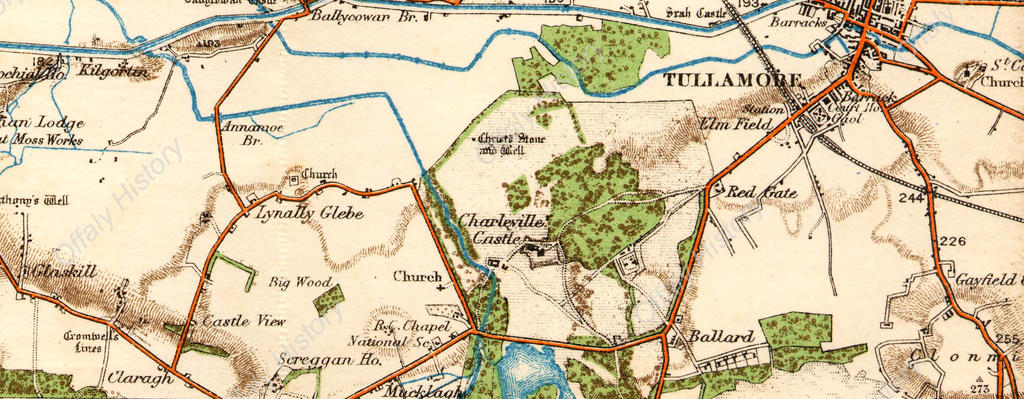
‘Catherine Maria Bury and the design of Charleville Castle’ is the title of an online lecture via Zoom provided by Offaly History for Mondy 20 September at 7. 30 p.m. Our speaker is Dr Judith Hill. She has kindly provided this note for Offalyhistoryblog readers on her forthcoming lecture.
When I started researching my PhD on Gothic revival architecture in Ireland after the Union I had no idea that Charleville Castle, one of the first and most impressive of the castles of this period, owed its inspiration to a woman. I wanted to compare the castles at Birr and Charleville, and was very much aware that their (male) owners had voted on different sides for the Union and that they came from different political traditions. Would this play any part in the designs for the castles that they built, or in the case of Sir Laurence Parsons, remodelled in the very first years of the nineteenth century?
Women at that time played no direct role in politics. They are also relatively (though not entirely) invisible in the historical record. It is only when you can look at family papers that you might find some evidence of what a woman might have done. Catherine Maria Bury’s letters have survived; some of these were published in 1937. They tell us about Catherine (later Lady Charleville) as a person, her friends, her interest in literature. They are tell us that she was close Charles William Bury, and that when he (for it was he) went to see how the building of the castle was progressing he would send detailed descriptions to her. Although he does not ask her directly for her advice, it is clear that when they were together they discussed the project.
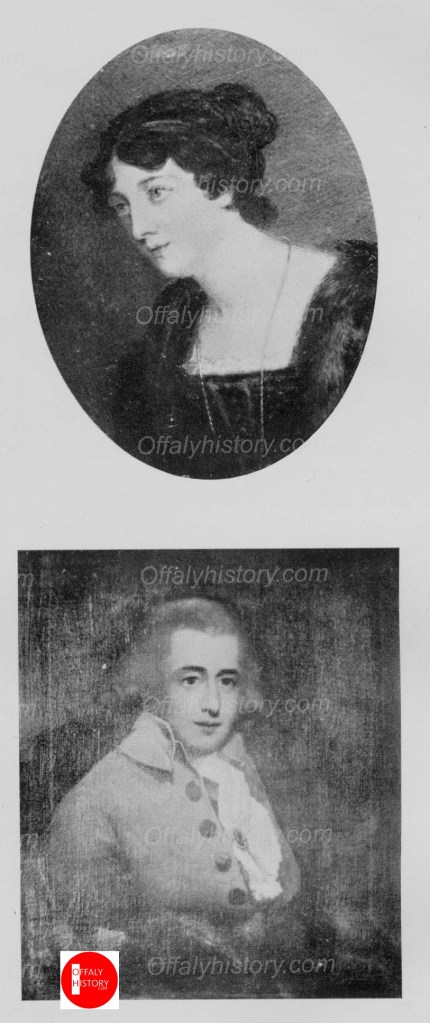
Catherine Maria Bury and Charles William Bury(more…)






 offalyhistoryblog