Fergal MacCabe: Can town planning make Tullamore a better place? An opening debate on the upcoming ten year-Local Area Plan. The talk is at 8 p.m. on Monday 27 Jan. and will be held after the AGM which commences at 7 p.m. An illustrated presentation by Fergal MacCabe architect and town planner at Offaly History Centre, Bury Quay, Tullamore R35 Y5VO.
Since 1967 the growth of Tullamore has been guided by seven successive Development Plans which delivered the Bypass, the Town Park, the pedestrianisation of O’Connor Square and many other improvements. Though promised in 2021, no statutory plan which would identify future local projects like these has yet been revealed. The next opportunity would appear to lie in the upcoming 2027-37 County Offaly Development Plan which will hopefully promote a Tullamore Local Area Plan.
Sometimes researching history is like trying to make a jigsaw that’s missing too many pieces. Sometimes, someone throws a few pieces from a different jigsaw in, just to complicate matters even more. This one such story.
New Arrivals in the neat little town
In May 1896 the Midland Tribune reported…
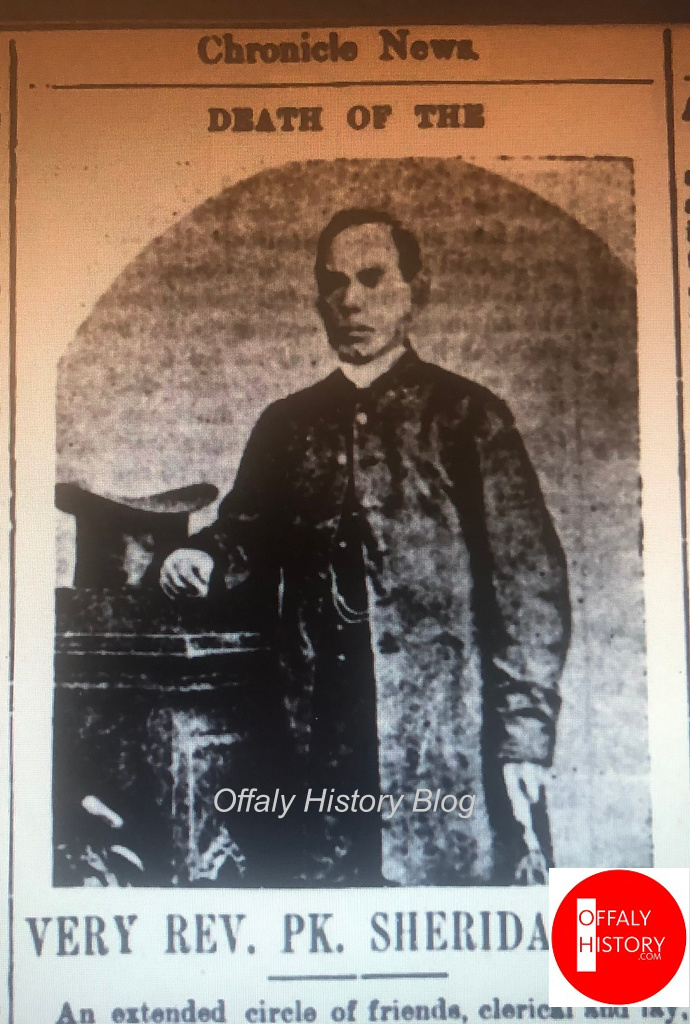
‘Tuesday last was celebrated by great festivity and rejoicing at Ferbane, the occasion being the arrival of four Sisters of the Order of St. Joseph to found a Convent in the neat little town. The nuns came at the invitation of the esteemed Parish Priest, Very Rev. Canon Sheridan who had prepared for their accommodation in the large vacant building beside the Brusna Bridge’
A Priest and his Parish
Canon Patrick Sherdian was a man who got things done, but he liked things done his way. Ordained in 1855 and stationed at Ferbane from 1875 until his death in 1899, the Canon interested himself in every aspect of his parishioners’ lives. His time in Ferbane was occasioned by conflict, be it with some members of the local home rule organisation, the Board of Guardians or his own curates. Nevertheless, his achievements were substantial. In 1894, he led the successful campaign to save the Clara to Banagher Railway branch line. Having built a national school in High Street, he set out to construct the Church of the Immaculate Conception at Ferbane. Work progressed quickly and the Canon set to work on raising the estimated £7,000 required to complete the job. To accomplish this, he organised a massive raffle and a Grand Bazaar to be held on the last week of May in 1897.
The year 2024 saw the local and general elections held and, of course, voting was by secret ballot. The polling centres of 2024 were remarkably quiet as if one were attending confession in a quiet corner of a church. Long gone were the days when a glass of Birr or Banagher or Bernie Daly’s Tullamore whiskey would be proffered by candidates or their agents to thirsty voters. The right of secret ballot extends back to 1872 and the Ballot Act. Before that time voting was in public and held in the towns in Offaly of Tullamore, Birr and Philipstown (Daingean).The Birr-based Chronicle newspaper had thought to describe the polling booth as the voter having to go ‘behind a screen, a la Punch and Judy mode, and there make the sign of the cross with a pencil on the voting paper opposite the names of the favourite men’. This was 50 years before the STV (single transferable vote was used in parliamentary elections in 1922 (see note 5 below) The Chronicle had noted in 1872 the emergence of the polling districts and the practice before 1872 in parliamentary elections:
Formerly, [before 1800] the county sent six members to the Irish Parliament, two for the county at large, and two for each of the boroughs, Philipstown and Banagher; but since the Union its representation has been limited to the two members for the county, and in 1836 the number of registered votes amounted to 1700. The election under the new Ballot Act will, of necessity, assume a different form, and will not be confined to Tullamore, Parsonstown and Philipstown.
This blog post will trace the decline of the canal as a means of transport and critical element in the economic development of Edenderry and the surrounding area. The transition of the canal and harbour as a tourist and leisure amenity will be discussed further on. The introduction of the railways in the mid-nineteenth century weakened the canals importance to the economy. Both the canal and railway had to compete for the limited inland trade. A struggle the canal was also going to lose.[i]
In the summer of 1846 it was reported that the people of Edenderry had averted an accidental breach in the branch canal to the town harbour.[ii] Another serious breach occurred between Ticknevin lock (20th) and the Blundell aqueduct in February 1849. The breach occurred in the bog embankment.[iii] The repairs were carried out under the Grand Canal Company’s (G.C.C.) new engineer, Christopher Mulvany. While repairs occurred Mulvany constructed dams and laid a tramway along the canals north bank allowing trade to continue. If the first half of the nineteenth century saw the rise of the canal as a revolutionary mode of transport, so too can the railway be seen to replace the canal.
‘Map of the canal and railway lines’, Ruth Delany, The Grand Canal, figure 23.
In 1835 Thomas Murray derided the idea of the possibility of a rail link to Edenderry:
‘There is nothing to be sent from this but a few passengers which only fill about three or four coaches every day and which will not pay almost anything.’[iv]
Although the Midland Great Western Railway (M.G.W.R.) and Great Southern and Western Railway (G.S.W.R.) both showed an interest in buying the G.C.C. in the 1850s, nothing came of it, and the Company remained independent.[v]
In 1871 before the beginning of the Land War, the Downshires still owned 14,000 acres of Edenderry as they had done at the beginning of the century, now with an annual rental of £6,800. The M. G. W. R. established a train station in Edenderry in 1877. It had reached Enfield twenty-seven years earlier. By the 1880s traffic on the canal had begun to decrease, although the G.C.C. was still running at a profit. In 1888 the Alesbury brothers moved their premises to the Grand Canal and built a factory there. The Alesburys used their own canal boat to transport timber for use in making furniture.[vi] In 1911 the G.C.C.’s engineer, Henry Wayte, was allowed by the Board to become the Irish agent for Bolinder engines and four of these were fitted. By 1911 the G.C.C. was converting its horse-drawn fleet to the Bolinder diesel engine. By 1914 twenty-eight canal boats had been converted to Bolinder engines.[vii]
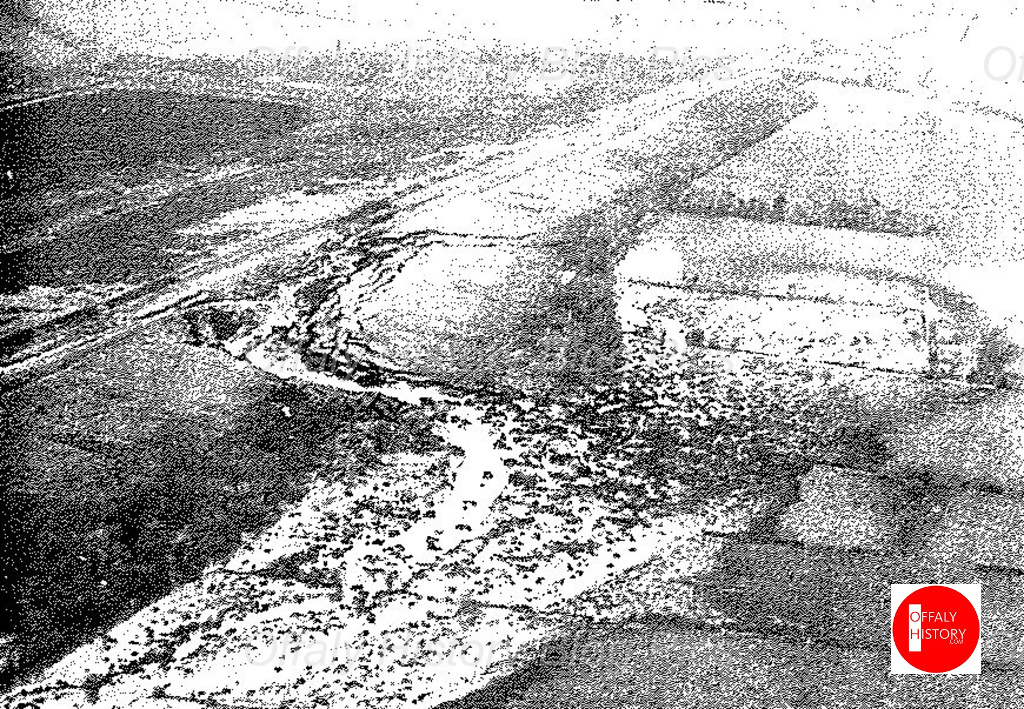
‘Breach at Edenderry, 1989’, Safe harbour, p. 17.
In 1916, again, there was a breach in the canal at Edenderry in the north bank of the canal near Blundell Aqueduct. On 11 January 1916, 300 yards of bank were carried away. Wayte had dams erected to try and keep trade moving and to help in bringing clay to the sit. The Leinster Leader vividly depicted the aftermath of the breach:
‘…no description, however graphic, could have prepared them for what they saw-the havoc wrought by the muddy rushing water, the enormous force that must have pressed it outwards, the utter impotence of the protecting line to resist the pressure and the great cataclysm that resulted….Again the breach took place on exactly the same spot as the great breach of 60 years ago.’[viii]
The cause of the breach was attributed by Gordon Thomas, engineer to the Grand Junction and Regent’s Canals, to ‘boisterous weather’ and ‘heavy rainfall.’[ix] Soon after Wayte decided to use three rows of new piles, backed and filled in with clay and bog material. Work in February was hampered by gales and snow with the workers exhausted. In March snows and blizzards continued to slow down progress. In early April, Wayte was able to report in his weekly report to the G.C.C. Board that the repair work had been completed.[x]
From 1917 to 1920 the government subsidised maintenance costs of the canal and paid war bonuses to the G.C.C. employees.[xi] During the Civil War conflict erupted on the canal when stores were burned and boats were attacked. By 1922, with the end of the revolutionary period, the Downshire estate consisted of 6,780 acres, most of it being unleased bog land. And in 1923 with the passage of the Irish Free State’s Land Act, the process of land purchase was completed. In 1950 the Grand Canal was nationalised under Córas Iompair Éireann at a cost of 1.25 million.[xii]
With the development of the River Shannon as a tourist amenity it was shown the Grand Canal still had a post-nineteenth century role for the Irish economy. The final barge to leave Edenderry Harbour was the 48M Canal Barge in May 1960, ending over 150 years of service.[xiii] The Edenderry branch had become impassable with weeds and was cleared and reopened for the opportunity tourism brought with it. An advertisement for the sale of the warehouse at the harbour, as part of the winding up of the financial use of the canal, was placed in the Offaly Independent in October 1960.[xiv]
‘Last barge, 1960’, Safe harbour, p. 26.
The canal breach of January 15th 1989 was the worst seen since 1916. 400 meters of the north embankment broke away at the midway point between Blundell Aqueduct and the Edenderry line.[xv] £1 million worth of damages was caused by the breach.[xvi] It would not be until March 1990 that the Office of Public Works would complete the repairs of the Edenderry canal.[xvii]
Stephen Rynne summed up the canal’s history as:
Fifty years in the thinking-out and arguing; fifty years in the making; almost fifty years flourishing; over a hundred years staggering along and not knowing from year to year when the final blow would fall.[xviii]
Since the 1990s festivals have become a recurrent sight during the summer season in Edenderry harbour. Canoeing too is popular today on the canal along with fishing. Among the fish inhabitants of the canal are roach, bream, perch and pike.[xix] The local inhabitants of Edenderry and the surrounding townlands and villages use the canal year-round as a walking route. The successful transition of Edenderry harbour and canal into a leisure and tourist amenity has given it a new lease of life into the twenty-first century.
‘Map of the canal and railway lines’, Ruth Delany, The Grand Canal, figure 23.
[i] Ruth Delany, A celebration of 250 years of Ireland’s Inland Waterways (Belfast, 1992), p. 5.
[ii] Delany, The Grand Canal (Newton Abbot, 1973), p. 165.
[iii] Delany, The Grand Canal of Ireland (Dublin, 1995), p. 175.
[iv] W. A. Maguire, ‘Missing persons: Edenderry under the Blundells and the Downshires, 1707-1922’ in William Nolan and Timothy P. O’Neill (eds), Offaly: history & society (Dublin, 1998), pp 515-42 at p. 537.
Much has been written about the changing face of Offaly towns in the 1900-23 period and the same can be said for the period from the mid-1990s to 2007. For towns such as Tullamore the recession lasted up to about 2017 and since then building has improved. The former Tea/ ‘Tay’ Lane, later called O’Connell St (from Stella Press to the canal bank), saw change in the 1950s with the demolition of the old Tea Lane houses. Next came the new wine warehouse for D.E. Williams (now Offaly History Centre, also in the early 1950s), followed by the new Irish Mist warehouses in the early 1970s and early 1980s. This was followed in 1982 by the opening of the Quinnsworth supermarket on part of the Williams ‘yard’ behind the head office of that company. Three years later, in 1985 the Irish Mist bottling facility was sold to C&C and the business transferred to Clonmel with the loss of up to 75 local jobs. Urban renewal tax relief in the late 1980s and early 1990s saw two blocks built close to the lane and off Kilbride Street by M/s Forrestal and Walsh for use as shops and apartments. (Chipland, florist etc).
In a departure from the Gibney plan the town council sold sites in nearby St Kyran Street for offices and apartments as part of the urban renewal scheme. About 1994 the large carpark was developed by the council from lands that had been set aside for the Kilbride park and playground. The year 1995 saw the conversion of the 1929 large Williams oats store to a department store by Tom McNamara. By 2007 the entire area was sold to an investment company for about €50 million with full planning for a supermarket and shops granted in 2009. Alas it was too late as the recession was developing and Ireland (outside of Dublin) did not recover for up to ten years. It was a case of ten years of plenty (the Tiger Years) followed by ten desperately lean years. Covid came next in 2020—21 and it was 2022–3 before the kettle was on the boil again in Tea Lane. Aldi demolished the Irish Mist warehouses and, at a cost of perhaps €1 million. the old 1929 store and former Texas shop that had been opened to great fanfare in 1995.
Robert James Enraght-Moony was a native of Doon, King’s County. His father owned a large estate and was a Justice of the Peace and Deputy Lieutenant for the county. The Moony family has enjoyed a continuous history, stretching back over a thousand years, in Doon.
According to a profile of the artist in The Westmeath Independent in 1909 the family went abroad when Robert was about five years old. They travelled on the Continent, firstly visiting Eisenach, in Thuringia, Germany, where they lived under the shadow of Wartburg Castle, where Martin Luther was imprisoned. They then went to Dresden and stayed for about a year, and from there they went to Lausanne where Robert first began to take an interest in art. His mother, Angelina (nee Maunsell) used to take him with her when she went out sketching, and it was at her side that he received his first art lessons.
In January 1953 Clara and Tullamore district was introduced to its very own ‘bat mobile’ the recently launched sports car, the Jaguar XK120. After the austerity years of WW II its sleek design and incredible speed was said to have inspired the creators of the fictitious ‘bat mobile’ in 1966. It was owned by Larry Egan of Gayfield, Clonminch Road. Larry was joint managing director (with his relation Paddy [P. V.] Egan, Cloncon and later Spollanstown) of the firm P. & H. Egan Limited headquartered on Tullamore’s Bridge Street. Their relation and good friend, Clara’s ace motorcar and motorcycle racer Charlie O’Hara raced it for them.
On January 19th 1947 Ireland saw the beginning of a freak weather event. A ‘cold easterly regime set in’ as Kevin Kearns puts it in his 2011 book, Ireland’s Arctic siege.[i] Night frost and snowfalls began from the night of the 19th and by the 24th temperatures dropped to between -20c and -60c. With the reduction of the goods train service an increase in cargo haulage on the barges along the Grand Canal brought with it trouble for the canal workers. The owners of the barges were working to capacity.[ii] The Grand Canal froze at night making it difficult for barge traffic to move as the bargemen slowly broke through the ice in the early morning. A repetition of this continued for weeks into February and March.
Beginning around the 24th January the canal began freezing over. For the next six weeks, every morning the bargemen made slow progress hacking and smashing their way through the ice.
The year 2024 was another good year for publications on Offaly history with overviews of County Offaly towns, books on Tullamore, Birr and a musician from Killeigh who acquired fame in the United States. We also had Cloneygowan, canals, peat, a Feehan bibliography and natural history.
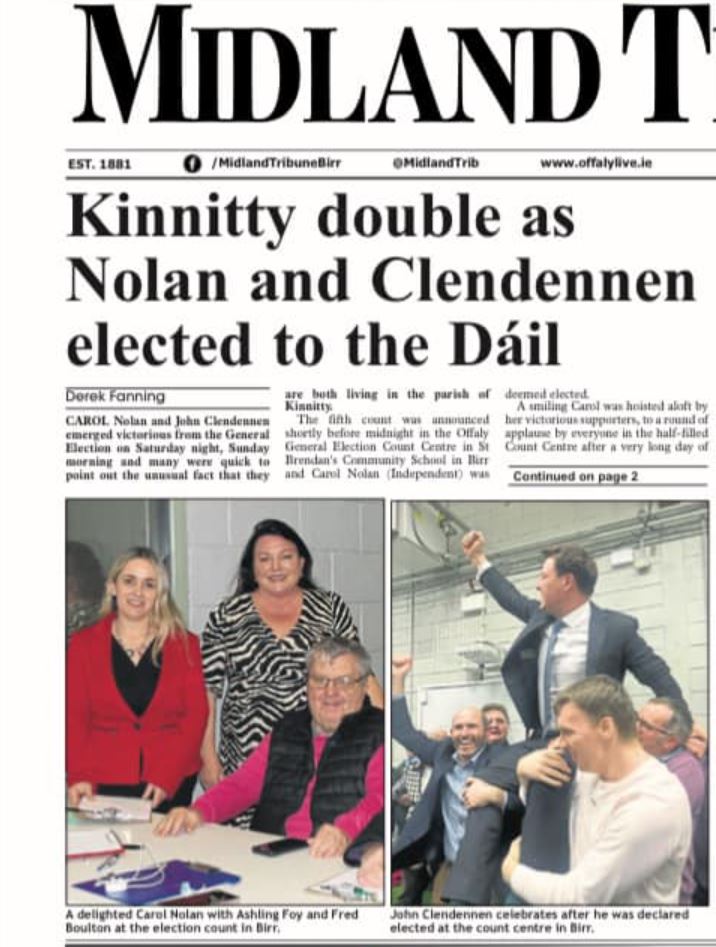
Kinnitty Parish can now celebrate having two TDs, not to mention so many of of its young men on the first Offaly team to win an All Ireland back in 1924. All part of recent celebrations. What was the village like a generation earlier in the 1890s and earlier 1900s? To find out more come to the launch of The Changing Face of Offaly towns in the early 1900s published by Offaly History and for which local woman Grace Clendennen contributed an essay. Please note the launch time of 8 30 p.m. (ed.)
From the Midland Tribune of 5 Dec. 2024
Grace Clendennen writes of Kinnitty in 1901 and 1911
Like the 1901 census, the majority of Kinnitty residents in the 1911 were born in the King’s County. There were 225 people recorded in 49 houses[1]. Roman Catholic was the most common religion stated but a sizable number, 42 out 225, stated their religion to be other than Catholic[2]. Akin to the census of 1901, eight properties were listed as ‘first-class’. Two of the properties were listed as general shops. In 1901 Patrick Egan and his wife were recorded as shopkeepers. A shop assistant, a domestic servant and a yard man lived with the Egan family.




 offalyhistoryblog