The 1901 census noted twenty-seven buildings in Castle Street, Birr (five less than in 1821, see our recent blog) of which six were unoccupied commercial properties, eight were shops including two public houses, four were boarding and lodging houses, and ten were private dwellings. Women were ‘head’ of house in six of the twenty-one dwellings. There was only one ‘dwelling’ where there was no more than one occupant and the largest household was thirteen. Only one house was divided between two families. Almost all those with stated occupations in the head of house category were in shops and craft industries with the exception of a bank porter, a retired teacher, and an Ordnance Survey employee. The latter family was Anglican as was Mrs Ellen Morahan and all other residents on the street were Roman Catholic. In 1821 perhaps up to one-third of the residents were other than Roman Catholic. The other significant change was the almost entire absence of domestic servants in 1901 and in 1911. This is a longish blog to accommodate the 1901 census. Next week we look at the street in 1911. If you have material to pass on email us info@offalyhistory.com.
In 2022, Barry Wrafter, sculptor and architectural stone carver, was interviewed about his work on Clare FM local radio. Among other things, he talked about the value of using traditional methods and skills in working with stone. Barry is the latest in a long line of Wrafters who have made their living by working with stone. The Wrafter involvement in quarrying and stonecutting in Ballyduff and Tullamore goes back almost certainly to the 18th century which means that the Wrafter name and its association with stonecutting has spanned four centuries.
I have identified three distinct branches of the Wrafter family that were involved in quarrying, stonecutting, and stone carving. In this article, I look more closely at one of these families. The other two branches will be dealt with in a separate article.
In earlier blogs for Offaly History (March 19 and April 20, 2022) I mentioned my great-great-grandfather John Wrafter (b 1794) and his role as sculptor in the building of the county gaol in Tullamore, in 1826. I mentioned his involvement in the making of the windows of the Catholic church in Birr in 1842, and the windows of St Laurance O’Toole church in the centre of Dublin in 1848. John was also contracted to build the workhouse in Tullamore in 1841. I also touched on his son John (b 1828) who, among other things, provided chiselled stone from Ballyduff qurries for a Presbyterian church in Mountmellick. Below I take a closer look at their involvement in stonecutting and the Ballyduff quarries.
The growth of the soccer club and the rugby club from the mid-1960s led to increased pressure on the grounds such that from time-to-time fixture lists had to be substantially revised so that a pitch would be available. The soccer club enjoyed a tremendous burst of success right through the 1960s while the rugby club was fielding a 2nd XV from the mid-1960s. It was this pressure on the resources at Spollanstown that, more than anything else, led to the dissolution of the Sports Club in 1971. But a secondary factor was the collapse of the carnivals and marquee dancing as a profitable venture from 1966. Thereafter for some five years substantial revenue was earned from Saturday night dancing. These Saturday night hops were largely the responsibility of the rugby club and the profits generated made the argument for independence irresistible. In January 1968 the rugby committee noted that the Sports Club had had a disastrous year financially and would be down £300 but for the profit of £540 from the Saturday night dances. The view of the meeting was that the rugby club wanted a home of its own even if this meant leaving Spollanstown. Soon after the Sports Club met and agreed to dispose of the bungalow built for the caretaker adjacent to the grounds for the sum of £2,650 to pay off the liabilities of the trustees.
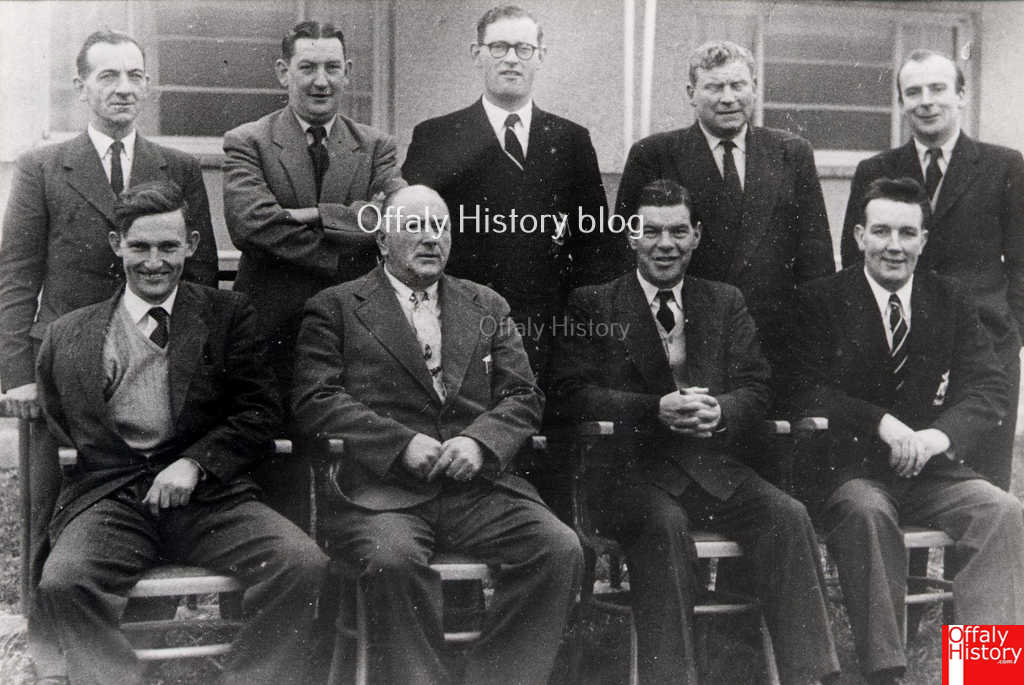
First trustees of the Tullamore Rugby and Soccer Club, 1956. Back row: T. Kelly, G. Smyth, H.L. Egan, W. Champ, D. Kilroy; front row: Terry Adams, W. Stephens, J. Kilroy, O. McGlinchey.(more…)
In the Pigot directory of 1824 Birr was described ‘as far the most considerable of any of the towns in the King’s County. Birr was the leading town in the county from the 1620s until the 1840s By the 1820s Birr had new Protestant and Catholic churches (the latter nearing completion at the time of the census and the publishing of the Pigot directory), two Methodist chapels and a Quakers’ meeting house. The charitable institutions of Birr, were a fever hospital and dispensary, supported by county grants and annual subscriptions; a Sunday school for children of all denominations; a free school for boys, and another for girls. Birr had a gaol and a courthouse where the sessions were held four times a year. The prisoners were sent to Philipstown/Daingean which was the county town until 1835 for trial for serious crimes. From 1830 when the new gaol was built in Tullamore Birr prison was more a holding centre only. . One mile from the town were the Barracks, ‘a large and elegant building, capable of holding three regiments of soldiers’. Birr has two large distilleries and two breweries, which, it was said, gave employment to the poor of the town.
The population in 1821 was 5,400. The market day was Saturday and the fairs were four in the year. And that was it. The brief introduction to Birr in the 1820s did not engage in any detail with the census of the town in 1821 other than to produce an abstract.
We need wind energy, but are we to give up on saving the bogs and destroying natural and community amenity in the process? This article looks at the works at Clongawney bog and the real threat to Lemanaghan and the natural heritage of County Offaly. More transparency is needed and more care about what outcomes we intend to have in Offaly in regards to our landscape. Will the area of Lemanaghan be now destroyed? We in Offaly need to revisit this and ensure care is taken and proposed works assessed by independent experts . The works proposed for Lemanaghan need to be scrapped or scaled back to protect what should be a special conservation area. Communities need to know what is happening to their local landscape. What has happened so far at Clongawney?
Clongawney works
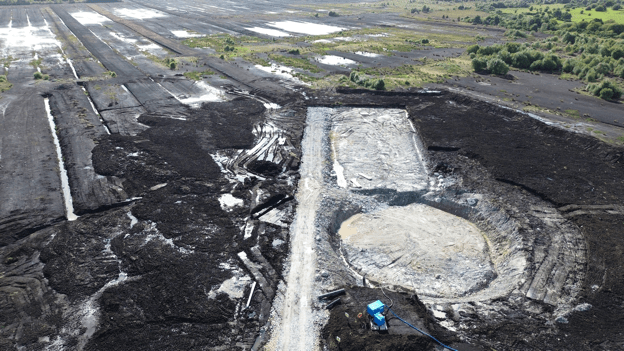
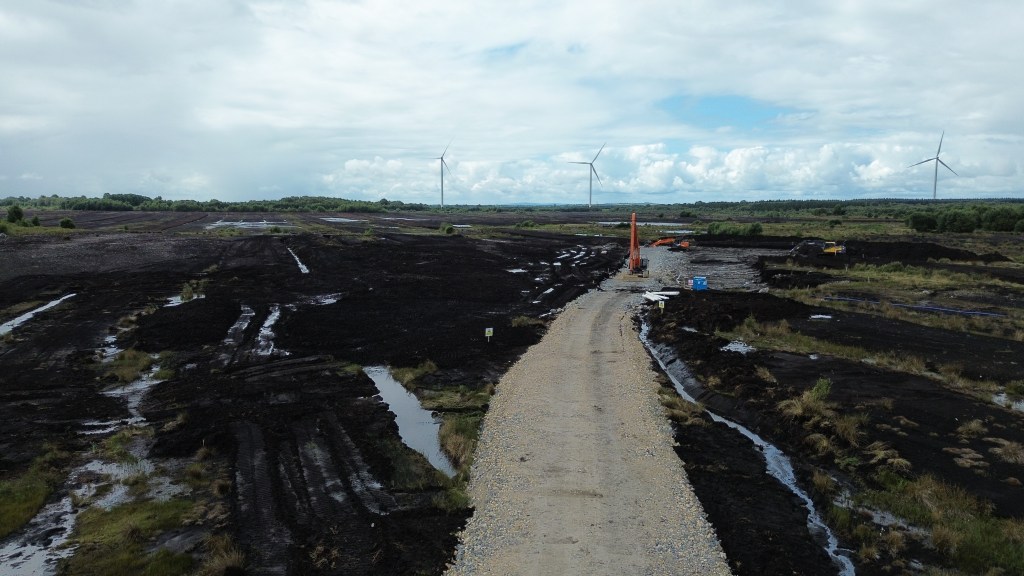
It is difficult not to be disturbed and distressed by the images below which shows excavation in progress for a wind turbine base in Clongawney bog. There is an enormous amount of destruction and disruption for a relatively small base. And what makes the situation much worse and even more disturbing is that the turbine is clearly located in bog wetlands. In a few years this area will be covered in vegetation and will be home to a variety of wildlife. And right in the middle will stand a massive turbine with massive blades. The bogs are special places. They have suffered so much over the last 70 years. Ignorance and necessity may be the explanation for what happened. However there is no excuse now. This is permanent destruction of our bogs. How can this be allowed to happen ?
Below are photographs of the works at Clongawney Bog near Banagher and the works which must conflict will all our plans to protect the natural environment.
CLONGAWNEY IS LOST. DERRINLOUGH IS LOST. LEMANAGHAN IS NEXT.
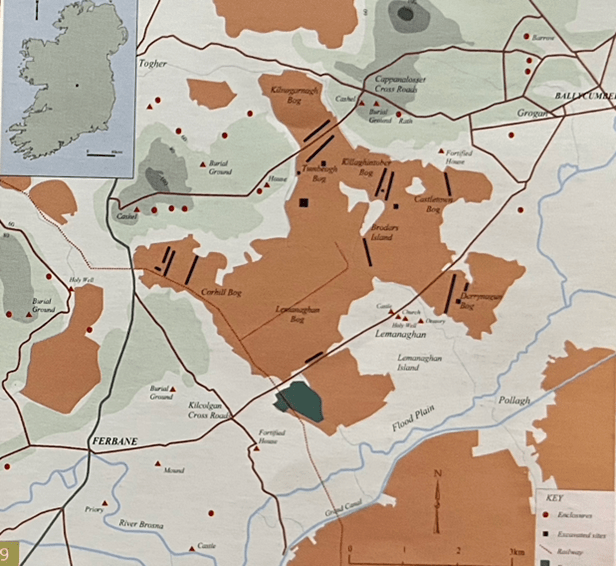
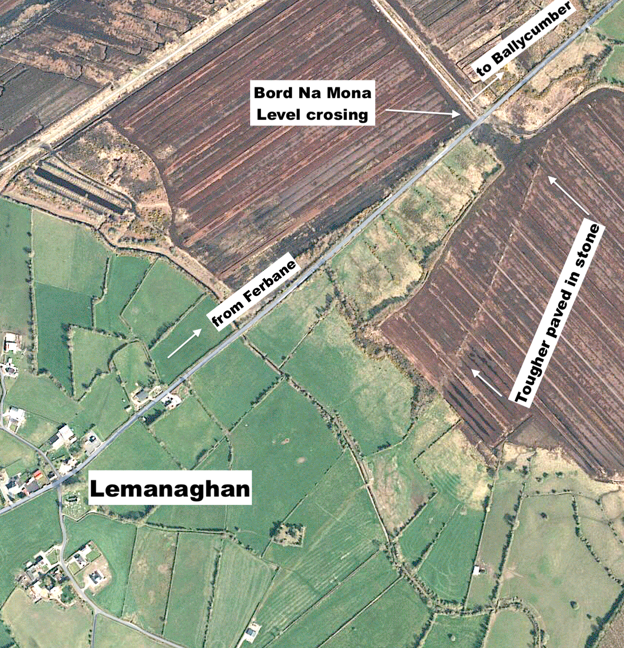
There can be few places in Ireland of more historic importance than Lemanaghan. The image above shows the location of several toghers which have been found on Lemanaghan Bog. Amazingly the largest togher on Lemanaghan can be seen clearly from space! Click on the Google Earth link and be astonished.As can be clearly seen from the map above the bog is criss-crossed with ancient toghers and holds an array of archaeological sites. It would be unthinkable to put wind turbines on the callows or the eskers or the bogs that surround
Links in higher resolution to some of the pictures below.
This is a dramatic way to show this fabulous togher Lemanaghan Togher
The massive dumper which can be seen on this image helps size this extraordinary motorway type junction on Clongawny Bog. This motorway/roadway will only be used once to transport the components for a turbine and then….? To comprehend the scale of what is happening you need to visit to Clongawny.This find took place a few weeks ago on Clongawny Bog, just a mile or so from Banagher. Note wind turbine construction activity in the background. It is piece of timber with at least two square holes worked by human hand, possibly two thousand years ago. The piece is located on the side of a drain about half metre below the bog surface. No doubt there are many more precious archaeological artefacts and sites awaiting discovery in Clongawny and Lemanaghan and in other bogs.This image shows an extensive deposit of bog iron ore also on Clongawny Bog. In the background are tens of thousands of stone are being poured onto the bog surface.
Bord Na Mona Bogs in 2023 A Brief Summary
Peat harvesting ended in 2020 but finished on many bogs more than 20 years earlier. There is at least 1 metre of bog remaining on all bogs and more than 2 metres in most places.
Return to nature
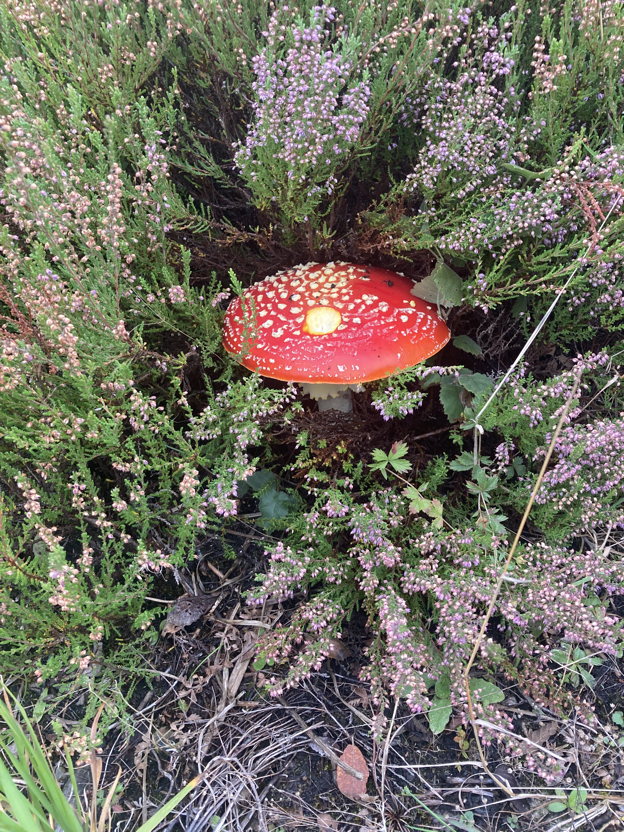
A wide variety of vegetation has become established on many bogs with little interference from anyone with the possible exception of the blocking main drains. Drinagh is now a beautiful area of perhaps 1000 acres with wide expanses of vegetation interspersed with water and inhabited by a variety of wild life.
Rewetting
Extensive ‘rewetting’ has been carried out on a few bogs. This mainly involves the construction of ‘berms’ about 3/4 metres high and up to 7 metres wide thereby dividing the bog into fields a few acres in size. The berms prevent water runoff and hopefully in time will lead to growth of sphagnum moss. This system is totally dependent on rainfall and long dry spells will be a significant test as well as fire risk when berms dry out. Derrinboy bog is a good example and is easily accessed from the Kilcormac- Kinnitty road.
Wind turbines
Wind turbines were erected on Mount Lucas bog a few years ago and are now in progress on Clongawney and Derrinlough bogs. Because of the heavy and sizeable components a grid of motorway type roads have to be constructed on the bogs. These are supported on mats of very heavy duty plastic as bogs are not capable of taking weight. On completion access is secured and controlled by BNM. If Mount Lucas is taken as an example wind turbine farms will not be an attractive place to visit unless cycling or walking on 7 metre wide ‘straights’ can be considered exciting. There is a real fear that at some point in the not too distant future BNM wind farms will be packaged and sold off to international investor funds.
Tracks and Trails
Substantial state funding is now available to help make the 10s of 1000s of acres of post peat harvesting bogs interesting and attractive places to visit for locals and visitors. The management of this fund seems to rest entirely with BNM. There are hundreds of kilometres of bog rail track which can be easily made into walking and cycle ways. All of the bogs have raised headlands where no harvesting took place and these are ideal and save places for cycling or walking. It is important that those playing a role in the design of this project have a familiarity with and sensitivity to the bogs and to the locality.
The rugby grounds at Spollanstown have been used for sporting activity in Tullamore for over 140 years. The establishing of the Spollanstown sports field is rooted in the difficult situation in the 1880s when the land war was at its height, the home rule movement was advancing steadily and, increasingly, sporting activities reflected the deep political and religious divide in the country.
Kilbeggan team in 1927-28. Birr was able to affiliate to IRFU in 1887 and Tullamore in 1937(more…)
But while Amy Biddulph’s life was happy, these were troubled times. From the age of nine Amy began to hear of the Land League. Francis read the newspapers out loud every day for the benefit of Annabella. Just after the shooting of the Chief Secretary Lord Frederick Cavendish in the Phoenix Park, her brothers were walking along one of the roads in the town near their house with two policemen walking in front of them. They saw a flash out of one of the houses and one poor young policeman fell dead almost at their feet. There was constant anxiety about Francis. As a J.P., a landlord and an army man he was a marked man. One day he received a letter containing a picture of a coffin with his name on it. In spite of this, for the three girls growing up in Birr, there was a lively social scene.
Castle Street, Birr comprises a mix of about thirty commercial and residential properties close to the Camcor river to the south, Main Street and the old parish church to the north, and to the west Birr Castle. On the east at the Market Place or Market Square the street opens into Main Street, Bridge Street and from the 1880s into the new Brendan Street. The market house stood from the 1670s where the memorial to the Manchester Martyrs was placed in 1894. Surprisingly, when the market house was taken down in the late 1700s it was not replaced with a new building in a less disruptive location.[1] The new courthouse and jail of c. 1809 took care of the legal functions, while two plots were reserved in Castle Street for the markets.
Francis Edward Biddulph was born in Congor, County Tipperary, the son of Nicholas Biddulph and Catherine Lucas. His mother died shortly after his birth. Francis was cared for by his aunt, and later by his stepmother Isabella Digges la Touche. He was to have nine half-siblings, many of whom would later live in Birr.
In 1861 he married Annabella Kennedy in Southsea. He was then a lieutenant in the 19th Regiment. They had fourteen children, six of whom survived to adulthood. The family moved from England to Burma and India, and back to England.
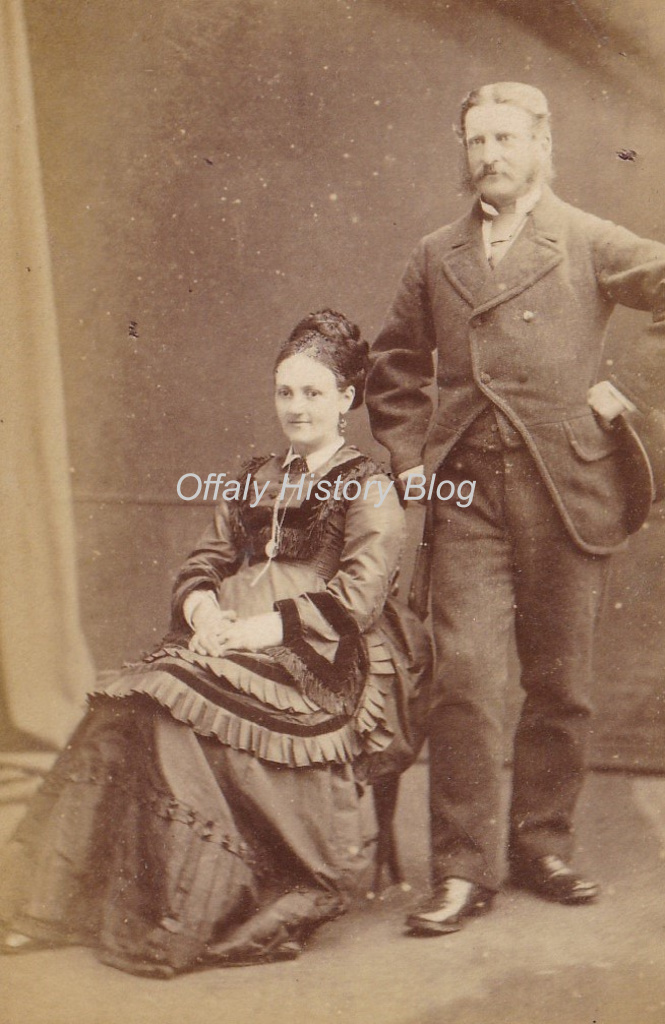
Francis and Annabella, Pembroke Dock, 1873. (Private Collection)
Their eldest daughter, Catherine Mary (Kate), had died in Bangalore, India aged 8. On their return to England they lost four more children. They are buried together in Llanion Cemetery, Pembroke Dock, Wales.
On his retirement from the army, Francis and Annabella returned to Ireland with their sons Nicholas, Charles, Hugh and Arthur, and their daughter Amy who had been born in Aldershot in 1875. Another daughter, Alice, died in Kilmainham, in 1877 and is buried in Grangegorman Military Cemetery. They took up residence, first in John’s Mall, and then in a house called St. Kilda’s, in Birr, then known as Parsonstown after the Parsons family who lived in Birr Castle. The two youngest daughters, Beatrice and May, were born in Birr. Arthur was later to die in Congor aged ten.
Francis became a Justice of the Peace. Later he became chairman, when Lord Rosse was away, of the Board of Guardians, and was on the Board. Then, in the church, he was the Rector’s Churchwarden, also teaching in Sunday school. For eleven years he belonged to the Unionist Association, and for the same length of time he was secretary of the tennis club.
Amy, the eldest surviving daughter, described living on John’s Mall as a child, and being taken for walks on Sunday afternoons with Francis and Annabella in the demesne of Birr Castle‘a glorious park, with miles of walks and rivers and a huge lake where water lilies abounded in summer, which I am ashamed to say often came home hidden under our coats as we were not supposed to pick them.’ Here she would play with her friend Emma McSheehy, daughter of the stipendiary magistrate, climbing the big trees, watching the fish in the river and scampering around what was at that time the biggest telescope in the world. Francis and Annabella would be asked to dinner parties and Lord Rosse would take the guests out to look at the stars and moon on a clear night, which they told Amy was a very wonderful sight.
She also gave an account of a terrible accident on the lake at Birr Castle:
In winter the lake froze and when the noble earl considered it safe for skating it was thrown open and there at seven I learned to skate. How I loved it – one part of the lake was not as safe as it was supposed to be and a bad accident happened – two sisters who were skating together happened on the thin part and one went through. The other tried her best to save her but alas, by the time others had come with ropes she had gone under altogether and I don’t think her body was recovered ‘til the ice melted. After that much greater care was taken and next year parts of the lake were roped off. We also used to skate when it wasn’t thought to be safe on some flooded fields near the barracks and that always ended in tea and lovely hot toast swimming butter in the depot mess, before a huge fire.’
In 1883 the family moved from John’s Mall to St. Kilda’s. The house was close to Crinkill barracks where there was always a regiment. The Leinster Regiment had their depot in Crinkill Barracks. Amy went to sleep every night to the sound of the Bugler’s Last Post, and woke to the Morning Reveille.
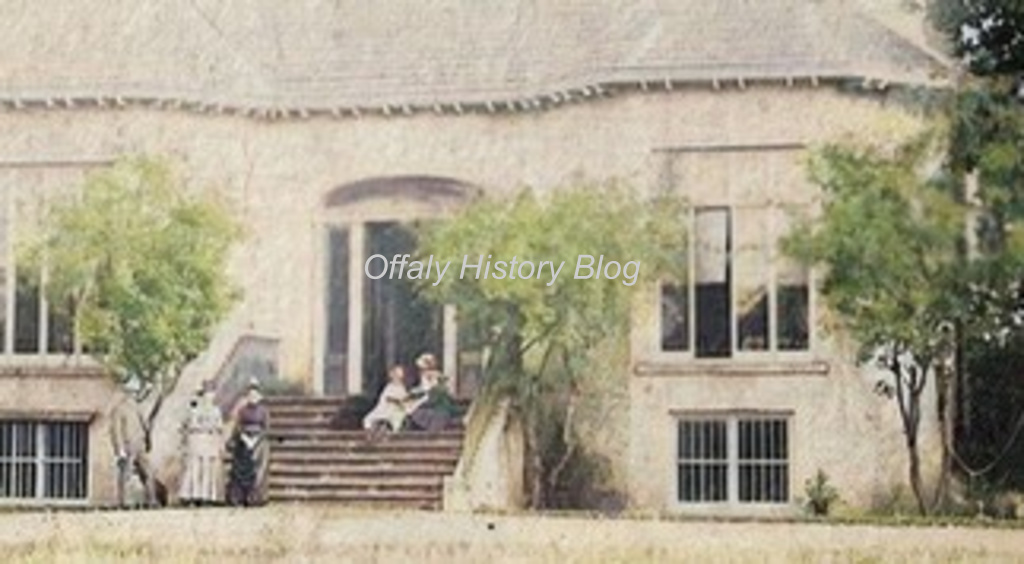
St Kilda’s, Birr, Co. Offaly (Private collection)
While the older Biddulph boys were away, Nicholas in Egypt with the army in Egypt, Hugh and Charles at boarding school in Aravon House, Bray, County Wicklow, the girls remained at home. Amy and the younger girls received an education from a governess. In Amy’s own words:
‘A governess came daily for a couple of hours to give me and my two sisters lessons. Education wasn’t much thought of for girls. As long as we could read, write a good hand and add up a few sums and have a smattering of history and geography. With me they went a bit further and I had painting lessons in the town and a master for music. The others didn’t get that far except what our governess could teach them.’
All three sisters attended Sunday school in Birr.
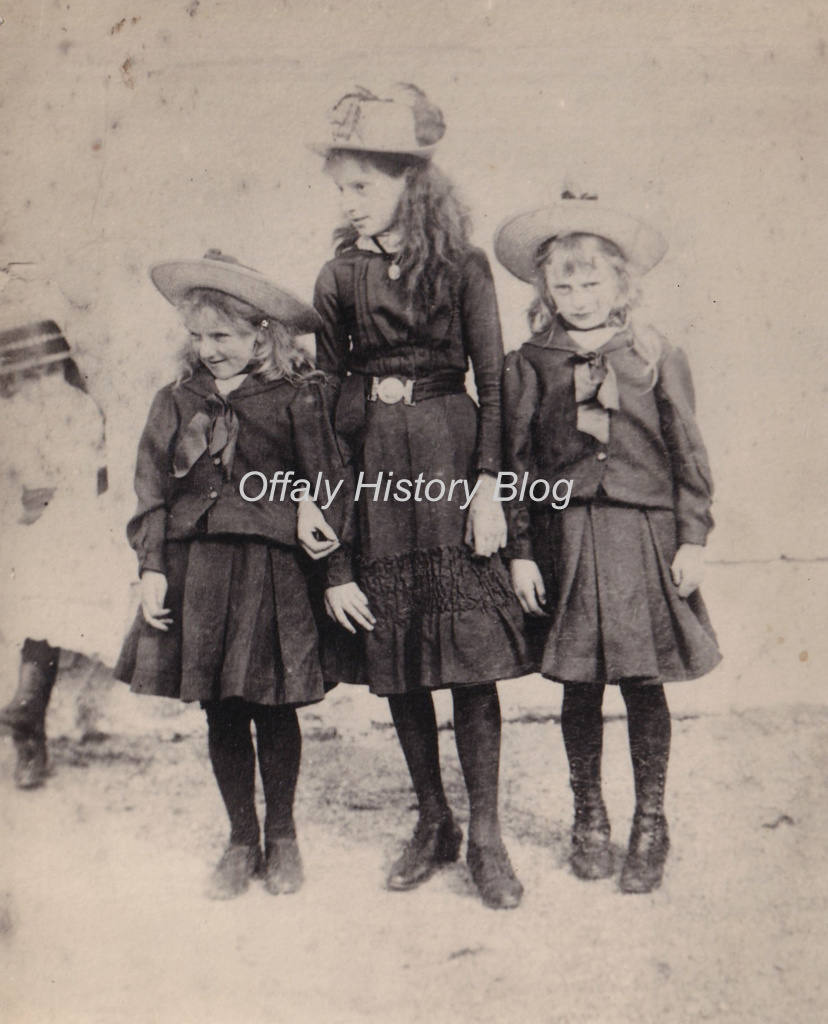
Beatrice, Amy and May Biddulph (Private collection)
Amy had dancing lessons in Birr Castle, with the children of Lord Rosse. They also frequently visited nearby Kinnity where their relatives, Assheton Biddulph and his wife Florence, together with their daughters Kathleen, Ierne, Norah and Ethne, and their son Robert, lived in Moneyguyneen, close to Kinnity Castle. Born between 1881 and 1891, the children were close enough in age to be playmates for the two younger Biddulph daughters, May and Bea. Assheton’s brother Middleton Biddulph lived and farmed at the Biddulph family home of Rathrobin with his wife Vera. They had no children.
Francis Biddulph’s younger half siblings Annie, Mary, James and William were all living in Parsonstown at this time. Annie lived at Birr View. There is a memorial window to Annie in Ardcroney church but the church itself is now located in Bunratty Folk Park. Mary and James lived at Bunrevan, Parsonstown.
James Digges La Touche Biddulph was the second son of Nicholas Biddulph, and the first son of his second wife Isabella Digges La Touche. His sister Mary was born the same year of 1842. It seems likely that they were twins but there are no surviving baptismal records. The church records for Ardcroney were destroyed in 1922.
James Biddulph died in Parsonstown in 1895 from general debility according to his death record. He was fifty years old. His sister Mary Biddulph was present at the death.
BIDDULPH – October 14, at Bunraven, Parsonstown, J. Digges la Touche Biddulph, son of the late Nicholas Biddulph, Congor, Borrisokane. Funeral at 9 o’c. tomorrow (Thursday) morning for Congor.
William was a Church of Ireland clergyman and married to Rebecca Clarke.
Amy described St. Kilda’s as her very happy home – ‘there was a large garden at the back of the house and at the end of it large apple and pear trees – one of these which I claimed as my own had very good branches for climbing and many a day when my two young sisters would be off playing their own games I would sit up for hours partly reading and partly watching the lambs which adjoined our place. How they skipped and jumped – she wrote – especially on old roots of trees which abounded – and then suddenly rushed off like mad things when their mothers called them. They were my delight, and also the rabbits, especially the tiny ones when they first came out of their burrows of which there was a lot in our fields.’ Her brothers, however, caught them in traps and shot them. They were a most useful addition to the menu.
‘The avenue which was more than half a mile long, opened off the Barrack Road.
There was a very high hill covered with big trees on one side and a pretty little lake on the other. When my brothers were home for the holidays they made a rustic bridge and a boat – and the island was always a sort of misty place inhabited by fairies and gnomes.’
Among Amy’s childhood memories were some involving her donkey Yankee. She described him as being almost human. ‘When some of the officers would come over from the barracks one of us would jump up on Yankee with just a stick in our hands to guide him, no saddle or bridle, and canter him round and then we would invite one of them to get on which they would do while we stood at its head. Then we’d say ‘Gee-up, Yankee’ and round he would go, kicking and jumping and arching his back ‘til the unlucky victim would fly off. How we trained him to do that trick I don’t know, but it was an unfailing one.’
But while Amy’s life was happy, these were troubled times. From the age of nine Amy began to hear of the Land League. Francis read the newspapers out loud every day for the benefit of Annabella. Just after the shooting of the Chief Secretary Lord Frederick Cavendish in the Phoenix Park, her brothers were walking along one of the roads in the town near their house with two policemen walking in front of them. They saw a flash out of one of the houses and one poor young policeman fell dead almost at their feet. There was constant anxiety about Francis. As a J.P., a landlord and an army man he was a marked man. One day he received a letter containing a picture of a coffin with his name on it.
In spite of this, for the three girls growing up in Birr, there was a lively social scene.
On the 1st January 1890, according to an item in the Irish Society (Dublin) of the 11th January 1890, the Countess of Rosse and Lady Muriel Parsons held a children’s fancy dress ball in Birr Castle.
‘Dancing commenced soon after 8 o’clock in the beautiful drawing room of Birr Castle, and was continued throughout the evening with the greatest possible spirit and enjoyment. Supper was served at 11 o’clock in the dining room, which was brilliantly illuminated with electric light.’ Miss Amy Biddulph attended as a Russian Tambourine Girl, Miss May Biddulph, as a Watteau Shepherdess, Miss Beatrice Biddulph, an Ice Queen. Miss Kathleen Biddulph, aged 9, daughter of Assheton Biddulph, was Little Bo-Peep.
As the three sisters grew older they played an active part in the life of the town..
May was a keen cyclist. Her name appears in an account of the Bog of Allen Club Bicycle Gymkhana which took place in July 1897. She was clearly an enthusiast of the bicycling craze which swept America and Europe at this time and promised greater freedom for women.
The Annual Gymkhana, promoted by the Bog of Allen Club, came off successfully at Oldtown, Naas, in tropical weather, and in the presence of a large and fashionable concourse of spectators. The Band of the 5th Battalion Royal Dublin Fusiliers played a fine selection of music during the afternoon, under the baton of Mr. Colvet.
She took part in the Hallow Eve Race (for Pairs) with Rev. L. Fletcher, and also in the Bending Race (for Ladies). Her sister Bea also took part in the Bending Race. The final race of the day was a One-legged Race (Ladies and Gentlemen). It’s not known if either May or Bea took part.
Amy Biddulph and her aunt, Miss Biddulph of Bunrevan, took part in a Birr Barracks Entertainment, an account of which appeared in the Midland Counties Advertiser of the 27th October 1892. Amy was seventeen years old.
‘Miss Biddulph, of Bunrevan House, next contributed a pleasing number ‘Saved from the Wreck’ which was very favourably received…Miss Amy Biddulph, St. Kilda, the eldest of the pretty daughters of Colonel Biddulph was, in the absence of Mrs Frend, requested to furnish a song, and greatly pleased her audience by giving a charming rendering of ‘The old home beyond the hill.’ The youthful vocalist fully sustained the musical reputation of her respected family, and she made a most favourable impression. Possessing a voice of singular power and sweetness and under perfect control, this young lady gives every promise of becoming a valued addition to local musical circles.’
Amy played tennis, sometimes mixed doubles with her brother Charlie, sometimes with Emma McSheehy. One year the annual tennis ball was held in St. Kilda’s. ‘It was a lovely moonlight night high in midsummer and the hay had just been cut and put up in heaps to dry and next day we had a great time discovering hankies and fans etc., at a great distance from the house – even on the island which told a tale! Also we weren’t very pleased to find the haycocks had been flattened.’
However this life couldn’t last. Francis had commuted his pension to fund the purchase of the 50-acre farm. When the farm failed through a combination of the agent’s deliberate mismanagement, Francis’ lack of competency, and the difficulties arising from the agrarian unrest, together with the refusal on the part of one of his half sisters to help him financially, the original entail inheritance having been broken to support his half sisters. He had borrowed money at an exorbitant rate from Joyce the moneylender in Dublin, and he was bankrupt. The family was forced to leave St. Kilda’s. All their horses were rounded up to be taken away and sold, though the donkey Yankee and the old pony Countess were later saved. Amy ran until she came to the wishing well and lay on her face on the mossy bank and cried her heart out. Amy’s brother Charlie helped to save some silver and jewellery by packing them into his uniform cases. Bea and May carried out pictures and hid them in an old derelict lavatory in the bushes. Next day they left St. Kilda’s forever and stayed in lodgings in Birr.
Francis and Annabella moved first to Dalkey in County Dublin. Their youngest daughter Bea, went with them and trained to become a nurse. There was worse to come when Charlie died of typhoid on the 26th of June 1900 in Queenstown, South Africa.
May married Charles Francis Pease in Belfast in 1904. He was ‘a well known Irish cyclist’ and the son of Charles Clifford Pease of Hesslewood, Yorkshire.
Amy travelled to Belfast to become a companion to an elderly relative. She married Surgeon-Captain James Walker in Belfast in 1906. By a strange twist of fate he had served in Crinkill Barracks, in Birr. They had seen each other but had never met. He died of pneumonia 18 months later in Jacobabad, India.
Bea would later marry Archibald Mateer, stepson of John Parnell, whose brother Charles Stewart Parnell had founded the Land League.
When Sr Dolores Walsh returned to Tullamore in the early 1970s to take over as principal of the Sacred Heart School she brought with her a wealth of ideas influenced by her years in California.
The Sacred Heart School (or SHS as it has always been known by its pupils past and present) is believed to have been the first school in the country to introduce a Student Council, a concept that did not become the norm nationally until 1998.
The 50th anniversary of the Student Council in the SHS was the perfect opportunity to celebrate a concept that was decades ahead of its time and to mark the school’s role “at the heart of education, at the heart of the community,” so it was decided to publish a book.
Initial meetings were enthusiastic and optimistic and as time marched on it became obvious it was going to be more than a labour of love and was going to be a publication of some heft as contributions began to pour in.
The book’s coordinator Jacinta Gallagher Carroll cajoled and persuaded past pupils from the 1970s through to 2023 to put pen to paper and recall their Student Council and SHS experiences. The contributions varied from succinct recollections to albums of newspaper cuttings to poems and sometimes poignant essays.







 offalyhistoryblog