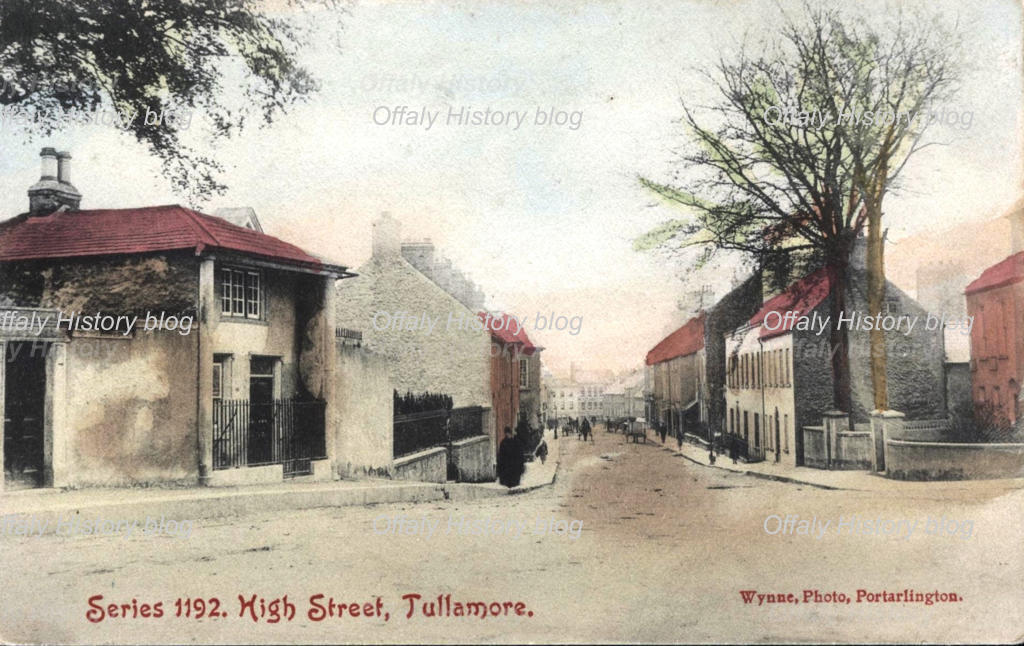
The square proper never had a public house until that in GV 5 in recent times, while the Brewery Tap on the western side at GV 3 High Street has served the public for well over 100 years. It was only in 2018 that a new public house and night club was opened at GV 5, now known as The Phoenix. The great garage of G.N. Walshe (GV 1 High Street) replaced the Goodbody hardware store which was in business from the 1840s to 1930 and with a tobacco factory at the rear until 1886.
Faithful Images: public art in County Offaly, will be launched on Monday 11 December at 8 p.m. at Offaly History Centre, Tullamore by Eddie Fitzpatrick, cathaoirleach of Offaly County Council. Faithful Images is a welcome addition to the growing library on the cultural patrimony of County Offaly. Thanks to Creative Ireland and Offaly County Council for their support. The new book is in full colour and is €20. It can be purchased at Offaly History Centre, Bury Quay (beside the Grand Canal and the Old Warehouse) and at Midland Books, and online at http://www.offalyhistory.com. You will be welcome to attend the launch and to purchase a signed copy.
The Turf Man – capturing working on the bog for over a century
The combination of Fergal MacCabe as architect/town planner/water colourist with that of Paul Moore as photographer makes for an excellent outcome. Fergal MacCabe has an eye to the broad sweep of architectural history from his having studied and practised the subject over sixty years. He has been looking at buildings with an admirable curiosity since his teenage years. By the 1970s this had blossomed into his being a superb watercolourist especially when it came to places associated with his childhood years in the midlands. Living in Dublin now he can return to his native place bringing with him a fresh perspective. We had the pleasure of working with him on Tullamore: a portrait in 2010, attending several of his exhibitions, and several of his lectures including those on the rediscovered Frank Gibney.
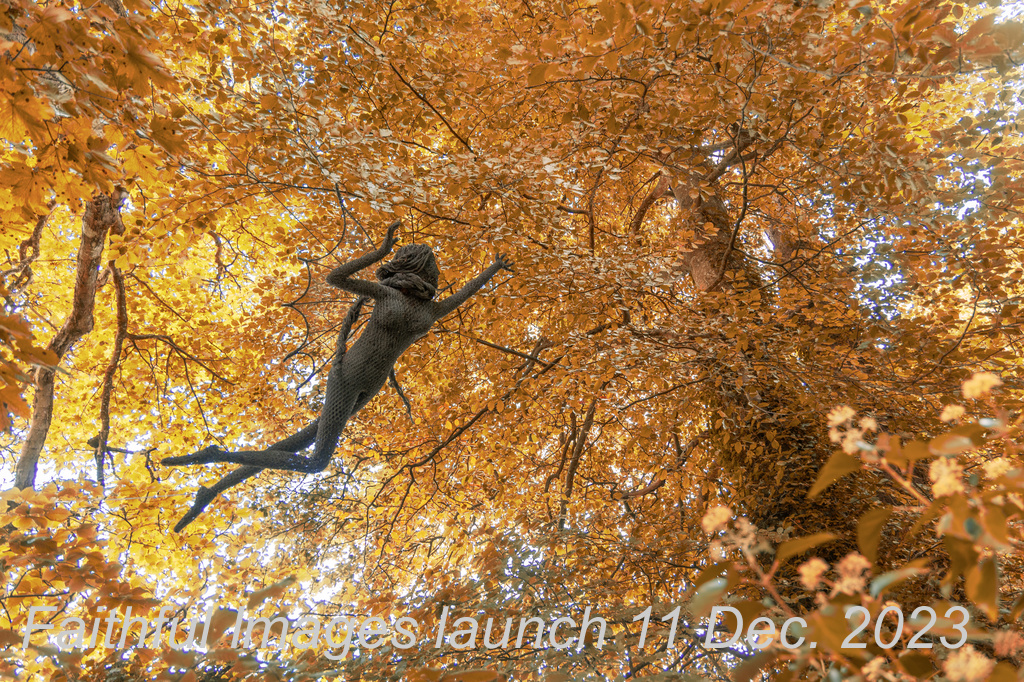
Aisling – the spirit of the trees, Geashill(more…)
Unlike Birr the detail for the 1821 census for Tullamore has not survived. The 1821 summary from the census of that year indicates that the total number of people living in Charleville/O’Connor Square in 1821 was eighty people, living in ten houses. This figure may have been arrived by excluding GV 1–4 High Street, the market house and treating GV 7 and 8 (Manly’s, now the library and PTSB) as one property, reflecting its leasehold ownership. The position in 1901 and 1911 is much clearer.
The publications below are available from Offaly History’s history shop at Bury Quay, Tullamore beside the Old Warehouse restaurant, online 24/7, and open Mon to Fri 9 to 4. 30. We are also in Bridge Centre from 14th to 24 Dec. as in previous years. We look forward to seeing you. All our work is to promote Offaly History on a selfless basis. All the publications below are from authors pro bono, pro deo, pro condado.
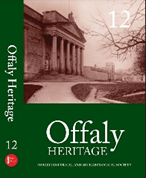
Offaly History is delighted to produce another volume of Offaly Heritage which is the twelfth collections of essays and writings on the history of the Faithful County’. The essays in section one reflect the ongoing research in Offaly into aspects of life in Ireland 100 years ago as we come to the end of the Decade of Commemoration (1912-1923). The essays reflect the changing nature of society in Offaly at that time, particularly during the years 1920 to 1923 and readers will enjoy contributions as varied as they end of the Wakely family of Rhode; the final years of the Leinster Regiment at Birr; the Protestant minority in Offaly during the revolutionary period; the courts of assize in King’s County in the years 1914-21; the burning of Tullamore courthouse, jail and barracks in 1922; the story of Belgian refugees in Portarlington, and Offaly claimants in 1916. A series of short lives are presented in this volume, as they were in Offaly 11 and includes entries on individuals as diverse as J.L. Stirling, Averil Deverell. Middleton Biddulph; Robert Hames Goodbody and volunteer Sean Barry. This volume of Offaly Heritage is also strengthened by a wide array of essays on aspects of Offaly history stretching from Colmcille to early soccer activity in Offaly in the late nineteenth century. The editors are particularly pleased to include essays from a number of contributors for the first time. The compilation of writings on Offaly history topics continues in this volume. The volume concludes with information on the Offaly Historical and Archaeological Society, the county’s heritage office and reviews of recent books of Offaly interest.
In 1961 I joined B. Daly & Co Ltd and two years later SI was transferred to Irish Mist (another wholly owned Williams company) to supervise the production line in the Bond Store. I joined up with Joe Scally, and I was still with him until I finished in 1985 over 22 years later. Joe and I were always involved in Production. We overcame many difficulties in the area over the years due to expansion and increased demand for output, with changes in packaging and design etc. I started on the middle floor of the Bond Store. We shared the building with Tullamore Dew. We had a staff of about 12 at the time, with no machinery as the output was small. Within a short time later, in 1966 due to increased demand, we had to move to the top floor. We became much more mechanised and we saw a dramatic increase in output, and also a big increase in staff numbers. We also saw the introduction of the Figurine, Blue decanter, the pocket Flask, the Waterford Glass decanter, and many more display packs, introduced onto the market. In 1966 a new office block was built, along with a new laboratory and a compounding unit.
[Birr Historical Society meets again on Monday 4 December 2023 after a break of three years. To mark the occasion we reproduce an article by J. Deering first published in the Midland Tribune in 1927 in the context of the golden jubilee of the coming of the Presentation Brothers to Birr. J. Deering makes reference to Chesterfield School and its first headmaster a Mr Biggs. The latter late went on to Portora as headmaster. We intend to publish articles on both Chesterfield and Mr Biggs next year. Then there is Banagher Royal School and the efforts to have its funding diverted to a new school in Birr. Deering makes no reference to the Birr Model School, but he has a few interesting comments on the smaller schools in Birr. Both the Mercy and Presentation schools have published histories as does Banagher (Quane North Munster journal article, 1967), but there is much more to uncover back to the 1820s and earlier.
Birr Historical Society is very strong in attendance at lectures and we have no doubt that Paul Barber’s lecture on Monday 4 December will have a capacity audience. In 2026 Thomas Cooke’s Picture of Parsonstown will reach the 200th anniversary of its first publication and that will be a case for celebration and emulation. The proposed lecture in Tullamore on 4 December was deferred in view of the two book launches at Offaly History Center, Bury Quay on 1 December (Irish Mist) and 11 December (Faithful Images) MB]
In the first two articles in this series we looked at the leasing of the sites in O’Connor Square and who built the houses. Today we look at the timeline and we have added more recent detail on occupiers and uses. There are sixteen properties to cover from the four on the west side to twelve in the main part of the square.
Commerce, community, and creativity are all part of the weave.
Golden, sophisticated, with a dash of mystery Irish Mist occupies a special place in the history of Irish distilling.
Ireland’s legendary liqueur might well be described as the accidental offspring of Tullamore Dew.
First produced in 1947 in response to the urgent need to make economic use of excess stock of whiskey it proved to be an inspired idea by Desmond Williams, grandson of the founder of the Tullamore Dew whiskey company.
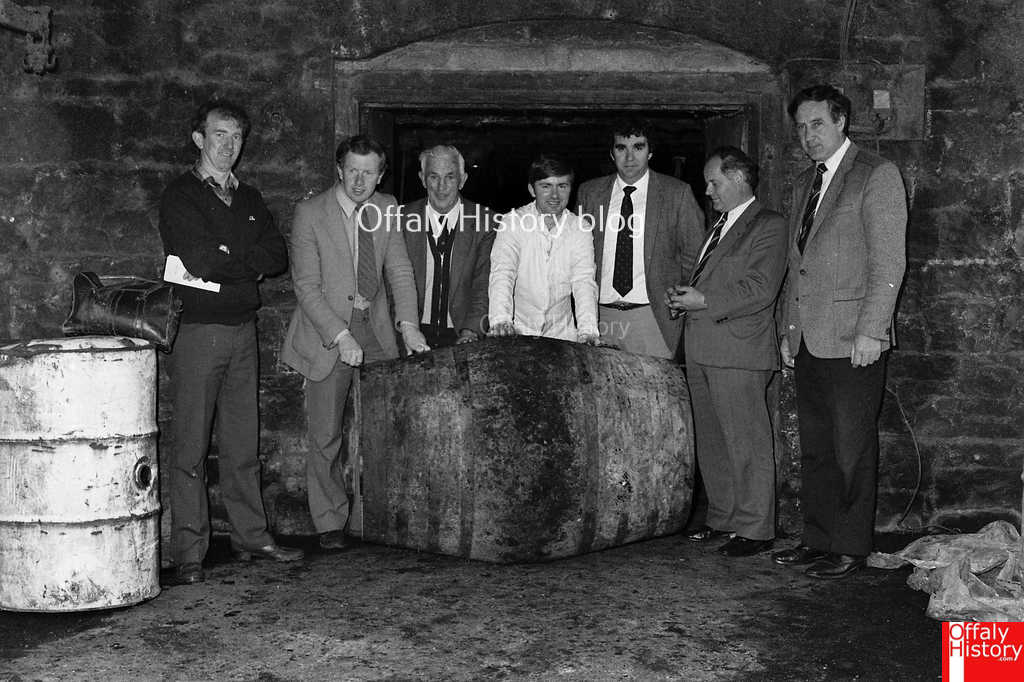
Rolling out the barrell – the last whiskey is the famous Sally Grove warehouse in Water Lane – now called Main Street with Irish Mist staff and the officers of the Excise in 1983.
The history of Irish Mist involves a secret receipt from a mysterious Austrian distiller, celebrated through the famed ceramic figure made by Coronetti, Cunardo, Italy.
Now a collector’s item the splendid figurine is a replica of an Irish officer in the Austrian army from the 1750s.
In the first half of the nineteenth century all of the original buildings in O’Connor Square were three-storey with the exception of the market house and the house where PTSB is now located (GV 8). The finest house was that of Pim/Wilson (GV 7) of c. 1740–48 (demolished 1936) and not unlike the fine houses in the square of the Quaker settlement of Mountmellick where the Pims and Wilsons would have had connections.
Over a series of articles, it is intended to examine the evolution of the ‘market place’, Tullamore to the fine square it is today. It is intended to look first at the evolution of the square over the period from 1713 to 1820 with additional comments on the building history in the last 300 years in the second article. This will be followed with analysis of the return for the 1901 and 1911 censuses and thereafter case studies of two of the houses in the square. Both are public houses, the Brewery Tap and The Phoenix, and business is conducted in the original houses albeit that both have been extended. Both are well known with the Brewery Tap one of the oldest pubs in Tullamore and The Phoenix the newest. The Brewery Tap house can be dated to 1713 and The Phoenix as a house to 1752.


 offalyhistoryblog