With preparations for the 25th anniversary of the Good Friday Agreement now underway, and especially with the historic visit of President Joe Biden to Ireland fast approaching, I find myself thinking again about the crucial importance of Irish America throughout our recent history. This is true not only with regards to current events, but also to the earlier part of the 20th Century whose decisions and conflicts so profoundly shaped the challenges we still face, as we work to maintain peace, stability and democracy across our island.
From the mid 19thCentury the Irish Independence movement was always closely connected with the huge Irish American population dispersed across many parts of the USA during and after the Famine, and those struggling for Independence benefitted from Irish America’s long standing and vital support for positive change in the country which so many Americans still called home. This dynamic was as true in the volatile situation of early 1922, of which I have written in my recent book, Fierce Tears, Frail Deeds, as it is now.
The ‘Second Reformation’ initiated by Magee was marked by:
An exhibition charting the development of the ‘Second Reformation’, one of the most significant periods of nineteenth-century Ireland, is currently running in Birr Library and is open to the public. Furthermore, a public lecture by Dr Ciarán McCabe (QUB) in Birr Library on Wednesday 5 April (at 6.30pm) will discuss the ‘Second Reformation’ (including the infamous Birr Crotty Schism) and the development of the exhibition.
There are a few surviving published diaries of soldiers who served in the British army in Ireland from the 1700s to the 1900s.[1] One such is that of colour sergeant Calladine whose account of his time stationed in the Midlands in 1822 (at pp 108-109) is of interest as to how soldiers were occupied at the time.[2]
George Calladine was born in Wimeswould, Leicester in 1793, the son of a gardener. After his father died, he was apprenticed to a framework knitter, but found the work boring. He joined the Derbyshire militia in 1810, and then the 19th Foot in the regular army. In 1814, his regiment was posted to Ceylon, and helped to put down a rebellion. The 19th Regiment of Foot was sent to Ireland in 1821, where Calladine, by now married, lived with his wife and children in barracks. In 1826, he chose to remain in Ireland as a hospital sergeant, rather than accompany his regiment to the West Indies. He was discharged from the army after twenty-seven years’ service in 1837, with a pension 2s. 1½d. per day. He returned to Derby and became the master of a workhouse. He and his wife had thirteen children, eleven of whom died in infancy. Calladine himself died in 1876, aged 83. In the excerpt below, Calladine discusses some of his courting experiences as his regiment moved from Hull to Westminster to Weedon. While he was unsuccessful, he was not the stereotypical irresponsible soldier seducing any young woman whom he came across. (From Women, Soldiers and the British army, 1700–1880 (London, 2020).
Calladine was in Clare Castle, County Clare in 1828 – a poor miserable place about a mile from Ennis and where two of his children died (see A tale of Old Clare per Google).
Calladine spoke well of Tullamore town but described the barracks as old. The barracks had been built in 1716 (located where the garda station is now located and the streets around) and survived until destroyed by the Republican IRA departing from Tullamore on 20 July 1922 during the course of the Civil War. Now read the diary extract:
Do you want to know more about your townland? In this article you will discover the origin name, meaning and history of some of the townlands in the parish of Kilbride, Tullamore. The civil parishes of Kilbride and Durrow are closely aligned with the boundaries of the Catholic parish of Tullamore
The description of the parish of Durrow and Kilbride from Petty’s Down Survey of c. 1654.The soil is fertile and watered by the Silver River and the Brasnagh – with great store of fish. The forfeited lands were those of the Briscoes of Srah Castle and the Herberts of Ballycowan Castle. Tullamore lands were owned by the settler Moores from the 1600s-20s period and as such Protestant and not for planting with new owners.(more…)
Bell Hill is a small townland close to the village of Clareen, Co. Offaly. The Bell Hill itself is situated on high ground with good views in all directions. A large bush sits on the hill and is known locally as the Bell Bush. There are a few other locations in Ireland called Bell Hill.
The story of Bell Hill starts with St. Ciarán of Saighir and is mentioned in nearly all of the Lives of the Saint. The story links St. Ciarán with St. Patrick and is probably best told in the Life of Ciarán as translated by Ingrid Sperber from the Codex Kilkenniensis, held in Marsh’s Library, Dublin.
In this Latin Life we find that when Ciarán ‘heard of the existence of the Christian religion in the city of Rome, he left Ireland and travelled thither. On his arrival, he was baptised and instructed in the Catholic faith, he remained there for 20 years, reading the Sacred Scriptures, collecting holy books, and studiously learning ecclesiastical rules. And when the people of Rome saw the wisdom and discretion, the piety and faith of the holy man Ciaran, he was ordained bishop and afterwards sent to Ireland, his native country.
And St Patrick, the Archbishop of all Ireland, met him on the road in Italy, and God’s two saints rejoiced in their meeting…. at that time St. Patrick was not yet a bishop, but he was later ordained archbishop by Pope Celestine and sent to preach in Ireland… and Patrick said to Ciaran, ‘go before me to the centre of Ireland, to a spring called Fuaran, on the border between the Southern and the Northern Irish. Build a monastery there, for there will be your estate and your resurrection’. St Ciaran said to him, ‘the location of this spring is unknown to me’. St Patrick answered him, ‘dear brother, proceed without anxiety, and God will be with you. Accept as your travelling companion this bell, which will remain dumb until you arrive at the same spring. When you have reached it, the bell will emit a clear sound and ring sweetly.… when St Ciaran reached Ireland, God directed him to the spring called Fuaran, and there the bell of the holy man rang clearly. This bell is called Bardan Ciaran and is kept and greatly honoured in the monastery of St Ciaran and throughout his entire diocese’.
Happy St Patrick’s Day to all our followers. A good day to recall a talented young man who died all too early. Sean Mac Caoilte/John Forrestal of Henry (now O’Carroll) Street, Tullamore is forgotten in his home town. Why is that? For one thing he died in Dublin at the age of only 37 having spent almost half his life there. He was from a strongly nationalist family with his father Andrew and sister Emily very much associated with the move for independence as was his brother Dick. Séan was a literary man from a young age. Richard (Dick) Barry (born 1880, emigrated to New York 1904) recalled him as prominent in the early days of the Irish Ireland movement in Tullamore.[1] He was also associated with the first historical and literary publication. In the Christmastide of 1903 appeared for the first time Ard na h-Eireann: An Irish Ireland Magazine, published under the auspices of the St. Columkille branch of the Gaelic League at Tullamore. A second and final issue appeared in 1904. This was to be the last such publication from Tullamore until Offaly Heritage in 2003 and Tullamore Annual in 2012.[2] Forrestal was very much the editor of the 1903 magazine and his literary leanings ensured that he was a prime mover in having the new street names for Tullamore recommended by the Gaelic League and adopted by the urban district council. An associate of Forrestal’s and very much in the same mould was the solicitor James Rogers, who in 1903–4 was still a law clerk in A. & L. Goodbody’s Tullamore office. Rogers lived on until 1967 and could have told us much but no one asked.
John Forrestal/ Sean Mac Caoilte (1880-1922). From Fierce Tears Frail Deeds (with permission).
The young Tullamore solicitor James Rogers was busy after 1908 with his own legal practice, but went on to found the Offaly Archaeological and Historical Society in 1938 and had the support of Tribune editor James Pike. The Society suffered during the war years because of transport difficulties, but in 1943 Pike was kind enough to call attention to the contribution of Rogers to the Gaelic League early in the century with his friends John Forrestal and the young Henry Egan.[3] We can return to this in a later blog. But now we want to hand over to an excellent short life of Forrestal published in ainm.ie and reprinted here with authority. The later blog will tell you of a new novel based partly on the life of our Sean Mac Caoilte who died in 1922 in the same year as the Free State was founded. His brother Richard (Dick) was part of the new National army. Emily worked with Mrs Wyer of Church Street another ardent nationalist. The Ainm.ie site is a must for historians and lay people and has lives not to be found in the DIB.
Forrestal homes raided by British military forces in Dublin and Tullamore in 1920 and Wyer’s in Church St where Emily Forrestal worked.(more…)
For about forty years Tullamore was home to the production, bottling and marketing of a world-class product, Irish Mist liqueur. The background to the project to establish a whiskey-based liqueur came from English contacts of the Williams distillery company, B. Daly, and arose out of the scarcity of whiskey in England as the war came to an end in 1945. By late 1947 production of the liqueur compound – a mixture of honey, sugar and whiskey – commenced in Tullamore. Sales were good initially, but with the return of competitors to the market, such as Drambuie, and difficulties with the English shareholders progress slowed.
The good news is that with the support of Creative Ireland and Offaly County Council we are on an excursion to find out what made Irish Mist a product distributed worldwide and using the best designs for packaging. It was all started in Tullamore in 1947 so you can help fill in the gaps. We want to hear from people with memories. We want to record it in book form while there are people who can give first-hand accounts.You have a story to tell and you may have pictures.Please contact John Flanagan, Ardan Heights, Brian Jaffray or Michael Byrne. Why not email us info@offalyhistory.com or call to Offaly History Centre, Bury Quay, Tullamore.The work on the project has now started so get in earlywith your contribution of a memory or a picture.
Desmond Williams, a grandson of the founder of the firm was with the product from the start. He concentrated his sales skills on the wealthy Irish in America and by 1953 had established a small market there. It was his famous father-in-law, Oliver St. John Gogarty, who introduced Irish Mist to the U.S. when he personally conveyed four miniatures to a trade agent there in late September 1949, by way of samples of the new product.[1] Later, it was Irish connections such as that with Jim Costello (formerly of Ferbane, Offaly) and owner of a unique bar and restaurant in New York with an avant-garde clientele who gave an order for two cases and was willing to take another eight of a small shipment in 1950.[2
Oliver Mulpeter was heard to say he ‘would not miss it for the world’ and carrying the national flag which he proudly bore as the nephew of one of the wounded soldiers, he was among the first to arrive.
The commemoration was to honour soldiers of the National Army who were wounded in a Civil War ambush, two of whom died some weeks later. Relatives of all four casualties gathered for a roadside ceremony on a bitterly cold January day with traffic thundering past inches away on that busy road between Raheen and Geashill in North Offaly.
An honour guard of soldiers of The Irish Defence Forces Veterans group was present led by Declan Sheridan. They came to attention and gave the salute as the ceremony progressed – a poignant mark of respect to their comrades-in-arms of a century ago, their presence there an important and vital element of the event.
It was one hundred years to the day that the ambush took place at that spot, within sight of old Raheen chapel, on a bend of the road overlooked by rising ground. The ambush party opened fire with rifles and a Lewis gun from both sides of the road on a platoon of fourteen soldiers marching from their Geashill garrison to Sunday mass. Luckily the Lewis gun jammed, otherwise casualties would have been much higher.
Standing at the bridge in Bridge Street and looking south towards the Windmill hill at Cormac Street is to observe 300 years of development comprised of three and two-storey houses and no single-storey properties or ‘cabins’. The latter were reserved for the lanes, side streets and long gardens to the rear of these large houses. When Arthur Young passed through Tullamore in 1770 he remarked that part of the town was well built. We have already looked at the intended first class development of Crow/Tara Street in an earlier article. T.W. Freeman, the geographer, noted in his 1948 article on Tullamore that there was firm ground on either side of the inconspicuous bridge and a slight rise northward to the canal, 203ft. above O.D., some ten feet higher than the river, and southwards to the courthouse, at 225ft. O.D. Near to the bridge on the west side was the town watermill drawing on the power from the Tullamore or Maiden River and at the high ground behind O’Moore Street and Cormac Street was a windmill dating from the early 1700s. One hundred years later the building of the street was almost completed.
High Street in 1821 contained eighty-four houses and 543 inhabitants. As almost all the houses were built before 1821 and there were only forty-two in 1901 this would suggest that this calculation includes the houses in Bridge Street and sub-divided properties.
In 1901 High Street with a population of 225had forty inhabited and two uninhabited houses and forty-one families of whom 158 were Roman Catholic, 50 were C of I, 4 Presbyterians and thirteen Methodists. The houses were all slated and stone-walled, twenty-six were placed in the first division and fourteen in the second. As to out buildings there were nineteen stables, five coach houses, three harness rooms, two cow houses, one calf house, one piggery and five fowl houses.
Nestled in the foothills of the majestic Slieve Bloom Mountains, Ballyboy or Baile Buí, meaning the town of the Yellow Ford, is a picturesque village of rich historical significance. Like many villages in Ireland, the modest present-day facade of Ballyboy belies a history that has seen the rise and subsequent fall of an early Christian monastery, a site visited by many historical figures in the early years, including Hugh O’Neill, the Normans and even Oliver Cromwell.
St. Brigid’s Convent & St. Mary’s Church
St. Brigid founded a convent in our village in or around the year 500 A.D. The people of the village maintain that it was the very first convent she built in Ireland. The Convent was situated on the mound still known as Abbey Rath (later becoming the site of the Norman Motte and Bailey) The convent continued until 1539. Around the same time as St. Brigid built her convent, it is said that the first church in the village, St. Mary’s Church was also built. Mass would have been celebrated in Saint Brigid’s Convent or at St Mary’s church.
From 1650, when Cromwell’s army marched to the village from Cadamstown and destroyed St. Mary’s Church, until 1704, there was no church in the parish. The old church had a round tower that came almost to the centre of the present-day road. There was also a tunnel from the church to the fort at Abbey Rath. The tunnel was 400 metres long.
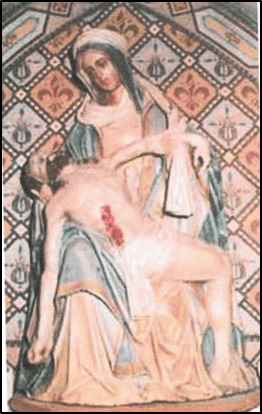
During Cromwell’s attack, the precious Pieta was bravely hidden by two McRedmond women from Knockhill. When they saw Cromwell and his men approaching from Cadamstown, they rushed to the church, took the Pieta from its place just inside the door and hid it outside in a heap of rubbish. Everybody fled to the woods and caves before Cromwell and his men reached the village, in case they would be killed. In the dead of night, for Cromwell’s army was still in Ballyboy, a party of men took the statue and carried it a short way across the Silver River and over the fields to Ballybracken, also known as Ridgemount. Here they buried it 6 feet deep in the bog below Derryhoy, where it lay hidden for over 60 years. Ridgemount is the area where the Faithful Fields are now situated. These men promised not to tell anyone where the Pieta was buried. Just before the last of the men died, he told people where it was located. When it was found, the Pieta was brought to the Church of the Nativity BVM in Kilcormac, where it still remains today.
The Pieta as it presently stands inthe Church of the Blessed Virgin Mary, Kilcormac.
During Penal Times Catholics were forbidden to practise their religion and resorted to celebrating mass in secluded places. There is still a corner field in Ballinacarrig called ‘The Mass Pit’. According to Rev. A Cogan’s “The Diocese of Meath, Ancient and Modern”, a priest was arrested in his vestments for saying mass near the Motte in Ballyboy.
St. Mary’s Church Ballyboy
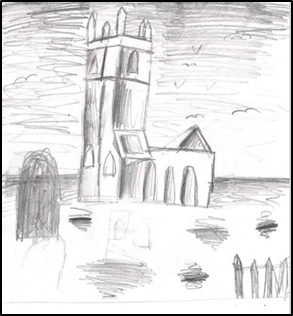
St Mary’s Church, Ballyboy by Aran Kelly
St. Mary’s Church Ballyboy
Saint Mary’s Catholic Church was taken over by the Church of Ireland between the dates 1709 and 1715 when there was renewed persecution of Catholics. The present church was built in 1815 with a loan of £900. Several years later, it was repaired with a grant of £279. In 1874, a very bad thunderstorm hit Ballyboy and the tower of the church was struck by lightning. It is said that the flash ripped a body that had been buried a few days before out of its grave. Two years after Griffith’s Valuation, the women of Ballyboy got together and subscribed a sum of money to purchase a chalice for the Church. This chalice is still in use in Kilcormac and on its base is inscribed ‘Pray for the Matrons of Ballyboy, 1856’.
Written by
Seán Lambe, Aran Kelly, Andrea Feighery, Kyle Jennings, Harry Bracken, Rory Grennan
The Normans in Ballyboy
In 1175, the Normans arrived in Ballyboy and built a Motte and Bailey in the village on Abbey Rath, on the banks of the Silver River. The Castle was initially built as a secure garrison for the Anglo-Norman army as they advanced through this region using the routeways in Fir Cheall. Once the region of Fir Cheall had been secured by the Anglo-Normans, the castle acted as a focus for settlement which grew up around and under the protection of the earth and timber castle. At the base of the mound are the remains of old walls, said by some to be the ruins of St. Brigid’s Convent.
Towards the end of the 14th century, the O’Malley’s took possession of the Anglo-Norman castle. The lands and castle of Ballyboy remained in the hands of the O’Malley’s until the Irish War of 1641-53. After this war the lands and castle of Ballyboy were confiscated by the Commonwealth government and granted to Sir William Petty. During the Williamite Wars in Ireland of 1688-91, the village and castle of Ballyboy became a garrison for Williamite soldiers. In 1690 the Jacobite forces attacked and burnt the town and the Williamite forces took refuge in the castle located on the ‘Mount’ in the centre of the village.
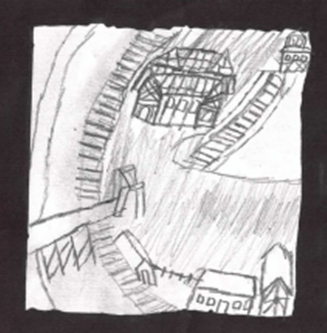
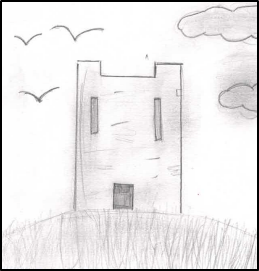
The earth and timber Norman Castle in Ballyboy by Grace Guinan
The Bailey part of the Motte and Bailey By Luke Guinan
The Norman Castle in Ballyboy by Anna Doolan
The archaeological remains of the earth and timber castle consist of a large D-shaped bailey that lies to the southwest of the low motte and survives today as a well-defined curving field boundary. The poorly preserved remains of a wall belonging to a stone structure can be seen standing on the summit of the motte. This wall may belong to the stone castle depicted standing on the summit of the motte on the 1654 Down Survey map.
In the post-medieval period, the castle was in ruins and the stone from it was probably reused in the construction of the present houses in the village. During this time, a stone wall was constructed along the base of the motte on the southern side. The church and castle with its associated settlement can be seen depicted on the 1654 Down Survey map of Ballyboy Barony. The Church of Ireland ruins are located on the site of the medieval church.
This photograph shows the motte or mound of the Anglo-Norman earth and timber castle. A later post-medieval wall cuts across the base of the motte which is visible on the left side of the photo. The footings of the stone structure can be seen on the top of the motte.
Written by
Grace Guinan, Luke Guinan, Anna Doolan, Aaron Coady
Scoil Bhríde Ballyboy
Our school, Scoil Bhríde Ballyboy is named after St. Brigid.The site of our present-day school was originally a hat and glove factory. During Penal Times, it was against the law for Catholic children to be educated, so a hedge school was set up to secretly educate local children. For a short period during the early 1700’s, the ruins of the old church in Ballyboy was used as a hedge school also.
The site of the Hedge School in Ballyboy
When Penal Laws ended in 1782 it was no longer illegal to have hedge schools so there was a school built in the village. There is little known about the school other than it had a thatched roof.
In 1820 a new school with a thatched roof was built by Lord Lansdowne’s wife. It is said that the school was also aided by an annual donation of £6 from the Marquess of Lansdowne. This school had a Protestant Schoolmaster and provided Catholic and Protestant children with an education. In 1832, the school was taken over by the Board of Education. The roof was slated and a Catholic Schoolmaster appointed. Griffith’s Valuation tells us that there was a dwelling house where the master would have lived. There was no piped water and the ditch was used as a toilet.
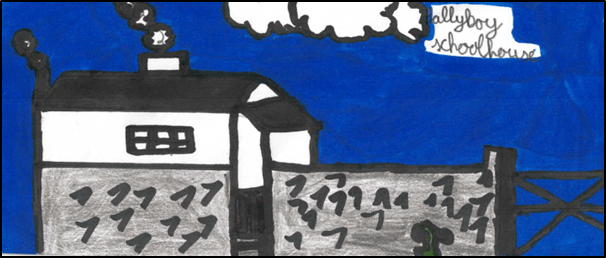
The Schoolhouse in Ballyboy, built by Lord Lansdowne’s wife
Ballyboy Schoolhouse 1820-1962 by MJ Hynes
The school was originally very close to the road but in 1960 it was knocked and a new one, seen below, built further back. This new school design was typical of the time being a large one storey building with tall windows. All the children were taught in two rooms. There was a small solid fuel stove in each classroom for heat, and the children would fetch turf from the shed which is now our boiler house.
Ballyboy School in the late 1960’s with the central chimney used to heat both classrooms. This central chimney is no longer present in our current school.
The school has been extended twice since it was built, in 1996 and in 2004. We now have a big playing pitch outside where we can play. We have a safe environment, and we are building a set down area so our parents can drop us off safely to school. For a such a small village we have a lot of history.
The First extension in 1996
Scoil Bhríde Ballyboy September 2022
Back in Time….the steps in our school wall that once led to the Hatter’s Factory
The old water pump outside our school. This pump would have been used as a source of water on the night of the fire in the hall.
Written by
Daniel Lambe, MJ Hynes, Theo Kilmartin, Sean Russell, Bryan Feighery, Aaron Grimes McDermott
Dan and Molly’s
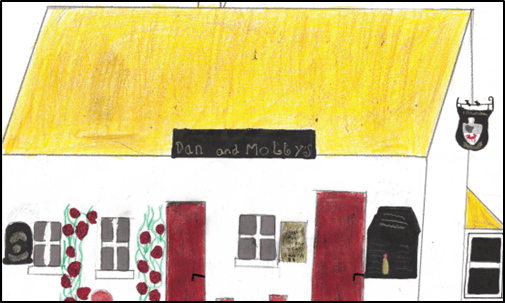
Dan and Molly’s pub was built in the 1800’s. It has been a pub for over 150 years. Originally the Redmond’s owned the pub, then the Molloy’s, the Petits, the Lynch’s and then the Ryan’s. The Ryan’s moved into the building in 1863 and Jack Ryan passed it down to his daughter Molly, who married Dan Boland. The pub then became known as Dan and Molly’s. Dan and Molly’s daughter Catriona now runs the pub alongside her husband Fergal. Dan and Molly’s still has the thatched roof because there was a preservation order put on the building in the 1970’s which does not allow it to be removed. Dan and Molly’s is the only straw thatched pub left in Offaly. The pub is used for music sessions, set dancing, card games, music lessons and general community events. The lessons are run by Ballyboy CCÉ. The family have a keen interest in the arts as the music has been passed down through four generations – namely Jack Ryan, his daughter Molly, grand-daughters Catriona and Stella and now the great grand-children John, Anna, Daniel, Séan and Katie. On April 12th, 2011, the pub went on fire, when a spark from the chimney ignited the straw on the thatched roof. This was a devastating evening for the family and for the community. It took many units of the fire brigade to bring the fire under control. Luckily the roof was restored to its original condition soon after.
Dan & Molly’s Ballyboy by Anna McDonald
Written by
Anna McDonald, Fiadhna Leamy, AJ Bracken, Daniel Heffernan, Cára Guinan, Mark Dolan
Ballyboy Hall
Ballyboy Hall was built in 1954 by the Young Farmers Association. It was built by voluntary labour mostly in the evenings, after the work of the day was done. In 1690, more than 250 years before this, King William of Orange had spent a night in the hotel which had stood on this very site. (The new hall was built on the site of the old hotel.) In 1967, there was a fire in the hall during a Whist Drive. The calamity happened because an oil heater caught fire. Local people who were there, said that it was an awful tragedy and many people got very badly burnt. On the night, water was pumped from the village pump, located outside the school to treat the injured. Luckily nobody died in the fire. The hall has remained derelict for many years until recently, when several locals came together and formed a group called Ballyboy Community Development Group. The group are fundraising to build a new community hall on the same site as the old one. They plan to develop a green space and recreational area in the village including landscaped area with seating, lighting and amenity car parking area.
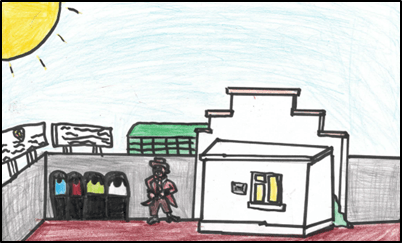
Ballyboy Hall by Cian Brunswick
Written by
Cian Brunswick, Adam Coady, Lochlann Fletcher, Alice Molloy, Sophie McGarry, Michael Clavin
Great work from the children of 5th and 6th class at Ballyboy School. This is our first blog from a school. Many of our blogs are used by schools and we look forward to more contributions from your area. Congratulations to Ballyboy, all the children who wrote and illustrated. A special thanks to the staff and in particular to their teacher Ms Michelle Egan, and also to Ms G. Clendennen.
Offaly History welcomes contributions by way of articles on all aspects of the history of County Offaly









 offalyhistoryblog