First established under the 1881 Land Act, the Irish Land Commission began as a regulator of fair rents, but soon evolved into the great facilitator of land transfer. However, over emphasis on these aspects of its work can sometimes camouflage its equal significance as the main instigator and architect of rural reform. There is no doubt that for most of its existence from 1881 to 1992 the Land Commission was the most important state body operating out of rural Ireland where its long tentacles spread into every nook and cranny. [Come to Professor Dooley’s lecture on Monday in Tullamore – see details below.
Two serious fires took place at Birr Castle within the hundred years from 1832 to 1919. Thankfully there has been nothing like it since and the castle was fortunate to survive the burnings of country houses in the county in the period from June 1922 to April 1923. Birr Castle is the only large house in the county to have survived in the same family since the 1620s. Its Gothic exemplar Charleville Castle, Tullamore also survived the destruction of the Civil War period. Both houses were occupied by the Free State Army from late July 1922.
The fire of 1832, ninety years earlier, was perhaps the most destructive and in its aftermath Laurence Parsons, the second earl of Rosse took the opportunity to add a third storey to the great house that had been substantially rebuilt in 1801–03. Its comrade in Tullamore is dated 1800 to 1812, or 1809 the grand opening – if not quite finished.
The B.B.C.’s centenary celebrations and John Bowman’s recent feature on RTÉ’s Sunday morning broadcast which included a recording of my late father, Llewellyn Marcus Goodbody, bring to mind the important part that Clara played in the development of radio, the scientific discovery which transformed communications and is now part of everyday life. Without the backing of Irish capital it is possible that Guglielmo Marconi’s invention would never have got off the ground.
Specially contributed to mark the Decade of Centenaries in Offaly #DecadeofCentenaries @DeptCultureIRL @DepartmentofCultureIRL Tourism-Culture-Gaeltacht @offalyheritage @offalylibraries
Bellair or Ballyard is in the Parish of Lemanaghan, in the Barony of Garrycastle and has an area of 1,198 acres and borders Hall, Westmeath in the north, Cappanalosset in the west, Moorock to the east and Springpark to the south. The dominant feature is the Hill of Bellair, which is visible from adjoining counties. The most striking feature of the Hill is the wonderful plantation of Beech and Fir trees which were planted on the instructions of Rev. Doctor Mulock. The Mulock or Mullock family were not planters, but were Irish landowners, who originated in the North of Ireland in the lands of Dal Araide.
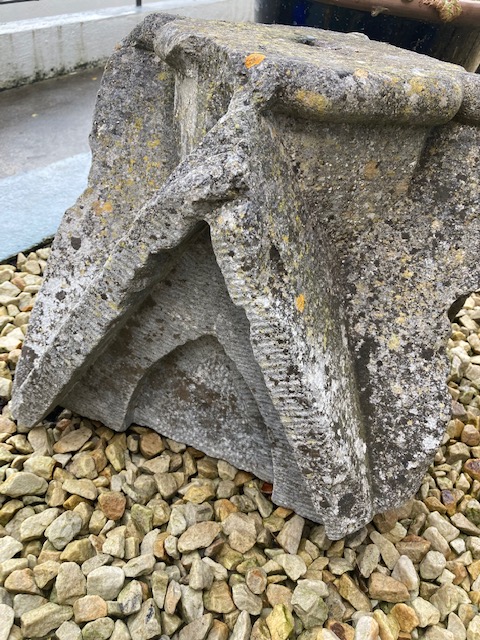
The first post-reformation Catholic Church in Tullamore parish was completed in 1775. Recently an architectural fragment from that church was presented to the Society. Ballyduff chapel was a small T-shaped building the remains of which are still standing and used to be glimpsed from the roadway between the former Wrafter’s farmhouse and the Carroll Meats factory. It is now in the grounds of Axis Business Park and easy to access.
The architectural fragment from Ballyduff first RC post-Reformation church of 1775 presented to Offaly History by John Wrafter.(more…)
Huge Crowd Gather in Bracknagh Community Hall for viewing of Film
Bracknagh Community Hall was full to capacity on Thursday last for the viewing of a film on the Ballynowlart Martyrs and the Turf Co Operative 101. The event was organised and hosted by the newly formed Bracknagh Heritage Group (A sub group of the Bracknagh Community Association). The guest speaker was Larry Fullam, local historian and researcher from Rathangan. Tony Donnelly extended a warm welcome to the large gathering. Mary Delaney, on behalf of the heritage group introduced and welcomed both Larry Fullam and Amanda Pedlow (Offaly Heritage Officer). Amanda addressed the audience on the supports provided by the Heritage Council for viable local projects.
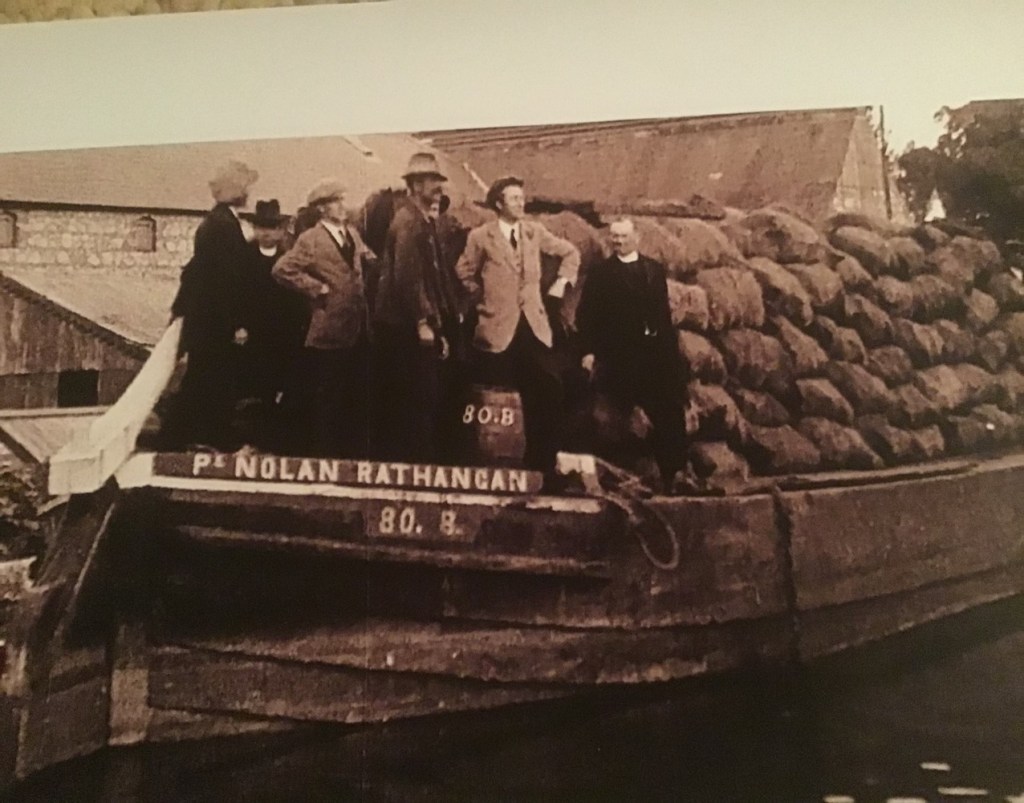
Larry spoke on how in 1917 a local priest Fr Kennedy with the help of Fr O’ Leary from Portarlington had the remains of the victims of a fire at Ballynowlart church in 1643 exhumed and reburied in the grounds of the St. Broughan’s church. The story of Ballynowlart attributes the setting alight of the church on Christmas Day in 1643 to Cromwell’s forces. A congregation of 108 people, who were attending Christmas Mass all died, with the exception of two, who were said to have escaped. The film produced by Pathe showed Fr Kennedy handling the exhumed skulls of the victims and preparing them for reinternment in Bracknagh in 1917. The second part of the film centered on how in 1921 (one hundred and one years ago), as part of the Government’s selling of bonds and fundraising, the Bracknagh Turf Co Operative exported sacks of turf to New York to raise money to fund the then, newly formed, Dail Eireann. Larry donated a number of photographs of the stills from the film to the Bracknagh Heritage Group.
The last time a film on Ballynowlart was shown was in 1964 in the cinema in Portarlington. This event was organised by the late Harry Milner of Walsh Island and was attended by a huge crowd from the Bracknagh area, many of whom are still part of the community of Bracknagh today. The Bracknagh Heritage group are very grateful to Larry for his in-depth research and knowledge and for providing us with a great insight into Bracknagh’s past.
The members also expressed their appreciation to all those who attended Thursday evening’s event and are delighted to see the interest and enthusiasm for local history in the area.
The group intend to pursue the following projects in the near future. The real story of the Ballynowlart Martyrs. The monastic site of Saint Broughan at Clonsast. The Impact of Bord na Mona in the area. The Story of John Joly and the extended Joly family.
Lord Ashtown and his role in evicting tenants from the Bracknagh area in the mid 19th century, and how some Bracknagh emigrants were banished to places like Oneido in New York.. The RIC Barracks in Ballynowlart and The Mill at Millgrove. It was highlighted at the conclusion of the meeting how the Catholic Church, built at the peak of the Irish Famine celebrates 175 years this year. The group extend;’/ thanks to Lisa Quinn, Chairperson of the BCA for facilitating the event.
Mary Delaney
(on behalf of the Bracknagh Heritage Group, which include. Francis Cunningham, Mary Crotty, Mary Briody, Barry Cunningham, Tony Donnelly & Aidan Briody).
People from Bracknagh gather outside Portarlington Cinema 1964 after watching a film on the Ballynowlart Martyrs (Photo courtesy of Larry Fullam) Bag of Turf from the Bracknagh Turf Co-Operative destined for New York 1921
Contributed by Offaly History to mark the occasion
The new book, St Manchan’s Shrine, by Griffin Murray and Kevin O’Dwyer was launched to great acclaim by the CEO of the Heritage Council Virginia Teehan on Friday 21 October 2022 at Offaly History Centre, Tullamore before a large and distinguished audience. Proceedings began at 5 30 p.m. with Amanda Pedlow ably acting as chair and introducing the four speakers. First was the author of the text Griffin Murray, followed by silversmith and photographer Kevin O’Dwyer. The County Offaly CE Anna Marie Delaney skillfully chartered the progress being made in regard to the county’s heritage while CEO Virginia Teehan paid tribute to the county for its wide-ranging involvement in heritage projects and availing of the funding available. The new Offaly Archives was a leading case but one among many successful projects undertaken. Another is that of the funding received to create the post of a biodiversity officer. Offaly has demonstrated its ability to secure funding for projects and that was a reflection of the work being done in the county. Ms Teehan congratulated the authors, Griffin Murray and Kevin O’Dwyer, on a job well done. Yet another exemplar.
Despite being out of the town for more years than I care to count I still get a kick out of telling people “I’m from Tullamore”. This often leads to “are you from the Town”? To which I readily reply in the affirmative, mentioning that I grew up on Patrick St. This invariably brings back memories of those happy days long ago. As a youngster in the 50s and early 60s I felt – and still do! – that Patrick St was the centre of the universe, a fantastic microcosm of daily life at the crossroads of the known world (well, High Street and William Street). To my young eyes it was Times Square, Piccadilly and the Istanbul souk all rolled into one. I remember the great variety of shops, with all kinds of enticing and exotic goodies, and behind the counters a wonderful collection of “grown-ups”, friendly but also each a source of curiosity to this young shopper. There was Talbots, definitely first among equals, where all your sweet fantasies could be fulfilled: ice creams (“wafers”) went from 2 pennies to 6 pennies (though I also remember a one penny half portion), while every cavity inducing confection was available from big glass jars. Particularly good value was the two-penny chocolate covered Trigger toffee bar. Turning right out of our house, you came to Cathy Dunne’s sweet shop, cousins of my dad, and always with an encouraging word for the “little fella”.
‘Uncertain Times’ – The Goodbody Family’s Experiences in Clara 1914–24 is the subject of an illustrated talk by Michael Goodbody on Monday 17 October at 7. 30 p.m. This talk by Zoom will be on the Goodbody family’s experiences in Clara during a turbulent period for individuals and businesses. The talk will cover the Great War, the 1916 rebellion, Independence and the ensuing Civil war and how the family coped with the changes and uncertainties during these events. You can also come to Offaly History Centre at Bury Quay, Tullamore and look at the talk on the big screen with friends. Tea served after the lecture. Admission is free . For the Zoom link email us at info@offalyhistory.com.
In this article John Gibbons talks about the value of oral history and the importance of making the recording. John started recording in Offaly in conjunction with the Offaly History in December 2014. Since then over forty people have volunteered to be recorded. You do have a story so why not contact John or we can put you in touch via Offaly History. John has contributed material to Offaly Archives which will prove very useful in years to come. A story worth telling is a story worth saving.



 offalyhistoryblog