
This is a new 20-minute video recording on the history of the Society, now better known as Offaly History with lots of interesting photos especially recorded for Heritage Week. We want to thank all who have contributed to making it so successful so far with activities across the county, and continuing until Sunday. The lecture on Larkin’s maps and their predecessors we shall post next week, also a video on the Durrow Pattern. Our next lecture is on 5 September on Michael Collins and is important. More information next week.
(more…)-
Troops ambushed near Tullamore, 29 August 1922: death of my granduncle Matthew Cullen. By Raymond Cullen. Blog No 412, 19th August 2022
The Lieutenant featured in this article was my granduncle Matthew Cullen and Monday the 29th of August 2022 will mark the 100th anniversary of his death, when he, along with a small party of National Troops [Free State army] from Tullamore Barracks were attacked by about fifty Irregulars [Republican IRA) at Bonaterrin [Bunaterin] Hill, near Blueball, Tullamore.
Lieutenant Matthew Cullen, (3rd Southern Division Óglaigh na hÉireann) was only 21 years old. Born 25th May 1901 in Ballymorris, Portarlington County Laois, he was one of five boys born to Timothy and Mary Cullen. Matthew joined the Free state Army on 16th of March 1922 as did his two brothers Thomas and James (my grandfather) and by August 1922 were all stationed at Tullamore barracks. Matthew was also an ex-internee of the Rath Camp in the Curragh of Kildare and was there in Hut 9 on the 9th of September 1921 when the great escape happened.
Before he was stationed in Tullamore Barracks [the barracks was at High Street – now Donal Farrelly’s house/ and Charleville Castle] Matthew spent over five months in the Nenagh Barracks, and since the opening of the Civil War was involved in almost every engagement in the Nenagh area. He was only a week in Tullamore when the fatal ambush happened.
On Sunday morning the 21st of August 2022 at ten, an anniversary mass will be said for him in the Church of the Assumption, Tullamore, the very same church where 100 years ago Requiem Mass was held for him by the Rev. Father Lynam CC.(The Midland Tribune, Tipperary Sentinel and Offaly Vindicator Saturday 2nd September 1922)
TROOPS AMBUSHED
NEAR TULLAMORE
LIEUT CULLEN KILLED AND LIEUT LEAHY SERIOUSLY
WOUNDED
DEADLY AND FIERCE ENFILADE FIRE AT BONATERRIN
MEDICAL TESTIMONY AS TO THE USE OF AN
EXPANDING BULLET
Coroner’s Jury Commend Motor Driver’s Bravery.
News reached Tullamore on Tuesday evening about 7.30 p. m, of a very painful and distressing character, which cast a gloom of sorrow and depression over the town and district. It was that a party of National troops had been ambushed at Bonaterrin, some four miles from Tullamore, and about a mile from Blueball, and that Lieut Cullen, a native of Portarlington, an ex-internee had been killed, and that Lieut Leahy, a native of Listowel, Co. Kerry, had been seriously wounded. Both were officers in the Tullamore garrison headquarters, were very well known, and much esteemed by the townspeople. Particulars to hand state that three cars carrying a party of about 20 officers and men from Tullamore, had been out in the neighbourhood of Kilcormac and Mountbolus engaged in clearing road obstructions.
When the work of clearing obstructions was finished they proceeded to return homewards about 6 p.m. The first car – they were all open cars – was driven by Capt. Donnelly, O C of the local garrison, with Lieut Cullen on his left, there also being in the car Capt. Wm Egan, son of Mr John Egan, Croghan, Rhode, with Lieutenants Lawlor, Leahy, and Volunteer Dunne. The second car, which was driven by Mick O’Neill, was in charge of Sergeant Reilly, a native of Tullamore who had with him a party of five men.

Bunaterin townland north of Blueball. So when you are whizzing past think of Matthew Cullen and that day 100 years ago. Map courtesy of Townlands.ie – one great site The third car was driven by Driver Ennis and contained a party of five men, in charge of Corporal Collins. Everything went well with the party until Bonaterrin was reached, when fire was suddenly poured on the first car, which was a considerable distance ahead of the other, by attackers who were in places concealment and who fired at close range. It is stated that they must not have been more than 80 or 100 yards distant. It was enfiladed fire of a very deadly character, and maintained with great fierceness. Lieut Cullen was struck with a bullet which pierced his heart, and he died immediately. It rent his uniform in the region of the heart, and appears to have been one of an explosive kind. Lieut Leahy was hit on the back and the bullet passed through his stomach, his spine being seriously injured. He lies in a critical condition, and at the time of writing, 11p. (Tuesday) is still unconscious.

St Vincent’s Hospital, Tullamore about 1930 where the body was taken The attackers appeared to have fired from both sides of the road at the point indicated, one crowd of them being evidently concealed in a wood and the other near a farmyard adjacent, at the opposite side of the road. The remaining occupants of the first car now replied vigorously to the attacker’s fire. Lieut Cullen had been killed and Lieut Leahy wounded, but the survivors Capt. Donnelly, O C, Capt William Egan, Lieut Lawlor, and Volunteer Dunne gallantly fought against great odds, until the other cars came along to their assistance. When the other two cars came on, a general engagement developed which lasted over half an hour but the National troops eventually, with the aid of a withering fire, scattered the attackers, who fled. Lieut Leahy was removed to Tullamore while the fight proceeded in the third car driven by driver Ennis passing under a hail of bullets. It was seen that he was bleeding profusely from the wounds he received in the attacks, and therefore little time was lost in bringing him away for treatment. He was promptly treated by Dr Moorhead on arrival at Tullamore Garrison headquarters. The doctor pronounced his injuries to be of a very grave character. Subsequently he was taken in a Tullamore Co Hospital ambulance to the Co Hospital, accompanied by Dr Meagher, who further treated him, and where he lies in an unconscious and critical state, under the care of the Nuns and nursing staff. The body of Lieut Cullen was removed to the morgue of the Co Hospital where it lies. His clothes were saturated with blood, and there are evidences of a terrible wound. The body was viewed by Rev Fathers Daly, Lynam, and O’Keeffe C C’s. The last rites of the church were administered to Lieut Leahy by Father O’Keeffe CC, before he had been removed from the garrison headquarters. Captain Donnelly received a slight wound in the course of the engagement.
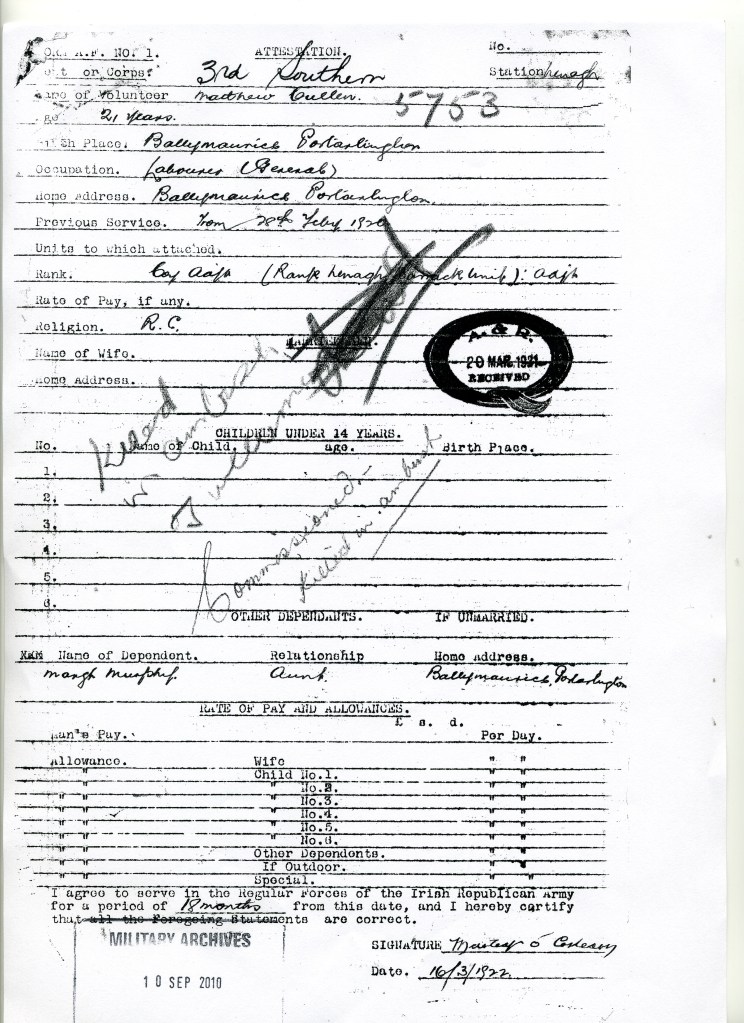
Service sheet for Matthew Cullen (courtesy of the Military Archive) Capt. Egan had a providential escape a bullet having swept the pince-nez he was wearing, without however doing him any injury. Lieut. Matt Cullen, killed, was a First Lieutenant and a native of Portarlington and was an ex-internee. Lieut. Leahy, wounded, was a native of Listowel, Co. Kerry, and was up to the time he joined the National Forces a chemist in the employment of Mr. Shiels at his pharmacy in Tullamore. He had been in town for a year or two and was well known to the townspeople, both in his professional and military capacity, and his kindly and gentle qualities rendered him a general favourite. Lieut. Cullen was about 28 years of age, and Lieut. Leahy about 32 years. When the news of the attack reached Tullamore, the local troops were mobilised, and proceeded to the scene immediately, but the attackers had fled before they arrived, as a result of the searching and with suing fire of Captain Donnelly, his officers, and men. It is stated that even though well protected by cover, the attackers must have suffered casualties. A visit to the scene of the irregular’s position disclosed to the troops the fact that the attack had been carefully planned. There was many evidence of the conflict around in the shape of empty cartridge cases etc.
SEMI-OFFICIAL REPORT.
A semi-official account of the fighting states:-“We left Tullamore on Tuesday about 3 o’clock in three Ford cars, containing five officers and ten men, and we went to Mountbolus, and from there went to clear some trees off the main road to Kilcormac. We were joined at Blueball by troops stationed there and proceeded afterwards to Kilcormac. We entered Kilcormac, and saw the Officer there in charge, and we left Kilcormac about 6.30 p.m, returning to Tullamore via Blueball.
The first car was the Brigade car which was about 40 yards ahead of the others at the time. In the car were Captain Donnelly, O C; Lieut. Cullen, Lieut. Leahy, Lieut. Lawlor, Staff CaptainEgan, and Private Dunne. When we came to the face of Bonaterrin Hill, about a mile from Blueball on the Tullamore side, fire was opened on us from two points, one on our right and partly in front, and on the other side from concealed positions in a shrubbery on the hill, about 60 yards from the road-that was on the left, or Rahan side. When the firing of the attackers opened Captain Donnelly turned the car into the ditch towards the left hand side, to give the occupants a chance of getting out without being exposed to fire or caught in the fall of the car, which turned over. There were four of us in the lower side of the car which had turned over when it was run into the ditch. We managed to get clear before the car turned. The car was then across the road. Lieuts Cullen and Leahy were on the upper or Tullamore side of the car: they had got off it, and were taking cover under a wall from the fire directed on them from the flank. That fire was coming from the scrub. There were only about two or three attackers on the other side of the road, but it was they who did all the damage. They held a position in a little grove near Bradley’s house, and we subsequently examined the position there. Just after we got out of the car and had taken up positions facing the flank fire, Lieut. Cullen was shot dead while in the act of ramming a cartridge into the breach of his rifle. He still held the bolt of the rifle in his hand when we got him. Immediately after Lieut. Cullen was shot Lieut. Leahy was struck on the side by a bullet fired from the same point-the grove near Bradley’s house- as he was crouching under a wall watching the flank fire from the other side.
The four remaining occupants of the car continued to fire in the directions from which theshots came – on the flank towards the scrub-and also in the other direction. We knew that there was fire coming up the road from the other direction, but we could not locate it exactly at the time. When the second car arrived its occupants dismounted and took cover, and we then poured a steady fire on both positions of the attackers-the scrub on the flank and the grove near Bradley’s on the other side of the road, from which the fatal shots came. When the third car came the soldiers it contained got out and took up positions about 120 yards away from the first car, and joined vigorously in the attack.
In the meantime, while firing was still hot, Lieut. Leahy, who was bleeding profusely from the wound on his side, was taken into Driver’s Ennis’s car; and Driver Ennis drove with thewounded officer through a heavy hail of lead from the attackers, to Tullamore. Lieut. Cullen’s death was practically instantaneous.
When the second and third cars came along and poured fire into the attacker’s positions the fire of the latter died out. Just before it ceased one of the attackers was heard to moan and shout on the left hand side of the road in the scrub, where his cap was afterwards found. The place was searched subsequently, and a large quantity of empty cartridge cases were found there – about 50 or 60 of them with some live cartridges. In the attack from Bradley’s grove side dum-dum bullets were used by the attackers. They cut holes the size of half-a-crown in the metal work of the car. Capt. Donnelly who was in charge of the party, had a narrow escape at the outset. A bullet went through the glass screen of the car he was driving, and if he had remained in his original position he would have got it straight; it came the moment he was swerving the car, and this movement saved him. All the occupants of this, the first car or Brigade car, had miraculous escapes, and the mystery is how any of them survived the terrible hail of lead concentrated on the car and its occupants.
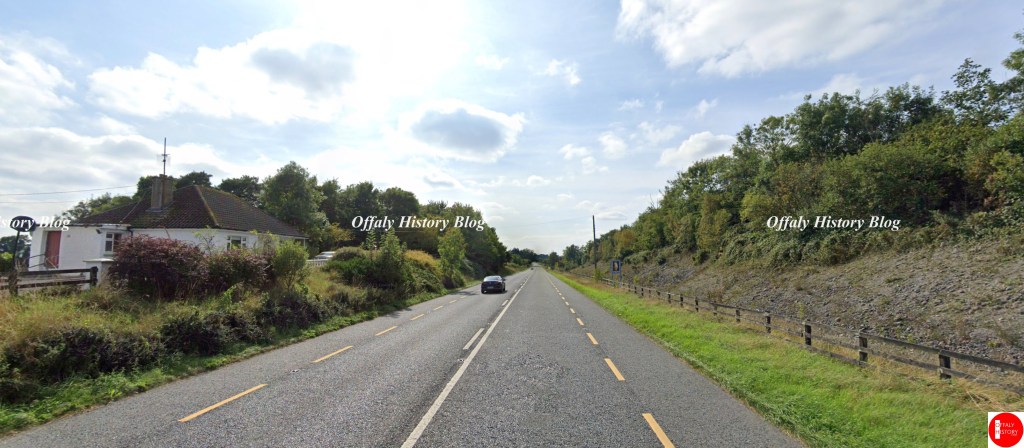
The road at Bunaterin, near Blueball and Screggan, today When reinforcements arrived from Tullamore the attackers had disappeared, and no trace of them could be found. They had three miles of wood cover under which they were enabled to retreat. Lieut. Cullen was struck on the chest with two bullets, which made a terrible gash. The military are communicating with Lieut. Cullen’s family conveying the sad news, and with a view to arrangements for his interment.
They are also trying to get in touch with Lieut. Leahy’s people (who live on or near Listowel, Co. Kerry). Lieut. Leahy was Brigade Chemistry Officer to the Offaly No.1 Brigade. Lieut. Cullen took part in recent fighting in Tipperary, and was only a week in Tullamore.
THE SCENE OF THE SHOOTING.
The scene of the attack, Bonaterrin is on rising ground, a short distance from Blueball – about a mile or a mile and a half. There is a grove near Bradley’s house, and almost directly opposite, but more on the Blueball side – the scrub, with extensive wood tract behind it. The grove portion commands the road, and that of the scrub overlooks it; the situation of the place favoured the operations of the attackers. From the scrub on the left, the troops as they were coming along to Tullamore, there was flanking fire, but the fire ftom the grove on their right, was partly frontal; from this point the most deadly and destructive fire came. Considering the advantages the attackers had in position and numbers, the fight put on by the troops, who had no time for selecting or preparing positions was a wonderfully plucky one. The small party, under capable leadership, handled the situation with great skill and bravery and rendered the positions of the attackers untenable, even before the Tullamore garrison reinforcements arrived.
EVIDENCES OF THE CONFLICT
A gentleman who passed from Kilcormac to Tullamore about an hour after the fighting, informed our Tullamore reporter that there were various evidence of the conflict at the scene of the battle. A number of cars from Kilcormac and Kinnitty side were held up on the road for a pretty long interval. The National troops have drawn a kind of cordon about the place. The point at which the attack took place is on one side a wooded eminence overlooking the road on the right hand side going from Tullamore to Kilcormac and on the left it also raised country, but with a few houses. The place is about half a mile from Tullamore Golf Links, [ the old links at Screggan] and is on the main road from Tullamore to Birr, four and a half miles from Tullamore and eight and a half miles from Kilcormac. The point from which the shots were fired was according to an account, only about forty yards from the main road along which the troops were proceeding. It was dusk and the conditions were favourable to the attackers, who were of course in a position to select their own ground. It is a fairly populated part of the country. Two cars riddled with bullets were seen after the fight on the roadside.
Prayers were offered up by the celebrant of the morning Mass in the Church of the Assumption, Tullamore on Wednesday morning, for the repose of the soul of Lieut. Cullen, who, he said, was murdered the previous evening.
INQUEST HELD
An inquest was opened on the body of Lieut. Matt Cullen in the Co. Hospital Board Room, Tullamore, on Wednesday, at 3 p.m. Mr. Malachy Scally was foreman and the other jurors sworn were – Messes T English, John Kelly, Harbour; Sg: P W Keaveney do; R Nugent, P J O’Meara, James Walsh, Barrack St, Joseph McGlinchey, P J Dunne, Barrack St, John Branet, Michael McGinn , Daniel Larkin, Geo N Walshe. The coroner (Mr. Conway, Solr) said – This is an inquiry into a tragic and serious occurrence, which I am glad to say, is the first of its kind that happened in this county, and I hope it will be the last. It happened yesterday evening, about 6 p.m. as the troops were returning from Kilcormac. They were attacked at a place called Bonaterrin, at the opposite side of Pallas, from the hills, and the wounds received by Lieut. Cullen practically meant instantaneous death. They were caused by what I am told is now a great favourite – dum-dum bullets – and they were fired from above, and practically his whole sheet was torn away; but I don’t want to distress you with any sermonising, as you can all form your own opinion when you have heard the evidence. I have received a circular from the Minister of Home Affairs as recently as Monday, and he directed that in the case of any person being shot that a telegram should be sent to him, so that there was a possibility of the Ministry sending down an inspector to attend this inquiry. I wired to the Minister for Home Affairs about this stating that I would open the inquiry at 3 p. m. today, but would take only evidence of identification, so as to allow the removal of the remains. The inquiry will be resumed at 12 o clock tomorrow, if that hour suits the convenience of everybody – Mr. English (juror) – I want to get away by the first train in the morning, and I would be grateful if you would excuse me. – Coroner – I will excuse you. The jury viewed the body lying in the morgue, Co Hospital. James Cullen deposed – I am a brother of the deceased officer. This is his body the jury have seen. He was 21 1⁄2 years old last birthday – last May. He was unmarried, and a native of Ballymorris, Portarlington. – Coroner – That is the only evidence I can produce today on account of the receipt the circular from the Ministry of Home Affairs, and I will adjourn the inquiry to 12 o’clock tomorrow (Thursday). I wired that information already. – Foreman – Does the morning train arrive here by 12 o’clock?. – Coroner – Yes or earlier. The representative of the Ministry may come down this evening. The reason I started the inquiry today was because the military wanted to remove the remains. – Foreman – We would wish to express our sincere sorrow at the sad occurrence. – Chairman – We can do that, and add it as a rider to the verdict later on. – Mr. McGlinchy (Juror) – Will Mr. Cullen (witness) be required tomorrow? – Coroner – No. – The proceedings then adjourned until 12 o’clock the following day.
REMOVAL OF REMAINS.
The remains of the late Lieut. Cullen were removed from the Co. Hospital, Tullamore, on Wednesday evening at 7 p. m, and were conveyed to the Church of the Assumption, where they lay overnight. At the church door they were received by the Very Rev. Father Callary, PP V G and Rev. Father Lynam, C C and placed on a catafalque in front of the high altar. The transference of the remains to the church was marked by a remarkable demonstration of public sorrow and sympathy. They were accompanied by an immense gathering of the people of all classes and creeds, blinds were drawn, and business places closed as a mark of respect to the memory of the gallant officer. A guard of honour composed of troops of the local garrison, with rifles reversed, marched beside the hearse, in which the remains were carried enclosed in a beautiful coffin, which was wrapped in the tri-colour. Rev. Father Lynam C C, accompanied them the Co. Hospital. Deceased’s brother, with officer comrades of the deceased, followed immediately behind the hearse.

Fr Callary (front row) and above Matthews and Fr Eugene Daly At the Church Rev. Father Callary announced that Requiem Mass would be celebrated for the repose of the soul of the deceased at 7.30 the following morning (Thursday) in the Church of the Assumption, and that the remains would be conveyed to the morning train for Portarlington afterwards.
REQUIEM MASS
The Requiem Mass on Thursday morning was celebrated by Rev. Father Lynam C C, a large congregation assisting, including a number of officers and men of the National Army. The coffin was removed from catafalque in church, where it rested overnight, and when the cortege proceeded to the station business in shops was again suspended, and the employees, as well as the general public of all classes, accompanied the remains to the station. The guard of honour, as on the previous evening, when the remains were removed to the church, consisted of the men who were in the fatal ambush with the deceased officer. This body of men also proceeded with the remains to Portarlington today (Thursday) and were the firing party at the graveside. The Pipers Band led the cortege from the Church of the Assumption to Tullamore railway station, playing “Flowers of the Forest” and Lord Lovatt’s Lament.
Beautiful floral tributes included one from the officers of the Tullamore garrison, and one from the men of the Tullamore garrison. The interment took place at 3 o’clock at Portarlington on Thursday with the Dublin Guards Band in attendance, when there was a remarkable demonstration of public sympathy. The chief mourners were – James and Tom Cullen (brothers), with the following officers – Brig General Gallagher, Capt. Forrestal, Quarter Master: Capt. Egan and Second Lieut. McMunn. Brigadier Transport Officers, all of Brigade staff; also Lieut Comdt O’Leary, Capt. S Irvine, Capt. Donnelly, Lieut Barry, O. C. Daingean; Lieut Keogh, O. C. Kilcormac; Lieut Lawlor, and Lieut Hughes of the Divisional Staff. Lieut. Cullen had been interned in Rath for eight months. He was stationed at Nenagh Barracks for a long time, and had seen much service since the opening of the present hostilities having been almost in every engagement in the Nenagh area. He was in Tullamore only about eight days when the fatal ambush took place.
FROM LEIX AND KERRY.
Lieut. Leahy is a native of Lisselion Cross a place between Ballybunion and Listowel, Co. Kerry, and belongs to the farming class, his people been extensive farmers. He is a young man of fine- physique.
Lieut. Cullen was a native of Portarlington, and was well over six feet – a tall, athletic young man and during the short time he had been in Tullamore a conspicuous figure, because of his size and fine soldierly bearing.
LIEUT LEAHY’S CONDITION
Lieut Leahy recovered consciousness on Wednesday morning and spoke now and again. The medical and nursing staff of the Co. Hospital are most assiduous in their attention to him, but his condition is still critical.
INQUIRY RESUMED
At the resumed inquest on Lieut Cullen at Tullamore on Thursday, Coroner Conway said he was glad to say that the inquiry would be shortened. He had got a telegram from the Minister of Home Affairs, and it was not proposed to send down any officer from headquarters. Consequently they wanted only one military witness and the doctor who examined the body. The proceedings would therefore, be comparatively brief.
CAPT. DONNELLY’S EVIDENCE
Capt. Wm. Donnelly deposed – We, military party, were coming along the road on Tuesday evening, 29th; I was driving the first car, and was not expecting anything to happen, but a few bullets came through the windscreen of the car. Whoever fired at us had positions on both sides of the road. There were six of us (military) in the car including myself. Immediately the fire opened I blocked the car to the left, and it ran into the ditch; the car toppled over on its side. The inside of the car was facing up the road towards Tullamore. Lieut. Leahy and Lieut. Cullen, who were now on the road, took cover kin the car. They had been thrown out onto the road and got back into the car. Fire opened then from Tullamore direction on the right-hand side of the road. Lieut Cullen was first hit, and I believe he died at once. About a minute afterwards Lieut Leahy got wounded by a shot from same direction, which came down the road. We got into position and started firing on the wood at left hand side going towards Tullamore. We could not see anyone at the time or at any time. The firing from both sides of the road continued for about ten minutes. There were two cars carrying military which came up to us in the meantime, and got into position, and joined in the defence. We had no casualties, but the two Lieutenants. Lieut. Leahy was only wounded about a minute when he was removed. The driver of the last car came up under fire, and took Lieut. Leahy and brought him straight on to Tullamore to the barracks. He was sent after a short time to the Co. Hospital – after our doctor had seen him. The whole affair lasted only ten minutes. It was about 6.45 p m when the occurrence took place – Mr. G A Walshe (juror) – What was the driver’s name? – Witness – Tommy Ennis was the driver of the Ford car that picked up and drove in the wounded officer, Lieut. Leahy, under fire.
DOCTOR’S EVIDENCE
Dr. Timothy Meagher deposed – I am medical officer for the military in Tullamore. I inspected the body of Lieut. Cullen (dead officer) on Wednesday morning, in the Morgue, Co/ Hospital. There were four bullet wounds in the chest, and one in the abdomen. Death must have been practically instantaneous. – Coroner – Were the wounds all caused by the same class of bullet? – Witness – It was obvious that all the wounds were not caused by the same class of bullet. There was one wound running from the right shoulder at the back, evidently coming out at the
left shoulder in front. This seemed to have been produced by an ordinary service bullet fired at fairly close range. There were two wounds on the breast bone, one of them about the size of half a crown and the other about the size of the palm of one’s hand. These I think were not produced by an ordinary service bullet – Coroner – Were they caused by soft nosed or Dum Dum bullets? – Witness – By an expanding bullet. The intestines were protruding through the stomach wound. I don’t think the stomach wound was caused by an ordinary service bullet. If it were the intestines would not have been protruding. The cause of death was shock and haemorrhage, due to gunshot wounds.
Tom Conway, solicitor and coroner (d. 1931) VERDICT
The jury brought in the following verdict – “We agree with the medical evidence that the cause of death of Lieut. Matt Cullen was due to shock and haemorrhage, caused by gunshot wounds received in an ambush at Bonaterrin, Screggan, on Tuesday 29th August, about 6.45 p m, shots wilfully and maliciously fired by persons unknown. We offer to the relatives of the deceased officer, and his comrades, our sincere sympathy, and commend to special note Driver Thomas Ennis for his bravery on the occasion. – The Coroner said that he concurred with the verdict. He thought it was an atrocity to have it occur in a country free from such things up to the present, and he hoped that freedom from such occurrences would continue, and that there would be no more investigations of this kind to carry out. He might add that as far as the sympathy of the public was concerned it was shown last night on removal of the remains from the church. Evidently deceased had the sympathy of the vast majority of the people of Tullamore. – After the jury produced their verdict Capt. Donnelly was called in, and the coroner, in explaining it to the officer, said it amounted to one of wilful murder practically against persons unknown. He would give the officer copy of it if necessary. – Capt. Donnelly – I don’t think it is necessary. _ Coroner – Any time you want it we will give it to you.
Offaly History wishes to thank Raymond Cullen for this article. If you have a story to tell get in touch info@offalyhistory.com. Our blogs reach 2,000 every week and are retained in our online archive at http://www.offalyhistory.com. Subscribe and get note of our stories with extra this week to mark Heritage Week 2022.
-
Exploring Castle Street, Birr from the 1620s: marketplace, buildings, families and business history. Blog No 411, 18th August 2022
A PowerPoint presentation narrated by Michael Byrne explores the identities of Castle Street in Birr as part of a project to know and appreciate our distinctive town centres. This Streetscape project is in partnership with Offaly County Council and part funded by the Heritage Council.
An initiative promoted by the Heritage Council as part of its Streetscapes Project

Castle Street about 1857. Courtesy of Birr Castle Archives The focus of this study is Castle Street in the town of Birr. The street comprises a mix of about thirty commercial and residential properties close to the Camcor river to the south, Main Street and the old parish church to the north, and to the west Birr Castle. On the east at the Market Place or Market Square it opened into Main Street, Bridge Street and from the 1880s into the new Brendan Street.

Castle Street about 1920. The market house stood from the 1620s where the memorial to the Manchester Martyrs was placed in 1894. Surprisingly, when the market house was taken down in the late 1700s it was not replaced with a new building. Castle Street varied greatly in character from the strong residential houses of two and three-storeys to the robust commercial warehouses close to the boundary of the castle, attracted by the availability of water-power and facilitating in the 1800s the development of distilling, brewing and malting houses. Castle Street was also the principal marketplace in Birr with markets held each week and large fairs three or four times per year. There was a strong base in agri-business in the street and this in turn created businesses such as draperies and boots and shoemaking to cater for the farming clients from the prosperous hinterland. That Castle Street was intimately bound up with the rural economy is clear from the surviving early photographs of the 1900s and one of 1856–7. The early photograph is by Mary Rosse and is of a market day in Castle Street.[1] This would make it the earliest surviving photograph of a busy street in Offaly, as most others are not before 1890 or 1900.

Castle Street about 1970, courtesy Birr Castle Archives
[1] David Davison, Impressions of an Irish Countess: the photographs of Mary countess of Rosse, 1813-1888 (Birr, 1989).

Crotty’s Church, Castle Street Click on the blue Offaly History Blog to open the video from an email
Exploring Castle Street, Birr: the buildings, business and people.
-
O’Connor Square, Tullamore, 1700s to 2020: a story in pictures of an evolving streetscape over 300 years. Blog No 410, 17th August 2022
A PowerPoint presentation narrated by Michael Byrne explores the identities of O’Connor Square, Tullamore as part of a project to know and appreciate our distinctive town centres. This Streetscape project is in partnership with Offaly County Council and part funded by the Heritage Council.
The Making of O’Connor Square, Tullamore since the 1700s: the buildings, business and people
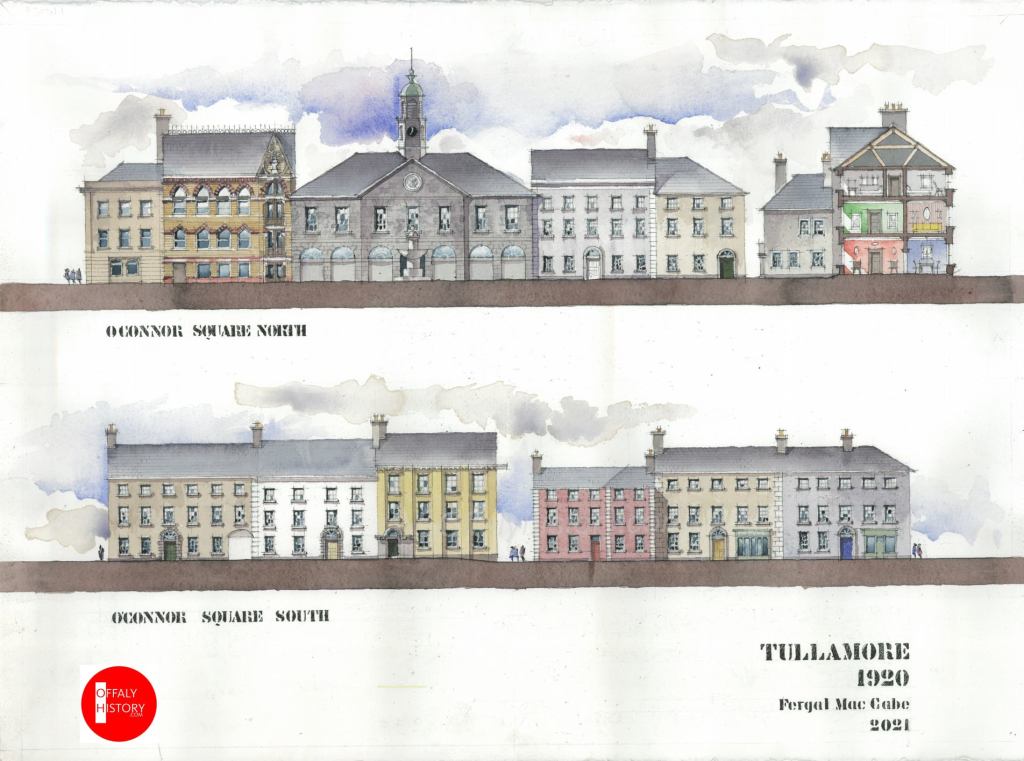
O’Connor Square is Tullamore’s most impressive open space and the gradual development of this area into its principal square is reflected in its fine houses, market house and the variety of names it has had. Despite the course of building for over some fifty years, from 1740 to 1790, it has a uniformity of scale even with the much later vocational school of 1936–37, now the Tullamore Library. In 1713 this area was simply known as the Market Place and, with the opening of one-third of the square in 2019 to pedestrian access only, is now enjoying a comeback to its original function as a meeting place, albeit now to barter ideas and stories and not agricultural produce. Our thanks to the Heritage Council and Offaly County Council for supporting this project and rejuvenation of the square. A special thanks to Fergal MacCabe for his watercolours that bring out so much of what is wonderful about townlife.
Take a look at the video below for more about Tullamore’s meeting place and prime residential location for so long. Tomorrow, we look at Castle Street, Birr over 400 years of history in that one street.
-
A presentation of the Birr poet John Frazer (J. de Jean). By Terry Moylan, Pádraig Turley and Laurel Grube. Blog No 409, 16th 2022
J. de Jean’ was the nom-de-plume of John Frazer (c. 1804–1852), a Presbyterian of Huguenot extraction, cabinet-maker and a native of Birr. As a young man he started writing poetry, and his first work – a lengthy poem entitled ‘Eva O’Connor’ was published in 1826 (Richard Milliken, Grafton Street, Dublin). During the 1840s individual poems, increasingly expressing radicalised politics, appeared in the newspapers and periodicals of the day, many of which were featured in his collected works `Poems For The People` 1845 and `Poems` 1851.
This online presentation is to promote the first complete edition of his poems, edited by Terry Moylan, Pádraig Turley and Laurel Grube, which will be published in October of this year. The society would like to thank Offaly County Council and Creative Ireland for support for this important publication.A presentation of the Birr poet John Frazer (J. de Jean)
-
Exploring our heritage and history in Offaly during Heritage Week, 13–21 August 2022. Something for the Polish community too, so take a look, subscribe and share. Blog No 408, 13th August 2022
This weekend sees the start of Heritage Week 2022 and a very welcome return to exploring the county in person with some great material coming on-line too from Offaly History. We are launching six new videos via Offaly History YouTube and Heritage Week 2022. Our thanks to Amanda Pedlow, county heritage officer for all who work in coordinating the programme. She writes:
‘Hopefully everyone signed up for this email has by now received the pdf / hard copy Offaly Heritage Week brochure however you can still check in on www.heritageweek.ie for updates in Offaly, download the Offaly pdf here https://www.offaly.ie/eng/Services/Heritage/News-Events/Heritage-Week-Brochure-2022.pdf or pick up a copy in the library. Do please note that a number of events do require booking!
With over 30 events here is a reminder for Saturday’s events as a starter’…@offalyheritage @HeritageHubIRE Our thanks to Fergal MacCabe for the use of three of his wonderful watercolours of Srah Castle (1588), Ballycowan (1626) and Bury Bridge (1801).

Ballycowan Castle, Tullamore. Courtesy Fergal MacCabe
(more…)
-
The Discovery of the Bronte Family Portrait in Hill House in Banagher, Ireland in 1914. Blog No 407, 10th August 2022
The Offaly Heritage Office and Amanda Pedlow have been working with Dr Maebh O’ Regan of National College of Art and Design supporting a project with the Banagher Crafting Group exploring the Banagher and Bronte connections. Some of you may have attended events at the recent That Beats Banagher Festival.
One of the outputs is a short fifteen-minute film about the discovery of the Bronte Family Portrait in Hill House in Banagher in 1914 and an interview with Dr Sarah Mouldon of the National Portrait Gallery London who care for it now. Please see the video link for you tube of a very fine presentation adding greatly to our knowledge of how the portrait was received when first presented to the public in 1914. We attach some background material on the discovery of the painting at Hill House, Banagher and how it came to be there from an earlier Offaly History blog. Our thanks to Amanda Pedlow and all concerned with this fine and informative production.
This is one of the projects supported by Offaly County Council through the Creative Ireland programme.
(more…)
-
Richard Barry, Tullamore Celtic Literary Society, William Rooney and Arthur Griffith. A contribution from Offaly History to mark the Decade of Centenaries and the death of Arthur Griffith, 12 August 1922. Blog No 406, 6th August 2022
Arthur Griffith died of a heart attack, or stroke, in Dublin on 12 August 1922. He was only 51 and had given a lifetime of service to his country at huge personal cost. To mark the centenary of his death we recall an important contribution from Richard Barry (1880–1978) in 1970 where he set out some of the cultural history of Tullamore in the period before the Rising and the War of Independence. Barry was greatly influenced by the writings of Arthur Griffith in the United Irishman and also by the earlier contributions of William Rooney (1873–1901). Rooney met Griffith probably in 1888 and both were members of the Parnellite Leinster Literary Society, and after 1892 of the Celtic Literary Society. When the United Irishman was launched in 1899, with Griffith as editor, William Rooney was the main contributor and, working together, developed Sinn Féin policy. Rooney’s early death at the age of 27 was a devasting blow to Griffith. William Murphy in the short life of Rooney in DIB cites Michael Collins as describing Rooney in terms normally associated with John the Baptist: ‘Rooney spoke as a prophet. He prepared the way and foresaw the victory’ (Path to freedom, 150).
(more…)
-
Going to UCD in 1978: the experience of one Tullamore man. By Declan McSweeney. Blog No 405, 3rd August 2022
I recently found myself reminiscing about the experience of moving from Coláiste Choilm, Tullamore, to University College Dublin in 1978.
In many ways, there was a sense of culture shock, it was like moving to a foreign country, though I suspect the transition would be less for today’s students.
I was moving from what was then a small secondary school where I knew all my classmates to a university which even then had around 10,000 students.
As you were in different classes with students for different subjects, it was obviously very difficult to get to know many of your classmates.
Nowadays it has over 33,000 students!
(more…)
-
The Ross dwelling house at 6 High Street, Tullamore. Part of Tullamore 400th series, no.8 By Michael Byrne. Blog No 404, 30th July 2022
The Ross dwelling house in High Street, Tullamore is a five-bay, two-storey, late-eighteenth-century house set over a high basement. It has a rough-cast walls and large windows with nineteenth-century glazing-bars. The round-headed doorcase, which is set up a flight of steps with moulding nosing, has a blocked-architrave dressing and a keystone. Fronting the house is a low wall with moulded coping and cast-iron railings. Beside the house is an elliptical-headed carriage-arch topped by a cornice. According to the Garner Tullamore: architectural heritage for An Foras Forbartha survey of 1979 the house has regional status (Garner, 1980). Thanks to Tanya and George Ross the house is now in excellent shape and one of the few town houses in Tullamore lived in as was intended by those who built it. The house is one of the few in Tullamore to be featured in national magazines and has been the subject of two articles.[1] The other two were Charleville Castle (Country Life, twice) and Shepherds Wood. The house is now called 6 High Street. In Griffith’s valuation of 1854 it was no. 45 High Street. This piece is also a contribution to the Heritage Council programme on living in towns.
(more…)
 offalyhistoryblog