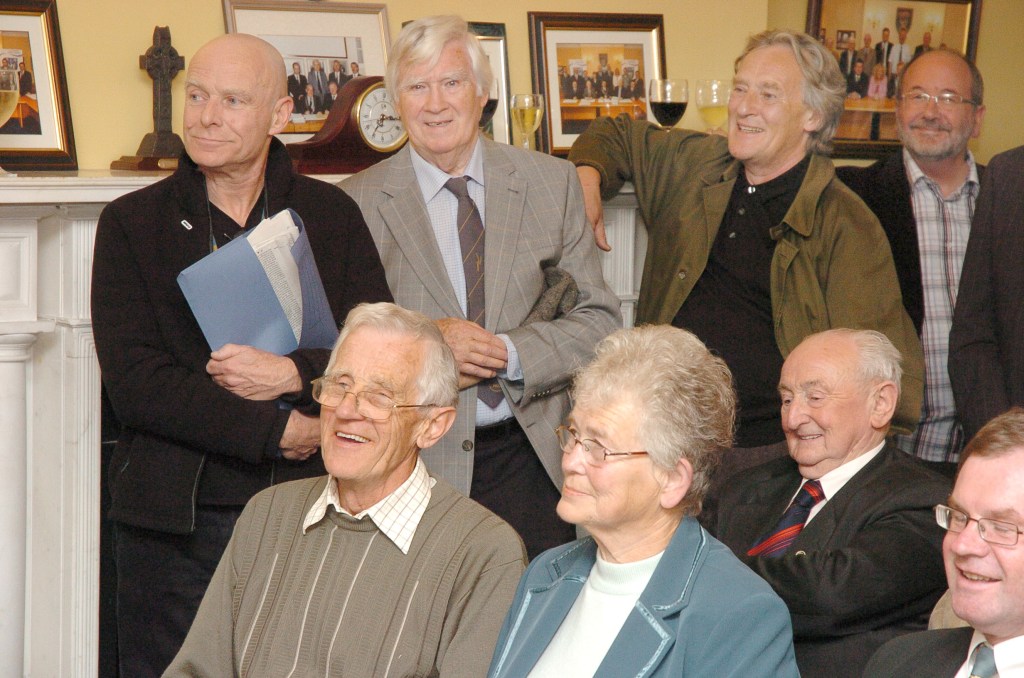
One hundred years of Clara History:The diary of Lydia Goodbody, 1841–86; Harold Goodbody’s history of Clara, 1887–1945. Illustrated with over 200 photographs, 360 pages (Offaly History, 2021). To be launched at GAA Centre, 8 pm on 4 Nov. Orders also per shop at http://www.offalyhistory.com and to callers (from 5 Nov.) to Offaly History, Bury Quay, Tullamore 9 am to 4 30 pm Mon to Fri. Thanks to Clara Heritage Society for all their help with the launch. Strictly in accordance with Covid guidelines for events so follow directions of members of society. There will be at least four points of sale to avoid crowds and possibly outside the hall as needs. Email us at info@offalyhistory.com for any special wants or needs in regard to securing a copy of the book. We have copies set aside for all who ordered. On the night have €15 for soft and €20 for hardback handy so as to avoid change and delay. Enjoy and with thanks to all in Clara Heritage Society.
Clara has long been associated with the textile industry; stretching from the bleach greens of the early 1700s to development of the country’s largest jute factory, which gave employment in the district from 1864 and ran as a very successful business for the next hundred years. Reading the diaries of his Victorian great-aunt during World War II Harold Goodbody realised that she had kept a day-to-day record of how this industry had been created and how it and her family’s flour milling activities had supported the local community.
Harold made extracts of the more relevant parts of the diaries and added his own notes and recollections, creating a history of the Goodbody family in Clara and how a modest Offaly village had been turned into one of Ireland’s leading industrial centres. His work has now been edited to what will be a valuable local history source. Harold’s own historical research, covering the period from the late 1880s to the 1940s, is particularly insightful in the context of a period of significant change in Ireland and in the fortunes of Clara and its leading entrepreneurial family. The work is illustrated with over 200 carefully selected photographs.
Tim Guiney, late of Cork and Tullamore died at Tullamore Regional Hospital on 15 October 2021. It was only a few weeks earlier – on Sunday 5 September – that we gathered in Tullamore Golf Club for the launch of a 125th anniversary publication on the club. Tim had led a team in publishing this book which was a follow on from the very fine history of 2010 to mark the centenary fourteen years earlier. Others had started the work on the 2010 book but Tim brought it to conclusion. He would put his team forward but it was he in his quiet persuasive way that ensured its completion. A doctor of science he brought his skills to the big 2010 history. This book will prove its worth for the social history of Tullamore in years to come.
The records of the Valuation Office stretch all the way back to the 1830s and are an invaluable source for the genealogist or local historian. They allow a researcher to trace the occupiers of land and buildings for decades. Just as importantly they give us insight into our ancestors’ lives in Ireland long ago. The enormous collection – thousands of ‘books’ and maps – cover every house and garden, field and townland, village and town in the country. These records have survived when so much of our heritage was lost. The majority of the collection was kept, organised logically, catalogued and safely stored. The records are now held in three repositories: The National Archives of Ireland, The Valuation Office of Ireland and the Public Records Office of Northern Ireland, and are generally accessible for researchers. Some of the records are available free online, with plans to add more. [Laura Price will give a lecture via Zoom on this topic on Monday 1 November to Offaly History. Get the link by emailing us at info@offalyhistory.com. You do not have to be a member and you are welcome.]
A two-page feature on Birr and its new telescope (s) was featured in the Illustrated London News of 9 September 1843. It was the first such international treatment for Birr and was combined with valuable illustrations of the town. It was also the first treatment by a national or international publisher promoting ‘Offaly Tourism’. It was the third earl of Rosse who organised the publicity for Birr and was now on the UK stage himself with his presidency of the British Association for the Advancement of Science.
The window on Birr would be the first of many arising from the completion of the larger telescope in 1845. Birr town was the principal settlement in Offaly since the 1650s and was the premier shopping town, as is clear from the Pigot directory of 1824. Cooke would go on to write of the town’s significant history in his 1826 book – a first in the midlands and just six years after Hardiman’s Galway. What is interesting about the article of 1843 was the active role given to Mary Rosse in her work in the demesne and the town of Birr.
The county grand jury system will be the subject of much focus from mid-2022 with the uploading of links to the county archives records throughout Ireland by way of the Beyond 2022:Virtual Record Treasury Project. The first thing to say is that a useful and well-illustrated booklet People, Place and Power: the grand jury system in Ireland (Brian Gurrin with David Brown, Peter Crooks and Ciarán Wallace, online 2021) can now be downloaded from the Beyond 2022 website as well as useful material from the county archives in Offaly, Wicklow and Donegal. Furthermore, Brian Gurrin has published online an interim listing of the records held in each county. The scope of the records is well illustrated and draws on more detailed catalogues for counties such as Offaly and Donegal where listings are available on the online catalogues from the county archives. For more on Offaly material see the blog and presentation by Lisa Shortall now on YouTube and as a video on the Offaly History Decade of Centenaries platform on http://www.offalyhistory.com.
In summary the access position to these records will be revolutionised within the year and will greatly facilitate family historians, those interested in the workings of local government and how local elites interacted. What elite families provided the power brokers and controlled local patronage? All were men, most were landowners, representative of the county families, and, of course, most were Protestant from the early 1700s and the enactment of the Penal Laws. It was not until the Catholic Relief Act of 1793 that Catholics were admitted, and being a select club were scarce until the 1830s.
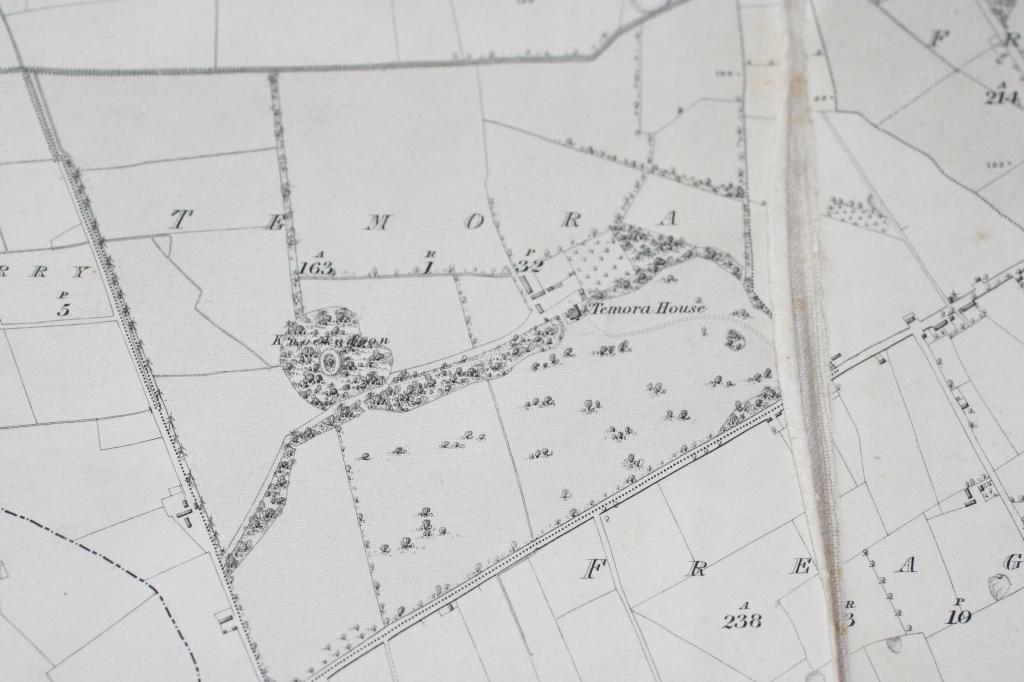
On the road to Birr, and not far from Kilcormac, are the classical gate piers of Temora – all that is left now of the home of the family of Magawly family. This Catholic family owned much of Kilcormac and, after a long legal battle, had the benefit of the articles of the Treaty of Limerick and were able to retain some of their lands. Temora may have been built in the 1750s or 1760s and the naming of the house possibly had an eye to the poem, Temora, of 1763 by James Macpherson. The illustrious history of the Magawly family can be recalled in the memorial inscription in the Catholic church in Kilcormac, placed there a few years after the completion of that church in 1867. The family had been obliged to sell the last of their landholding in 1852, but the pressure was on from the mid-1840s when the process servers were sniffing about. Money problems may have gone back at least 100 years earlier to the 1740s and 1750s when much of the Magawly landholdings were sold by way of long leases. The house itself was occupied by the Free State army in the early 1920s and destroyed by arson about 1930.
…..The soft and dreary midlands, with their tame canals,
Wallow between sea and sea, remote from adventure….’
‘Dublin Made Me’ Donagh MacDonagh
Lumcloon
Once a month, my uncle Billy Holohan who was the Assistant County Engineer for West Offaly, would come to Tullamore to report to his superior, the County Engineer Tom Duggan, in the courthouse.
After the meeting he would sometimes pick me up from my mother’s house in Clonminch and bring me to stay with himself and his wife Nell in Gallen Lodge in Ferbane. The highlight of the journey, for both of us, was an inspection of the progress on the construction of the two cooling towers of Lumcloon Power Station.
We watched as immense rings of slim, angled columns emerged and were tied together by large circular bands to form the base from which the structures would rise. Over the next few years we marvelled at the gradual ascent of the elegantly modulated shapes, first curving inwards and then subtly outwards to form a lip. Billy tried to explain to me the structural engineering concepts behind the design, but as a small boy I could only marvel at the height and sheer scale of the undertaking.
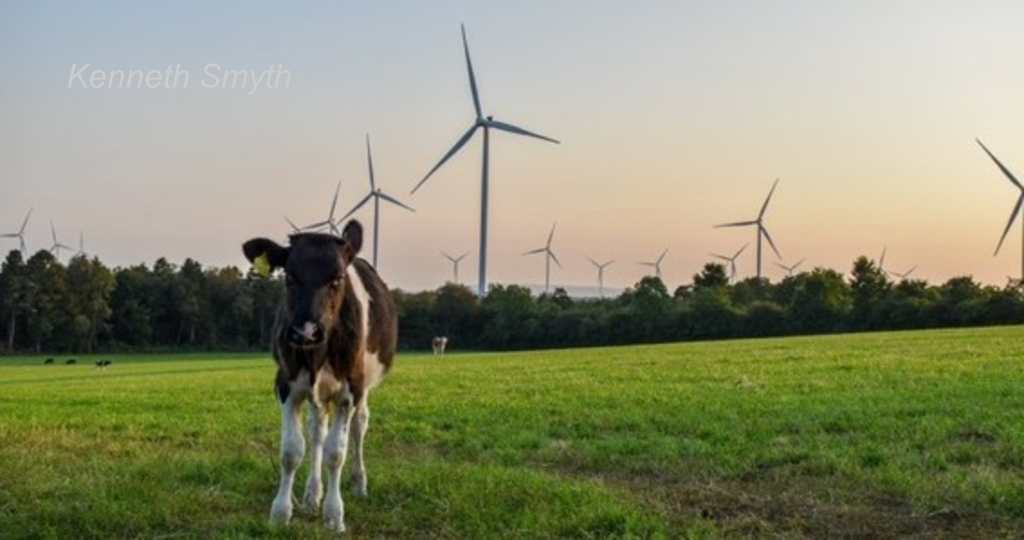
An impression of the proposed mills at Leamanaghan. Very high and very prolific. Our thanks to Kenneth Smyth for this picture.
Leamanaghan Castle
Unusually for an engineer, Billy had a deep interest in history. He brought me along on his site inspections and introduced me to Clonmacnoise and Sier Kieran. His favourite stop on our return journey to Tullamore was Leamanaghan where we roamed amongst the remains of the Monastery. He delighted in showing me the hoof mark inside the gate of the school which marked the passage of St Manchan’s stolen cow and then brought me over the fields to St Mella’s Kell which I still believe is one of the most romantic spots in Ireland.
Lemanaghan Castle, top left. This was where the Annals of Clonmacnoise was completed. The castle was demolished in the 1950s as was Kilcolgan nearby to provide filler. Courtesy of Offaly Archives
Then in 1959, in an act which was deeply symbolic of Ireland in that peculiar time between economic stagnation and rapid growth, Leamanaghan Castle was bulldozed to provide hardcore for works at Lumcloon Power Station. The Castle, which was derelict but still substantial, had been the ancestral home of the Mac Coghlans. Cardinal Rinuccini had stayed there (or more likely nearby Kilcolgan, also demolished) during his time as Papal Nuncio to the Confederation of Kilkenny and the Annals of Clonmacnoise were translated into English in the house. I was dumbfounded but hadn’t the courage to ask Billy whether it was the ESB or the County Council who were responsible.
Cooling towers of the old economy, so succesful for Offaly from the 1950s to the 2000s in regard to employment.
The Cooling Towers
The cooling towers were completed and over the years, became part of the public perception of the Midland landscape.
Driving westwards you knew you were approaching Kildare and Offaly when the Allenwood towers became visible, then Portarlington and Rhode emerged with Lumcloon in the far distance. Their harmonic shapes complemented Croghan, Endrim and Bellair hills and provided points of vertical interest in an otherwise soft and dreary plain. The bogs, which had been perceived for centuries as profitless and impassable were now a proud testimony to national energy self-sufficiency and local technological advance.
However, with the passage of time, what was originally considered a solution, became a problem and peat extraction began to be wound down with grievous personal and economic consequences which are still being felt. The Power Stations were closed, their towers and buildings demolished and their sites converted to other uses.
Portarlington was the second last to go. At 10.30 on the morning of the 4th of April 1997, the cooling tower that had taken three years to build and stood for forty seven years, vanished in three seconds at the hands of an English demolition expert who already had many redundant cooling towers on his c.v..
Futile last minute efforts to save it were led by the Heritage Council and a local preservation group organised by Progressive Democrat Senator, Cathy Honan. Architect Gerard Carty of Clonbullogue, now a director of the world famous Grafton Architects, wrote in protest that the Power Station was ‘A monument to those visionaries who grafted a semi-industrial outlook onto the principally agricultural psyche of the Midlands’. Their protests crumbled in the face of the ESB’s assertion that ’ It was built for power generation and that function is over’.
The crowds watching the spectacle of the demolition were serenaded by local accordionist Louis Melia who played his composition ’The Tower I Loved So Well’ during the countdown to the explosion.
An era had ended and the advent of wind power was at hand.
Wind Turbines
Because of the absence of nearby dwellings but with existing connections to the national grid, the Midland bogs were identified very early on as first choice locations for large scale wind energy generation. But, whatever about their ecological impacts, the visual impacts of turbines can be a lot more substantial than those of cooling towers.
Unlike one or two isolated towers, turbines spread haphazardly over large areas of the landscape. Though man-made, their scale and large array results in their being read as part of the natural landscape itself- which can be visually disturbing. As the blades rotate in different cycles, they can often cause visual irritation, even from very far away. The scale of the turbines can be incongruous and though they are generally no higher than the former cooling towers, there are a lot more of them. All in all, their visual impacts are significant and often unassimilable. But then, maybe the cooling towers were also, but in the 1950s any development was welcome, while today’s affluence allows us to make choices.
But whether it is cooling towers or turbines, the greatest sensitivity should always be shown when their development impinges on historic sites. Leamonaghan paid a price for the construction of Lumcloon and shouldn’t be put in the firing line a second time.
The old world that was partly destroyed in the 1950s.But the shrine at Lemanaghan survived in its original locus. A remarkable survival in its locale. Ballycumber castle was used for filler as was Kilcolgan. So much for heritage in 1920s to 1960s Ireland. Heritage was in a linguistic form only and divorced from real life.So much empty platitudes.
A Flashpoint
With the imminent lodgement by Bord na Mona of its proposal for a 17-turbine wind farm with blade heights of up to 220 m, the bogland island of Leamanaghan with its ancient monastery and graveyard will be in the forefront of the conflict between architectural heritage and power generation. Preliminary images show turbines dominating its surrounding landscape on its northern side.
However, just as in the 1950s, the likelihood is that national energy needs will trump all other considerations- particularly in the light of the recent correspondence from the Office of the Planning Regulator directing the Council to dramatically increase Offaly’s megawatt production.
This should not mean that the vulnerable character of Leamanaghan be disregarded, but that the most careful consideration needs to be given to the interface between it and the future wind farm. As one of the most sensitive locations in Offaly (and also to make restitution for the shameful razing of the Castle) the balance of the argument should favour the protection of its history and beauty.
The windmills of the past or a message of hope. Lemanaghan 120 years ago before the data centres and when most things were in the head of the local person and not in the Cloud.Courtesy of Offaly Archives
A Return to Profitless Bog?
As wind replaces peat extraction, it is not unthinkable that it may in turn be replaced by a less visually obtrusive or ecologically harmful form of energy production.Turbines last for about twenty years before they need replacement and a point may come when this is no longer economical.
In March of this year the United Nations Economic Commission for Europe declared that ‘Nuclear energy can be a critical component of a decarbonised energy system for those member states that choose to consider it as a part of their sustainable development and climate change strategy’. It will be interesting to see how other European countries respond to the technological advances which are now delivering safer nuclear energy.
I wonder if in seventy- or eighty-years’ time, as the last of the turbines come down and the land gently recedes back into its ancient role of profitless bog abounding in nesting snipe, will a small and nostalgic group emerge to campaign for the preservation of the remaining few of these iconic structures?
We are pleased to welcome a new contributor and old friend Dr Mary Jane Fox. She has contributed to Offaly Heritage journal.
Saint Colmcille[1] is very much a part of Offaly’s history, almost exclusively due to the early monastic site of Durrow. It is not certain exactly when he founded Durrow, but the land for it was possibly gifted to him either by Aedh, a son of Bréanainn, king of southern Uí Néill kingdom of south Tethbae,[2] or Ainmuire mac Sétnai, a prince from the Cenél Conaill branch of the northern Uí Néill. In both cases it was likely to have taken place around 553.[3
There has been significant controversy over the years regarding St. Colmcille’s copying a psalter belonging to his teacher, St. Finnian of Moville. Doubt about the event itself and events subsequent to it still persist, and the mystery has never truly been solved. For something that occurred almost 1500 years ago, how would that be possible anyway? Granted, it might never be solved, but we might find ourselves a few steps closer to what happened if we reconsider what sort of evidence we are seeking and what we consider acceptable.
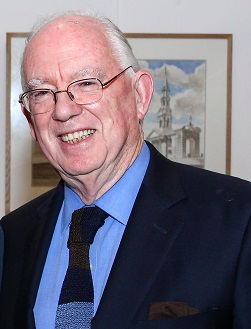
We were sorry to hear of the death of that great newspaperman Geoff Oakley who died on 21 September in his 93rd year. Geoff and his late wife Dorothy, who died in March 2020, had no immediate family but that is only in the narrow sense. Their children were the people of Offaly and both, in their respective occupations, provided care and nourishment on a 24 7 basis to all, but especially those who needed care and a kind word. Dorothy and Geoff married in 1972. They had met after a service in their local Church of Ireland and it was a case of love at first sight and lifelong companionship.
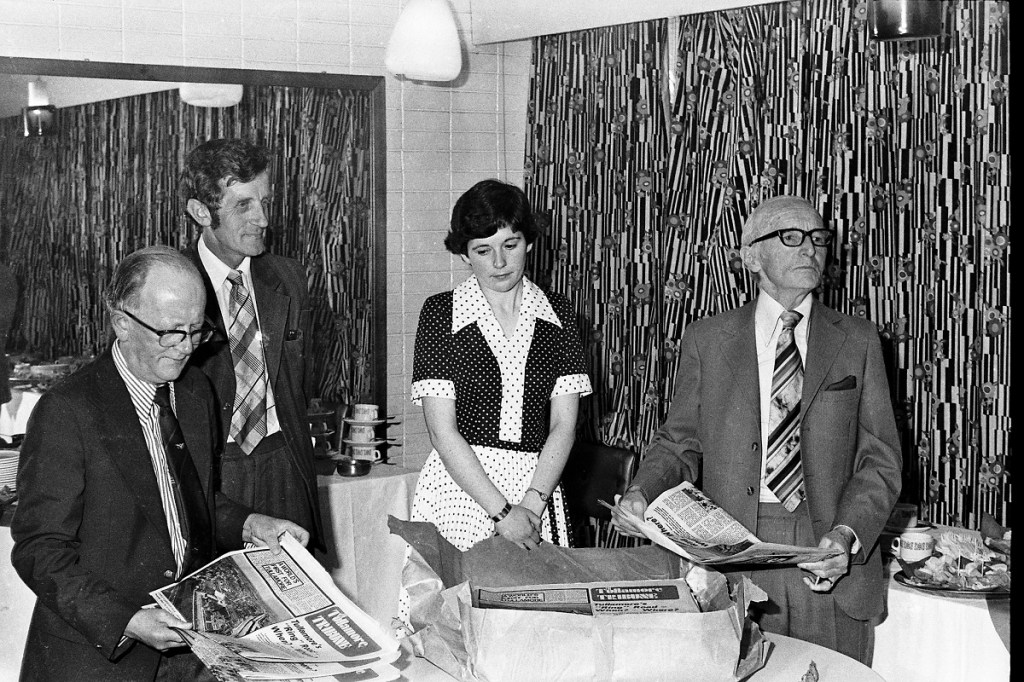
The launch of the Tullamore Tribune in May 1978: Geoff Oakley (G.V.) seen here second from left. From l to r: Buddy Burke, Geoff, Phyllis Byrne, and James I. Fanning.
Geoff started in the local press about 1945 with the old Offaly Chronicle and when it was purchased by James I. Fanning in 1948 moved to the MidlandTribune. As such he was the last link with this newspaper that was started in Birr in 1845 and was owned by the Wright family from the 1870s. In 1978 Geoff became the editor of the new Tullamore Tribune and remained at the helm until Ger Scully took over in 1994. Geoff made a singular contribution to the saving of the hospital in Tullamore in the mid-1970s with the help of the Offaly Committee to save the Hospital. Week after week the articles poured out and the pressure that was piled on secured the hospital and paved the way for the new hospital from the late 1990s.
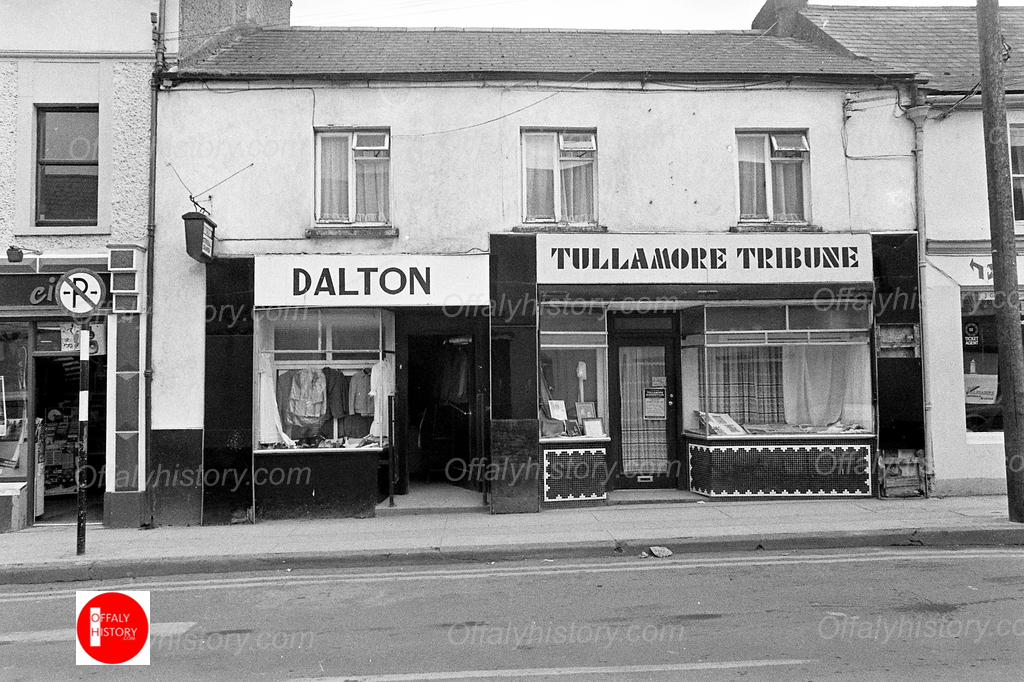
The first office of the Tullamore Tribune in Church Street, Tullamore. Beside Mrs Dalton’s, then the only used clothes shop in Tullamore. Picture about 1980.Tullamore Superstars on the poster may help to date this one. It be may be Ray Quinn’s music store to the left.
Geoff saw in groups such as Junior Chamber all that was good about civic life and reported its doings and that of so many other voluntary bodies. A lover of music he was a strong member of the Tullamore Gramophone Society and often gave the recital. He and Dorothy were keen travellers across the globe as backpackers. They were both pivotal members of OSPCA and many animals found good homes as a result of their work. This writer had the pleasure of meeting him in August in Shinrone. How well he was. Asking how everything was in Tullamore and about Birr Vintage Week which was then in progress.
He was greatly missed from the time of his retirement but up to recent years was a regular visitor with Dorothy to the Saturday market in Tullamore and to his beloved Offaly Historical Society and the Tullamore Gramophone Society How important it will be for us to get back from November to meetings and lectures offline so that we can again meet our members who have supported our causes over many years.
Geoff and the late Dorothy at an NUJ event in Tullamore 2007. Seamus Dooley, Irish Secretary NUJ to the extreme left, Michelle Stanistreet, then President and now General Secretary, NUJ on the right.Thanks to Seamus Dooley for this picture.
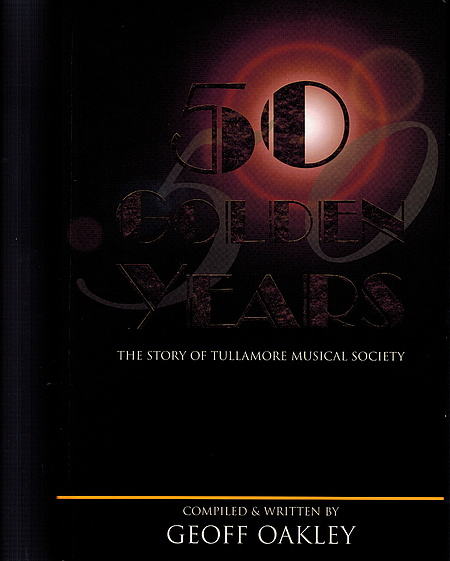
Geoff’s work as a newspaper man will stand to him well into the future. All the more so in this digital age when his articles can be so easily accessed. Those in the Tullamore Musical Society have reason to thank him for his fine published history and all his reviews of their annual show. Now Offaly History can get to do a short review of GVO, but it can only be paltry beside that of the quiet sincere man who made such a great impact in County Offaly and all of it was for good. Geoff was also a national figure in amateur musical circles as an adjudicator for AIMS and editor of the AIMS newsletter. His reviews of local plays were awaited with terror one expects. While never harsh he did not confuse journalism with parochialism.
Geoff and Dorothy pictured at a reception in Tullamore Town Hall marking the NUJ Delegate Conference in 2007. Included in the picture are: Standing: Eamon McCann, Derry, Jim Eadie, former Irish Secretary, NUJ, Tim Gopsill, Editor, the Journalist, Martin Fitzpatrick, Sunday Independent. Seated are Eddie Rogers (RIP, Tullamore) and Cllr Sean O’Brien.
Seamus Dooley has provided an appreciation which will also be published in Offaly Heritage 12 next year.
Geoff Oakley: An appreciation. By Seamus Dooley
Geoff Oakley was something of an enigma. In a distinguished career he was passionate about news: cultured, wise and opinionated his integrity and sense of honour defined Geoff in his public role as Editor of the Tullamore Tribune. Yet Geoff was in many ways a shy man who shunned the limelight, seldom speaking in public or giving interviews to the national media on issues of local interest. For many years Geoff was the Tullamore Tribune and his vision and commitment were key ingredients in the success of the paper. J. I. Fanning, proprietor and editor of the Midland Tribune was nominally editor when the sister newspaper was founded in 1978 but from the beginning Geoff was the guiding spirit – his formal appointment as editor merely confirmed his status. From a dark pokey two desk newsroom. in Church Street Geoff churned out reams of copy on a noisy, battered manual typewriter which, like the office itself, had seen better days. David Pate had never been in Tullamore before Fanning offered him the job of reporter on the fledgling title. A young Scot reared in Dublin and educated at TCD Dave was an unlikely recruit but Pate, who took early retirement as as a senior producer with CBC Nova Scotia last year, and Oakley made a formidable team. Mary T Bracken made up the office triumvirate for much of his rein. When David moved to pursue a successful career in the national media I succeeded him in the Tribune having worked during breaks from college. Geoff was a mentor to me and to many young journalists, insisting on the highest standards of accuracy. He had flawless shorthand and placed a premium on attention to detail. His report on the inquest into the death of Fr Niall Molloy is an outstanding example of his reporting while his profile of Thomas MacDonagh in the Midland Tribune’s supplement to mark the 50th anniversary of the 1916 Rising, “A noble life and a proud death” serves as a reminder of his elegant writing style. A young journalism student on placement in Tullamore was once severely chided for failing to ask the name of a family dog who featured in a Richard May photograph which accompanied a well , written human interest story. “Are you joking” he declared as Geoff instructed him to ring the family, “that’s just crazy”. Geoff firmly but patiently explained that the dog was a family member and must be named. Years later I met the now matured journalist in a Dublin pub. Then working in London he said the dog episode had taught him a valuable life lesson! Social historians have reason to appreciate Geoff’s obsession with fully captioned pictures, something which sometimes challenged the patience of Richard May, Joe O’Sullivan and Mary Dunne but he always appreciated their professionalism. As an editor Geoff showed leadership in challenging the consensus. He was a champion of constitutional politics and abhorred violence, often courageously challenging the IRA. While supportive of the campaign to save the then Tullamore General hospital he incurred the wrath of some activists by his refusal to oppose every proposal for redevelopment of specialist facilities at regional level, preferring a more nuanced and strategic analysis.
His editorial stance on social issues, such as the divorce and 8th amendment referendums, was equally courageous while his absolute commitment to fairness meant that all sides were accorded coverage. All who knew him, including his readers, knew of his love for and devotion to Dorothy. Despite his natural reserve their holidays were the subject of endless quirky features, always written with style and humour.
Geoff and Dorothy made a wonderful couple and enriched the lives of so many, humans and animals through the OSPCA. As an editor Geoff Oakley ‘s greatest contribution was to develop a paper which, despite limited resources, reflected the diversity of life in the community. For him, local news mattered. It still does! —
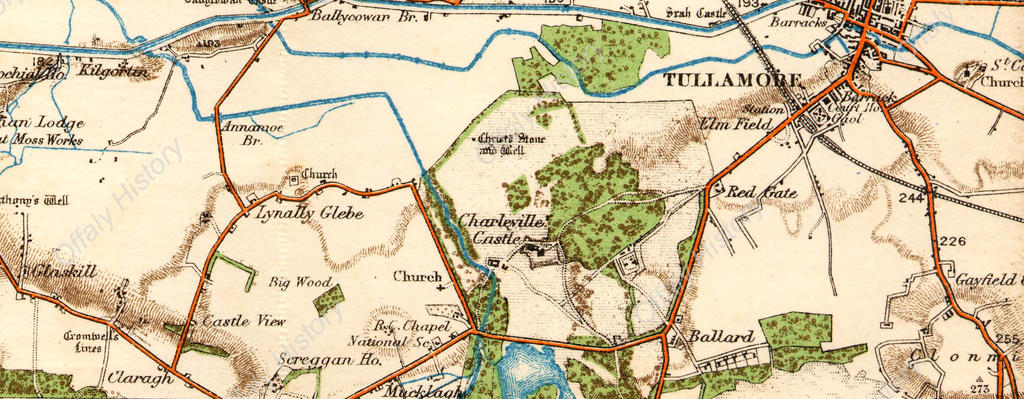
‘Catherine Maria Bury and the design of Charleville Castle’ is the title of an online lecture via Zoom provided by Offaly History for Mondy 20 September at 7. 30 p.m. Our speaker is Dr Judith Hill. She has kindly provided this note for Offalyhistoryblog readers on her forthcoming lecture.
When I started researching my PhD on Gothic revival architecture in Ireland after the Union I had no idea that Charleville Castle, one of the first and most impressive of the castles of this period, owed its inspiration to a woman. I wanted to compare the castles at Birr and Charleville, and was very much aware that their (male) owners had voted on different sides for the Union and that they came from different political traditions. Would this play any part in the designs for the castles that they built, or in the case of Sir Laurence Parsons, remodelled in the very first years of the nineteenth century?
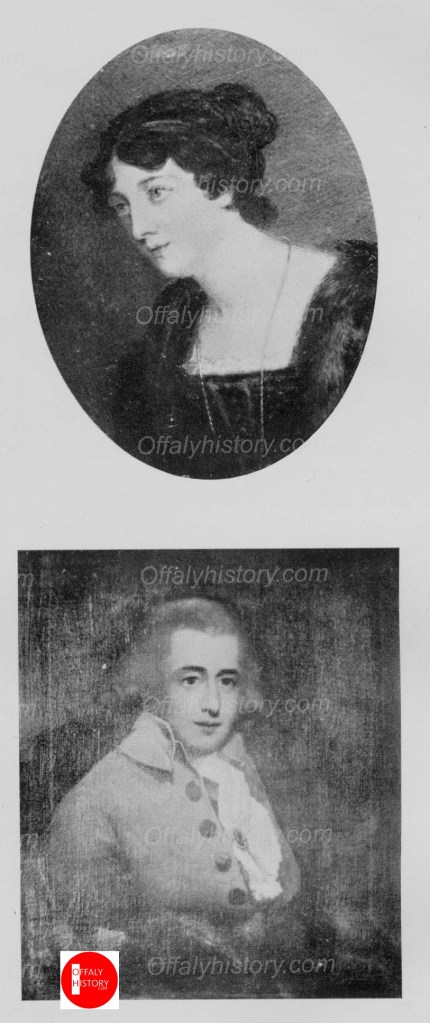
Women at that time played no direct role in politics. They are also relatively (though not entirely) invisible in the historical record. It is only when you can look at family papers that you might find some evidence of what a woman might have done. Catherine Maria Bury’s letters have survived; some of these were published in 1937. They tell us about Catherine (later Lady Charleville) as a person, her friends, her interest in literature. They are tell us that she was close Charles William Bury, and that when he (for it was he) went to see how the building of the castle was progressing he would send detailed descriptions to her. Although he does not ask her directly for her advice, it is clear that when they were together they discussed the project.
Catherine Maria Bury and Charles William Bury(more…)






 offalyhistoryblog