
Originally known as Acres Hall after the eighteenth century building developer Thomas Acres, this fine house with its Georgian features is now home to Tullamore’s town council chambers. In 1986 the house was acquired by Tullamore Urban District Council who undertook a refurbishment programme and extensions to the north and south wings, and at the rear of the house, to accommodate new civic offices. While much of the house was subject to a major reconfiguration, the development attempted to be sympathetic and sought to retain the house’s external architectural simplicity. Acres built the house in 1786 and positioned it in a commanding elevated position at the confluence of High street, Cormac street and O’Moore street. The location of the house may be on the hill from which the town takes it name, Tulach Mhór (great hill). Acres Hall is listed as a protected structure in the Tullamore town development plan.
(more…)-
The killing of Sergeant Henry Cronin in Tullamore on Sunday 31 October 1920 and the consequences in Tullamore and Clara. By Michael Byrne. Blog 237, 31st Oct 2020
Killings such as that of Sergeant Cronin were rarely spoken of in Tullamore in the years from 1920 to the 1990s. As to who shot Cronin there were so many suggestions – men from out of town, a policeman siding with the I.R.A. and so on. Like the Spanish Civil War there was a pact of forgetfulness (olvidados) for those who were there. When Peadar Bracken made the Offaly I.R.A. Brigade return in 1940 (filed in confidence for over seventy years) in connection with service and pensions for those who had fought in the 1916–21 period he described the Cronin killing outside Cronin’s house in Henry/O’Carroll Street as
‘31st Oct., 1920 – Sergeant Cronin ‘wounded returning to Barracks, at Tullamore. Died subsequently.’
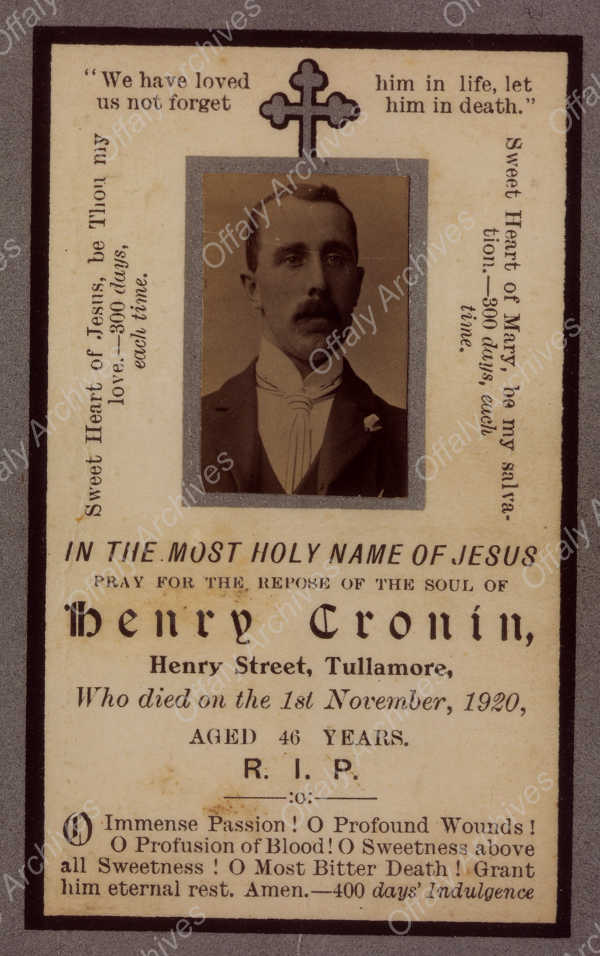
Today we know that the causes, course and consequences of any national struggle are complex and that the results can be not what was anticipated. In Ireland it became a Free State with a Civil War that set back the country for many years. Perhaps until after the emigration of 400,000 in the 1950s.
(more…)
-
Birr Barracks and burials: a new military and family history record published. Sources for Offaly History and Society, no. 13. By Stephen Callaghan. Blog No 236, 28th Oct 2020
A new book detailing the history of Birr Military Cemetery has been published by Offaly County Council. Researched, written and designed by Stephen Callaghan the book gives an authoritative history of the cemetery and all those identified as buried there. While the cemetery only contains 52 inscribed memorials, the book gives biographical details of a further 230 people buried there. The memorials which survive are also examined and described in detail, including information about type, symbols and details about the materials used and the stonecutters who made them. The cemetery is one of the few surviving features of Birr Barracks and is an important link to the past. The people buried there are a mix of soldiers, soldiers’ wives and children, the latter make up most of the burials.
(more…)
-
FORGOTTEN SOULS IN BANAGHER, OFFALY. NEW BOOK ON SAINT RYNAGH’S OLD GRAVEYARD, BANAGHER by James Scully. Blog No 235, 23rd Sept, 2020
An attractive new book on the history and memorials of Saint Rynagh’s Old Graveyard in Banagher has just been published. The book has 192 pages, almost 400 photographs and historical images plus a collection of essays and short articles on eminent souls buried there and on aspects of the site’s ecclesiastical history. The book is written by James Scully, a long-time student of Banagher’s history. This is your Saturday blog coming early because of Halloween.
(more…)
-
A new source for the hisory of education in Ireland: Offaly History Sources Series, 12. Schooling in Ireland: a clustered history 1695-1912. Blog No 234, 21st Oct 2020
Schooling in Ireland: a clustered history 1695-1912. by John Stocks Powell. Published by Offaly History (2020) , 364 pp in softback and limited run of 50 only for sale in hard covers €28. Offaly History Centre, Whelehans in Portarlington and Midland Books, Tullamore.
The cluster is Portarlington, and now appears in book form, published by Esker Press for Offaly History in Tullamore. It should be remembered that Portarlington is as much in Co. Offaly as in Co. Laois; and in this history of schools the exact locations revealed more on the Offaly side than the Laois.
The early schools of Portarlington have so often been seen as a follow-on to the Huguenots, and more or less left at that. This book shows the school history to have surpassed the Huguenots both it time span, and in importance: so many eighteenth and nineteenth century printed sources wrote of the schools as significant, and not the French. Indeed the 1803 Post Chaise Companion for Ireland ignore the French and cite ‘several schools in great repute’.
(more…)
-
The Vikings in Offaly. By John Dolan. Blog No 233, 17th Oct 2020
Our traditional view of the Vikings in Ireland was established by our early primary and secondary schooling. We were aware that the Vikings commenced raiding in 795 AD by their raid on Rathlin Island. Eventually they settled in a few areas around our coastline. However, most of the country was within reach of Viking raiding parties. One of the primary bases from which Viking raids emerged was from the city of Limerick. Limerick provided a springboard for raids up the Shannon, affecting areas on either side of the river.
These raids were on church monasteries resulted in the slaughter of monks and workers in the monasteries. It also appears that the Vikings knew exactly where these monasteries were located and regularly their arrival coincided when particular religious events were underway. From other evidence they were after people, cattle and very occasionally the gold and silver in the monasteries. People were regularly taken to be sold at slaves. The largest such raid was carried out at Howth in the year 821 AD where over 600 females were taken away by ship for slavery. In later times Dublin became the largest Viking slave centre in Western Europe; Kiev in Ukraine was their largest slave centre in the East.
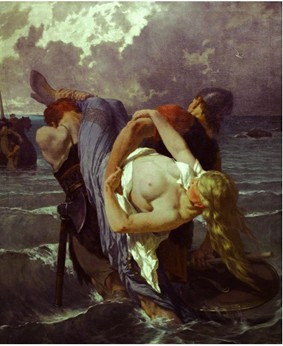
Les pirates normands au IXe siècle by Évariste-Vital Luminais (1894), Musée Anne de Beaujeu, Moulin
-
Tullamore Gas Company: the missing archives. By Michael Byrne Sources for Offaly History no. 11. Blog No 232, 14th Oct 2020

Now where is this in Tullamore ? So here we are talking about sources that have been lost. We have a new Offaly Archives since March 2020 and we are working to fill it, but yet we have to regret what has been lost. There are many such collections in Offaly – grand jury records (some) mostly pre-1820 are missing, county infirmary records (very little surviving), the records of Tullamore town commission ( all gone). We should do a list of what we are missing. Somebody out there may have them. The writer of 1915 had access to the minute books of the Tullamore Gas Company, but where are they now.? Where are the books for Birr?
(more…)
-
Hunstanton Norfolk to Hunston Offaly and the L’Estrange family. By Sylvia Turner. Blog No 231, 10th Oct 2020
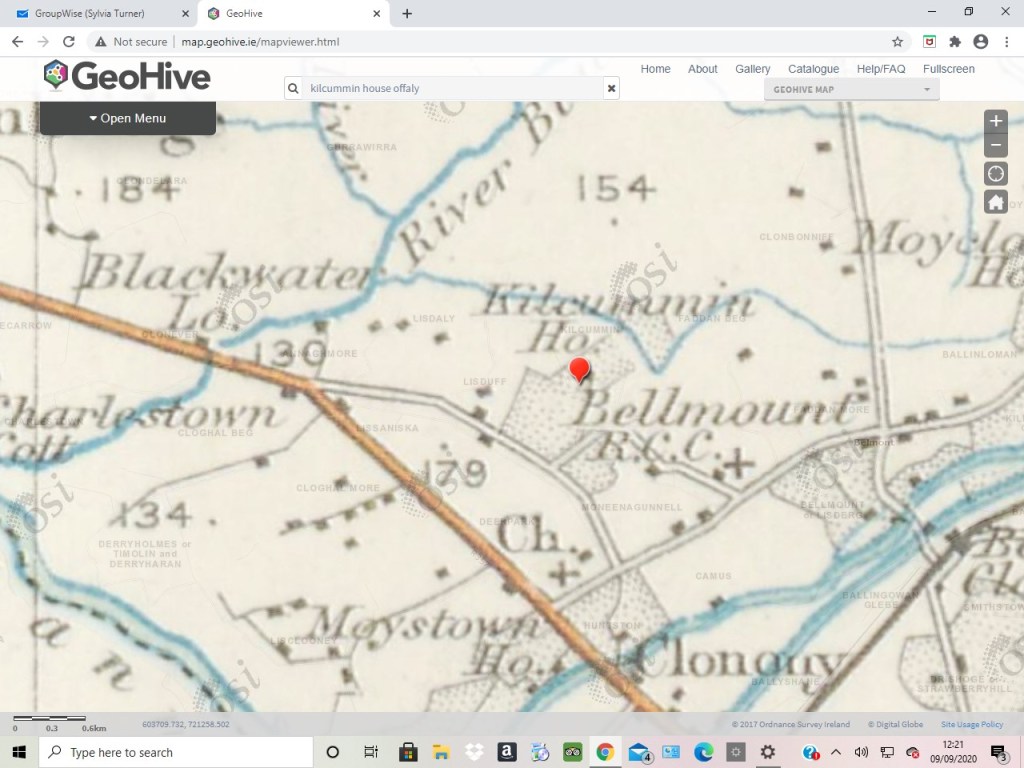
Hunston is the name of a townland in the west of Offaly, close to where the Brosna and Shannon rivers meet. It is unlike many place names in Ireland which relate to an anglicised geographical description. It originates from a planter family who came to Ireland from England in the 16th century during the first plantation of Ireland.
Following Henry VIII claimed of kingship over all of Ireland in 1541, the English wished to extend their control further than the area called the Pale around Dublin to the whole of Ireland. One way was to drive the Irish landowners off their land and replace them with English or Scottish settlers, called ‘planters’. The first plantation took place in the region now known as Offaly and Laois in 1556. It was from this area that the O’Connor and O’Moore clans had invaded the Pale. The Government divided the land into Counties. Present day Laois was named Queen’s County, after Queen Mary, daughter of Henry VIII and present-day Offaly was named King’s County after Mary’s husband King Philip of Spain. Forts were built at Maryborough (Portlaoise) and Philipstown (Daingean).
(more…)
-
The Maynooth Local Studies Series, recent issues, the Offaly volumes and the entire series listed here. Sources for Offaly History and Society, number 10. Blog No 230, 7th Oct 2020
The current issue of Irish Historical Studies (no. 165, May 2020) has a featured review of five issues from the Maynooth Local Studies series published in 2019. That brought the number issued to 144. We attach the list to 144 for your convenience and we bring to your attention the latest batch of four. Raymond Gillespie is the quiet man behind the series and who has acted as general editor since its inception in 1995. The reviewer in IHS, Maura Cronin, reminds of his characterising local history as being ‘primarily about people in places over time’. Place is described as the bedrock of local history, but it must be seen in the context of the actions of people and the pivotal role of historical research is looking for the forces of disruption and of cohesion. What brought people together and what drove them apart.
The four new issues of 2020
Four new volumes have been published in the Maynooth Studies in Local History series (general editor Professor Raymond Gillespie). The volumes by Denis Casey, Emma Lyons, Brendan Scott and Jonathan Wright and can be ordered via Offaly History Centre.
(more…)
-
The Rag Trees of County Offaly. By John Dolan. Blog No 229, 3rd Oct, 2020
During the early Christian period the midlands region was covered with great oak forests and vast expanses of bogland left over from the last ice age. Transport was only possible on glacial ridges or eskers and important monasteries had been built along these trackways. The most famous of these roadways was the Eiscir Riada which runs westward across the northern edge of Co Offaly on its way between Tara and Clonmacnoise which was always a significant Shannon crossing point into Connacht. A second great roadway connected Tara to north Munster; this was referred to as the Slighe Dhála and runs through the southern part of Co Offaly. There was a connecting link between both of these main roadways by a North South running corridor on which a number of additional monasteries were built. (more…)
 offalyhistoryblog