Skip to content
  • Home
  • About Offaly History
  • Copyright statement
offalyhistoryblog

offalyhistoryblog

  • Facebook
  • Instagram
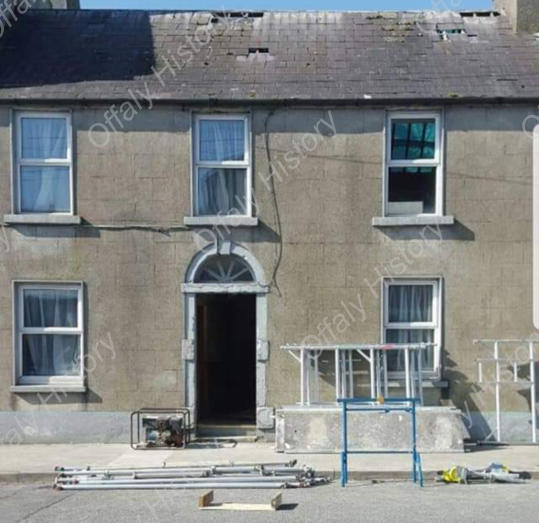
  • Renovation of a 210-year-old Tullamore house in Store Street. By Bernard and Melissa Westman. Blog No 163, 23 Nov 2019

    IMG_5873~photo
    Over three years later and we are settled in our 210-year-old house in the heart of Tullamore, far from finished but we are happy to date. We tried to keep as much character as possible within the house with the stone walls. We also kept the original height of the ceilings in the bedrooms which are over 14 feet. Two of the bedrooms have the old iron cast fireplace and we restored them by sanding and spraying them back to their original look.
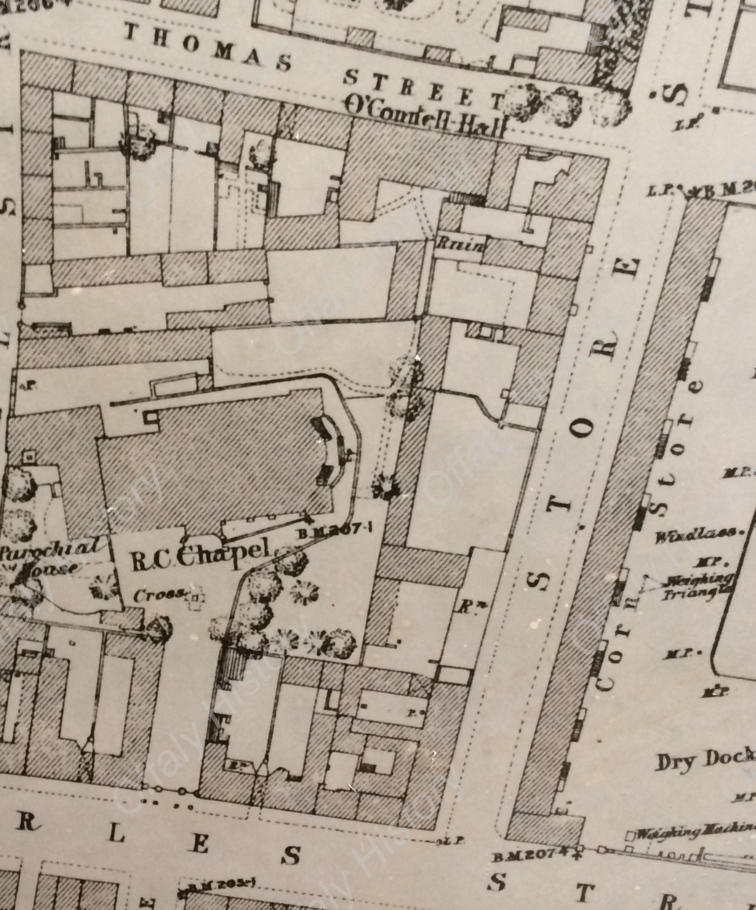
    1880s map of part of Tullamore - Copy
    Store Street and the old church  in the mid- 1880s with two or three of the big houses demolished . O’Connell Hall is now the Parish Centre.

    Store Street is one of the quieter streets in Tullamore now, but from 1800 to the 950s it was a busy place with the canal stores in use beside the busy harbour. The passenger boat traffic finished in the 1850s with the advent of the railway and the canal hotel became a parochial house for the Catholic clergy. Besides the bustle of draymen was that boys heading up to the old St Brigid’s School from the late 1870s to 1961 while the younger children attended the convent primary school on the corner of Thomas Street and Store Street. Like Harbour Street the new Store Street of the early 1800s owed its origins to the building of the Grand Canal to Tullamore in 1798. The new chapel on the site of the present one was completed in 1802 and the CYMS hall (later St Mary’s Hall) and now the Parish Centre was in use from 1860 to the 1960s for meetings and dancing. If Store Street was quiet as to houses (only 12 to 15) it was still a busy spot at mass and school times and with the comings and goings of horses and drays to the canal stores (burned about 1960).
    (more…)

    November 23, 2019

  • Shackleton’s photographs of Tullamore and west Offaly in the 1890s. Michael Byrne. Blog No 162, 16th Nov 2019

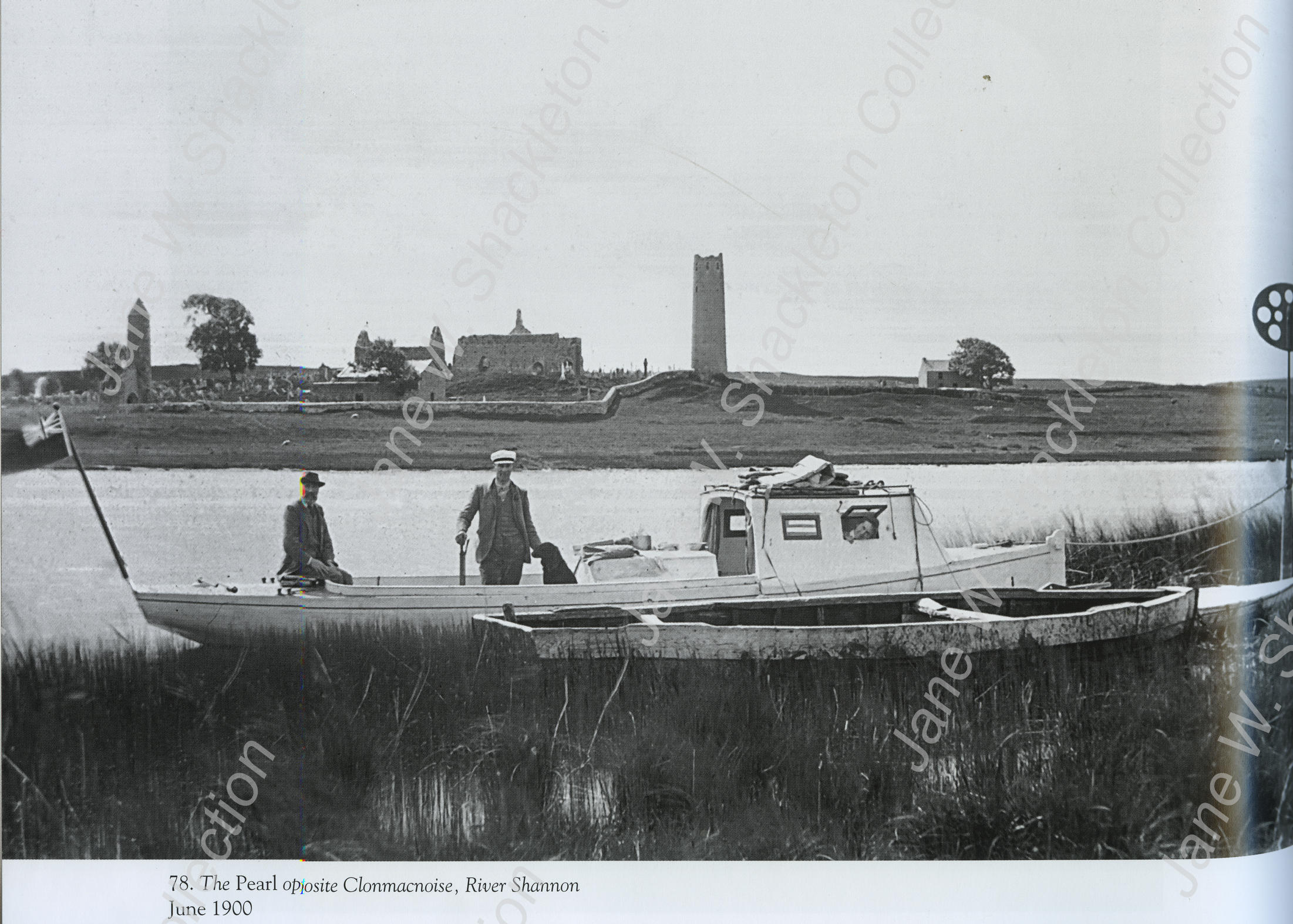
    064928 Shackleton Collection (1)

    Jane W. Shackleton’s Ireland compiled by Christiaan Corlett (Cork, 2012) is an attractive large format publication from the growing stable of books issued by Collins Press and consists of 180 well produced photographs by Jane Shackleton. Jane Shackleton (nee Edmundson) was born in 1843 and in 1866 married Joseph Fisher Shackleton of the famous Ballitore, County Kildare family of Quakers. Thirteen Shackletons are included in Richard S. Harrison’s, Dictionary of Irish Quakers (second edition, Dublin, 2008) including Jane’s husband, Joseph Fisher Shackleton. Like his father he was a miller and in 1860 took over the Anna Liffey Mills in Lucan.

    (more…)

    November 16, 2019

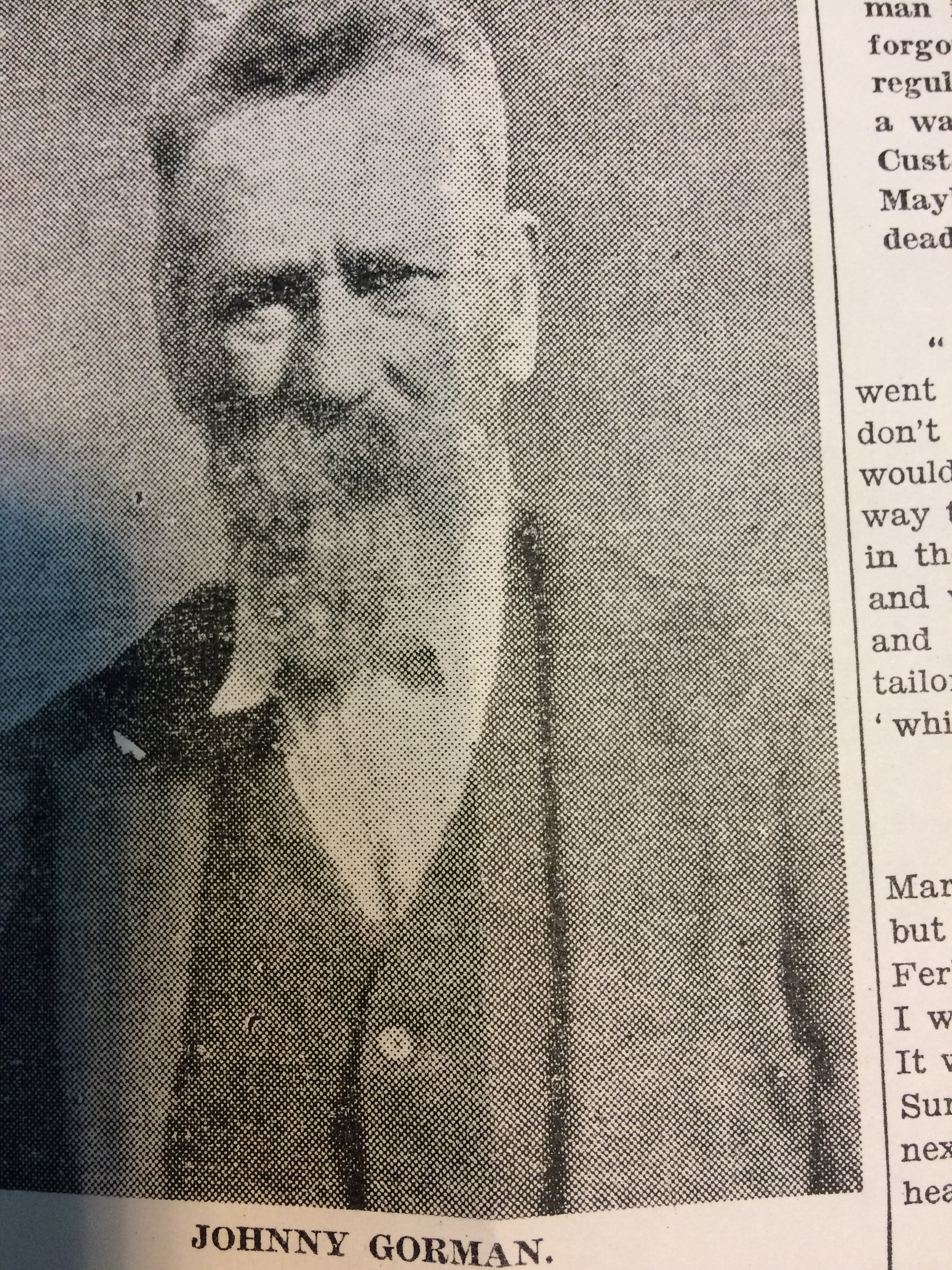
  • Johnny Gorman the tailor of Ferbane. The Story of a Fenian. By Tomas O Cleirigh M.A. and Offaly History. Blog No 161, 9th Nov 2019

    19341201 Johnny Gorman Irish Press
    Johnny Gorman, 1847-8 – 143

    Some died by the glenside, some died ‘mid the stranger,
    The wise men have told us their cause was a failure;
    But they stood by old Ireland an’ never feared danger,
    Glory O! glory O to the Bold Fenian Men”
    Peadar O’ Cearnaigh

    Ferbane is a little place of about three hundred inhabitants. They often been wonder why the Shannon Scheme went out of its way to come to them. It’s queer to see it all lit up at night, because I think the whole three hundred go to bed at nine. There is bog all around it- miles and miles of good, hard bog, and a clean cold wind that makes fine men. Johnny Gorman is one of them.
    Johnny is a brisk and blue-eyed little fellow – a tailor by trade with a halo of glory by way of his having been once upon a time a bold Fenian man. I went to see him early on a Monday morning, and wondered if he could spare me a few minutes. That made Johnny laugh;
    “Musha, it’s not in New York ye are now, my son, and even so, sure Monday’s tailor’s holiday and I can stay talking to you all day if you wish.”

    (more…)

    November 9, 2019

  • Going in on the Altar or an altar boy`s apprenticeship in West Offaly in the 1950s. By Pádraig Turley. Blog No 160, 9th Nov 2019

    This episode in my life dates from the early 1950s. I was about nine year old at the time. I lived with my mother, grand-parents and uncle on a farm in the townland of Clerhane, near the village of Shannonbridge. My father worked in Dublin.
    Our house was what was then called a rambling house, where friends and neighbours would gather for a chat, and to generally sort out the problems of the world. I must add that my grandmother, a somewhat severe woman, felt these matters could be sorted out elsewhere. My grandfather loved these evening chats, so it was unlikely my grandmother`s desire would ever prevail.

    IMG_4411
    1. The Sacristy of the old Church in Shannonbridge where Willie Fallon introduced me to my life as an altar boy.

    Great craic and the curved ball

    (more…)

    November 9, 2019

  • Stories and traditions from the historic ruins in Ballinagar. Specially Contributed by John Malone, Blog No 159, 2nd Nov 2019

    030176 Ballinagar RC Church

    ‘At Ballinagar a large and handsome R.C. chapel was in the course of erection in the ancient English style of architecture’.

    Samuel Lewis in 1837 remarks that ‘at Ballinagar a large and handsome R.C. chapel was in the course of erection in the ancient English style of architecture’. This church replaced an earlier thatched building on the same site which probably dated back to the latter half of the 18th century on the relaxing of penal laws. When the present day church was reopened after being burnt in 2004, the wooden tabernacle of the original church was gifted by the Hackett family to the church and is now kept in the sacristy.
    Lewis also remarks that near Ballinagar are the ruins of a church. There is local tradition that there was a church on Hackett’s lane on the Geashill road in Ballyduff south. There was a church in Clonmore called Balleen Lawn church and there also was a reference by Dr Comerford in his history of Kildare and Leighlin to a church graveyard in Clonadd which is between Ballinagar and Daingean.

    (more…)

    November 2, 2019

  • ROBERT BALL, ASTRONOMER AND TEACHER AT BIRR 1865-1867, DESCRIBES HIS TIME AT BIRR CASTLE. Presented by Michael Byrne. Blog No 158, 26th Oct 2019

    Birr telescope c 1845
    The Great Telescope about 1845 with the castle in the background

    Surviving diaries and accounts of activities in Offaly (King’s County) in the nineteenth century are uncommon and because of this all need to be catalogued and evaluated. Diaries of travel writers, correspondence and memoirs can all throw light on activities of that time. One such source recently acquired by the Offaly Historical and Archaeological Society for its library is Reminiscences and Letters of Sir Robert Ball edited by his son W. Valentine Ball and published in 1915. It sets the scene for the intellectual milieu in which the children of the third earl of Rosse grew up and provides further information on the construction of the great telescope. Recently, a history of the building of the telescope was reprinted by Cambridge University as a cheap paperback while the Royal Society hosted a lecture on the ‘Leviathan of Parsonstown’ now available as a podcast.

    (more…)

    October 26, 2019

  • County Offaly in the Military Service Pensions Collection: an exploration by Cécile Gordon. Blog No 157, 19h Oct 2019

    Cécile Gordon is Senior Archivist and Project Manager of the Military Service (1916-1923) Pensions Project in the Military Archives of Ireland. She will give a lecture on Offaly in the Military Service Pensions Collection on Monday 21 October, 8pm in Offaly History Centre, Tullamore. The talk will include an overview of the records available in MSPC for county Offaly and will illustrate how they interconnect. The highlight will be put on the IRA Brigade Activity Reports for Offaly Brigades. A selection of some of the most interesting pension cases will be presented with a focus on newly catalogued records and claims lodged by the women involved in the independence movement in Offaly.

    The Military Service (1916-1923) Pensions Collection – General

     The Military Service (1916-1923) Pensions Collection (MSPC) Project is one of the leading projects of the Irish government’s plan for the Decade of Centenaries, led by the Irish Department of Defence and supported by the Defence Forces. With around 250,000 files, it is the largest collection in the Military Archives and the largest collection covering the revolutionary years, anywhere.

    In a nutshell, the MSPC records are the pensions applications lodged by over 80,000 people who took part in the 1916 Rising, the War of Independence and the Civil War.  Veterans applied under various legislation from 1923 onwards, enacted to recognise active military service or to award gratuities for wounds or injuries contracted during active service. Dependants of deceased members of certain organisations could also claim in respect of their relatives. (more…)

    October 19, 2019
    Annie Grogan, Matthew Kane, Military Archives, MSPC, Offaly No 1 Brigade, Offaly No 2 Brigade

  • Tullamore, a magical place for Cafés and Coffee by Cosney Molloy. Blog No 156, 12th Oct 2019

    High St 1960s cafe
    High St in the 1960s with St Anne’s on right (now Midland Books)

    I was down from Dublin last week to visit some of my Molloy nieces in the Tullamore/Killoughey and Banagher areas and I am beginning to think there are as many coffee shops in Tullamore as there are in D 4 where I have lived (mostly in flats) since the 1970s. I counted five new coffee shops open in Tullamore, or on the verge of grinding the beans and not a one by a Molloy as far as I know. Besides my old haunt of Chocolate Brown there are the new King Oak out in Cloncollig, the Foxy Bean (nearly ready in Bridge Street in Egan’s old seed and manure store), Olive and Fig (in the not so old Caffé Delicious and close to where Chip Kelly used to be), the Blue Monkey at No. 1 Bridge Street (where Foxy used to be), Mark Smith’s Little Coffee Hut (out of town) and a new one in O’Connor Square that I could not get near to handy with all the road works in the old square. It’s in the old Hibernian office where I worked for a while and was a place called Bake for a short time (near the lovely new library). In High Street there is a place called Conway & Co where I used to buy cigarettes (one or two) when I was going to the Brothers’ school when there was no free education. It was a shop called Daly’s and had a Mills and Boon lending library. It was beside Dermot Kilroy’s. Reading a piece in the Irish Times about three weeks ago about Tullamore being a magical place in the 1950s got me interested in all the new cafés and goings-on. Sure when all this ‘enhancement work’ is finished the streets will be full of coffee tables and umbrellas.

    (more…)

    October 12, 2019

  • Central Leinster: some reflections on the architecture of County Offaly by Andrew Tierney. Blog No 155, 5th October 2019


    Medieval architecture
    In a region crowded with fine buildings, County Offaly has a lot of significant works of architecture of which to be proud. It is rich in early Christian and Romanesque remains at Kinnitty, Durrow and Rahan, while the monastic settlement at Clonmacnoise is one of the outstanding survivals of this period in Ireland.

    1. Clonony Castle
    PHOTO 1. Clonony Castle, a seat of the MacCoghlan clan. From 1612 the home of German planter Mathew de Renzi

    The county is less fortunate in its late medieval ecclesiastical buildings, but of the three Central Leinster counties (Laois, Offaly and Kildare) retains perhaps the most extensive architectural legacy of its Gaelic lordships – notably in tower houses such as Leap, Cloghan and Clonony, among others.

    (more…)

    October 5, 2019

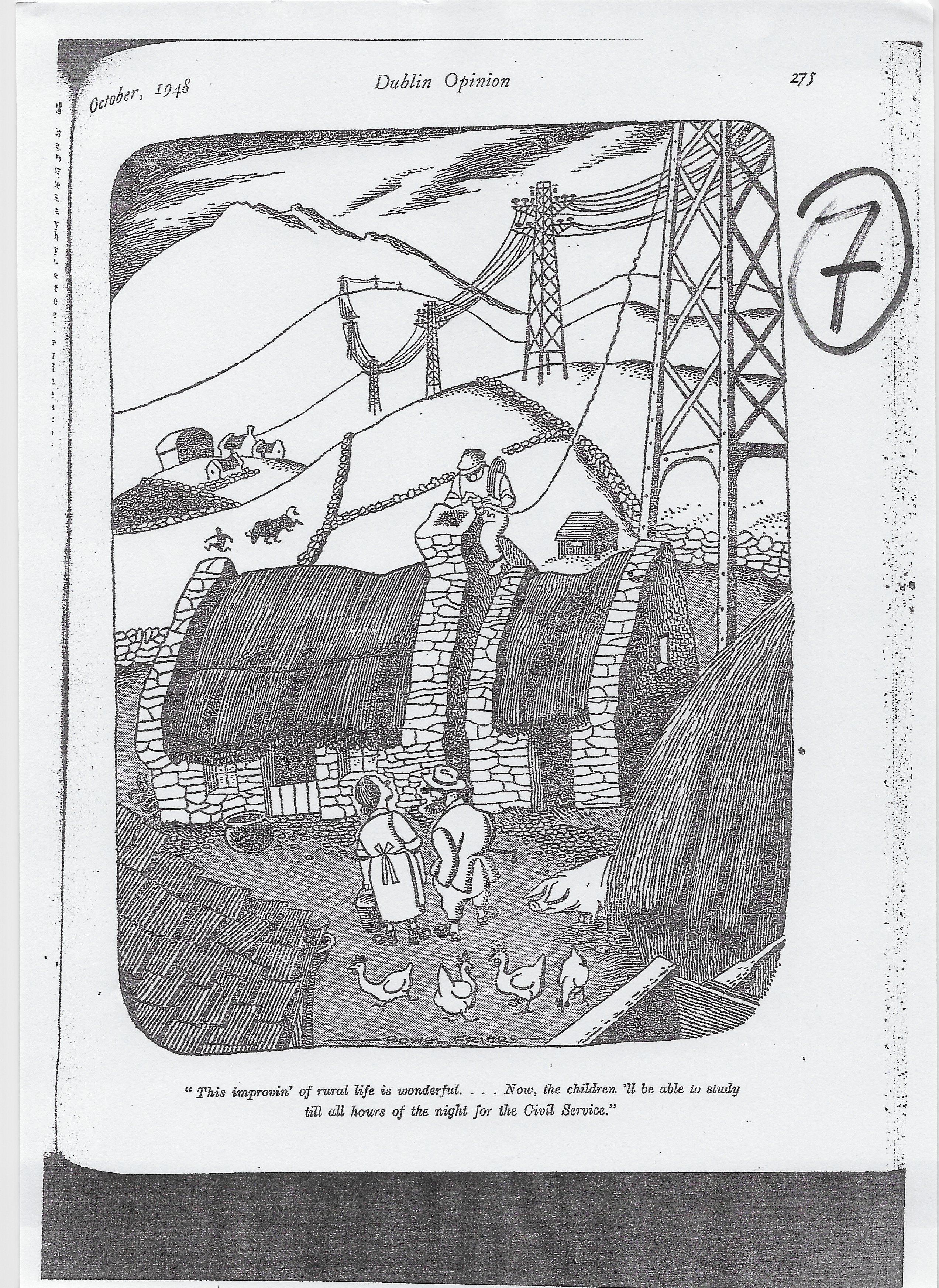
  • Memories of Rural Electrification and the Arrival of the ‘Electric’ in County Offaly An Oral History Project John Gibbons. Blog No 154, 28 Sept 2019


    SCAN0302In October 2014, following an introduction by Amanda Pedlow and Stephen Callaghan, an understanding was reached with the late Stephen McNeill, the then President and Micheal Byrne Secretary of the Offaly and Archaeology Society for them to assist and source interviewees in connection with my project to record persons talking about their memories of life around and about ‘The arrival of the rural’ in Offaly, to date I have recorded over 30 persons in Offaly. Since August 2016,utilising excepts from recordngs, a 45 minute audio/slide presentation which was shown by me to members of History Societies in Edenderry, Tullamore, Rhode, in March 2019 a fourth presentation was shown to members of the Ballinteer Active Retirement Association. A fifth presentation is scheduled for showing in Bury Quay, Tullamore in early 2020.
    This Blog seeks to briefly explain aspects of the Rural Electrification Scheme in Ireland and what Michael Shiel in his book called The Quiet Revolution (Dublin 1984) [JPG0292]

    (more…)

    September 28, 2019

Previous Page Next Page

Blog at WordPress.com.

Loading Comments...
  • Subscribe Subscribed
    • offalyhistoryblog
    • Join 376 other subscribers
    • Already have a WordPress.com account? Log in now.
    • offalyhistoryblog
    • Subscribe Subscribed
    • Sign up
    • Log in
    • Report this content
    • View site in Reader
    • Manage subscriptions
    • Collapse this bar