
The recently announced sale on 11 March 2025 by Noonans of Mayfair of the Jutland medals of Tullamore man Arthur Craig (assumed Waller in 1920 on inheritance) is a reminder of the fact that despite being an inland county Offaly (King’s County up to 1920) has a significant association with the Royal Navy through the celebrated achievements of Birr-born Charles Parsons (1854–1951), of Dreadnought fame; Birr-born Sir Frederick Charles Dreyer (1878–1956), the expert in naval gunnery; and Tullamore-born Alexander Percival McMullen (1885–1916) who was killed at the Battle of Jutland in 1916. The Birr men could have lost the war in an afternoon! Both McMullen and Craig were associated with St Catherine’s, Tullamore – the first of an old Tullamore family who emigrated to Canada in 1910, and Craig as a son of the rector of the parish from 1869 to 1902. His brother succeeded in 1902 and was parish rector up to his death in 1929.
(more…)-
Holy Wells in County Offaly: the search is on ‘Do you know about your local holy well, do you visit it, can you share your knowledge and experiences’. Under the current Offaly Heritage Plan we are carrying out research and keen to hear from you – email heritage@offalycoco.ie . Blog No 694, 19th Feb 2025
There are more than sixty Holy Wells in County Offaly along with springs, mineral spas and local wells. Their setting varies from directly on the roadside such as St Finan’s at Cumber East, to the middle of a field (St Molua’s Well, Roscomroe).
They can be associated with a neighbouring church (St Lugna’s Well, Letter), or remain isolated from a religious setting in some cases located in the middle of agricultural land (St Brigid’s Well or Toberneera, Castlearmstrong).
Many of the wells have an associated patron saint, the spelling of which may have changed many times across verbal, mapping and literary references, while in some cases the name changed entirely to a different saint.
While difficult to date, most are recorded monuments, an early reference is noted by Thomas Lalor Cooke (Cooke’s History of Birr), quoting from the Annals of Clonmacnoise that ‘a person named torbaid was comorban of St Patrick previous to the year 758, when his son Gorman died on a pilgrimage at the well of St Fineen at Clonmacnoise’.
(more…)
-
Striking the right note: The formation of Ferbane’s Confraternity Brass Band in 1925. By Aidan Doyle. No 5 in the Anniversaries Series from Offaly History. Blog No 693, 15th Feb 2025
There is a long history dating back to the Middle Ages of lay confraternities seeking to bring together Christians for prayer and charitable actions and during the 19th century several such organisations came into being. In 1844, a Dutch born, Belgian army captain Henri Belletable established the Holy Family Archconfraternity in an effort to promoted piety and prayer among the industrial workers of Liege. The group enjoyed a meteoric rise across catholic Europe, in part due to the support of the Redemptorist Order.
Massive changes in relation to industrialisation, urbanisation, education, and transportation acted as a catalyst during the 19th century, facilitating the creation of religious, political, fraternal and sporting bodies. While the term the ‘Golden Age of Fraternalism’ is often applied to the United States during the later third of the nineteenth century and the early part of the twentieth century, Europe too saw ordinary people engage a plethora of new organisations with mass membership during this period.
(more…)
-
Mapping the Past, Shaping the Future: the Changing Story of Ireland’s Boglands. Blog No 692, 12th Feb 2025
News of a temporary exhibition at NLI Kildare Street, Dublin for February only

A new temporary exhibition at the National Library of Ireland explores the history of the Irish Bogs Commission and how its 19th-century maps are now shaping the future of Ireland’s peatlands.
Peatlands are among the world’s most vital carbon stores and play a crucial role in climate regulation. But when they’re drained, they lose their carbon sink potential and unique biodiversity and contribute to climate change. In Ireland, peatland drainage for agriculture and industry has shaped the landscape for centuries. Now, as part of national efforts to combat climate change, restoration of these ecosystems is a top priority.
(more…)
-
Inter-Provincial GAA Hurling Competitions and successful Offaly players who won Railway Cup medals. By Sean McEvoy. No. 4 in the Offaly Anniversaries Series 2025. Blog No 691, 8th Feb 2025
In the history of the GAA, Inter Provincial competitions have had three distinct phases. The first was known as the Railway Shield and began in 1905 when the Great South and Western Railway Company provided two shields for the winners of the competition. A rather strange rule included in the competition was that the first team to win the shield in two consecutive years, or three times in total, would be deemed the outright holder of the trophy. Not surprisingly, the football version only lasted three years in total as Munster won the 1906 and 1907 deciders after Leinster had captured the inaugural title in 1905. The hurling title lasted a little longer and resulted in a play-off to decide the outright winners in 1908 which Leinster won.
(more…)
-
Dancing in Ireland’s Biggest marquee at Killeigh Carnival and the revival of the ancient Killeigh Festival in 1950s Killeigh, County Offaly. By Offaly History storytellers. No 3 in our Offaly Anniversaries Series 2025. Blog No 690, 1st Feb 2025,
On Thursday July 24th 1958 the following article appeared in the Irish Press.
Dancing in Ireland’s Biggest marquee at Killeigh Carnival
The Irish Press Thursday, 24th July 1958

Killeigh Macra na Feirme Branch
Back L-R: Tommy Clavin, Peter Phelan, Jim Plunkett, Jim O’Rourke, Senchell Gallagher or ? O’Brien, Phil Deering, Dick White, Jack Bracken, Mick Dunne, Dinny Plunkett, Joe Plunkett, ? O’Brien, [], John Deering, Ben Purcell, Mick Dunne, Paddy Conroy, Christy Murray, Tony/Sony Foy, Jimmy Meackle, Ned Berry, Mick Murray, Brian Deering, Aage Delaney, Harry Cox, Willie O’Rourke, Ned McElduff.
Centre Kneeling: Brian O’Rourke, Joe Kane, Paudie (Pat) Condron, Seated: Martin O’Grady, Billy Mitchell, James Matthews, Fr. Donohoe, John Kearney, Mick Horan, Paddy Mitchel
Front: Paddy Berry, P.J. Meehan, Pauline O’Brien, Marie O’Rourke (?Molloy), ?O’Brien, [?], [?] , Dolores Plunkett, ? O’Brien, John Cox, Jim Gallagher
If any names are incorrect or missing please let us know in Offaly Historical Society at info@offalyhistory.com or 057 9321421.
(more…)
-
Can town planning make Tullamore a better place? An opening debate on the upcoming ten-year Local Area Plan. By Fergal MacCabe. Blog No 689, 22nd Jan 2025
Can town planning make Tullamore a better place?
Fergal MacCabe: Can town planning make Tullamore a better place? An opening debate on the upcoming ten year-Local Area Plan. The talk is at 8 p.m. on Monday 27 Jan. and will be held after the AGM which commences at 7 p.m. An illustrated presentation by Fergal MacCabe architect and town planner at Offaly History Centre, Bury Quay, Tullamore R35 Y5VO.
Since 1967 the growth of Tullamore has been guided by seven successive Development Plans which delivered the Bypass, the Town Park, the pedestrianisation of O’Connor Square and many other improvements. Though promised in 2021, no statutory plan which would identify future local projects like these has yet been revealed. The next opportunity would appear to lie in the upcoming 2027-37 County Offaly Development Plan which will hopefully promote a Tullamore Local Area Plan.
(more…)
-
Mixing a Bazaar, Religion, Politics, Sport and Song in West Offaly during 1897. By Aidan Doyle. No 2 in the 2025 Offaly Anniversaries Series. Blog No 688, 15th Jan, 2025
Sometimes researching history is like trying to make a jigsaw that’s missing too many pieces. Sometimes, someone throws a few pieces from a different jigsaw in, just to complicate matters even more. This one such story.
New Arrivals in the neat little town
In May 1896 the Midland Tribune reported…
‘Tuesday last was celebrated by great festivity and rejoicing at Ferbane, the occasion being the arrival of four Sisters of the Order of St. Joseph to found a Convent in the neat little town. The nuns came at the invitation of the esteemed Parish Priest, Very Rev. Canon Sheridan who had prepared for their accommodation in the large vacant building beside the Brusna Bridge’
A Priest and his Parish
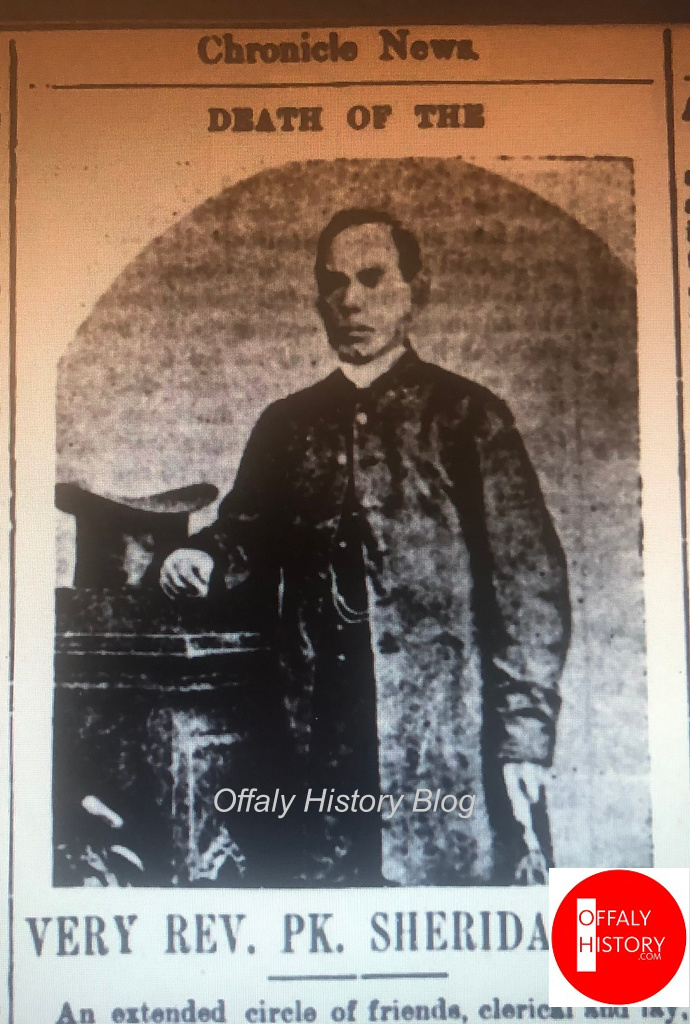
Canon Patrick Sherdian was a man who got things done, but he liked things done his way. Ordained in 1855 and stationed at Ferbane from 1875 until his death in 1899, the Canon interested himself in every aspect of his parishioners’ lives. His time in Ferbane was occasioned by conflict, be it with some members of the local home rule organisation, the Board of Guardians or his own curates. Nevertheless, his achievements were substantial. In 1894, he led the successful campaign to save the Clara to Banagher Railway branch line. Having built a national school in High Street, he set out to construct the Church of the Immaculate Conception at Ferbane. Work progressed quickly and the Canon set to work on raising the estimated £7,000 required to complete the job. To accomplish this, he organised a massive raffle and a Grand Bazaar to be held on the last week of May in 1897.
(more…)
-
The first public elections by secret ballot in King’s County/Offaly were held in Birr and Tullamore in October 1872. Offaly History Anniversaries Series, no. 1 of 2025. Blog No 687, 8th January 2025
The year 2024 saw the local and general elections held and, of course, voting was by secret ballot. The polling centres of 2024 were remarkably quiet as if one were attending confession in a quiet corner of a church. Long gone were the days when a glass of Birr or Banagher or Bernie Daly’s Tullamore whiskey would be proffered by candidates or their agents to thirsty voters. The right of secret ballot extends back to 1872 and the Ballot Act. Before that time voting was in public and held in the towns in Offaly of Tullamore, Birr and Philipstown (Daingean).The Birr-based Chronicle newspaper had thought to describe the polling booth as the voter having to go ‘behind a screen, a la Punch and Judy mode, and there make the sign of the cross with a pencil on the voting paper opposite the names of the favourite men’. This was 50 years before the STV (single transferable vote was used in parliamentary elections in 1922 (see note 5 below) The Chronicle had noted in 1872 the emergence of the polling districts and the practice before 1872 in parliamentary elections:
Formerly, [before 1800] the county sent six members to the Irish Parliament, two for the county at large, and two for each of the boroughs, Philipstown and Banagher; but since the Union its representation has been limited to the two members for the county, and in 1836 the number of registered votes amounted to 1700. The election under the new Ballot Act will, of necessity, assume a different form, and will not be confined to Tullamore, Parsonstown and Philipstown.
(more…)
-
62 Edenderry Canal, from the 1840s to the present day. No 62 in our Grand Canal Offaly series. By J.J. Reilly. Blog No 686, 4th Jan 2025
This blog post will trace the decline of the canal as a means of transport and critical element in the economic development of Edenderry and the surrounding area. The transition of the canal and harbour as a tourist and leisure amenity will be discussed further on. The introduction of the railways in the mid-nineteenth century weakened the canals importance to the economy. Both the canal and railway had to compete for the limited inland trade. A struggle the canal was also going to lose.[i]
In the summer of 1846 it was reported that the people of Edenderry had averted an accidental breach in the branch canal to the town harbour.[ii] Another serious breach occurred between Ticknevin lock (20th) and the Blundell aqueduct in February 1849. The breach occurred in the bog embankment.[iii] The repairs were carried out under the Grand Canal Company’s (G.C.C.) new engineer, Christopher Mulvany. While repairs occurred Mulvany constructed dams and laid a tramway along the canals north bank allowing trade to continue. If the first half of the nineteenth century saw the rise of the canal as a revolutionary mode of transport, so too can the railway be seen to replace the canal.

‘Map of the canal and railway lines’, Ruth Delany, The Grand Canal, figure 23. In 1835 Thomas Murray derided the idea of the possibility of a rail link to Edenderry:
‘There is nothing to be sent from this but a few passengers which only fill about three or four coaches every day and which will not pay almost anything.’[iv]
Although the Midland Great Western Railway (M.G.W.R.) and Great Southern and Western Railway (G.S.W.R.) both showed an interest in buying the G.C.C. in the 1850s, nothing came of it, and the Company remained independent.[v]
In 1871 before the beginning of the Land War, the Downshires still owned 14,000 acres of Edenderry as they had done at the beginning of the century, now with an annual rental of £6,800. The M. G. W. R. established a train station in Edenderry in 1877. It had reached Enfield twenty-seven years earlier. By the 1880s traffic on the canal had begun to decrease, although the G.C.C. was still running at a profit. In 1888 the Alesbury brothers moved their premises to the Grand Canal and built a factory there. The Alesburys used their own canal boat to transport timber for use in making furniture.[vi] In 1911 the G.C.C.’s engineer, Henry Wayte, was allowed by the Board to become the Irish agent for Bolinder engines and four of these were fitted. By 1911 the G.C.C. was converting its horse-drawn fleet to the Bolinder diesel engine. By 1914 twenty-eight canal boats had been converted to Bolinder engines.[vii]
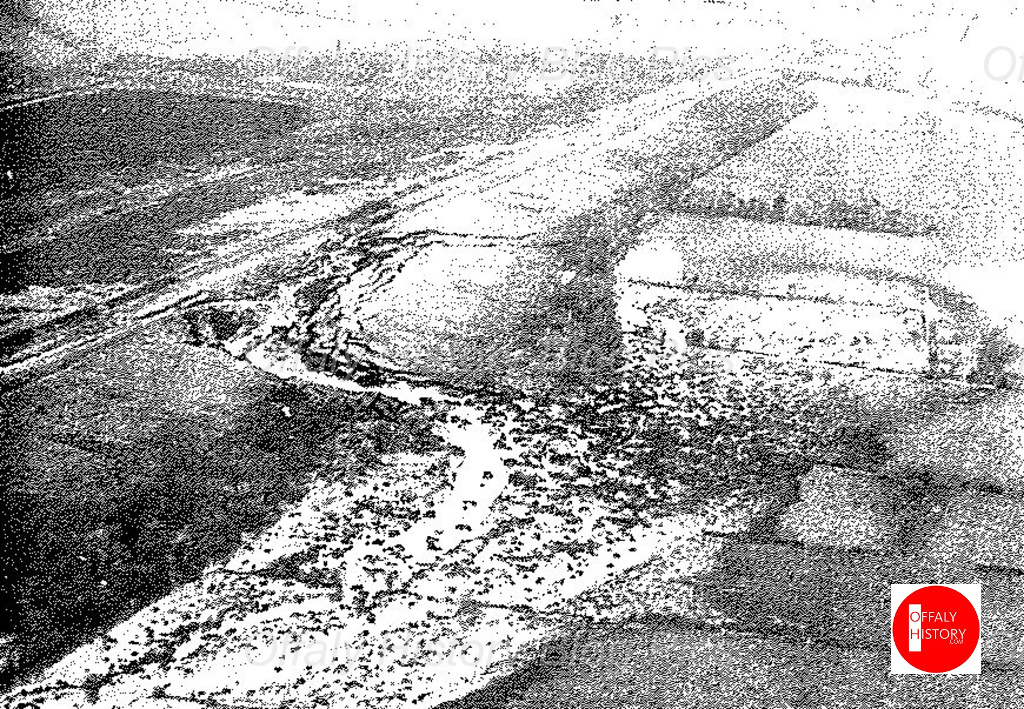
‘Breach at Edenderry, 1989’, Safe harbour, p. 17. In 1916, again, there was a breach in the canal at Edenderry in the north bank of the canal near Blundell Aqueduct. On 11 January 1916, 300 yards of bank were carried away. Wayte had dams erected to try and keep trade moving and to help in bringing clay to the sit. The Leinster Leader vividly depicted the aftermath of the breach:
‘…no description, however graphic, could have prepared them for what they saw-the havoc wrought by the muddy rushing water, the enormous force that must have pressed it outwards, the utter impotence of the protecting line to resist the pressure and the great cataclysm that resulted….Again the breach took place on exactly the same spot as the great breach of 60 years ago.’[viii]
The cause of the breach was attributed by Gordon Thomas, engineer to the Grand Junction and Regent’s Canals, to ‘boisterous weather’ and ‘heavy rainfall.’[ix] Soon after Wayte decided to use three rows of new piles, backed and filled in with clay and bog material. Work in February was hampered by gales and snow with the workers exhausted. In March snows and blizzards continued to slow down progress. In early April, Wayte was able to report in his weekly report to the G.C.C. Board that the repair work had been completed.[x]

From 1917 to 1920 the government subsidised maintenance costs of the canal and paid war bonuses to the G.C.C. employees.[xi] During the Civil War conflict erupted on the canal when stores were burned and boats were attacked. By 1922, with the end of the revolutionary period, the Downshire estate consisted of 6,780 acres, most of it being unleased bog land. And in 1923 with the passage of the Irish Free State’s Land Act, the process of land purchase was completed. In 1950 the Grand Canal was nationalised under Córas Iompair Éireann at a cost of 1.25 million.[xii]
With the development of the River Shannon as a tourist amenity it was shown the Grand Canal still had a post-nineteenth century role for the Irish economy. The final barge to leave Edenderry Harbour was the 48M Canal Barge in May 1960, ending over 150 years of service.[xiii] The Edenderry branch had become impassable with weeds and was cleared and reopened for the opportunity tourism brought with it. An advertisement for the sale of the warehouse at the harbour, as part of the winding up of the financial use of the canal, was placed in the Offaly Independent in October 1960.[xiv]

‘Last barge, 1960’, Safe harbour, p. 26. The canal breach of January 15th 1989 was the worst seen since 1916. 400 meters of the north embankment broke away at the midway point between Blundell Aqueduct and the Edenderry line.[xv] £1 million worth of damages was caused by the breach.[xvi] It would not be until March 1990 that the Office of Public Works would complete the repairs of the Edenderry canal.[xvii]
Stephen Rynne summed up the canal’s history as:
Fifty years in the thinking-out and arguing; fifty years in the making; almost fifty years flourishing; over a hundred years staggering along and not knowing from year to year when the final blow would fall.[xviii]
Since the 1990s festivals have become a recurrent sight during the summer season in Edenderry harbour. Canoeing too is popular today on the canal along with fishing. Among the fish inhabitants of the canal are roach, bream, perch and pike.[xix] The local inhabitants of Edenderry and the surrounding townlands and villages use the canal year-round as a walking route. The successful transition of Edenderry harbour and canal into a leisure and tourist amenity has given it a new lease of life into the twenty-first century.

‘Edenderry harbour and storehouse, 1971’, Waterways Ireland, (https://archive.waterwaysireland.org/collections/4/the-delany-photographic-collection/290/edenderry-harbour-in-1971) (11 Mar. 2024). Image Sources
‘Alesbury’s factory’, Mairead Evans and Therese Abbott, Safe harbour, p. 22.
‘Breach at Edenderry, 1989’, Safe harbour, p. 17.
‘Edenderry harbour and storehouse, 1971’, Waterways Ireland, (https://archive.waterwaysireland.org/collections/4/the-delany-photographic-collection/290/edenderry-harbour-in-1971) (11 Mar. 2024).
‘Last barge, 1960’, Safe harbour, p. 26.
‘Map of the canal and railway lines’, Ruth Delany, The Grand Canal, figure 23.
[i] Ruth Delany, A celebration of 250 years of Ireland’s Inland Waterways (Belfast, 1992), p. 5.
[ii] Delany, The Grand Canal (Newton Abbot, 1973), p. 165.
[iii] Delany, The Grand Canal of Ireland (Dublin, 1995), p. 175.
[iv] W. A. Maguire, ‘Missing persons: Edenderry under the Blundells and the Downshires, 1707-1922’ in William Nolan and Timothy P. O’Neill (eds), Offaly: history & society (Dublin, 1998), pp 515-42 at p. 537.
[v] Delany, Ireland’s Inland Waterways, p. 140.
[vi] Mairead Evans and Therese Abbott, Safe harbour: the Grand Canal at Edenderry (Edenderry, 2002), p 22.
[vii] Delany, The Grand Canal (1973), p. 203.
[viii] Leinster Leader, 22 Jan. 1916.
[ix] Delany, The Grand Canal (1973), p. 209.
[x] Delany, The Grand Canal (1973), p. 210.
[xi] Delany, Ireland’s Inland Waterways, p. 141.
[xii] Mícheál Ó Riain, On the move, Córas Iompair Éireann, 1945-95 (Dublin, 1995), p. 123; Transport Act, 1950/12 [R.I.] (17 May 1950), sec. 23.
[xiii] Evans and Abbott, Safe harbour, p. 24.
[xiv] Offaly Independent, 8 Oct. 1960.
[xv] ‘Major breach near Edenderry,’ Waterways Ireland, (https://archive.waterwaysireland.org/collections/4/the-delany-photographic-collection/1942/major-breach-near-edenderry) (7 Mar. 2024).
[xvi] Offaly Independent, 20 Jan. 1989.
[xvii] Tullamore Tribune, 17 Mar. 1990.
[xviii] Evans and Abbott, Safe harbour, p. 25.
[xix] ‘Angling on the Grand Canal,’ Waterways Ireland, (https://www.waterwaysireland.org/places-to-go/grand-canal/angling) (11 Mar. 2024).
 offalyhistoryblog