
I left Tullamore years ago but I enjoy reading the Offaly History blogs and delighted with the articles on Church Street. A friend of mine died there a few years ago and it brought back many memories of my time sharing in a flat in Church St, Tullamore. I was there in the late 1960s and 70s and it had certainly changed when I saw it lately. I came to work in the hospital from a small farm near the Mayo Sligo border and found the midlands a bit strange at first. I came to love Tullamore. I lived in hospital accommodation at first but eventually a friend and I branched out into a flat. There were lots of flats in Church St in those days. Nobody called them apartments! We were down near Merrigan’s furniture store in the terrace below the Methodist church. There were two of us. We had one bedroom and a living room. Our kitchen was actually little more than the passage between the two rooms with a two-ring cooker and oven, a sink and a little press. Ikea eat your heart out! We shared a bathroom and toilet with the girls across the corridor and it was fine .We took turns to clean it and we never fought! We also took turns to answer the phone in the hall and answer the front door. We all certainly knew each other’s business! There were lots of people living in similar flats right along Church St and we knew each other well to see. You could set you watch by one lad who used to drive his car around from Church St to Harbour St every morning to collect his paper from Francie Gorry ! I think he was one of the teachers from near the Manor.
(more…)-
The five Methodist Churches in Tullamore town, 1760–1889. In the Offaly History series on Church Street, Tullamore: houses, businesses and families, over 300 years. By Michael Byrne and Offaly History. No 5 in the 2025 Living in towns series prepared with the support of the Heritage Council. Blog No 741, 23rd August 2025
John Wesley, the founder with his brother Charles, of the religious movement, Methodism, visited Ireland on twenty-one separate occasions between 1747 and 1789 and has left eight volumes of journals (the Curnock edition) to tell the tale. The journals are mainly spiritual in character but nevertheless contain much that is useful about Irish life, the towns, estates and even the weather. The late T. W. Freeman, in his ‘John Wesley in Ireland’ used the Everyman edition The Journals of the Rev. John Wesley, A.M., edited by the Rev. F. W. Macdonald.[1]
Freeman noted that Wesley generally visited Ireland in the late spring and stayed for two or three months; making what was in those days, the perilous journey across the Irish Sea. Wesley was born in 1703 and died in 1791 and was the fifteenth child of Samuel Wesley. His ‘conversion’ is dated to this time and following the example of George Whitefield (1714 – 70), the originator of Methodism, he began his open-air preaching of which he did much across his ‘parish’ which was effectively England, Scotland, Wales and Ireland. The ODNB noted that his journal of missionary travel would serve as a guidebook to Britain and Ireland.[2] To the last he continued to travel and is said to have preached 40,000 sermons and travelled 250,000 miles.
(more…)
-
James Lyle Stirling Mineral and Medicinal Water Manufacturing, Importer of Wines and Brandies, Athy and Church St., Tullamore. By Noel Guerin. Part of the Offaly History series on Church Street, Tullamore: houses, businesses and families, over 300 years. No 4 in the 2025 Living in towns series prepared with the support of the Heritage Council. Blog No 740, 20th August 2025
James Lyle Stirling was born 16 May 1858 to Thomas Lyle and Anne Stirling of Tullamore. He was a business man who ran several businesses in Tullamore, between the years of 1880 and 1888, and is best remembered for his mineral water manufacturing company.
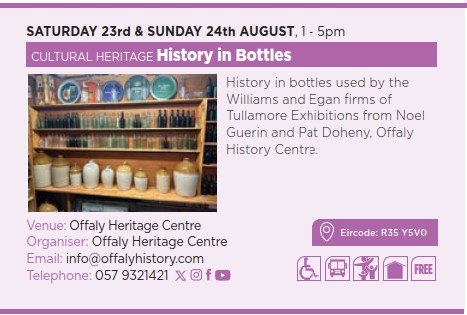
You can find out more about Stirlings by visiting the exhibition on Saturday and Sunday at Offaly History Centre.
His father, Thomas Lyle Stirling, was a brewer and merchant in Kings County, who ran most of his business in Church St., Tullamore. He was also an active Tullamore town Commissioner and sometime acted as an agent for Mary Anne Locke of Locke’s Distillery Kilbeggan. Thomas Lyle Stirling married Anne Jane, daughter of William and Catherine Commins of Cappincur, Tullamore, they had six children, all born in Tullamore except the youngest, Thomas who was born in Dublin. The children were Margaret (born 1857), James Lyle (1858), William (1860), Catherine (1862), Isabella Elizabeth (1863) and Thomas (1866).
(more…)
-
The first Protestant church in Tullamore town, Church Street, 1726–1815. In the new Offaly History series on Church Street, Tullamore: houses, businesses and families, over 300 years. By Michael Byrne and Offaly History. No 3 in the 2025 Living in towns series prepared with the support of the Heritage Council. Blog No 739, 16th August 2025
The young Arthur Fisher from Annagharvey was at the age of twelve in 1880 apprenticed to Archibald Warrren, the Church Street draper (where Salter’s shop was later located) and could recall many years later (c. 1949) coming into Tullamore that day with his mother to begin his five-year term. At the end of the fifth year he would receive £5 and in the meantime live over the shop with bed and board. The town he recalled was built on the river and Grand Canal. He went on to describe the entry to the town from the Geashill Road-Portarlington via Cloncollog.
(more…)
-
Church Street, Tullamore: houses, businesses and families, over 300 years: the well-known Hayes’ Hotel (Phoenix Arms), now Boots Pharmacy. By Michael Byrne and Offaly History. No 2 in the 2025 Living in Towns series prepared with the support of the Heritage Council. Blog No 738, 9th August 2025
It is strange that we should start with the most modern of buildings in Tullamore completed in 2001 and since 2015 Boots Pharmacy. Prior to that it was Menarys fashion and homeware and opened in 2001 as #1 Bar and Restaurant. It is the newest of the new buildings in the town and replaced one of the oldest – Hayes’ Hotel. The hotel was built in 1785 as a new hotel for Tullamore but was perhaps a refurbishment and not a new build.
The building is in a strategic location with four streets intersecting and was known for many years as Hayes’ Cross. The original building was L-plan in shape not unlike no 3 in O’Connor Square (the insurance brokers) and its neighbour south of the river Flynn’s bakery, also L-plan until street widening in 1938 removed the two front rooms to Bridge Street. The hotel was on the south-west corner of the narrow part of Church Street – the oldest part dating back to at least 1726 when the first Protestant church was built in what was later the Shambles and market south of the Foresters Hall, now as to the ground floor a Thai restaurant.
(more…)
-
The Birr family of George Morrison of Mise Eire fame, died August 2025, aged 102. No 15 in a series on the arts heritage of County Offaly, 1750-2000, explored through the works of artists from or associated with County Offaly. By Michael Byrne. Offaly History Blog No 737, 6th August 2025
One of Offaly’s pioneering photographers living in Birr in the late nineteenth century was George Morrison, son of Edward, both were jewellers in the town in Duke now Emmet Square. George Morrison was a trained photographer who had opened a studio in his Birr jewellery shop in 1894. He was grandfather to the now acclaimed documentary artist George Morrison of Mise Éire (1959) fame who has just died at the age of 102. It can be said that George Morrison inherited a tradition commenced in the family by his grandfather, but following in the footsteps of many others including Mary, third countess of Rosse.
Another Birr neighbour of the Morrison family was Archie Wright, of nearby Cumberland House, Birr had also trained in photography and would assist his father in producing photographs weekly for the local King’s County Chronicle newspaper from 1885. At the time an innovation in the provincial press. The Chronicle was one of the first provincial papers to use the block process and Wright had been sent to London to study the process.
(more…)
-
Church Street, Tullamore: houses, businesses and families, over 300 years. By Michael Byrne and Offaly History. No 1 in the 2025 Living in Towns Series on Church Street prepared with the support of the Heritage Council. Blog No 736, 2nd August 2025
The Church Street series of articles is supported by the Heritage Council. The series has as its object making people aware of the history and heritage of their own town and to see how, in this case, one Tullamore street has evolved over 300 years.
You can help with the study by sending us your memories, stories and pictures to me at info@offalyhistory.com. You can also call to Offaly History Centre, Bury Quay (beside the new Aldi), We can photocopy items or scan them as you wish.
(more…)
-
Irish personalities depicted in the Williams calendars in the 1950s and 1960s, based on commissioned drawings from Irish artists. By Michael Byrne. No 14 in a series on the paintings and drawings heritage of County Offaly, 1750-2000, explored through the works of artists from or associated with County Offaly. Blog No 735, 30th July 2025
Desmond Williams (1908–1970), a director of the Williams Group of companies spent over thirty years with the company in promoting Tullamore Dew whiskey, Irish Mist liqueur and the company’s wine distribution network. He died prematurely in 1970 at the height of the sales decade for Irish Mist with exports to over 100 countries.
(more…)
-
Liam C. Martin (1934–98), Kilbeggan born artist and his work on the D.E. Williams buildings in Tullamore. By Michael Byrne. No 13 in a series on the paintings and drawings heritage of County Offaly, 1750-2000, explored through the works of artists from or associated with County Offaly. Blog No 734, 26th July 2025
Liam C. Martin was born in Kilbeggan in 1934 so he must have known all about the Locke’s distillery in that town and the associated distilling history of the Williams family in Tullamore. In about 1980 he was commissioned by the Williams Group and the late Edmund Williams to record the Williams buildings in Tullamore for posterity. The drawings were printed in an issue of about 25 copies and presented in a specially printed folder. There are some of the drawings in Offaly Archives and complete sets in private collections. It was the act of a far seeng man to have the legacy recorded and Liam C. Martin was a great choice.
(more…)
-
Lady Beaujolois Bury (1824–1903) the prayerful artist of Charleville Castle, Tullamore. By Michael Byrne. No 12 in a series on the paintings and drawings heritage of County Offaly, 1750-2000, explored through the works of artists from or associated with County Offaly. Blog No 733, 23rd July 2025
Beaujolois Elenora Catherine, the only daughter of the second earl of Charleville (1801–51) and his wife Harriet Charlotte Beaujolois Bury née Campbell (1803–48) was born on 4 December 1824 and survived almost as long in years as her later cousin, Col. Howard Bury. In case anyone would think that the name Beaujolois is in recollection of some Bacchanalian festive evening we should know that the unusual name was (as De Beer writes) due to her having as her godfather, Louis Charles d’Orleans, Comte de Beaujolais, brother of Louis Phillipe.[1] There is much about this connection in the Charleville Papers in Nottingham University. Beaujolois married Captain Hastings Dent in 1853 and died in 1903. Dent died in 1864. Lady Beaujolais had been married for only eleven years and was a widow for almost forty.
(more…)

