
Birr sometimes called Parsonstown
In the Pigot directory of 1824 Birr was described ‘as far the most considerable of any of the towns in the King’s County. It is situated on the river Birr [Camcor], and adorned with a fine castle, built by the family of the Parsons, the residence of the second earl of Rosse, the proprietor of the town. This town it was said has since been rebuilt by the present earl’. Birr was the leading town in the county from the 1620s until the 1840s but began to loose out because of the lack of an easy and direct link with Dublin, and it being that bit more distant from the capital and less central for local administration. The decline would accelerate after 1900 with the loss of political and administrative influence. By the 1820s Birr had new Protestant and Catholic churches (the latter nearing completion at the time of the census and the publishing of the Pigot directory), two Methodist chapels and a Quakers’ meeting house. The charitable institutions of Birr, were a fever hospital and dispensary, supported by county grants and annual subscriptions; a Sunday school for children of all denominations; a free school for boys, and another for girls. Birr had a gaol and a courthouse (from c. 1803), where the sessions were held four times a year. The prisoners were sent to Philipstown, which was the county town until 1835 for trial for serious crimes. From 1830 when the new gaol was built in Tullamore Birr prison was more a holding centre only. The ruins of the old church near the castle wall are still visible. One mile from the town were the barracks, ‘a large and elegant building, capable of holding three regiments of soldiers’. Birr has two large distilleries and two breweries, which, it was said, gave employment to the poor of the town.
The population in 1821 was 5,400. The market day was Saturday and the fairs were four in the year. And that was it. The brief introduction to Birr in the 1820s did not engage in any detail with the census of the town in 1821 other than to produce an abstract. The census was commenced on 28 May 1821 under the guidance of William Shaw Mason and using tax collectors assisted by resident magistrates. There may have been a degree of under enumeration.

While many are now familiar with the value of the 1901 and 1911 censuses for family history less use has been made of these documents for social history and population studies. How much more excitement there is for some places where the 1821 census survives. This is the case with Birr and the entire barony of Ballybritt. Some years ago the 16,700 entries were indexed by the Offaly Historical and Archaeological Society and can be consulted at RootsIreland.ie and also at the Irish National Archives website.

So much for being able to trace back one’s family for 100 years when the opportunity is available as it is for Birr town and district for 200 years it is a wonderful thing. Family members of a great age in 1821 bring us back two to three generations further. The oldest person in the town at the time seems to have been Ellen Egan of Graveyard Street. This was the most packed street in the town with 639 people If the census had also survived for Clonlisk barony the Kearneys, of Obama connection, who left Ireland by 1851 could have been looked at in even closer detail.
Castle Street, for example, was then a crowded place with some 32 occupied houses and over 200 people. Probably the principal business there was the distillery of Arthur Robinson and Robert Robinson (later the Woods brewery and in the 1980s the Williams Waller business). Arthur Robinson (61) was living in Duke Square with his family and Robert (30) with his family in Castle Street. Other distillers included Charles Burris and Michael Hackett in Moorpark Street. But in the same street lived a horse breaker, comber, bakers, a chandler, a hatter, jeweller, a copper smith, publicans and labourers. Not forgetting John Sheilds, the schoolmaster, soon to become a bookseller in Duke Square. The story of the street can be put together from that time and even back to the leases of the 1740s and beyond. In Duke Square was the celebrated hotel of Thomas Dooly (70) and his son George (36) and a large family. The other hotel in the town was Coghlan’s in Main Street where James Coghlan (55) innkeeper and publican lived with his family. Also on this street was John Kingston (50) and his son William (21) the ancestors of Charles P. Kingston, County Secretary, 1900–21.
The occupations of the 16,700 enumerated in Ballybritt included an ‘admiral of the Blue’ – Sir H.D. Darby of Leap, four apothecaries all in Birr including William Wilkinson (48, also a surgeon and farmer) Noble Luke Usher (31) and Thomas Woods. There were three attorneys – Cooke, Weatherlock Hobart (50) of Walcot and George Mitchell, two auctioneers and three bailiffs. Mitchell was then aged 40 and was the lead in five generations of lawyers in Birr. By 1821 he and his wife Susannah had eight children living in the age bracket 1 to 14. Henry Byrne was a bookseller in Back Lane and Thomas Legge (27) of Cumberland Street, the only printer; the Goddards in Cumberland Street were play actors and three were tragedians. Many were farmers, servants and labourers and others pensioners, pupils and widows. The second earl was one of the joint postmasters general. He was then aged 63 and Alice Lloyd, his wife was 41. Lord Oxmantown at 21 was the same age as Lord Tullamoore. Young John Parsons (he of the Hall bearing his name) was 19 and died young. The castle has six servant maids, five servant men and a tutor.
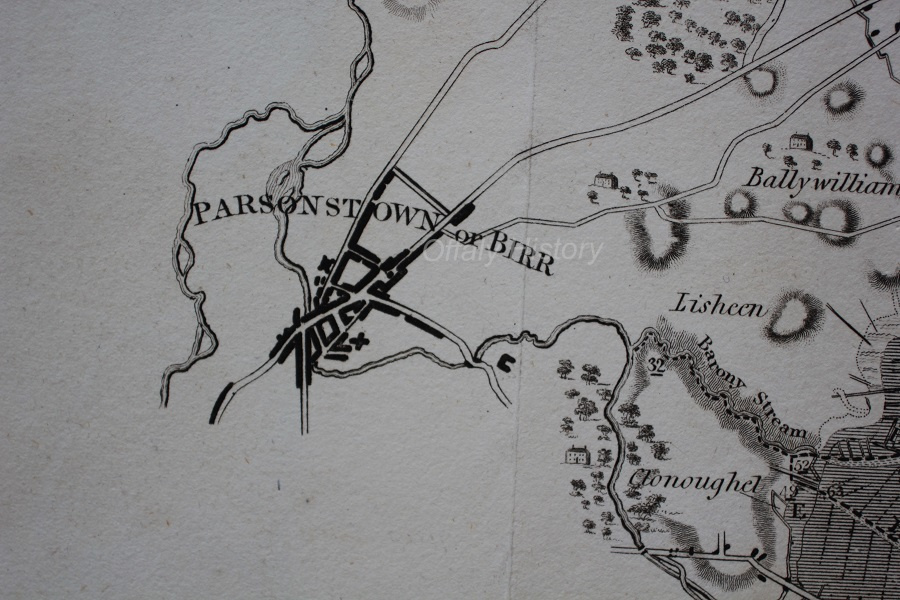
On the northern side of the town in Cumberland Street (now Emmet Street) lived the soon-to- be local historian then fresh from his controversies over Fr Crotty (who would later have a church in Castle Street), none other than Thomas Lalor Cooke. He published his first history of Birr in 1826. Cooke was then 31 years old and living, on 28 May 1821, with his wife Lucinda (26) and sons William (1) and Richard (5). William would issue the second edition of Cooke’s history in 1875, six years after his father’s death. There were several other families in the town of the same surname. Lucinda was connected with the legal family of Antisell and her mother, also Lucinda (48) lived with them – at least on census night. Working in the house were a servant boy, cook, nurse and servant maid.
Edward Synge (32) was farming 200 acres at Syngefield and the household comprised himself and two servants. The soldiers in the new barracks at Crinkill were all listed and with the townland comprising 870 inhabitants.
The streets and lanes of the town were densely populated. It was not until the 1900s that one saw the development of new suburban housing for the working classes. Prior to that people were crammed into the lanes and courts behind the bigger houses and paying 6d. to 1s. per week. In 1821 the details of the housing were provided for each street and that is reproduced here. But there is much to be done. Every lane needs to be identified. Cooke’s map of 1822 is helpful as are the maps of 1838 now on osi.ie and Geohive.
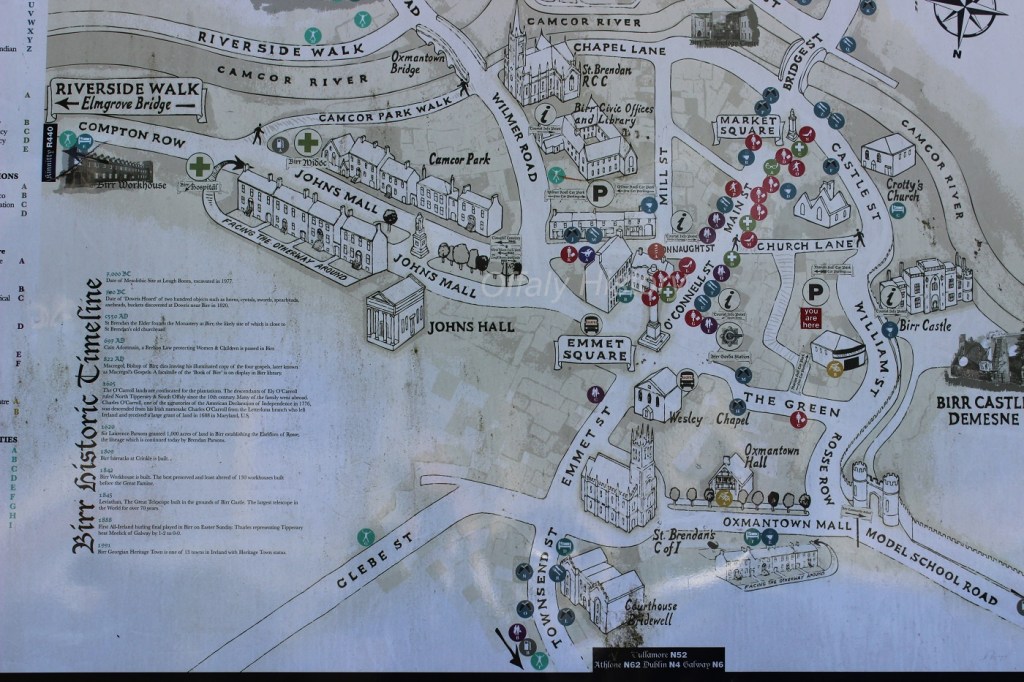
The street names, number of houses in each street and total population for each street will be of interest to those studying urban history. It is interesting to see so many living in Graveyard Street south of the river and outside the town ‘walls’ in what might be called ‘the Irishtown’. A similar situation prevailed in Tullamore with many living in Upper Barrack Street (now Kilbride Street) away from the town centre and the good freehold/long leasehold properties. Catholics could not easily engage in property development and speculation until after the Relief Act of 1793. Oxmantown Place had nine and not five houses at this time with one major, a colonel, a widow, a gent. one unoccupied and four more. One of the houses was occupied by Dr Thomas Waters (44), physician to the King’s County Militia and his wife Catherine (30) and her mother Anne Lestrange (56).
The study of the urban history of Birr is greatly enhanced by the estate records, parish records and from the 1830s the mapping and valuation surveys. The atlas of Birr published in 2005 by John Feehan and Alison, Lady Rosse, must make the study of the town so much more enjoyable. So too does the work of Stephen Callaghan and Caimin O’Brien in publishing the readings from the graveyard in Birr. Families such as that of Noble Luke Usher, Wilkinsons and Sheilds all get generous coverage.
The enumeration of the population by street and the street names will be of interest. Cooke complained (1826) that parts of Sefffin (189 inhabitants, 40 houses) and Drumbawn should have been included in Birr town.

The Census of Ireland
Population of the Town of Birr in 1821 and number of houses in each street
Houses Inhabitants
Pound Street 39 197
Charles Street 39 200
Melsop Street 34 137
Love Lane 6 30
Burke’s Hill 50 243
Cumberland Street 35 234
Old Bridge Street 33 182
Davis’s Close 2 12
Moor Park Street 97 488
Old Post Office Lane 23 111
Walcott Place 10 52
Back Lane 47 249
Burke’s Lane 14 81
William Street 5 43
Langton’s Lane 8 33
Duke Square 13 84
Duke Street 13 80
Pig Market 3 17
Main Street 67 439
Graveyard Street 124 639
Mount Silly [Sally] 4 23
Lower Eden 41 190
Upper Eden 37 189
Turf Market 9 51
Castle Street 32 203
Spinner’s Lane 30 150
Mill Lane 21 62
Church Lane 24 128
Chapel Lane 11 74
Connaught Street 35 109
New Bridge 76 366
The Green 38 203
Oxmantown Place 5 34
The Castle of Birr 0 19
1027 5429
[1016] [5352]
We have checked the totals and they do not agree with ours (which are in the square brackets). This could be explained as printing or interpretation errors. The figures in the original newspaper report are not easily decipherable.
The published abstracts of the 1821 Census for Birr contain the following:
| Offaly Town | Persons M F T | Families No. Of | Houses INH. UNINH. BLDNG |
| Birr | M – 2,531 F – 2,875 T – 5,406 | 1,200 | 974 1,200 1 |

Next week: The census for Kinnitty and other parts of Ballybritt barony. More on this census in the forthcoming Offaly Heritage 12.

Books mentioned in this article such as The atlas of Birr and the Tombstone readings from the old graveyard in Birr are available from Offaly History. So also is Printing and bookselling in Offaly which has much of interest to Birr. it is also available at the shop at Birr Castle.
 offalyhistoryblog