
The foundation stone for the Tullamore jail was laid on 13 September 1826 just 200 years ago. Two hundred years of history as we pass those gates of what is now Kilcruttin Business Park. We may wonder at what went on there over 200 years. In many ways the former jail encapsulates the history of Tullamore since the 1820s. When the jail was built Tullamore was not yet the county town. There was no railway until 1859 at this location. No road up from Kilcruttin until 1938, Lloyd Town Park was agricultural land with an old out-of-town cemetery nearby. Only the ‘Charleville Parade’ houses north of the courthouse were built. The courthouse was not completed until 1835. The jail was designed to accommodate 120 prisoners and had double that number during the Famine years of the late 1840s. It was well run on reform lines but Victorian prisons were tough places.
(more…)Category: Archival collections
-
Memories of life by the Grand Canal: the Cummins family at Ballycowan Lock as recorded in 1983. Blog no. 816 in the Offaly History Blog Series. 11 Sept. 2026
The Grand Canal, like all great waterways, has its own traditions. One of the most enduring of these customs is the tradition of loyal service given by those men and women who work on, or at the canal. In many cases, this tradition of service remains within a family, and is passed down from generation to generation. The Cummins family of Ballycowan Lock are such a family.
In the early years of the twentieth century when trade and commerce flourished, and the Grand Canal was still a thriving transport waterway with barges steaming up and down from Dublin to Shannon, Michael Cummins worked as a greaser in the Canal Basin T Shannon. In 1915 he was the victim of a tragic drowning accident in the place where he had spent his whole working life. He left behind a widow, Catherine, and a teenage boy, Joseph and to keep the wolf from the door, they had to find a new means of living. Thus began the long association between the Cummins family and Ballycowan Lock.
(more…)
-
Phil O’Reilly, Harbour Street, Tullamore – An Appreciation: He fought the good fight, both on the playing field and in civic life. A special article in the Offaly History Blog Series, no. 814, 1 Sept. 2026.
This appreciation piece is based on an interview by Aidan Barry and Shaun Wrafter (Offaly History members) with Phil O’Reilly Snr. at his home in Harbour St. Tullamore on 10th June 2024.
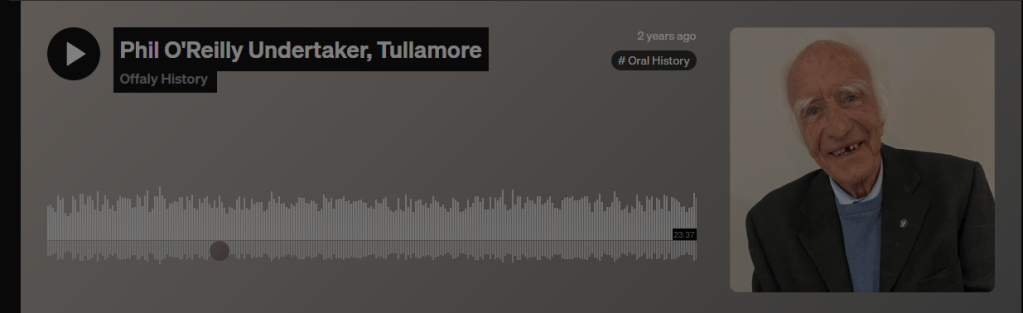
You can listen to the full interview here at Offaly History on SoundCloud. Go to Phil O’Reilly on SoundCloud or to Voices on the http://www.offalyhistory.com website. A lifetime spent in the quiet, noble service of a community leaves an indelible mark on the town that bred it. In the summer of 2024, when Shaun Wrafter, Offaly History sat down with Phil O’Reilly Snr in his beloved Harbour Street, the retired undertaker and former Offaly footballing legend looked back across his ninety years of life in Tullamore. With the news of his passing, Tullamore, County Offaly, and the wider GAA community mourn not just a giant of local history, but a man whose humble dedication, deep faith, and sporting courage touched generations.
From his earliest days kicking a ball along Harbour Street, Tullamore to the roaring, record-breaking crowds of Croke Park, and onward through over five decades of comforting grieving families as one of the town’s funeral directors, Phil O’Reilly Snr lived a life defined by decency, duty, and devotion.
Phil Reilly was born in 1993 and grew up in TullamoreBorn in 1933, Phil was a son of Tullamore and a true product of Harbour Street. His father, Phil, hailed from Tullamore, while his mother, Nora, came from Ballyhaunis, County Mayo. The couple had married in New York, where Phil’s eldest sister, Patsy, was born in 1932 before the family returned to Ireland and settled into the property on Harbour Street.
(more…)
-
‘One of the most remarkable days Tullamore has seen for some time’: A Fashionable Marriage in Tullamore 135 years ago – Michael F. Gorry senior and Edith McGlynn. Blog no. 812, 21 Aug. 2026 by Michael Byrne.
Then, as now, fashionable weddings get a lot of press attention. Michael F. Gorry was the great grandfather of Francis (Francie) Gorry whose family had the famous newsagency shop in Harbour Street, Tullamore for over 100 years. Michael F. Gorry was the first person to be buried in the new Catholic cemetery in Clonminch in 1893. The report of a wedding on 31 July 1891 was published in the Midland Tribune on 8 August and no doubt created a stir in Tullamore. The style of the report was that of the kind carried in the Birr Protestant and unionist King’s County Chronicle, a then hated rival of the Midland Tribune, and might have been related to Gorry’s being the agent for the Birr Chronicle in Tullamore. One James Joyce also used this style to describe fashionable bourgeois occasions is his Ulysses (published in 1922).
(more…)
-
T. L. Cooke of Birr and the Great Industrial Exhibition in Dublin of 1853. By John Dolan. Blog no. 809, in the Offaly History Series,7.8.2026
The 1850s was the decade of the Great Exhibitions. The London Crystal Palace Exhibition in 1851 was followed by Dublin and New York in 1853 and Paris in 1855. In Ireland there were regional/city exhibitions including in Cork (1852). It must be remembered that Ireland was still struggling to emerge from the disaster of the Great Famine.
The Great Industrial Exhibition of 1853 was the most ambitious exhibition ever held in Ireland up to that time. Staged in Dublin from 12 May to 31 October 1853, it was inspired by the famous Great Exhibition in London and was intended to showcase industry, technology, art, and manufacturing while encouraging economic development in Ireland. One of the developments of partcular interest was to copy the emergnce of Monster Houses (department stores) that began to appear in cities throughout Western Europe and the USA from the 1840s.
The exhibition aimed to move Ireland away from solely agricultural production towards industrialisation, promoting a shift toward Victorian consumer culture.
[Congratulations to Birr Historical Society on the reprint of Cooke’s first book on Birr published in 1826 and launched on 5 August 2026. Ed.]
(more…)
-
The Groome Family of Knockdrin and Garr in the Heart of Uíbh Fhailí. ByPadráig Groome. Blog no. 807, 24 July 2026.
The Groome Family of Knockdrin and Garr in the Heart of Uíbh Fhailí
Introduction
Nestled on the frontier of the ancient kingdom of Uíbh Fhailí, beneath the shadow of Croghan Hill, lies the historic townland of Knockdrin—a place long known as the “Hill of Conflict.” For centuries, this landscape formed part of the heartland of Gaelic Offaly, where kings ruled, battles were fought, and generations of ordinary families worked the land and built their lives.
Like many Irish families, the history of the Groomes was preserved through seanchas, the ancient Irish tradition of storytelling. Long before history was written in books, it was carried in memory. Stories of ancestors, local events, victories, hardships and family life were passed from one generation to the next around the warmth of the turf fire by the seanchaí (traditional storyteller), ensuring that the history of a family and its community would never be forgotten.
(more…)
-
Tullamore Town Park and its historic associations: a walk in the park on Saturday 18 July 2026, 10 30 a.m. to 12 noon. Blog no. 806 in the Offaly History Series, 16.7.2026. By Michael Byrne
The second guided town walk on 18 July 2026 is alongside Tullamore River to the town park and Cormac Street. We start from Bridge House Hotel on Distillery Lane at 10 30 a.m. on Saturday 18 July and make our way through a part of the old Water Lane (now Main Street) taking the path along the river to Lloyd Town Park while reflecting on its historical features and change in the landscape of the area and the town of Tullamore since the 1700s. All are welcome and the tour is free. Michael Byrne is your guide for the morning. Richard Jack will talk about the town park and its trees.
In the park close to what is now the filling station can be seen the remains of a corn mill of c. 1800 and where Daniel E. Williams of Tullamore DEW fame started work as a young man in the mid-1860s. He lived nearby in the miller’s house (now demolished) until Dew Park was completed in 1900. Beside the corn mill was a flour mill demolished in the early 1990s to facilitate the Bridge Centre and new apartments. It was known as Cooke’s Mill and was said to be haunted by ‘old Ned Cooke’.
(more…)
-
Buildings and housing of the Tullamore Workhouse, 1839-1852. By J.J. Reilly. Blog no. 804 3 July 2026 in the Offaly History Blog Series
The first meeting of the Tullamore Board of Guardians took place on Tuesday, the 26 November 1839, with 21 guardians present.[i] There were 24 elected members from 15 electoral divisions. The Union comprised an area of 246 square miles, covering 13 electoral divisions in King’s County and two in County Westmeath, with a total population of 53,905.[ii] It was headed by a chairman, John Hussey Walsh, with Charles Bagot as vice-chairman and John O’Brien deputy vice-chairman.
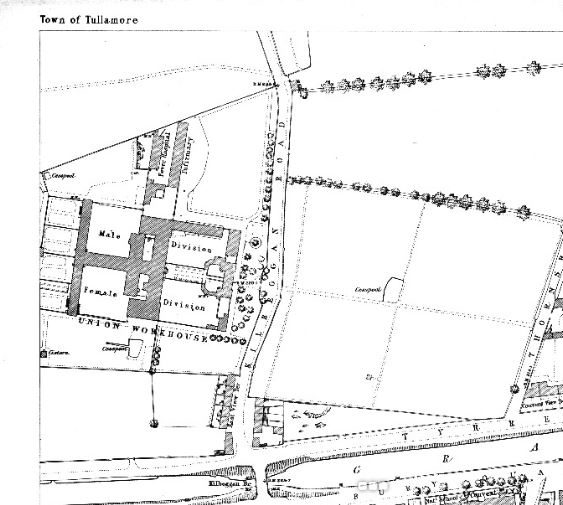
Figure 1 Tullamore Union Workhouse (Ordnance Survey, 1889)
The workhouse was situated on a 6.5 acre plot of land north of the Grand Canal on Emmet Road, or better known as Ardan Road. George Wilkinson, an Englishman, was the architect who followed similar designs to other poor houses built according to his designs in the years following the passage of the Irish poor laws Act. The Workhouse opened to inmates on the 9 June 1842. The workhouse cost £5,950 to build and a further £1,265 for fittings and furnish, bringing a total cost of 7,215.[iii]
(more…)
-
A new study of Offaly’s two Great Houses at Birr and Charleville, Tullamore Blog no. 802 in the Offaly History Series, 18 June 2026.
A new study of Offaly’s two Great Houses at Birr and Charleville, Tullamore just published
Two of the great houses of Ireland, are here in County Offaly at Birr and Tullamore. Both regularly feature in articles and magazine stories. Birr Castle much more so as it has been the family home of the Parsons family, earls of Rosse, since the 1620s. The present earl and his wife from the death of the sixth earl in 1979, have worked for almost fifty years to promote the castle and gardens for the benefit for tourism and build on the enthusiasm of the sixth earl to create a science museum commemorating the work of the third and fourth earls and that of Charles Parsons, the engineer who helped win the First World War. Both earls worked tirelessly for the gardens at Birr Castle.
(more…)
-
Portarlington market house: a place of many uses and now restored. By John Stocks Powell. Blog no. 801 in the Offaly History Blog Series, 12 June 2026
On Thursday 23rd April 2026 the new, changed, developed, market house in Portarlington’s square was formally opened, following over a year’s work on the structure to commence a new chapter in its long history. The new occupier is the Portarlington Community Development Association, and the building has become available, for gatherings, conferences, presentations. There is no doubt this is a construction for specific purposes.
And the building has two names: market house, though there is no longer a market; and tholsel, a name given to municipal buildings in Ireland where tolls and dues were collected. Tholsels had an authority in a town, and usually hosted corporation bodies. Notable examples of tholsels in Ireland may be found at Carlingford, Clonmel, Kilkenny and Youghal. In other locations tholsels have been changed into other uses, or gone to demolition, such as that in Mountrath.
(more…)
 offalyhistoryblog