The 1850s was the decade of the Great Exhibitions. The London Crystal Palace Exhibition in 1851 was followed by Dublin and New York in 1853 and Paris in 1855. In Ireland there were regional/city exhibitions including in Cork (1852). It must be remembered that Ireland was still struggling to emerge from the disaster of the Great Famine.
The Great Industrial Exhibition of 1853 was the most ambitious exhibition ever held in Ireland up to that time. Staged in Dublin from 12 May to 31 October 1853, it was inspired by the famous Great Exhibition in London and was intended to showcase industry, technology, art, and manufacturing while encouraging economic development in Ireland. One of the developments of partcular interest was to copy the emergnce of Monster Houses (department stores) that began to appear in cities throughout Western Europe and the USA from the 1840s.
The exhibition aimed to move Ireland away from solely agricultural production towards industrialisation, promoting a shift toward Victorian consumer culture.
[Congratulations to Birr Historical Society on the reprint of Cooke’s first book on Birr published in 1826 and launched on 5 August 2026. Ed.]
Who was T L Cooke?
Thomas Lawlor Cooke (1792-1869) was a solicitor, antiquarian. He was apprenticed to a solicitor in Dublin, and entered King’s Inn in 1815. Through marriage he was given access to the archives of the Parsons family of Birr Castle. He became an enthusiastic antiquary and collector of antiquities, particularly of ancient church hand bells. He experienced financial difficulties in the 1850s, part of his collection was sold to the British Museum and in 1882 the remainder was auctioned off. His private collection was one of the largest by any individual in Ireland at that time. Cooke was also author of The Early History of the Town of Birr, or Parsonstown.
William Dargan.
Funding for the construction of the exhibition halls was provided by William Dargan personally; there was no public funding for this enterprise. Dargan was regarded as the most successful businessman in 19th century Ireland. He was known as the Father of Ireland’s railways, he pioneered marketing Ireland as a tourist destination. He also developed canals, the North Circular Road in Dublin and the entire resort of Bray. Dargan hoped to stimulate Irish industry and help modernise the country in the years following the Great Famine.
Dargan’s aim was to respond to the 1851 Exhibition in London and he offered £20,000 to initiate the project and eventually contributed £100,000 to ensure its completion. After the exhibition closed Dargan calculated that he had incurred a personal loss of about £20,000.
The building was designed by John Benson and constructed with the assistance of engineer Richard Turner. It consisted of an iron frame with timber and glass pavilions. The building was constructed on the lawn of Leinster House with a 300-foot-long front on to Merrion Square with soaring barrel-vaulted halls.
These exhibition buildings were once-off only and taken down when the Exhibition closed. This practice continued until the French World Fair of 1889 when the Eiffel Tower was left in situ.
The Exhibition.
The premise was to display Ireland in the context of the empire; Ireland had not been represented in the London exhibition of 1851 perhaps due to a London view that Ireland had little to offer. There was no formal representation from Ireland in London, unlike Scotland and Wales, but Irish poplin, linen and lace was on display. The exhibition was held in an environment where Ireland was struggling to recover from the Great Famine.
Over 1,800 exhibitors showcased Irish art, industry, manufacture and antiquities that were organised into 42 categories.
- Machinery and industrial products from Ireland, Britain, America, Australia, and elsewhere.
- Fine art galleries containing hundreds of paintings, there were no art galleries in Ireland at the time so all items on display came from private collections.
- Irish antiquities and Art.
There were a number of exhibits from businesses in Offaly as well as a major contribution from Mr. Cooke.
Many publications and articles were produced about the Exhibition in Ireland and Britain. Three of the most important publications that related to the Exhibition are worth mention.
The Executive Committee commissioned a catalogue, The Official Catalogue of the Great Industrial Exhibition, 1583, it comprised 222 pages detailing the work involved in putting the exhibition in place as well as details of each item donated to the exhibition.

Title Page of the Catalogue of the Exhibition.
John Sproule produced The Irish Industrial Exhibition of 1853 in 1954. This a 562-page review of the exhibition that covers the exhibitors, the exhibits and comments on the impact of the displays. It also provided a day-by-day detail of the tickets sales. Analysis of the various industries on display was provided, particularly for mining and manufacturing across Ireland.
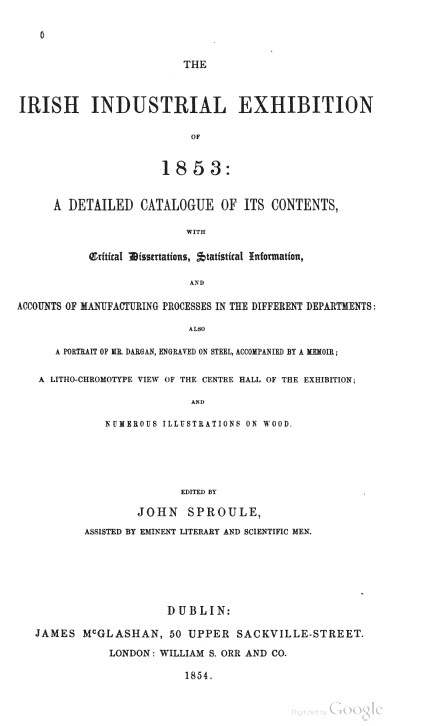
The Irish Industrial Exhibition Title Page, J Sproule
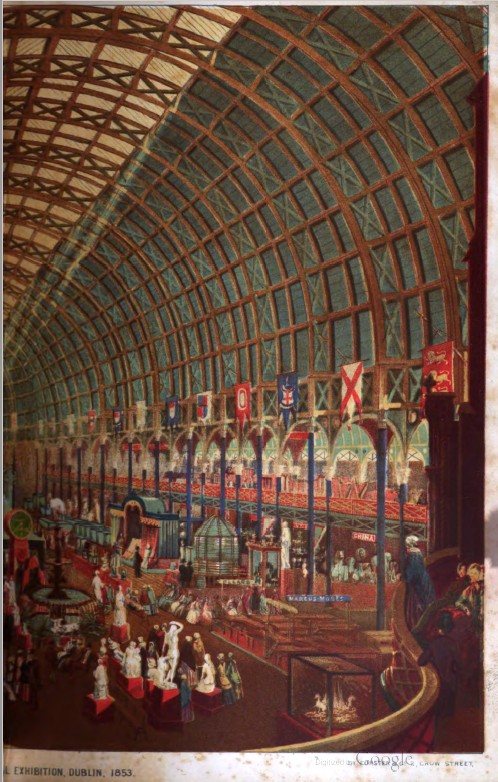
Centre Hall, Great Exhibition RDS Dublin, 1853, source J Sproule
Finally, the Exhibition Expositor and Advertiser was a special, weekly newspaper published on-site. Running from 12 May to 31 October, 1853, the Advertiser acted as a vital promotional tool, cataloguing exhibits, advertising products, and advocating for Irish industrial development and consumption. The first edition claimed ‘the Exhibition Building may truly be regarded as a great educational establishment, calculated to impress upon the minds of all classes lasting and important lessons: and it is fairly to be presumed that its value should be greatest to those whose range of observation is ordinarily the most limited’.
More than 600,00 people paid to see the exhibition, a similar number were said to have availed of free passes. The most significant event was the visit of Queen Victoria and Prince Albert on 30 August 1853. By the closure day it was estimated that over 1 million people had attended the exhibition.
The poor did not attend the exhibition.
The Relics of Ancient Art – Archaeology and Artefacts Court.
The Antiquities Court and the Temple of Industry were the courts most visited. However, the Tara Brooch, (part of the collection from Waterhouse & Co. 25 Dame St. Dublin) was the item that generated the greatest excitement. Queen Victoria herself purchased no less than four copies of the Tara Brooch along with many copies of other Irish antiquarian jewellery as souvenirs.
The archaeological/antiquarian artefacts are listed under Relics of Ancient Art in the catalogue. These exhibits are listed between pages 128 – 150, those contributed by Cooke are listed on pages 146 – 150. The Royal Irish Academy emptied its museum collection to form the greater part of the exhibition.
Richard Hitchcock writing to the Kilkenny Archaeological Society about Cooke’s contribution claims ‘Next in importance and tasteful arrangement in the Exhibition was the extensive contribution of Thomas L. Cooke, Esq.; being a portion of a collection which, I understand, Mr. Cooke has been amassing, at very considerable cost, for nearly half a century.’ Cooke was not the only contributor from Co. Offaly, a Mr. T R Murray from Edenderry contributed some bronze items found in the river Boyne.
Others who contributed antiquities included George Petrie, Lord Talbot of Malahide, Lord Londesborough, Lord Rosmore, Duke of Northumberland, Duke of Marlborough, Sir John Nugent, Sir Philip de Malpas Egerton and the Dean of Waterford. Exhibits were also provided by the museums in Belfast, Cork and Galway. Artefacts also came from the Archaeological Institute of Great Britain and Ireland, from antiquarians in Scotland, Italy and as far away as British Guiana and India. The Queen, herself, contributed a gold torc found in Needwood Forest.
Many items in the Catalogue are single items; however, one entry may relate to multiple items such as the collection of eleven Ogham stones from the Royal Irish Academy.
Cooke’s contribution.
It is not surprising to see saint’s bells lead Cooke’s collection. The bells related to Saints Ruadhan, Cuanna, Moula, Camin, Cuimin, Culamis, Senan and from Coberg, King’s Co. He sold five of the bells to the British Museum, one is in the National Museum of Ireland and the location of the other two bells are unknown.
His exhibits were mainly from Offaly (46), then Tipperary (16) but also included artefacts from Laoise, Clare, Limerick, Westmeath, Galway, Meath, Louth, Longford and Galway. His dealings were spread wide over central Ireland. You will note that a substantial number of the antiquities were from the massive find of bronze items from Dowris near Five Valley, Offaly.
Four pages of Cooke’s exhibits
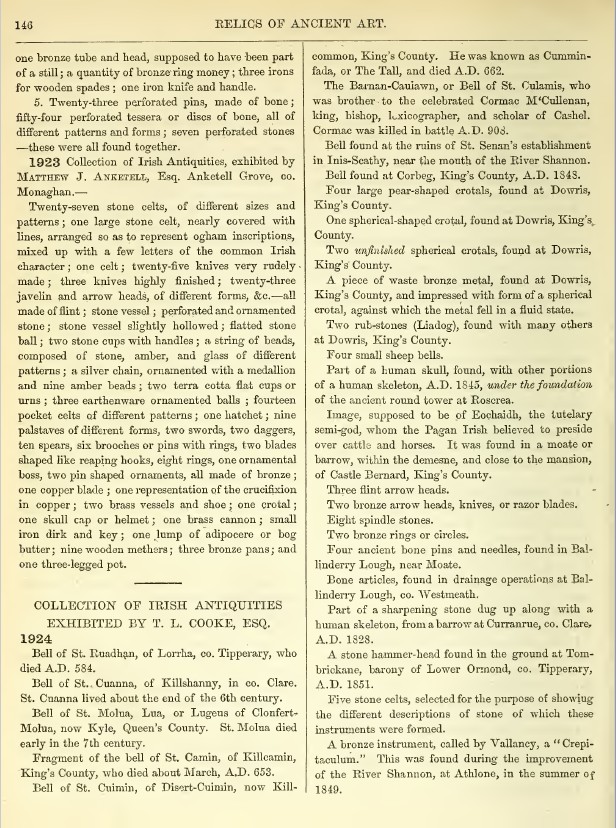
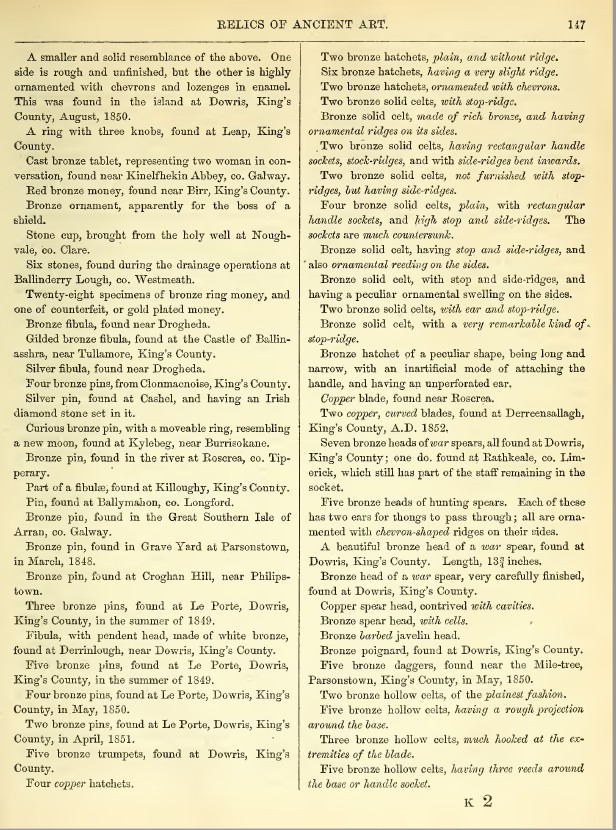
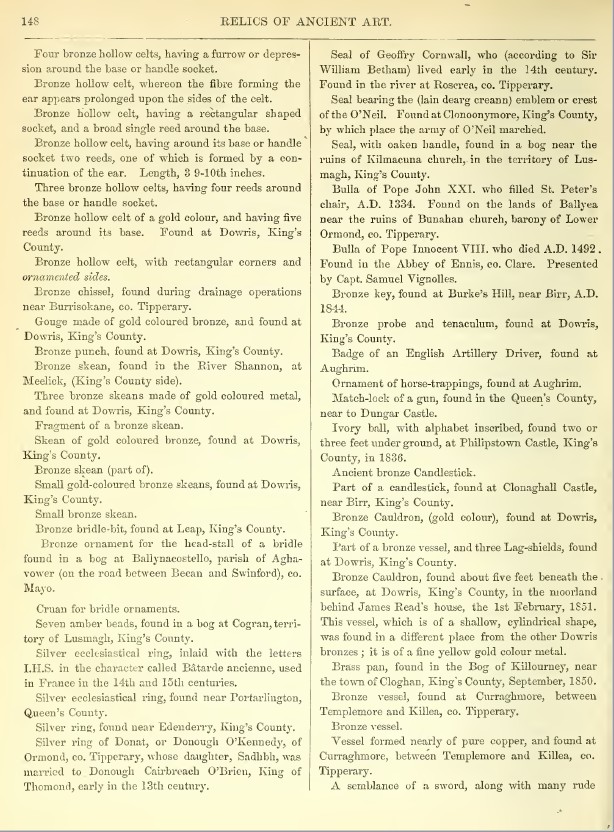

In considering the items listed above many questions are raised. Were all of these items in Cooke’s possession or had others given them to him for the exhibition? Did Cooke have a substantial storage facility available to him in Birr? What level of security did he maintain on them as many were very valuable and highly desirable?
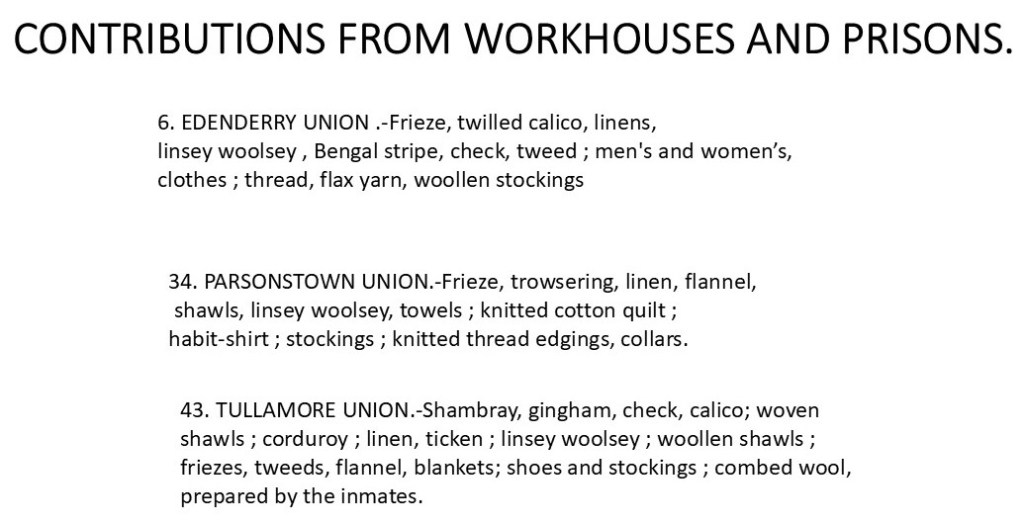
The Committee contacted the Poor Law Unions requesting that they might contribute to the Exhibition. The responses were very low, the workhouses in Offaly contributed as below:
Workhouse contributions -Birr, Edenderry, Tullamore
‘Monster Houses’:
‘Monster houses’ were a slightly derogatory term used by traditional merchants, it referred to massive retail buildings that housed dozens of distinct sales departments under one roof, rather than the small, specialized shops that previously dominated the city of Dublin. Many existing and smaller retailers formed protest groups including the Dublin Retailers Association.
These large stores fundamentally changed middle-class urban life in Dublin, offering fixed pricing, window-shopping, and varied merchandise that defined the post-Famine economic recovery.
Arnotts is Ireland’s oldest and largest department store. Located on Henry Street, the iconic 300,000-square-foot retail institution grew from a modest drapery shop into an enduring city landmark that has successfully navigated rebellions, global conflicts, and devastating fires. Scottish entrepreneurs George Cannock and Andrew White opened a small drapery shop at 14 Henry Street. In 1845 prominent bankers Andrew and Patrick Reid joined as partners. After Andrew White passed away in 1848, Scottish entrepreneur Sir John Arnott joined the business, bringing significant financial investment. The business was officially renamed Arnotts in 1865.
The New Martstore opened in Sackville Street in May 1853, owned by Peter and Paul McSwiney, who would go on to be lord mayor of Dublin in the 1860s. One of the very first purpose-built department stores in the world, it was five storeys tall, with six display windows opening onto Sackville Street. Inside there was a ‘great centre hall’. In 1883 the building and stock was sold to a number of investors, including Michael Clery from Limerick. By 1884 the building was renamed Clery & Co.
Other department stores that emerged in Dublin at this period included Pim Bros.; McBirney, Colles & Co.; Todd, Collis &Co.; Todd, Burns & Co.; Cannock, Burns& Co. etc
Closure.
The exhibition was formally closed on Monday 31 October 1853 by the Lord-Lieutenant. Up to 21,000 people attended the outdoor activities. Both sacred and military music was played. The Lord-Lieutenant gave the closing speech and he concluded by calling for three cheers for Mr. Dargan.
Later the exhibitors gave a banquet to Mr. Dargan in the King’s Room of the Mansion House, Dublin. Some 600 people attended and the Lord Chancellor, Lord Ward thanked Mr. Dargan for the success of his enterprise.
The exhibition led to the establishment of the National Gallery of Ireland in 1854. It was not until 1877 that an Act of Parliament founded the Nation Museum of Ireland in Kildare St., then called the Museum of Science and Art. The collection from the Royal Irish Academy was transferred to the museum as the foundation of a National Museum.
The Royal Irish Academy produced the following videos on the 170th anniversary of the Exhibition. https://www.youtube.com/results?search_query=great+industrial+exhibition+dublin+1853
All images for this blog are courtesy of the National Library of Ireland, Dublin
Sources:
Committee of the Royal Dublin Society, (1853), The Official Catalogue of the Great Industrial Exhibition, 1583, John Falconer, Dublin
Sproule J. (1854) The Irish Industrial Exhibition of 1853, James McGlashan, Dublin.
 offalyhistoryblog