The Grand Canal, like all great waterways, has its own traditions. One of the most enduring of these customs is the tradition of loyal service given by those men and women who work on, or at the canal. In many cases, this tradition of service remains within a family, and is passed down from generation to generation. The Cummins family of Ballycowan Lock are such a family.
In the early years of the twentieth century when trade and commerce flourished, and the Grand Canal was still a thriving transport waterway with barges steaming up and down from Dublin to Shannon, Michael Cummins worked as a greaser in the Canal Basin T Shannon. In 1915 he was the victim of a tragic drowning accident in the place where he had spent his whole working life. He left behind a widow, Catherine, and a teenage boy, Joseph and to keep the wolf from the door, they had to find a new means of living. Thus began the long association between the Cummins family and Ballycowan Lock.
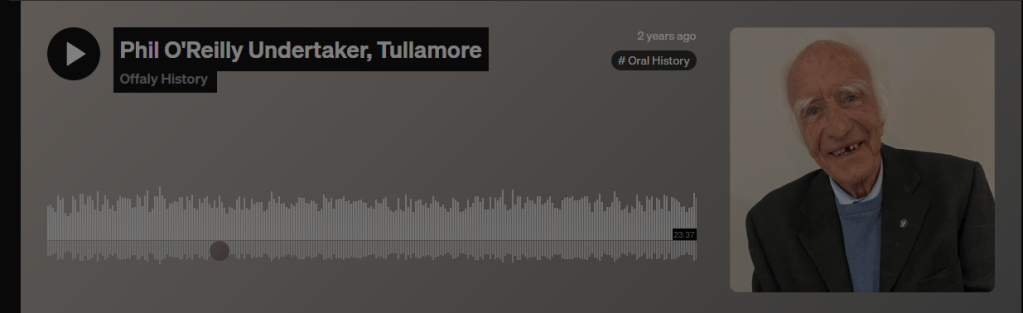
This appreciation piece is based on an interview by Aidan Barry and Shaun Wrafter (Offaly History members) with Phil O’Reilly Snr. at his home in Harbour St. Tullamore on 10th June 2024.
You can listen to the full interview here at Offaly History on SoundCloud. Go to Phil O’Reilly on SoundCloud or to Voices on the http://www.offalyhistory.com website.
A lifetime spent in the quiet, noble service of a community leaves an indelible mark on the town that bred it. In the summer of 2024, when Shaun Wrafter, Offaly History sat down with Phil O’Reilly Snr in his beloved Harbour Street, the retired undertaker and former Offaly footballing legend looked back across his ninety years of life in Tullamore. With the news of his passing, Tullamore, County Offaly, and the wider GAA community mourn not just a giant of local history, but a man whose humble dedication, deep faith, and sporting courage touched generations.
From his earliest days kicking a ball along Harbour Street, Tullamore to the roaring, record-breaking crowds of Croke Park, and onward through over five decades of comforting grieving families as one of the town’s funeral directors, Phil O’Reilly Snr lived a life defined by decency, duty, and devotion. Phil Reilly was born in 1993 and grew up in Tullamore
Born in 1933, Phil was a son of Tullamore and a true product of Harbour Street. His father, Phil, hailed from Tullamore, while his mother, Nora, came from Ballyhaunis, County Mayo. The couple had married in New York, where Phil’s eldest sister, Patsy, was born in 1932 before the family returned to Ireland and settled into the property on Harbour Street.
At eight o’clock in the morning, my mother burst into my bedroom waving a telegram.
‘You have got a County Scholarship! You have to go to Dublin straight away!’
It was late October 1957. I had applied for a scholarship from Offaly County Council to study architecture in UCD but when the new term opened at the beginning of the month and I had no word I presumed that my Leaving Cert results simply weren’t good enough and had given up hope. Being an unemployed widow there was no way my mother could have found the money for fees and digs. A scholarship – of which there were only six- was my only hope.
At the last moment a student brighter than I had pulled out and I was next on the list. However, the offer had to be taken up that very day or else would be withdrawn. My mother thrust the telegram and three pounds into my hands and I raced to the station and caught the train to Dublin.
At Kingsbridge I got a taxi to the offices of the National University of Ireland in Merrion Square. My telegram from the Council was carefully scrutinised and to my great relief I was told that I was accepted but would have to be interviewed by the Professor of the School of Architecture who would have the final say. A call was made and I was told to race across to Earlsfort Terrace where Professor Desmond FitzGerald would interview me at one o’clock.
It was plainly obvious from the moment I entered his office that the Professor was unenthusiastic about my joining the course. I had already missed two weeks of projects and lectures and would never catch up, he said. Might it not be better if I used my scholarship to do an Arts degree. Anyway, why did I want to study architecture?
Then, as now, fashionable weddings get a lot of press attention. Michael F. Gorry was the great grandfather of Francis (Francie) Gorry whose family had the famous newsagency shop in Harbour Street, Tullamore for over 100 years. Michael F. Gorry was the first person to be buried in the new Catholic cemetery in Clonminch in 1893. The report of a wedding on 31 July 1891 was published in the Midland Tribune on 8 August and no doubt created a stir in Tullamore. The style of the report was that of the kind carried in the Birr Protestant and unionist King’s County Chronicle, a then hated rival of the Midland Tribune, and might have been related to Gorry’s being the agent for the Birr Chronicle in Tullamore. One James Joyce also used this style to describe fashionable bourgeois occasions is his Ulysses (published in 1922).
The 1850s was the decade of the Great Exhibitions. The London Crystal Palace Exhibition in 1851 was followed by Dublin and New York in 1853 and Paris in 1855. In Ireland there were regional/city exhibitions including in Cork (1852). It must be remembered that Ireland was still struggling to emerge from the disaster of the Great Famine.
The Great Industrial Exhibition of 1853 was the most ambitious exhibition ever held in Ireland up to that time. Staged in Dublin from 12 May to 31 October 1853, it was inspired by the famous Great Exhibition in London and was intended to showcase industry, technology, art, and manufacturing while encouraging economic development in Ireland. One of the developments of partcular interest was to copy the emergnce of Monster Houses (department stores) that began to appear in cities throughout Western Europe and the USA from the 1840s.
The exhibition aimed to move Ireland away from solely agricultural production towards industrialisation, promoting a shift toward Victorian consumer culture.
[Congratulations to Birr Historical Society on the reprint of Cooke’s first book on Birr published in 1826 and launched on 5 August 2026. Ed.]
The Groome Family of Knockdrin and Garr in the Heart of Uíbh Fhailí
Introduction
Nestled on the frontier of the ancient kingdom of Uíbh Fhailí, beneath the shadow of Croghan Hill, lies the historic townland of Knockdrin—a place long known as the “Hill of Conflict.” For centuries, this landscape formed part of the heartland of Gaelic Offaly, where kings ruled, battles were fought, and generations of ordinary families worked the land and built their lives.
Like many Irish families, the history of the Groomes was preserved through seanchas, the ancient Irish tradition of storytelling. Long before history was written in books, it was carried in memory. Stories of ancestors, local events, victories, hardships and family life were passed from one generation to the next around the warmth of the turf fire by the seanchaí (traditional storyteller), ensuring that the history of a family and its community would never be forgotten.
My very first memory is of waving goodbye to a man who was on his way to the scaffold.
I was just three and was frightened by the noise and smoke of the steam train and the hubbub created by a large crowd but was totally unaware of the reason for it all.
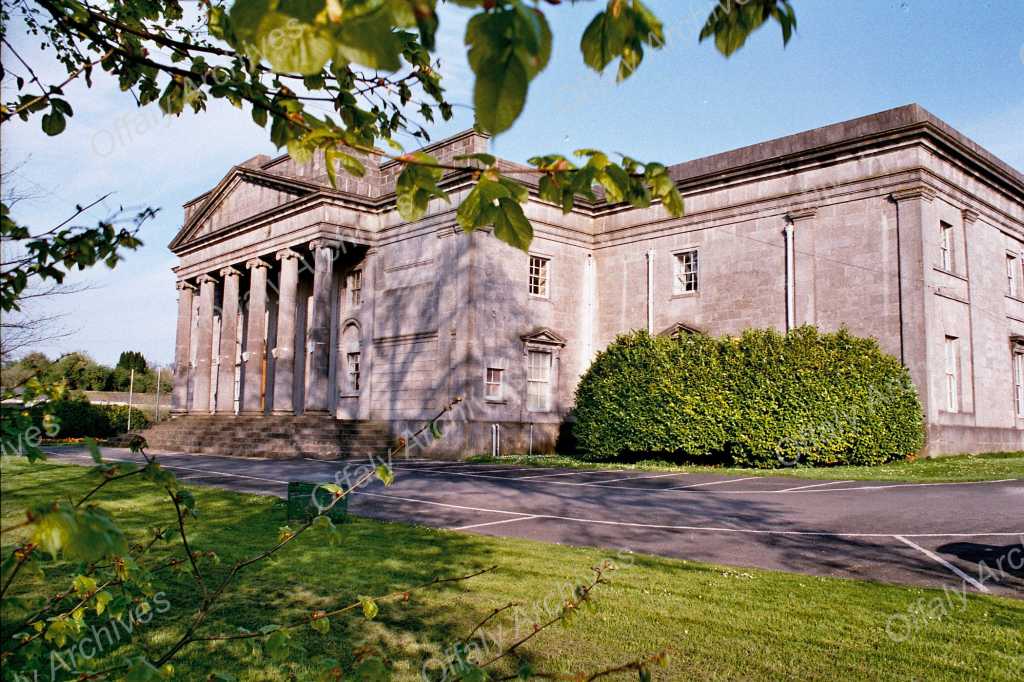
The Tullamore courthouse
Barney Kirwan
I was with my mother and her friend Tessie Leonard who had brought me along with them –together with half Tullamore – to wave goodbye to Rahan man Barney Kirwan who was being brought to trial in Dublin accused of having chopped up his brother, following a dispute over property and then burying the pieces in a nearby bog. Barney was now being transferred from Tullamore railway station to Mountjoy Gaol to await a high-profile trial whose guilty verdict he would challenge.
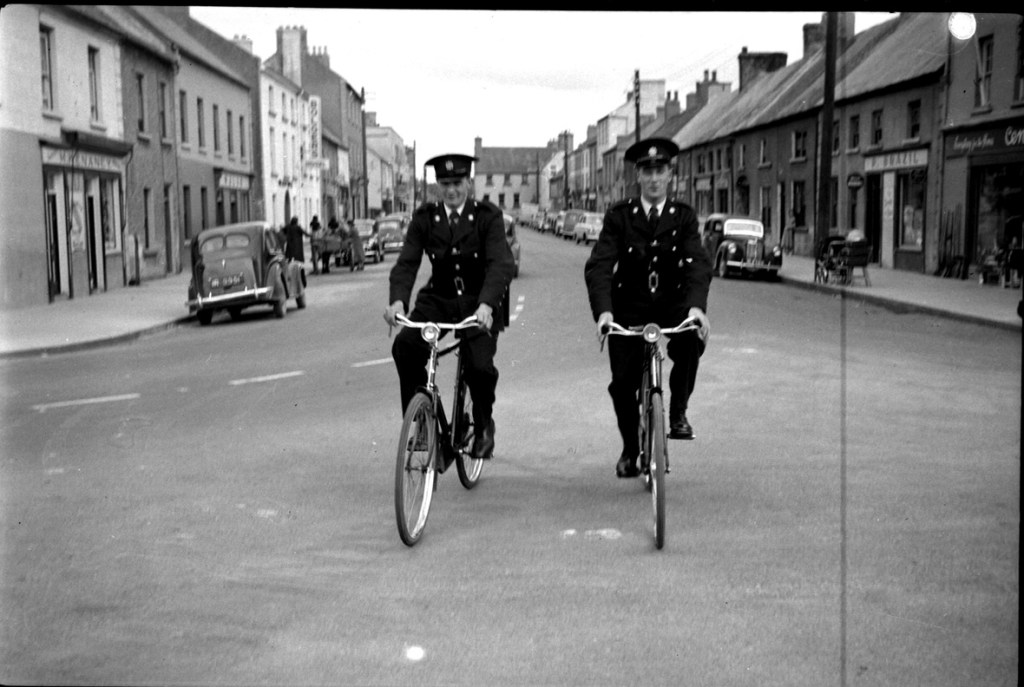
On the bikes in Kirwan’s time at Patrick St, Tullamore.
Following an unsuccessful appeal to the High Court he was hanged on 2 June 1943. Brendan Behan who was in Mountjoy on Republican charges at the same time would make the event famous with his play ‘The Quare Fellow’ in which Kirwan is the unseen but central character.
The last hanging in Ireland was in 1954 and the brutal practice was terminated in 1990.
A Threat to Tullamore
I was born three days after the outbreak of the Second World War and was therefore quite oblivious of its progress and significance. This was to dramatically change on the 23rd January 1944 when a massive American B‑17 Flying Fortress which had taken off from Goose Bay, Newfoundland, bound for RAF Prestwick in Scotland, developed engine trouble over Northern Ireland
Its crew of ten parachuted to safety over Enniskillen. Before leaving the aircraft, they had set the now unmanned bomber on a course back toward the coast, hoping it would continue flying until it ran out of fuel and would crash harmlessly into the sea.
However, the prevailing winds shifted the aircraft off its intended path, carrying it further inland rather than out toward the coast. The unmanned bomber (luckily without a lethal load) remained aloft, flying on without its crew, but began gradually to lose height as it flew over the Irish Midlands. Its flight path brought it over Edgworthstown, west of Mullingar, over Kilbeggan and heading straight for Tullamore.
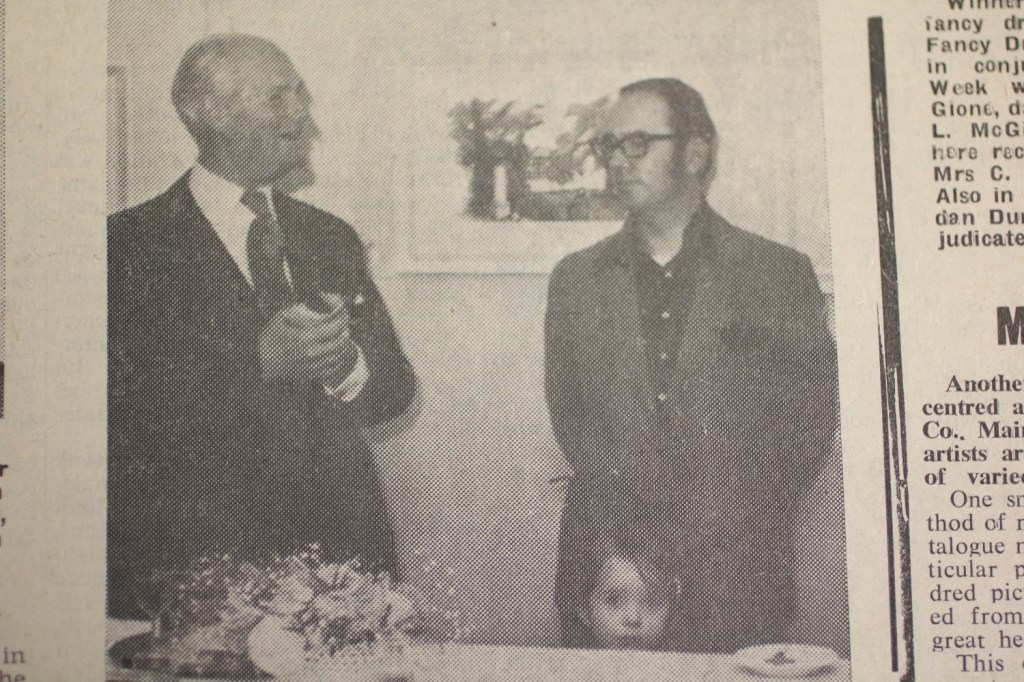
Fergal MacCabe (right) at one of his art exhibitions in 1972 and attentive to the comments of the sixth earl of Rosse.
This created an emergency which was transmitted by alarm calls over Radio Eireann. The prospect of its crashing near, or even on, Tullamore caused great excitement. I remember standing in our yard and seeing it drifting slowly and silently over the town at a low level. It disappeared over Ballard bog. We waved it on its journey and hoped Portlaoise would not be its final destination. Eventually it crashed harmlessly in fields half a mile from the village of Johnstown in Co. Kilkenny.
In 1947 I asked my brother Tommy how the war was getting on. So far as I knew there had always been a war. I was quite surprised when he told me it had concluded two years previously.
A Big White Wedding – Williams and O’Reilly
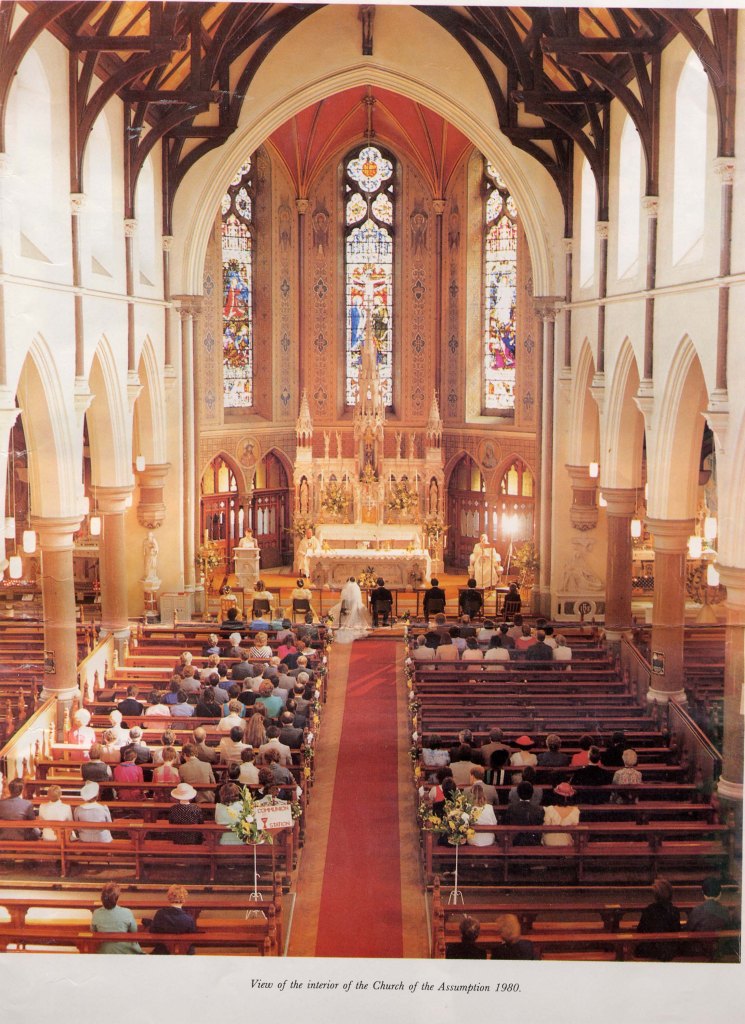
The old Tullamore RC church of 1906-83
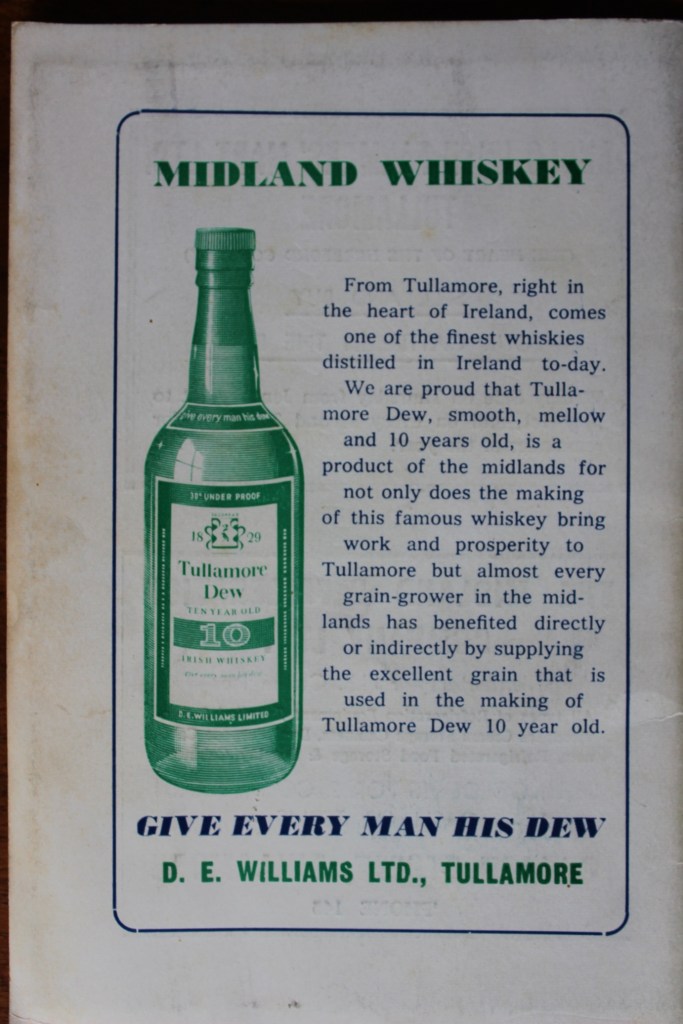
Tullamore Dew and Powers
But the event which made the greatest impact on me was the wedding in 1950 of our next door neighbour Teresa Williams to Frank O’Reilly (1922–2013) of Powers Distillery.
The excitement, glamour, fashion, music, food and general gaiety which it generated stimulated my young imagination and had a beneficial effect on the town of Tullamore which in those dreary days desperately needed a diverting public spectacle.
Though wealthy, the Williams family lived very modestly, their only public luxury being a beautiful dark blue Chrysler limousine.
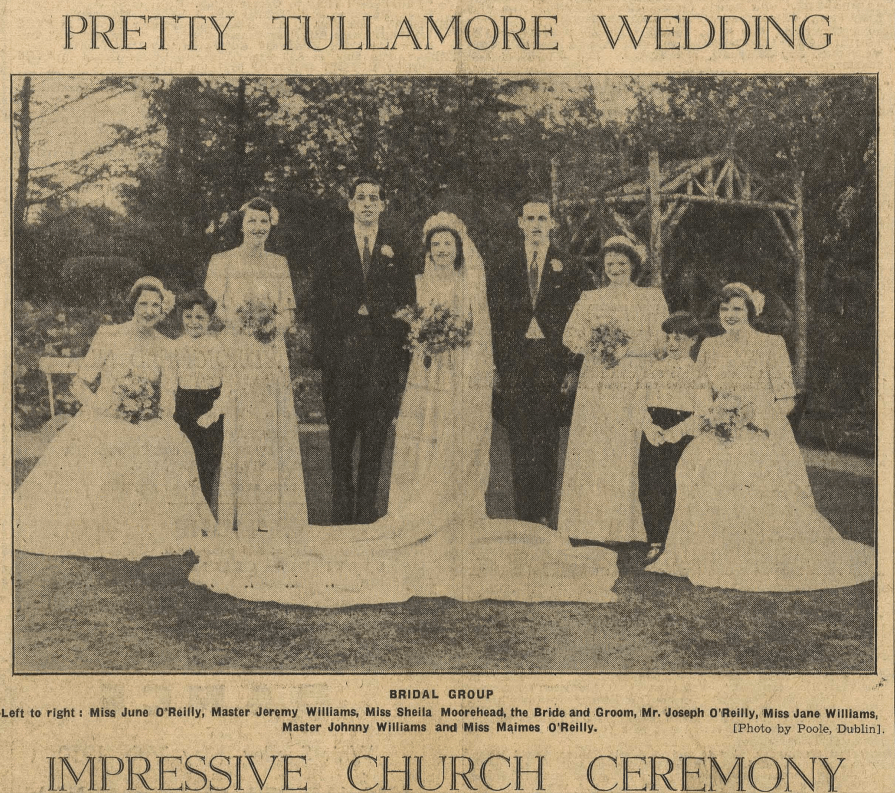
The engagement of their eldest daughter to the handsome Frank O’Reilly who had returned from service in the British army during the Second World War to take over his family business of Powers Distillery, was not just a love match (they went on to produce ten children) but the linking of two great Irish distilling families. No expense would be spared therefore to mark the great occasion and a three-day gala was planned. For Tullamore it would be a huge event and everyone was excited by the glamour of it all.
The Williams O’Reilly wedding with a young Jeremy Williams on the left (see an earlier blog).
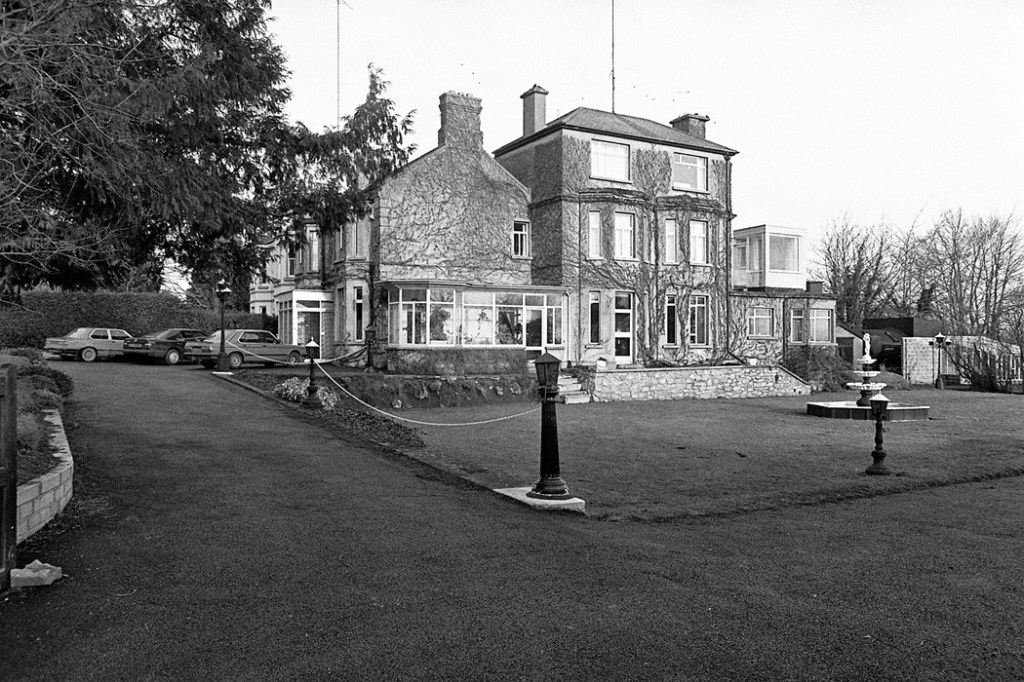
I lived with my mother and brother in my grandparents house ‘Innisfree’ (now Loughmore Lodge) which was semi-detached with the Williams residence ‘Auburn’ owned by Captain Jack. The property had been much extended and additional land acquired to provide a magnificent south facing lawn and tennis court.
Scene of the wedding breakfast. Auburn then the home of John and Mrs Williams (nee Moorhead).
In the run up to the great day tents began to be erected in the grounds to accommodate three days of festivities. On the first evening there was a spectacular fireworks display-the first I had ever seen.
The following day all of Tullamore went to the Church of the Assumption and crowded outside to greet the bride and her six bridesmaids and to witness the first white wedding in Tullamore since 1939.
The imposing west door of the church (now sadly blocked up) made a magnificent backdrop for the emerging bride and groom and I remember confetti being thrown and the bridal bouquet tossed in the air to be grabbed by a scrum of enthusiastic young women.
The bridal party then proceeded to Clonminch where a reception and dinner were provided by caterers brought from Dublin for the occasion. All us neighbouring children gathered on the flat roof of our shed which overlooked the kitchen where the feast was prepared and from time to time we were fed titbits. I savoured the unfamiliar tastes of lobster, pate and rhum baba.
The dancing under the fairy lights continued all night and in my bedroom I could hear it until I went to sleep. It was magical.
On the third day a party was thrown for the staff and employees of the two distilleries whose owners were now united in marriage and the gaiety continued well into that night too.
Then the tents were folded, the caterers cleaned up and departed and Tullamore got back to normal. But the wedding had brought a welcome interlude of glamour at the beginning of a decade that would be marked by further economic decay and emigration.
The Tullamore Dew whiskey of the late 1950s – ten years old and a child for every year in the Williams O’Reilly household.The brand was sold in 1965 and yes the sum was £10,000. For an excellent Life of Frank O’Reilly see the online Dictionary of Irish Biography, written by Tullamore man Terry Clavin [Ed].
Thanks to Fergal MacC for these memories and more to come we hope.
The Goodbody family is widely associated with the prosperous Quaker industrial dynasty that emerged in Clara and Tullamore during the nineteenth century. However, this article focuses on a lesser-known and far less successful branch of the family: the descendants of Thomas Goodbody (1783–1848), brother of the prominent miller Robert Goodbody (1781–1860). While Robert’s line flourished, Thomas’s life and that of his children was marked by repeated financial failure, instability, and eventual decline, culminating in the disappearance of the Goodbody name from Birr by the early twentieth century.
The new edition of Prison Poems or Lays of Tullamore by T.D. Sullivan, now edited by Terry Moylan and Padráig Turley, will be launched on Saturday 28 March at 11 a.m. at Cormac Street entrance to the old prison. Coffee will be available from 10 a.m. at Tullamore market Spollanstown to the rear of the old prison, now Kilcruttin Centre.. Parking is available at the farmers’ market, Spollanstown and at the Cormac Street frontage to the old jail (best approached from Cormac St to take a left turn into the jail/Kilcruttin Centre). Pedestrian access only will be available from the market to the front of the jail from 10 to 12 noon The book can be ordered online from Offaly History or purchased on the day or later at Offaly History Centre and Midland Books.
28 March Saturday at 11.00 a.m. at the former Tullamore Prison/Kilcruttin Business Park, Cormac Street, Tullamore,
The plan is to meet in the farmers’ market, Spollanstown for coffee from 10 a.m. and process at 10 45 to the front hall of the jail for the launch. Tony Flanagan has kindly sponsored the coffee in the market and OH will distribute a voucher ticket to those attending the book launch.
The book will be launched by Michael Hanna who gave the lecture in December 2025.
The launch should take about thirty minutes.
The speakers are:
Chair of Offaly History Shaun Wrafter welcomes the speakers
Padraig Turley, a co-editor, on the author T.D. Sullivan
Terry Moylan, co-editor, on the Poems
Delcan Harvey Cathaoirleach of Tullamore Municipal
Michael Hanna to launch – on the jail, medical men and the new book. Michael Hanna is the author of Irish General Practice: the long story. He spoke on medical doctors at Tullamore prison in the 1880s in the course of his lecture to Offaly History in December 2025.
Michael Byrne, General Secretary Offaly History, to close and thanks to all.
[Before moving to the article Offaly History wish to congratulate the authors/editors on the issue of the new annotated edition of Prison Poems; or Lays of Tullamore from Terry Moylan and Pádraig Turley and published by Offaly History with the support of the Decade of Commemorations funding. The book is now on sale and is available from Offaly History Bury Quay and online at www.offalyhistory.com. Ed.]
Timothy Daniel Sullivan MP and Lord Mayor of Dublin published Prison Poems; or Lays of Tullamore in 1888, printed by The Nation at 90 Middle Abbey Street, Dublin. What are these about? What made Sullivan write them?
Paddy Claffey was born in Noggusboy, Ferbane, on April 17th, 1921, three months before the end of Ireland’s War of Independence. His parents were Sarah (Flaherty) of Gallen and Kieran Claffey, Noggus. The youngest of their ten children, Paddy had six sisters – Maryann, Maggie, Kit, Ellen, Jane, and Sarah – and three brothers – Ned, Kieran, who died aged 27, and Johnny, at birth.
The siblings attended Gallen NS, where Paddy’s teacher was Master Goodwin. In Brendan Ryan’s book, On Gallen Green, a 1927 school photograph on page 122 shows P.J. Claffey in the front row.
For his 90th birthday party in the Bridge House Hotel, I had the pleasure of interviewing my granduncle and writing his story. Paddy was a natural storyteller. Recalling his first time away from home for a long spell, he was thirteen and had taken an awful pain. Doctor Maher advised hiring a car to drive him to Tullamore. The hospital was the very same as a big hayshed, Paddy said, with auld lads smoking; they couldn’t see one another with the smoke. His sister, Ellen, cycled in to see him every day, and the woman who owned Lawless’s shop sent her two daughters with books and sweets. He was glad to go home, but couldn’t get used to the small house in Noggus for the longest time.

 offalyhistoryblog