
At eight o’clock in the morning, my mother burst into my bedroom waving a telegram.
‘You have got a County Scholarship! You have to go to Dublin straight away!’
It was late October 1957. I had applied for a scholarship from Offaly County Council to study architecture in UCD but when the new term opened at the beginning of the month and I had no word I presumed that my Leaving Cert results simply weren’t good enough and had given up hope. Being an unemployed widow there was no way my mother could have found the money for fees and digs. A scholarship – of which there were only six- was my only hope.
At the last moment a student brighter than I had pulled out and I was next on the list. However, the offer had to be taken up that very day or else would be withdrawn. My mother thrust the telegram and three pounds into my hands and I raced to the station and caught the train to Dublin.
At Kingsbridge I got a taxi to the offices of the National University of Ireland in Merrion Square. My telegram from the Council was carefully scrutinised and to my great relief I was told that I was accepted but would have to be interviewed by the Professor of the School of Architecture who would have the final say. A call was made and I was told to race across to Earlsfort Terrace where Professor Desmond FitzGerald would interview me at one o’clock.
It was plainly obvious from the moment I entered his office that the Professor was unenthusiastic about my joining the course. I had already missed two weeks of projects and lectures and would never catch up, he said. Might it not be better if I used my scholarship to do an Arts degree. Anyway, why did I want to study architecture?
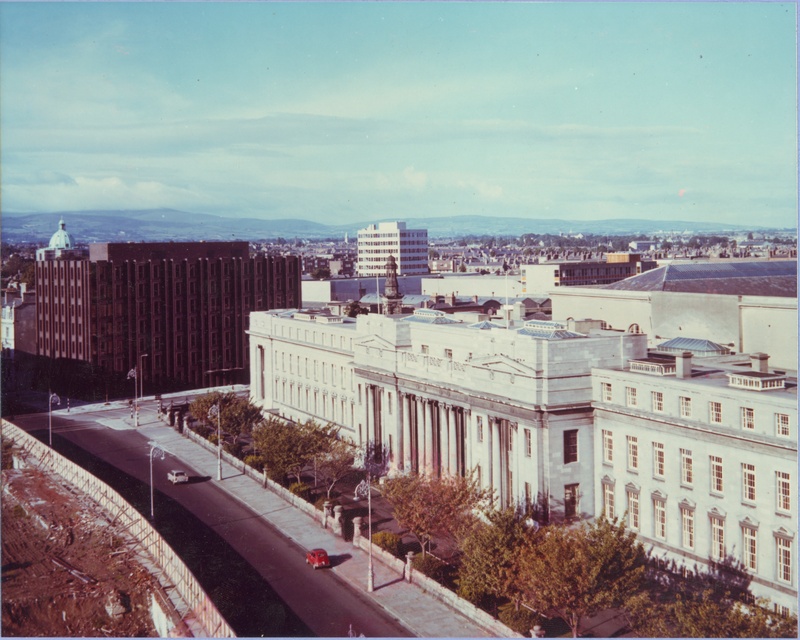
Earlsfort Terrace courtesy of University College Dublin.
Sixth earl of Rosse
I explained that I had been drawing since childhood and my work had been commented on by a local personality who felt that I should consider architecture as a career.
The idea that some provincial dignitary would have enough sophistication to make such a suggestion seemed to amuse the Professor. ‘And who on earth in Offaly might suggest that you study architecture?’ he asked. My reply that it was the Earl of Rosse transformed our conversation.
How could I possibly have known that the Professor had recently designed a very elegant factory in Birr for the Earl and that further commissions were eagerly anticipated. He enquired as to the health of the Earl which I assured him I found excellent at our last meeting and suggested that I might convey his best wishes to the Earl when he and I met again. I assured him that I certainly would.
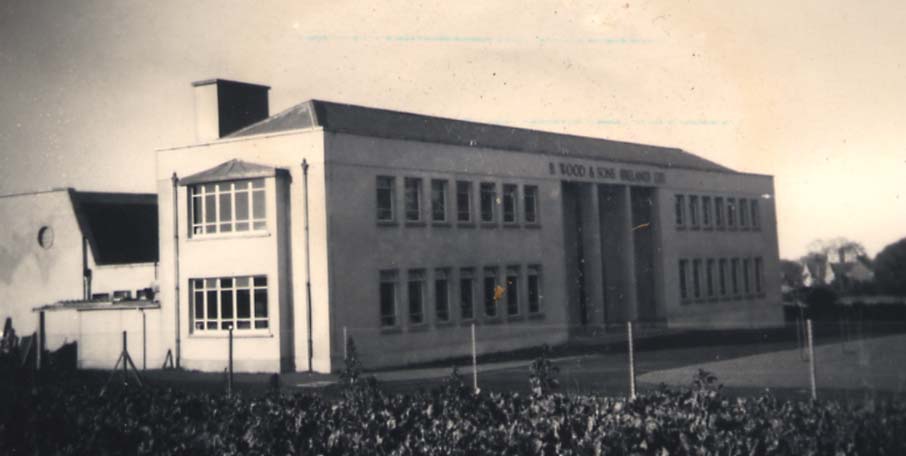
I might have exaggerated my relationship with Lord Rosse somewhat.
‘Well then’, the Professor said ‘I suppose you had better waste no further time. Your first-year class are just starting their weekly drawing lesson in the College of Art in Kildare Street and you had better join them straight away’.
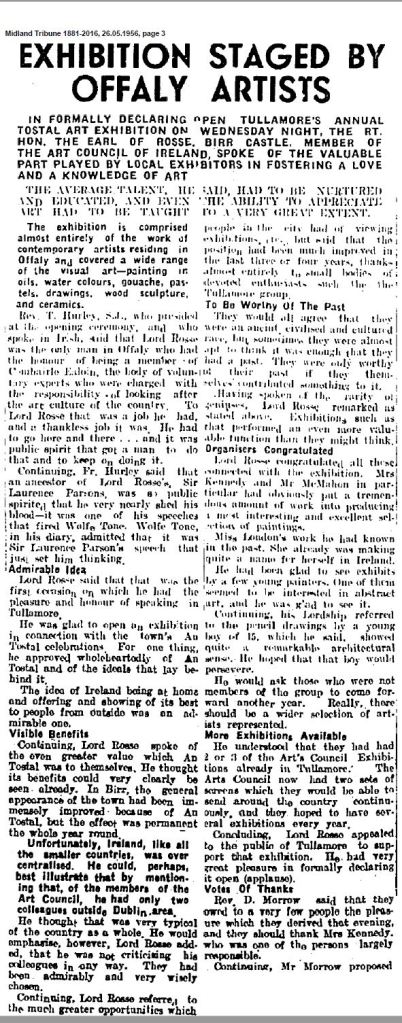
I was in!
Stopping to buy some pencils and a sketch pad in Dick Trueman’s art supplies shop, I ran into the College and asked the porter where the First-Year architects were. He directed me down the corridor to the third room on the right.
I entered and found a group of about twenty students bent over their sketchpads and focussing intently on an attractive girl in the centre whom I noticed straightaway wasn’t wearing any clothes. As I was absorbing this extraordinary phenomenon, I was accosted by the tutor who angrily asked me who the hell I thought I was barging into a life class like this. I stammered my explanation and he coldly told me to sit down and start drawing.
Bill Sheedy, my brilliant art teacher in St Columba’s, had taught me how to observe and analyse and soon I became engrossed in the technique necessary to depict the nuances of light and shade which drawing the human body requires. I did several quick preliminary sketches and then attempted a larger composition.
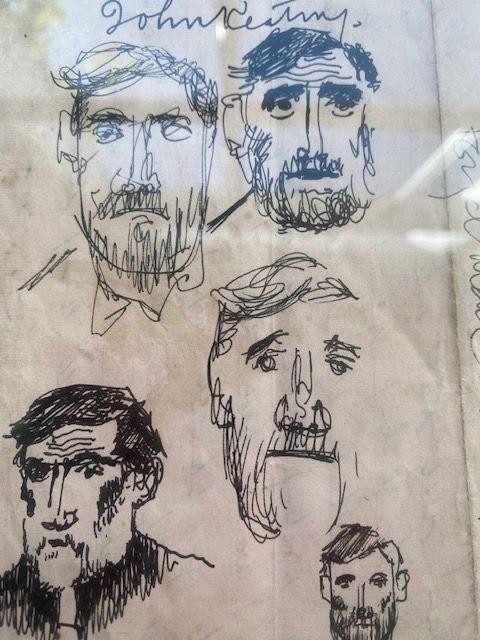
At this point I realised that my tutor was none other than Sean Keating, the most famous artist of the day and whose work I admired. He came over and looked at my drawing for a long time and pointing at various points of the model’s anatomy such as breasts and buttocks, delicately observed ‘You have got that thing there wrong, let me show you’. I got up and he sat down and drew over my amateur efforts. The trick lay in getting the cast shadows right – a lesson I have never forgotten.
The class was in two sessions and while the model was taking a break, I made some quick surreptitious sketches of Keating himself. He spotted me, came over and demanded to see them. To my delight he said ‘Not bad- I’ll sign them’. Interestingly he signed John rather than Sean.
The model returned, took up a new pose and we went back to work. It was an intense and exhausting session and when it was over my new classmates gathered around, introduced themselves and welcomed me. They suggested we go across to Brian’s the long-vanished student pub on the corner of Molesworth Street and South Frederick where we were soon joined by our model who was introduced to me as Audrey. Within minutes she and I were firm friends. The pints and the chat flowed but like Cinderella I had to leave the ball to catch the 6.30 back to Tullamore.
My mother was anxiously waiting for me on the platform. We sat down together in the waiting room and I will never forget her joy and amusement at my account of the day’s adventures.
The next few months were to be equally exciting and stimulating but then disaster struck.
A student magazine Yahoo published an opinion piece denigrating the family Rosary as a devotional practice. This made the national papers and at their January meeting the members of Offaly County Council expressed their disgust and resolving that no pure Offaly boy should be exposed to such filth in a radical institution like UCD, pulled my scholarship.
I was distraught but Brian Farrell who was the Bursar at the time assured me that the College would not press for fees and that the controversy would soon blow over. A generous benefactor gave me a temporary allowance to cover my digs.
At their Easter meeting the Councillors quietly reinstated my scholarship plus arrears.
I give out about Offaly County Council from time to time but not a day passes but I think about what my life might have been without its timely generosity and all is forgiven.
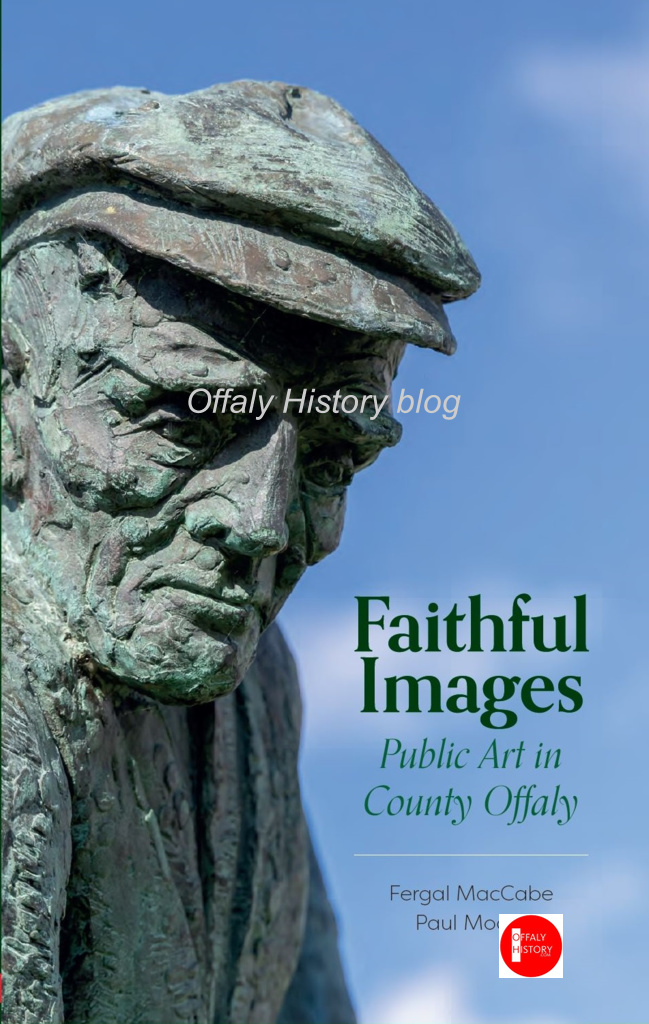
An example of giving back (ed.) Published in 2024 and available from Offaly History shop and online order.


