
No, it was not a blue raincoat but rather a Crombie of an unusual hue. Yet the wearing of it while dining in, not one but two Dublin hotels, was rejected by the headwaiters of such places. The set for this culinary tragedy was not the famous Restaurant Jammet, or the Royal Hibernian, but rather the Central Hotel and the Wicklow Hotel, both near enough to affluent Grafton Street but not haute cuisine for all that.

It was Danny Lynam of Church Road, Tullamore and for many years as director of P. H. Egan Ltd in Bridge Street, Tullamore who was the protagonist on behalf of our fellow countrymen. Lynam sought to establish the principle that he could wear his overcoat while eating in an hotel dining room. It was, he said, a very cold day on 13 January 1959, and besides wanting to keep himself warm he had important papers in the pocket of his protective garment. Anyway, he noticed women wearing fine fur coats and a few with duffle coats (then fashionable I suppose). In winning his court action and nominal damages (and costs of course) Lynam ‘shot to worldwide fame’. Lynam ought to have known about the duties of hotels because the company of which he was a director owned Hayes’s Hotel and Colton’s Hotel in Tullamore, and also Dooly’s in Birr. The latter hotel would also ‘shoot to fame’ because of Queen Elizabeth’s phone call in 1961 to Dooly’s seeking to talk to her sister Princess Margaret and getting the journalist, one Seamus Brady. It made his day. but a newsman colleague made some jokes about this famous old hotel in Birr for which Egan’s received damages from Newsweek a few years later. But to get back to our overcoat story as it emerged in the Dublin Circuit Court in December 1959 and reported at the time:
Tullamore Man Wins Action and Decrees Against Two Dublin Hotels
A Tullamore company director who brought an action for damages for breach of statutory duty in innkeepers to serve meals to travellers, against two Dublin hotels who, he said, had refused to serve him a meal because he declined to take off his overcoat, was awarded nominal damages of £5-5-0 [guineas in the Law Library] against each of the hotels by judge Ryan in Dublin Circuit Civil Court
Judge Ryan, who granted costs to the man and a stay of execution, said there had been an important principle involved in the case, which might be taken elsewhere. Daniel Lynam, Gayfield Tullamore, director of Messrs. P. & H. Egan, Ltd., Tullamore, brought his actions against the Central Hotel, Dublin, and the Wicklow Hotel, Dublin. The case was heard on Friday of last week. Giving judgement, Judge Ryan said the plaintiff was wearing an overcoat described as a Crombie of quite unusual shade and in good condition. It had been conceded that the day in question, January 13 last, was bitterly cold. The plaintiff stated that he had recovered from a recent illness and had been admonished to be careful of his dress by his doctor, and to wear a top-coat on long journeys.

DUFFLE COATS
He said that the plaintiff had sworn that in the Central Hotel he saw quite a number of ladies with fur coats on in the restaurant, and that there were some gentlemen wearing duffle coats at the tables. No evidence to the contrary had been adduced.
It was noticeable that in his direct evidence the plaintiff did not state that he informed the waiter in the Wicklow Hotel, as he had done in the Central Hotel, that he had been ill and that the day was very cold.
It had been argued that he was a traveller and that an inn keeper was bound to receive and entertain him unless he had some reasonable grounds for refusal, and that in the circumstances the wearing of this overcoat did not constitute sufficient grounds.
It had been argued that on behalf of the defendants that the plaintiff never stated in evidence that he informed the waiter in either premise that he was a traveller. He did not accept this proposition.
DISCRETION
“I accept the proposition that a hotel in a capital city is allowed by law a pretty wide discretion as to rejecting guests that are not suitable,” said Judge Ryan, “but landlords must not exercise their discretion capriciously or maliciously.”
In the case of the Central Hotel no defence lay on the evidence before him. The uncontradicted evidence was that other guests were being received and offered a meal whilst attired in duffle coats, and in the case of ladies, fur coats.
Plaintiff’s evidence was also uncontradicted when he stated that he informed the waiter at the Central Hotel, that he had been very ill, the day was very cold and he had valuable papers in the pocket. He (the Judge) was satisfied that the Central Hotel could not succeed in their defence. As the plaintiff merely sought to uphold a principle, he assessed nominal damages at £5-5-0. With regard to the Wicklow Hotel, the Judge said the position was not so clear, in view of the plaintiff’s testimony that he was not sure whether he told the waiter that he had an illness recently or that the day was cold. He accepted the head waiter’s assertion that he was not informed of that illness, but the head waiter had admitted that the day was bitterly cold.
A notice in the Wicklow Hotel requesting customers to leave their coats in the cloakroom did not, in his opinion protect the proprietors.
REGRETTABLE
It was regrettable that such an uncompromising attitude was shown. No thought was seemingly given to the possibility of unusual circumstances.
It was suggested to the plaintiff in cross-examination that he would not wear an overcoat in leading London hotels. The plaintiff stated that he had done so on occasions.
Whether he did or not was, in the judge’s view, not very material, because it should not be overlooked that Dublin, unlike London, was the capital of an agricultural country.
In the special circumstances of this case he had come to the conclusion that the defendant’s attitude was not reasonable. He awarded nominal damages of £5-5-0 for the same reason as in the other case.
The Judge certified for Circuit Court costs.
Daniel Lynam, Tullamore, died in May 1961
Danny Lynam died in May of 1961 more than two years on from the sartorial jousts in the Dublin hotels. He was 65 years old and a member of one of the oldest families. He was survived by his wife, Mrs Lily Lynam, his brother, Mr. James Lynam, and three married sisters. Lynam had been ‘for very many years past one of the Directors of Messrs. P. & H. Egan, Ltd., Bridge House, Tullamore, and its subsidiary companies. He had been associated with the Company from his boyhood days. He was an exemplary Catholic and a member of every parochial organisation in an active capacity. He was a man of great business and acumen and remarkable energy, being absolutely fearless and forthright in the expression of his views. In recent years he attained world-wide fame in his successful action against a well-known Dublin Hotel in the assertion of a principle—the right to wear an overcoat while eating, or being served with a meal in the public dining room. He was plaintiff in the action and the case earned world-wide publicity, a thing from which he naturally shrank. His manly stand evoked admiration in many lands and for months afterwards he was the recipient of letters and telegrams of congratulation.’
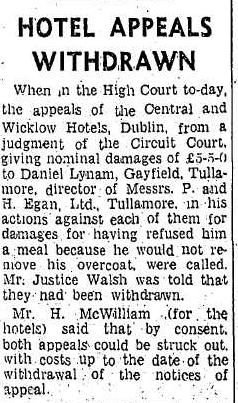
The hotels appealed to the High Court but Danny Lynam was not for turning and won his costs to the point of the withdrawal of their appeal.

