The Birr Weekly Journal: Birr’s first local newspaper, sidelights on the hazards of retailing in 1774. Michael Byrne. Offaly History blog no. 803 26 June 2026. Birr’s newspaper publishing tradition began in earnest 181 years ago with the issue of the King’s County Chronicle by Francis Sheilds of Emmet Square (or Duke or Cumberland Square as it then was). It was staunchly Protestant and unionist and grew out of the Leinster Express, first issued in 1831. The latter was intended to serve the counties of Kildare, King’s and Queen’s (Laois). Sheilds saw an opportunity and set up the Chronicle in Birr in September 1845. It was not the first Birr newspaper nor would it be the last. For the Midland Tribune was founded in Birr in 1881 as an antidote to the Chronicle’s unionism and Orangeism. The Chronicle spawned titles to gather in sales and advertising in Roscrea and Tullamore. The Tribune did likewise for Nenagh and Portumna, but its most important offspring was the Tullamore Tribune established in 1978. But what about Birr’s first local paper.
On Thursday 23rd April 2026 the new, changed, developed, market house in Portarlington’s square was formally opened, following over a year’s work on the structure to commence a new chapter in its long history. The new occupier is the Portarlington Community Development Association, and the building has become available, for gatherings, conferences, presentations. There is no doubt this is a construction for specific purposes.
And the building has two names: market house, though there is no longer a market; and tholsel, a name given to municipal buildings in Ireland where tolls and dues were collected. Tholsels had an authority in a town, and usually hosted corporation bodies. Notable examples of tholsels in Ireland may be found at Carlingford, Clonmel, Kilkenny and Youghal. In other locations tholsels have been changed into other uses, or gone to demolition, such as that in Mountrath.
My very first memory is of waving goodbye to a man who was on his way to the scaffold.
I was just three and was frightened by the noise and smoke of the steam train and the hubbub created by a large crowd but was totally unaware of the reason for it all.
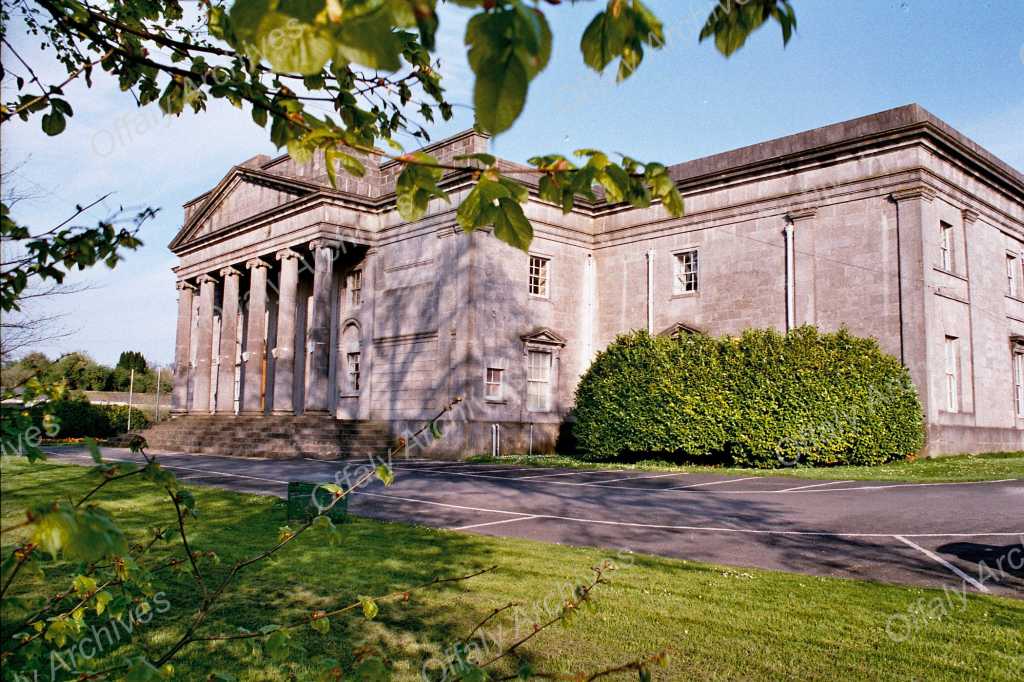
The Tullamore courthouse
Barney Kirwan
I was with my mother and her friend Tessie Leonard who had brought me along with them –together with half Tullamore – to wave goodbye to Rahan man Barney Kirwan who was being brought to trial in Dublin accused of having chopped up his brother, following a dispute over property and then burying the pieces in a nearby bog. Barney was now being transferred from Tullamore railway station to Mountjoy Gaol to await a high-profile trial whose guilty verdict he would challenge.
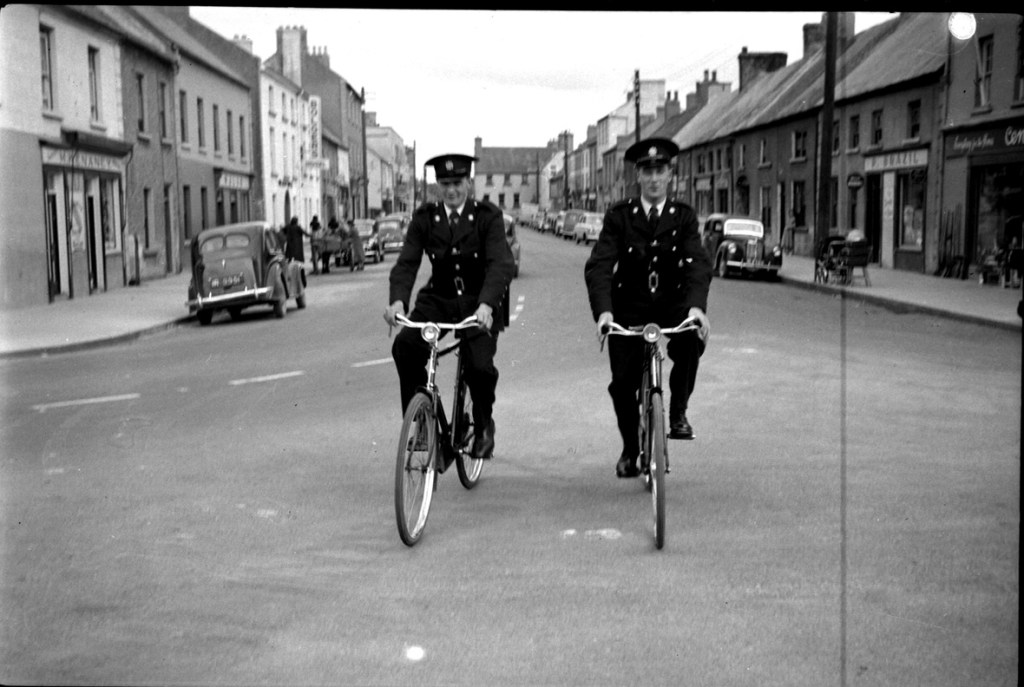
On the bikes in Kirwan’s time at Patrick St, Tullamore.
Following an unsuccessful appeal to the High Court he was hanged on 2 June 1943. Brendan Behan who was in Mountjoy on Republican charges at the same time would make the event famous with his play ‘The Quare Fellow’ in which Kirwan is the unseen but central character.
The last hanging in Ireland was in 1954 and the brutal practice was terminated in 1990.
A Threat to Tullamore
I was born three days after the outbreak of the Second World War and was therefore quite oblivious of its progress and significance. This was to dramatically change on the 23rd January 1944 when a massive American B‑17 Flying Fortress which had taken off from Goose Bay, Newfoundland, bound for RAF Prestwick in Scotland, developed engine trouble over Northern Ireland
Its crew of ten parachuted to safety over Enniskillen. Before leaving the aircraft, they had set the now unmanned bomber on a course back toward the coast, hoping it would continue flying until it ran out of fuel and would crash harmlessly into the sea.
However, the prevailing winds shifted the aircraft off its intended path, carrying it further inland rather than out toward the coast. The unmanned bomber (luckily without a lethal load) remained aloft, flying on without its crew, but began gradually to lose height as it flew over the Irish Midlands. Its flight path brought it over Edgworthstown, west of Mullingar, over Kilbeggan and heading straight for Tullamore.
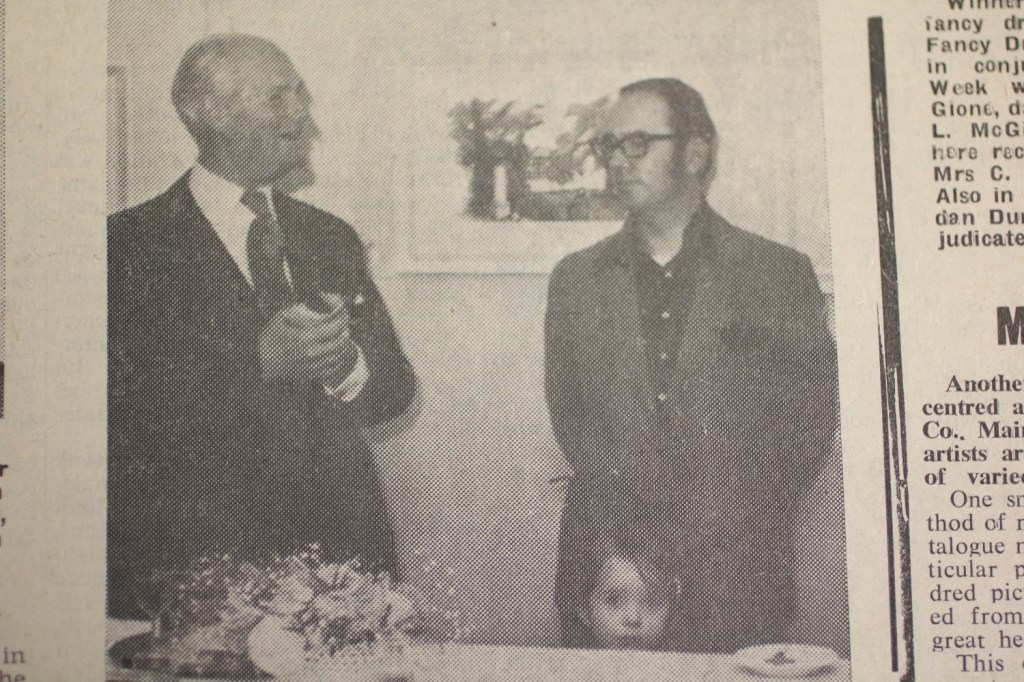
Fergal MacCabe (right) at one of his art exhibitions in 1972 and attentive to the comments of the sixth earl of Rosse.
This created an emergency which was transmitted by alarm calls over Radio Eireann. The prospect of its crashing near, or even on, Tullamore caused great excitement. I remember standing in our yard and seeing it drifting slowly and silently over the town at a low level. It disappeared over Ballard bog. We waved it on its journey and hoped Portlaoise would not be its final destination. Eventually it crashed harmlessly in fields half a mile from the village of Johnstown in Co. Kilkenny.
In 1947 I asked my brother Tommy how the war was getting on. So far as I knew there had always been a war. I was quite surprised when he told me it had concluded two years previously.
A Big White Wedding – Williams and O’Reilly
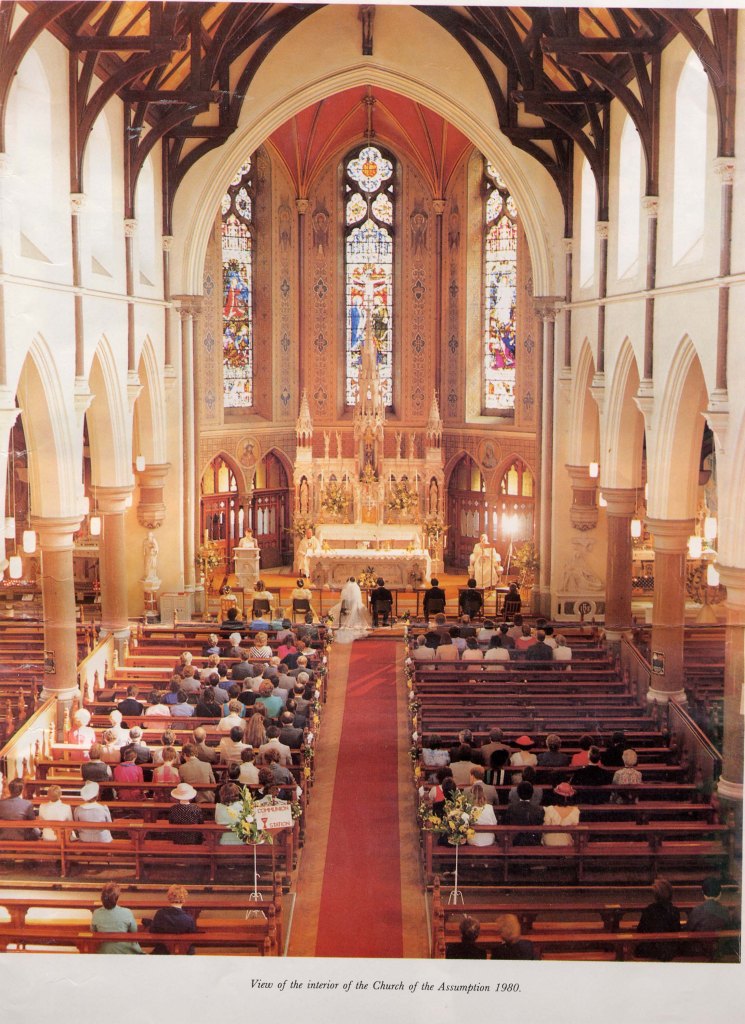
The old Tullamore RC church of 1906-83
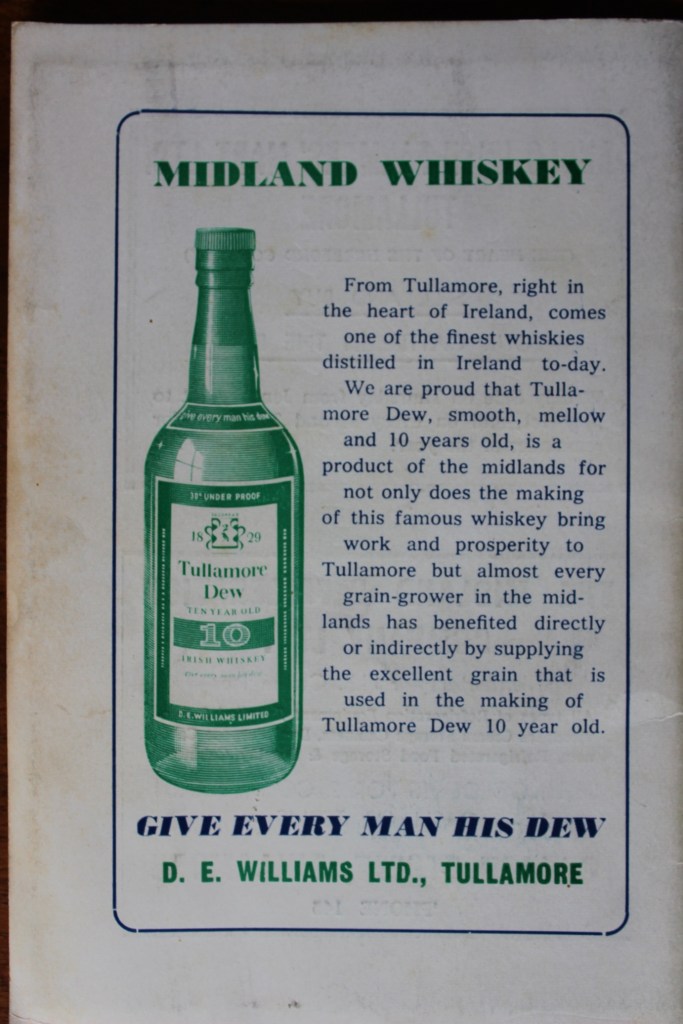
Tullamore Dew and Powers
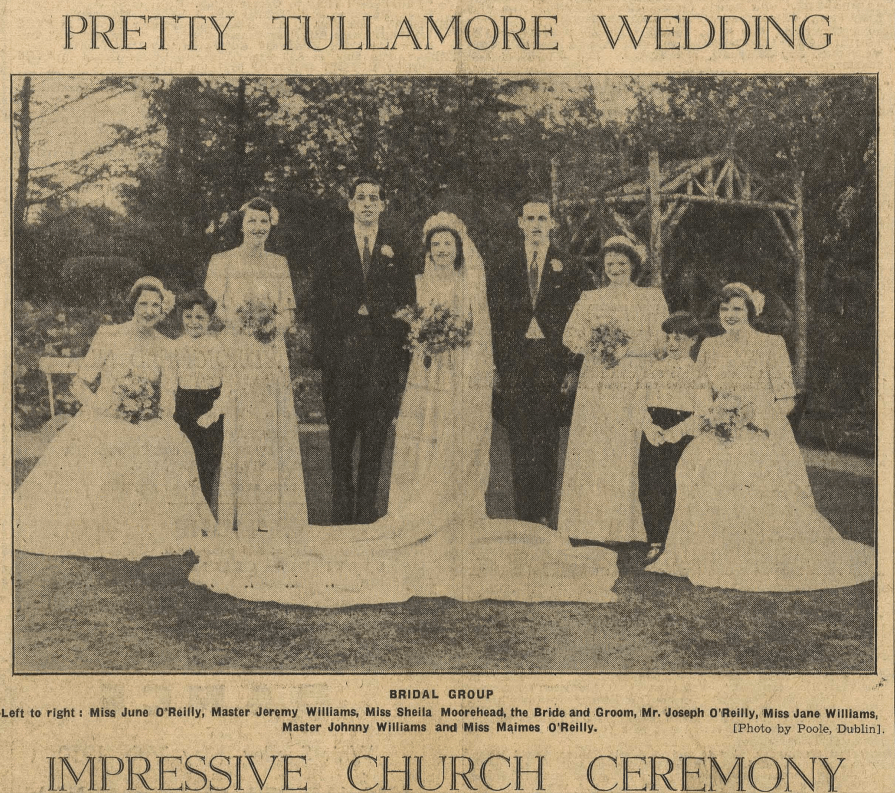
But the event which made the greatest impact on me was the wedding in 1950 of our next door neighbour Teresa Williams to Frank O’Reilly (1922–2013) of Powers Distillery.
The excitement, glamour, fashion, music, food and general gaiety which it generated stimulated my young imagination and had a beneficial effect on the town of Tullamore which in those dreary days desperately needed a diverting public spectacle.
Though wealthy, the Williams family lived very modestly, their only public luxury being a beautiful dark blue Chrysler limousine.
The engagement of their eldest daughter to the handsome Frank O’Reilly who had returned from service in the British army during the Second World War to take over his family business of Powers Distillery, was not just a love match (they went on to produce ten children) but the linking of two great Irish distilling families. No expense would be spared therefore to mark the great occasion and a three-day gala was planned. For Tullamore it would be a huge event and everyone was excited by the glamour of it all.
The Williams O’Reilly wedding with a young Jeremy Williams on the left (see an earlier blog).
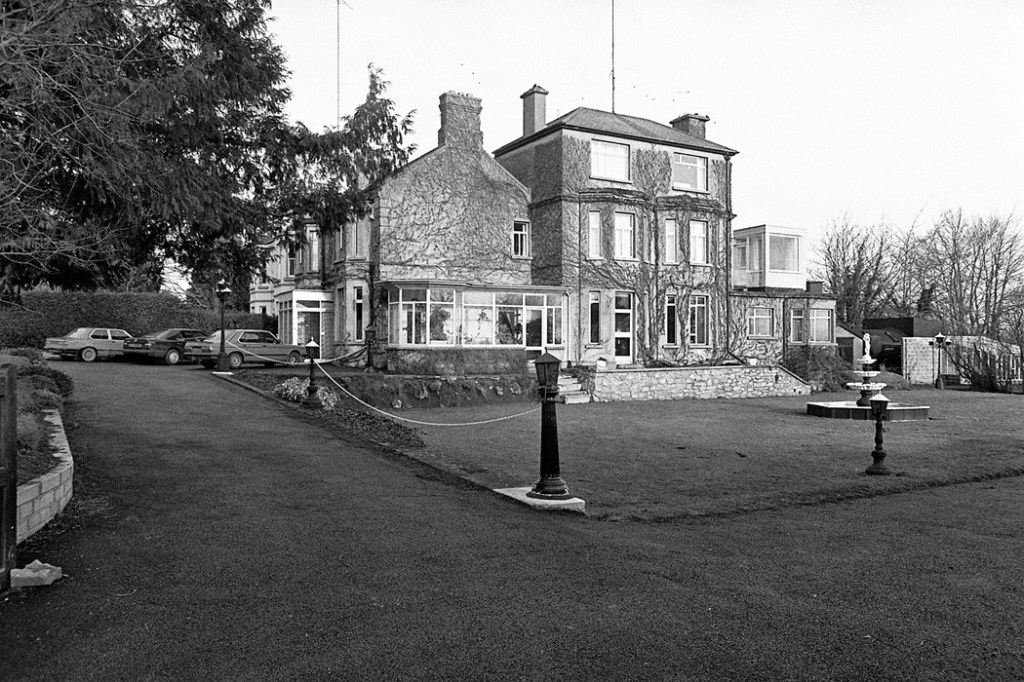
I lived with my mother and brother in my grandparents house ‘Innisfree’ (now Loughmore Lodge) which was semi-detached with the Williams residence ‘Auburn’ owned by Captain Jack. The property had been much extended and additional land acquired to provide a magnificent south facing lawn and tennis court.
Scene of the wedding breakfast. Auburn then the home of John and Mrs Williams (nee Moorhead).
In the run up to the great day tents began to be erected in the grounds to accommodate three days of festivities. On the first evening there was a spectacular fireworks display-the first I had ever seen.
The following day all of Tullamore went to the Church of the Assumption and crowded outside to greet the bride and her six bridesmaids and to witness the first white wedding in Tullamore since 1939.
The imposing west door of the church (now sadly blocked up) made a magnificent backdrop for the emerging bride and groom and I remember confetti being thrown and the bridal bouquet tossed in the air to be grabbed by a scrum of enthusiastic young women.
The bridal party then proceeded to Clonminch where a reception and dinner were provided by caterers brought from Dublin for the occasion. All us neighbouring children gathered on the flat roof of our shed which overlooked the kitchen where the feast was prepared and from time to time we were fed titbits. I savoured the unfamiliar tastes of lobster, pate and rhum baba.
The dancing under the fairy lights continued all night and in my bedroom I could hear it until I went to sleep. It was magical.
On the third day a party was thrown for the staff and employees of the two distilleries whose owners were now united in marriage and the gaiety continued well into that night too.
Then the tents were folded, the caterers cleaned up and departed and Tullamore got back to normal. But the wedding had brought a welcome interlude of glamour at the beginning of a decade that would be marked by further economic decay and emigration.
The Tullamore Dew whiskey of the late 1950s – ten years old and a child for every year in the Williams O’Reilly household.The brand was sold in 1965 and yes the sum was £10,000. For an excellent Life of Frank O’Reilly see the online Dictionary of Irish Biography, written by Tullamore man Terry Clavin [Ed].
Thanks to Fergal MacC for these memories and more to come we hope.
A Prima Donna in King’s County/ Offaly, Dame Nellie Melba 1861-1931. By Aidan Doyle.
Melbourne, February 26 1931-
The usually busy streets of Melbourne were hushed today when Britain’s “Queen of Song” Dame Nellie Melba, was taken in a simple farm cart on her last journey to her beloved village of Lilydale, 20 miles from Melbourne not far from her own beautiful home, to be buried by the side of her father. Australia’s last respects were paid by thousands of people who reverently lined the route of the funeral cortege from the Presbyterian Church to the cemetery, and the world’s tributes were represented by a mountain of wreaths from mourners in every corner of the globe. Throughout the early part of the morning crowds filed past the coffin in the Presbyterian Church in which the famous singer lay in state, and in which as a girl she used to sing in the choir. When the memorial service began every pew was packed. The Federal and State Governments and the worlds of music and art were fully represented. Dr. Borland, State Moderator, conducted the service which was fully choral. “Our sorrow and sympathy” he said in a striking tribute to Melba” are shared by millions in every land who feel grateful that God raised up in our nation for the benefit of the whole world the gifted singer they mourn. 1
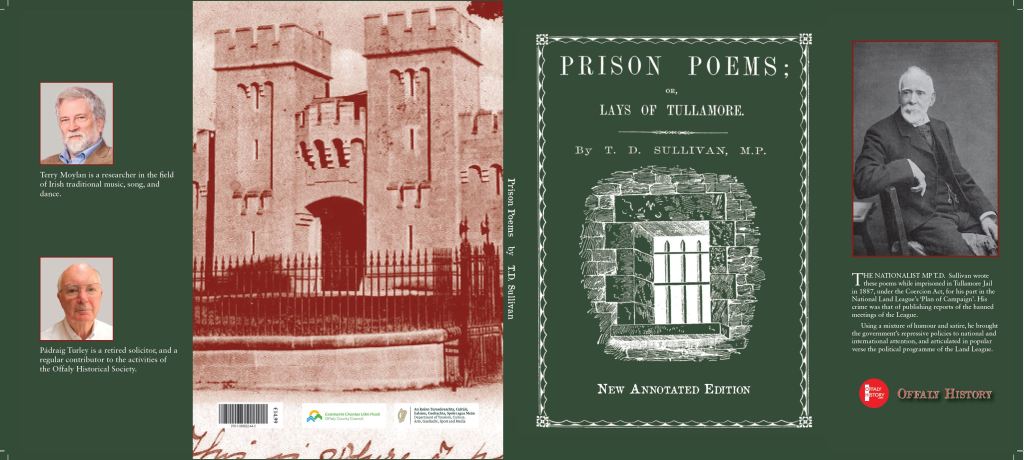
28 March Saturday at 11.00 a.m. at the former Tullamore Prison/Kilcruttin Business Park, Cormac Street, Tullamore, for the Launch of anew edition of Prison Poems or Lays of Tullamore by T.D. Sullivan, edited by Terry Moylan and Padráig Turley. Sullivan like William O’Brien and John Mandeville were political prisoners who refused to wear the prison clothes.
See Cormac Street from a new perspective
Jacket of the new edition of Prison Poems
Today we are reminded of the jail every time we stop at the lights at the junction with Cormac Street, Kilcruttin and Charleville Road and look to the magnificent limestone façade, memorial tablet, jail warders’ cottages and the very fine gates with their Roman fasces to remind us of the symbols of authority back to early times. Then who has not heard of the underground passage (now mostly closed off) that allowed the prisoners to be brought into one of the two semi-circular courts in the old pre-1922 courthouse.
The new edition of Prison Poems or Lays of Tullamore by T.D. Sullivan, now edited by Terry Moylan and Padráig Turley, will be launched on Saturday 28 March at 11 a.m. at Cormac Street entrance to the old prison. Coffee will be available from 10 a.m. at Tullamore market Spollanstown to the rear of the old prison, now Kilcruttin Centre.. Parking is available at the farmers’ market, Spollanstown and at the Cormac Street frontage to the old jail (best approached from Cormac St to take a left turn into the jail/Kilcruttin Centre). Pedestrian access only will be available from the market to the front of the jail from 10 to 12 noon The book can be ordered online from Offaly History or purchased on the day or later at Offaly History Centre and Midland Books.
28 March Saturday at 11.00 a.m. at the former Tullamore Prison/Kilcruttin Business Park, Cormac Street, Tullamore,
The plan is to meet in the farmers’ market, Spollanstown for coffee from 10 a.m. and process at 10 45 to the front hall of the jail for the launch. Tony Flanagan has kindly sponsored the coffee in the market and OH will distribute a voucher ticket to those attending the book launch.
The book will be launched by Michael Hanna who gave the lecture in December 2025.
The launch should take about thirty minutes.
The speakers are:
Chair of Offaly History Shaun Wrafter welcomes the speakers
Padraig Turley, a co-editor, on the author T.D. Sullivan
Terry Moylan, co-editor, on the Poems
Delcan Harvey Cathaoirleach of Tullamore Municipal
Michael Hanna to launch – on the jail, medical men and the new book. Michael Hanna is the author of Irish General Practice: the long story. He spoke on medical doctors at Tullamore prison in the 1880s in the course of his lecture to Offaly History in December 2025.
Michael Byrne, General Secretary Offaly History, to close and thanks to all.
[Before moving to the article Offaly History wish to congratulate the authors/editors on the issue of the new annotated edition of Prison Poems; or Lays of Tullamore from Terry Moylan and Pádraig Turley and published by Offaly History with the support of the Decade of Commemorations funding. The book is now on sale and is available from Offaly History Bury Quay and online at www.offalyhistory.com. Ed.]
Timothy Daniel Sullivan MP and Lord Mayor of Dublin published Prison Poems; or Lays of Tullamore in 1888, printed by The Nation at 90 Middle Abbey Street, Dublin. What are these about? What made Sullivan write them?
T.D. Sullivan was one of the most high-profile political figures to be targeted by the London administration under the Crimes Act for publishing what they considered dangerous material that could incite opposition and violence against the police from carrying out their duties of evicting tenants who were unable to pay their rents. The Irish National League was established with the aims of bringing about the end of rack-rents (extortionate rents) and ownership of the soil by the occupier and a nationwide fund was in place for several years to prevent as many evictions as possible. However, publicising this opposition and encouraging the people to come together in the newspapers now placed a target on the backs of editors who began to be arrested and imprisoned for encouraging the ‘Plan of Campaign’ and Sullivan was the latest editor to be arrested and conveyed to the notorious Tullamore Jail. He arrived in Tullamore on December 7 1887 and upon his arrival met the Governor of the Prison, Captain Fetherstonhaugh, who was extremely frosty in his reception to such an illustrious new inmate and Sullivan was astonished to learn that despite his being regarded as a first class misdemeanant, he would be sharing a cell with other inmates. The Tullamore Town Commissioners were immediately on the ball to try and make contact with the political prisoners now incarcerated and to assess their wellbeing in this institution that gained notoriety for its deplorable unsanitary conditions and the treatment of the prisoners subjected to hard labour.
This is part three of a four-part blog on the 1835 Poor Law Inquiry into the baronies of Philipstown Upper and Lower. The respondents to the questionaries for Philipstown/Daingean were Rev P. Rigney and Roger North. Roger North was a landowner in King’s County. He inherited the Kilduff estate upon the death of his father, Roger North, in 1830. He was involved in estate management, including raising rents, which made him unpopular with local farmers and other landlords.[1] North was shot dead in 1850.
Transcripts of the Poor Law Reports – ContinuedThe questions raised by the Poor Law Commissioners for the local respondents are in the column on the left
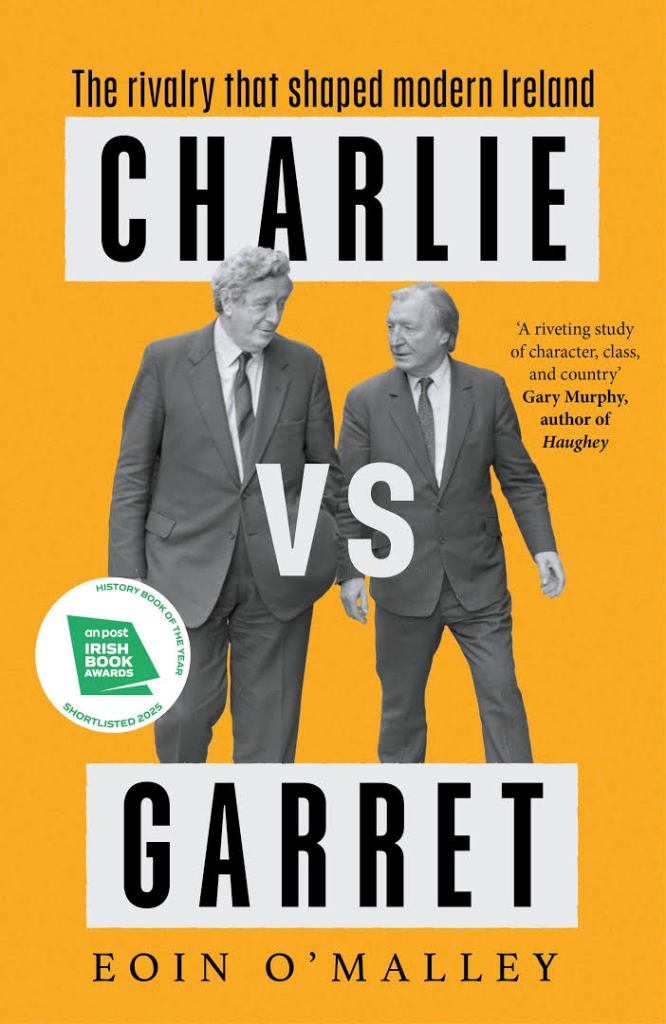
Today we mark the 100th anniversary of the birth of that hugely popular politician Garret FitzGerald. An intellectual in politics he was greatly respected in Ireland, Britain and Europe. Recent estimates such as that of Eoin O’Malley’s Charlie vs Garrett (2025) have not been so flattering to his handling of the economy in the 1980s. And yet his achievements and those of John Bruton have underestimated their roles in bringing peace to Northern Ireland.
FitzGerald, according to the DIB life by Patrick Maume (summarised here) was one of the most influential Irish political figures of the late twentieth century, known for his intellectualism, his commitment to European integration, and his efforts to modernise Irish society. Born in Dublin to the prominent revolutionary and cabinet minister Desmond FitzGerald and his wife Mabel McConnell, Garret grew up in a household steeped in politics, culture, and international connections. His parents’ mixed religious backgrounds—his father Catholic, his mother Protestant—shaped his lifelong interest in reconciling Irish identities and overcoming sectarian divides.
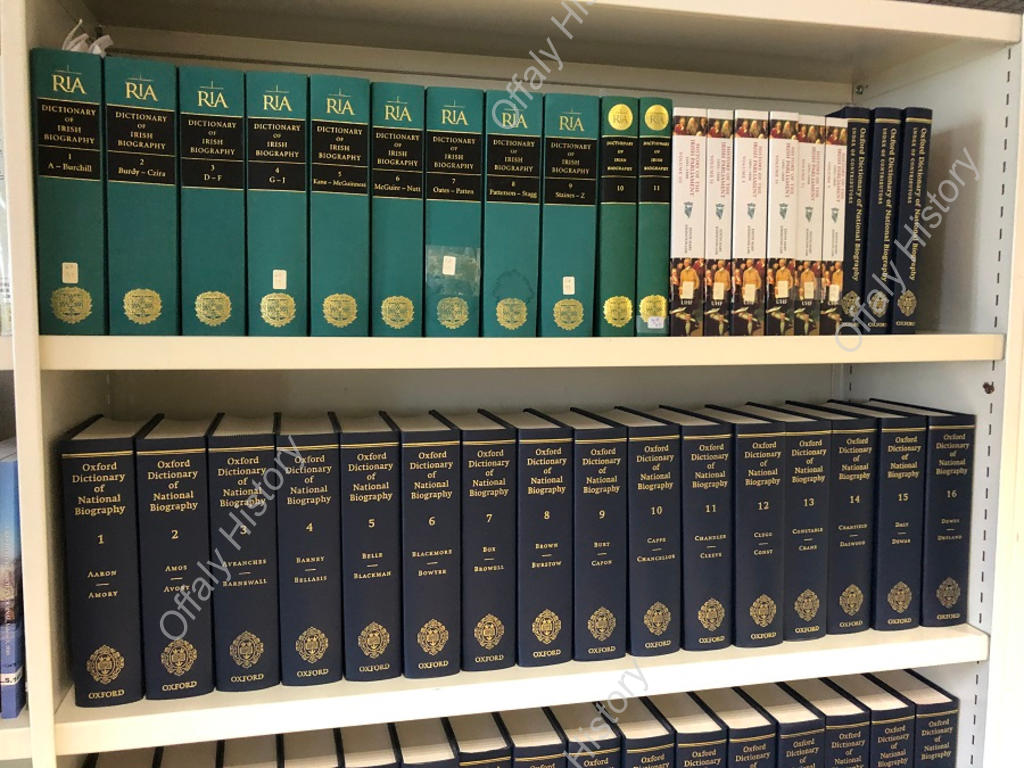
The DIB (above in green binding) runs to eleven printed volumes and is now online and free to use – a wonderful resource.Pic from Offaly History Centre.(more…)
As mentioned earlier there are many histories of hurling in recent times, particularly county and local club histories. A major and broad history of hurling, Scéal na hIomána was produced by Brother Liam Ó Caithnia in Irish and was published in 1980, but was left largely unappreciated for decades. Ó Caithnia’s history was an exhaustive work, the definitive historical account, written initially as an academic thesis, 826 pages long, written in dense Irish with a small print font and included references and appendixes. Over a dozen mentions of Co. Offaly are to be found in the Scéal.

 offalyhistoryblog