
A Prima Donna in King’s County/ Offaly, Dame Nellie Melba 1861-1931. By Aidan Doyle.
Melbourne, February 26 1931-
The usually busy streets of Melbourne were hushed today when Britain’s “Queen of Song” Dame Nellie Melba, was taken in a simple farm cart on her last journey to her beloved village of Lilydale, 20 miles from Melbourne not far from her own beautiful home, to be buried by the side of her father. Australia’s last respects were paid by thousands of people who reverently lined the route of the funeral cortege from the Presbyterian Church to the cemetery, and the world’s tributes were represented by a mountain of wreaths from mourners in every corner of the globe. Throughout the early part of the morning crowds filed past the coffin in the Presbyterian Church in which the famous singer lay in state, and in which as a girl she used to sing in the choir. When the memorial service began every pew was packed. The Federal and State Governments and the worlds of music and art were fully represented. Dr. Borland, State Moderator, conducted the service which was fully choral. “Our sorrow and sympathy” he said in a striking tribute to Melba” are shared by millions in every land who feel grateful that God raised up in our nation for the benefit of the whole world the gifted singer they mourn. 1
From her operatic breakthrough at Brussels in 1887 until her death at Sydney in 1931, soprano vocalist Melba had been an international superstar performing sell out shows across the world. As thousands queued to pay their final farewell for the most famous woman in Australia, few if any among their number would have realised that almost 45 years before that the ‘Queen of Song’ had taken small steps on the road to stardom, entertaining modest crowds in the Irish Midlands.
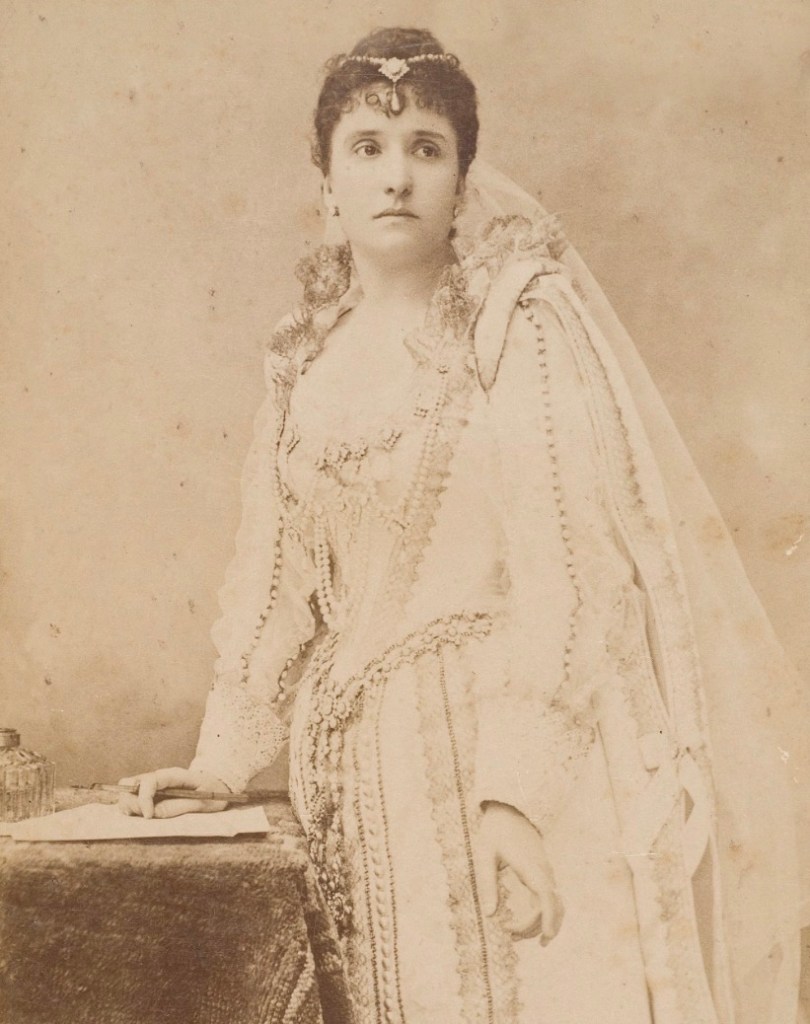
It is a long story and one which had its roots in Scotland. David Mitchell was the son of Scottish tenant farmers. Emigrating to Australia he soon became Melbourne’s premier building contractor. In time his business interests would include brick yards, gold mines, quarries, factories, vineyards, and extensive farming. In 1856 he married Isabella Dow and Helen ‘Nellie’ Porter Mitchell was born in 1861. 2
The Mitchell home was a musical house and Isabella tutored Nellie and her sisters from an early age. At school Nellie continued her education in things musical particularly the piano.3 Having completed her formal education, she accompanied her father to Mackay, Queensland where he had been contracted to build a sugar mill and it was there, she met Charles Nesbitt Frederick Armstrong.
The Armstrong family traced its roots to the Debatable Lands, where between the 14th and 17th the Border Reivers exploited the confused political situation to carve out a power base and fortunes, raiding for cattle and extorting black rent during the Anglo Scottish Wars. With the death of Queen Elizabeth I, James VI of Scotland assumed the English throne and the Debatable Lands became the Middle Shires with less opportunities and even less tolerance for the banditry of the Reivers. Simultaneously, across the sea in Ireland, the Flight of the Earls and the Plantation of Ulster provided new opportunities and members of the family began to settle in county Fermanagh. As the 17th and 18th century progressed, Charles ancestors expanded their property portfolio into the midlands. With manor houses constructed at Ballycumber, Banagher, and Gallen Priory, the Armstrongs became pillars of the landed establishment in King’s County.
Sir Andrew Armstrong of Gallen served as a Liberal member of parliament throughout the eighteen forties, but as was so often the case the family was overextended financially. In the aftermath of the Famine, there were widescale evictions on his holdings to facilitate the sale of land in the Encumbered Estates Court and he spent much of the eighteen fifties in Britain. Andrew was 72 when his son Charles was born at Sussex in 1858. 4

Five years later, Gallen and the remaining property passed into the hands of Charles’ brother the Rev. Edmund Armstrong. As the youngest of 13 children from an aristocratic family on the wane, Charles’s found his options somewhat curtailed. It has been suggested that he spent some of his formative years as a merchant seaman, but by the eighteen seventies he had followed the path of many improvised gentry and set out for Australia. His sister Frances had married into the Bell family of Jimbour, Queensland. Originally from Kildare, the Bells had amassed power and wealth squatting on the Darling Downs. Charles spent some time learning the ropes his relations, before striking out to make his own fortune buying horses and driving them north to sell at Mackay. 5 In his spare time Armstrong competed as a prize fighter and at some point, acquired the moniker ‘Kangaroo Charlie’.
The exact details of Nellie and Charles first meeting is lost to time, but they were soon engaged. The courtship was not without difficulties, but the couple were married in December 1882 at St. Anne’s Presbyterian church, Brisbane. The Armstrongs had one son: George, born in 1883. Charles wrangled a job managing the sugar mill his father-in-law had constructed; but Nellie found conditions at Mackay primitive to say the least…
My husband lived in the heart of the Bush, as the manager of a sugar plantation in Port Mackay, and it was there, after our honeymoon, that we retired. We had a little house with a galvanized iron roof, desolate and lonely, with no other company than that of the birds and especially of the reptiles. Soon after we arrived it began to rain; and rain in Queensland is rain indeed. It rained for six weeks. My piano mildewed; my clothes were damp; the furniture fell to pieces; spiders, ticks, and other obnoxious insects penetrated into the house – to say nothing of the snakes, which had a habit of appearing underneath one’s bed at the most inopportune moments. It rained and rained, a perpetual tattoo on the roof 6
Nellie had always been musically inclined but returning from Mackay to the city, she began to focus on establishing a successful singing career. She received tutelage from the vocalist Pietro Cecchi who introduced her to the different Italian operas and debuted at Melbourne Hall in 1884. Reviews were positive and just as importantly her new career provided an income, but full-blown stardom remained elusive. In 1886, when David Mitchell was appointed commissioner of a Colonial Exhibition in London, the Armstrongs upped sticks and departed for Europe. The trip allowed Charles to introduce his wife to her in-laws. After meeting the Dowager Lady Armstrong in England, the couple travelled to Ireland. Charles enlisted as an officer in the Leinster Regiment, while Nellie spent much of the Summer as a guest at Gallen Priory. 7
The young Australian Mrs. Armstrong became a popular feature at all social events held at local country mansions, especially after her vocal capabilities became apparent. Famously while staying at Dooly’s Hotel, in Cumberland Square Parsonstown, she sang from her window to entertain a crowd assembled in the square below. Years later the diva would recount with uncharacteristic modesty…
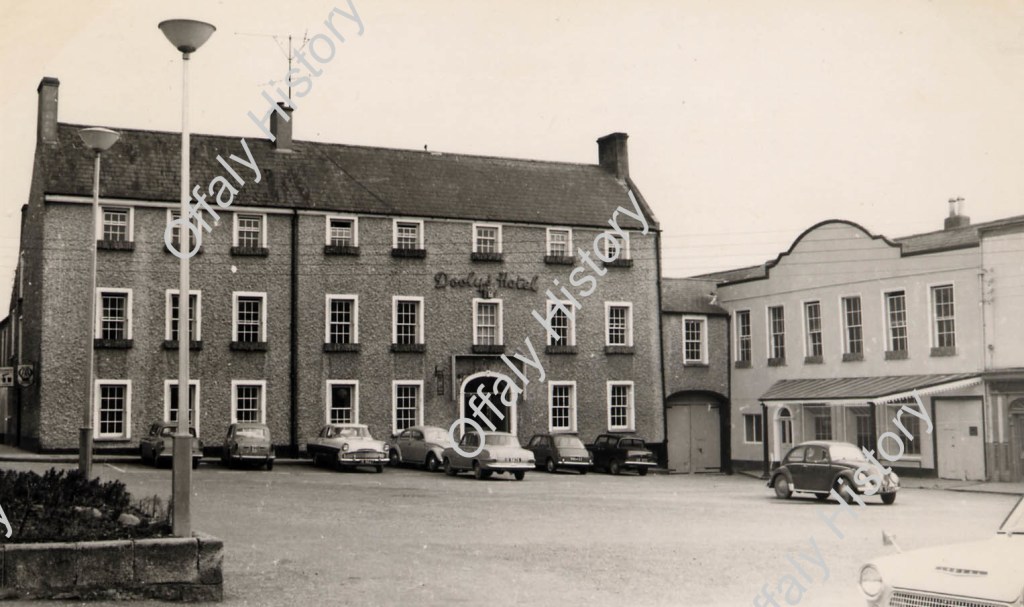
When I had first gone as an unknown and struggling singer to Ireland to visit my husband’s relations. In those days I had been to them merely “Charles’ wife”, a strange and wild colonial girl who needed a certain amount of explaining in so proud a family as the Armstrongs. And another memory I had was of singing in the open square on a drizzly afternoon at a concert in Birr and being well routed in popular favour by the village belle, a strapping lass with red ribbons in her hair. 8
The prima donna’s talents were well recognised in Parsonstown as can be seen from the Kings Chronicle County’s review of her performance at a charity concert in aid of Cree national school…
But the thrilling part of the feast of sound was reserved for Mrs. Charles Armstrong, the daughter, we believe of an opulent Melbourne gentleman, and sister-in-law of the Rev. Sir Edmund Armstrong, Bart., one of our kindest local landed proprietors. What shall we say of her, feeling as we do still spell-bound? Her voice is worthy of the choicest orchestral accompaniment, and she had that distinction which is the first of its kind that we remember ever to have heard in Parsonstown. “Sing sweet bird” was her selection and better there could not have been nor yet a more superb voice for the imitation of the tiny lark that sends its carols to the sky. As she descended from the highest range the strain on her powers must have been severely taxed; for in the breathless silence with which the audience listened the slightest discordance- the minutest foreign strain- would have been fatal to the naturalness of the effect. But this extraordinary singer evidently knew her strength, and so her clear seashell like tones were sustained. As the last note died away the staid and the sedate, … in one spontaneous roll of encoring which we never heard surpassed in earnestness and this their applauding tribute of supreme delight was rewarded by another song. “Bid me goodbye” by Tosti, which went to prove yet more cogently that Australia has given a daughter to the circle of voices that might be counted with the five quarters of the world that have given them birth. In the second part Mrs. Armstrong sang “Dear Heart” with such bewitching effect that it seemed possible she could do almost anything with her enchanting soprano powers; but what she could not do was to pacify or satisfy her hearers whose covetous ear were strained for more; and when she sang, in compliance with the last encore, “Home sweet Home” the charm was almost complete; and the proof was there that some old songs were like old China, which only connoisseurs knew how to arrange. In the instance under observation nothing could exceed the trueness of the deep sympathy given out with a melting sweetness that seemed coming laden with the balm of some celestial messenger. We have heard now of prima donnas receiving immense salaries per night, but till now we thought the tale needed to be received “cum grano salis”, but after hearing Mrs. Armstrong we confess to be ready to believe anything about big prices, as such a voice would in our humble judgement, be worth almost any price that could be possibly afforded. We now part with regret from the topic, and we are sure also that a similar emotion will arcuate others when they learn that she shortly returns to a distant land “ten thousand miles away” but while memory lasts it will be acknowledged that one concert has been stamped with immorality in Parsonstown- and that is the concert of the 13th of August, 1886; and all who took a part in it will be justly proud of the connection 9
Such encouragement was no doubt welcome, but it was not to replicated in London, where Nellie found few opportunities to showcase her talents. Undeterred she set sail for Paris, where she blossomed under the training and patronage of Mathilde Marchesi. She adopted the stage name Melba in honour of her home city. Her performance, in Rigoletto in Brussels proved a triumph. By 1888 she was appearing at Covent Garden in London. La Scala in Milan and the Metropolitan in New York followed as Mrs. Armstrong of Mackay became Melba international super star. 10
As the eighteen nineties progressed and Melba’s popularity grew, she found herself performing in front of Queen Victoria, the Tsar of Russia, the German Kaiser, and the Emperor of Austria- Hungary. The Melbourne born singer was a gifted social networker, making friends among Britain’s rich and titled elite. Melba was an admirer of old-world nobility and in many cases the respect was mutual, but the notoriety around her relationship with one aristocrat would result in the much unwanted publicity The Armstrong’s marriage had been an unhappy one and Melba would later state that her husband had been physically abusive. The couple had effectively separated in the aftermath of Melba’s Brussels success. As the singer’s tour crisscrossed Europe, a new admirer, Phillippe the Duke of Orleans followed in hot pursuit. In 1891, Armstrong filed for divorce and named Orleans as a co-respondent. The case created something of a scandal, as Bourbon Royalists intent on restoring the monarchy viewed Phillippe as the legitimate heir to the French crown. A compromise was reached, and it was reported…
Madame Melba, the Australian prima donna, and her athletic colonial husband, Captain C F Armstrong, alias “Kangaroo Charlie”, have arranged their little marital differences and agreed to separate without seeking the services of their lordships of the Divorce Court. So that the faithful remnants of the adherents to royalty in France will not be scandalised by the appearance of the heir to the throne in the unenviable character of co-respondent. 11
In the aftermath of the scandal, Phillippe or his advisors decided that further publicity should be avoided at all costs, and the duke decamped to Africa on a two-year safari. Melba revived her hectic touring schedule and in the years that followed continued to enthral Covent Garden and the various royal households of Europe. Charles Armstrong emigrated to the United States, taking the couple’s only child George with him. On reaching maturity George left America and re-joined his mother’s entourage. In 1900, after the divorce was finally formalised in Texas, Charles travelled west to operate a ranch outside Klamath Falls in Oregon. He spent the latter years of his life at Lake Shawnigan in British Columbia and died there in 1948. 12
Never one to rest on her laurels, Melba found new avenues for her talents. Embracing new technology, she became one the world’s first recording stars. Through the first decade of the 20th century, she embarked on an all-encompassing tour of her homeland, bringing her talents to the most far-flung corners of the continent, and winning the admiration of ordinary Australians in the process.
The outbreak of the Great War in 1914 launched Melba into a series of charity concerts. Ever conscious of her own importance, she suspected the German agents alarmed by her support for the war effort, had attempted to assassinate her by staging an accident on one of her US tours. Her patriotic and philanthropic efforts were acknowledged in the 1918 honours list when she was awarded the title Dame Commander of the order of the British Empire (Later upgraded to Dame Grand Cross). Thereafter she entered the popular imagination as Dame Melba.
In June 1920, Melba became the first professional performer to sing on live radio when she appeared on the BBC. In the decade which followed the number of ‘Farewell Concerts’ organised for the prima donna, reached such proportions that the term ‘Doing a Melba’ entered the popular lexicon to describe someone who carried on doing their job long after making numerous and vocal announcements of retirement.
She passed away at Sydney in February 1931. During her life, Dame Melba’s fame had reached dizzying heights. During her many stays in London, Auguste Escoffier a founder of haute cuisine had created the recipes for Melba Toast, Melba Sauce, Melba Garniture and Peach Melba. 13 Melba’s life spawned countless biographies, novelizations and several movies including Evensong in 1934, Melba in 1953 and a television miniseries in 1988. Her image has graced Australian postage stamps and most recently the countries $100 dollar bill. Charles’ nephew Sir Andrew Armstrong sold Gallen Priory to the sisters of St. Joseph of Cluny in 1922; it has operated as a private nursing home since the 1990s. Kings County was renamed Offaly in 1920 during the War of Independence.
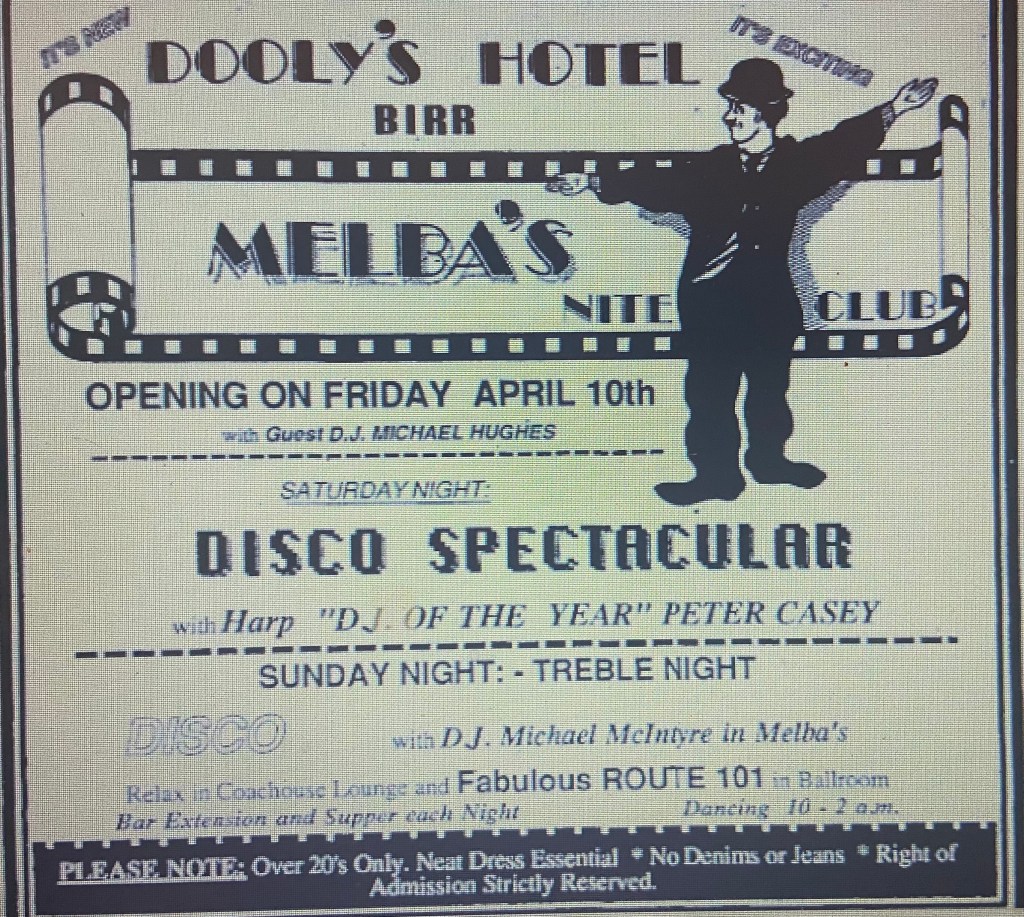
Dooly’s Hotel continues and it was there that the most public acknowledgement of the Armstrong’s Irish visit was to be found. In April 1987, Melba’s night club opened its doors for the first time. In the 38 years which followed until its closure in May 2025 the club served as a major social hub and in that way Melba’s name has been perpetuated to generations of people from south Offaly, even if the reason for her celebrity remains unknown to many of them.
1. The Scotsman, Feb 27, 1931.
2. Joan Campbell, Australian Dictionary of Biography online at https://adb.anu.edu.au/biography/mitchell-david4209 3 Jim Davidson Australian Dictionary of Biography online at https://adb.anu.edu.au/biography/melba-dame-nellie7551
3. Jim Davidson Australian Dictionary of Biography online at https://adb.anu.edu.au/biography/melba-dame-nellie7551
4 J.F. Bosher Imperial Vancouver Island who’s who 1850-1950. (British Columbia, 2012) pp94-99.
5 Melba Museum online at https://nelliemelbamuseum.com.au/marriage-and-family-dame-nellie-melba-museum/
6 Nellie Melba, Melodies and Memories (Cambridge, 2011) p17.
7 https://nelliemelbamuseum.com.au/bound-for-europe-dame-nellie-melba-museum/
8 Nellie Melba, Melodies & Memories, p184.
9 Midlands Counties Advertiser KCC, Aug 19, 1886.
10 Jim Davidson online at https://adb.anu.edu.au/biography/melba-dame-nellie-7551
11 Evening Herald, Sept 21, 1892.
12 J.F. Bosher Imperial Vancouver Island who’s who 1850-1950 (British Columbia, 2012) pp94-99 century
13 Famous Foodies: Nellie Melba online at https://www.theguardian.com/lifeandstyle/2003/jul/13/foodanddrink.features13
Don’t forget our lecture on the Armstrong family and tour to Shannonbridge tomorrow Saturday – See the blog on 20/5/2026

