
On Thursday 23rd April 2026 the new, changed, developed, market house in Portarlington’s square was formally opened, following over a year’s work on the structure to commence a new chapter in its long history. The new occupier is the Portarlington Community Development Association, and the building has become available, for gatherings, conferences, presentations. There is no doubt this is a construction for specific purposes.
And the building has two names: market house, though there is no longer a market; and tholsel, a name given to municipal buildings in Ireland where tolls and dues were collected. Tholsels had an authority in a town, and usually hosted corporation bodies. Notable examples of tholsels in Ireland may be found at Carlingford, Clonmel, Kilkenny and Youghal. In other locations tholsels have been changed into other uses, or gone to demolition, such as that in Mountrath.
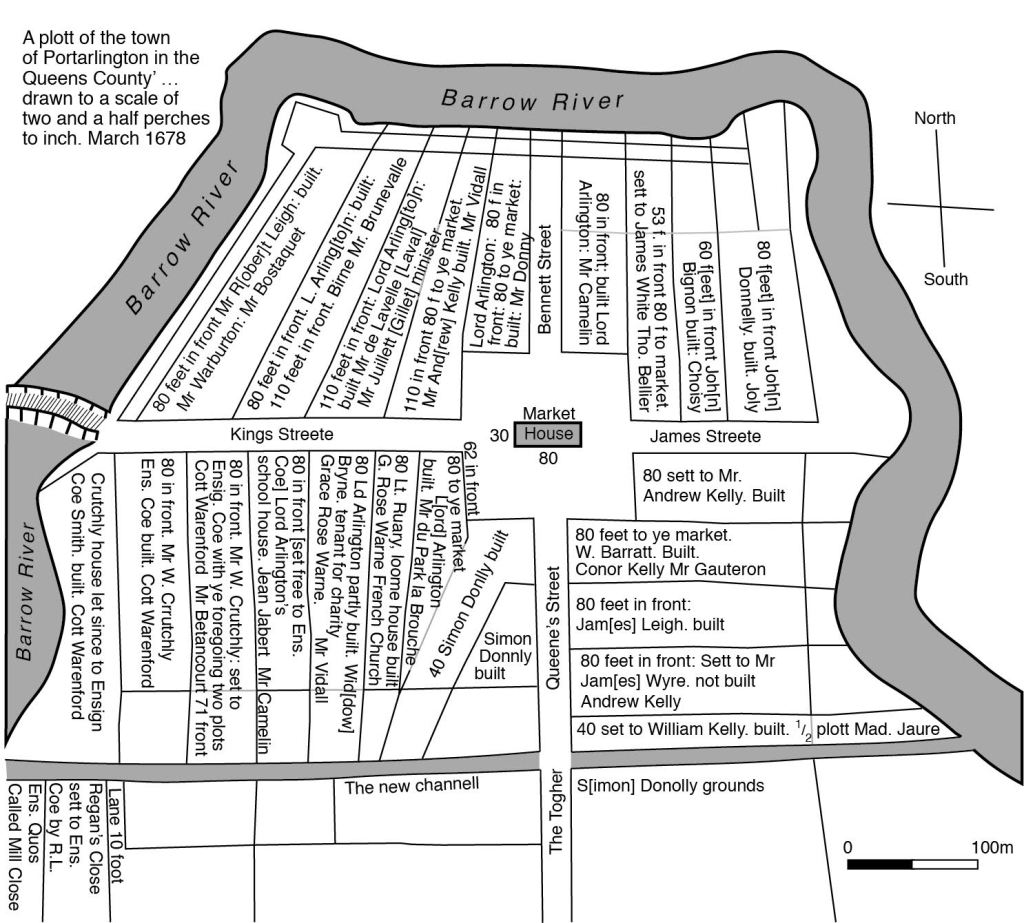
The first reference to the Portarlington tholsel is from the 1678 town map, in the National Library of Ireland[1]. This map was drawn up to outline what was a new town, created in 1666, as an enterprise by Henry Bennet, Lord Arlington[2]. It is described as a market house, and is rectangular. We have no visual image of this structure, do not know if it were one storey or two. Given models elsewhere, it would be reasonable to assume a two-storey building, rooms above an enclosure, most likely gated, where markets around could be organised, and where the authority of legal weights and measures would be enacted. We know from the town charter and documents in the Calendar of State Papers Ireland, for this period that Portarlington became a corporate borough, stretching into both counties King’s County (Offaly), Queen’s County (Laois)[3]. Portarlington was to send two M.Ps to the Dublin Parliament until the Act of Union, and then retained one to the Westminster Parliament until 1885[4]. With the loss of both corporation and constituency, the county boundary along the River Barrow split the town.
Thus this building’s occupants were the town’s corporation, which consisted of a Sovereign (Mayor)[5] a Portreeve (Deputy)[6] to be elected out of a group of burgesses numbering fourteen. The corporation as a body had the right to admit freemen to privileges of the borough, which usually consisted of free commonage and grazing cattle. The burgesses, right up 1832, had the right to elect the town’s M.Ps: fourteen men and in open session.
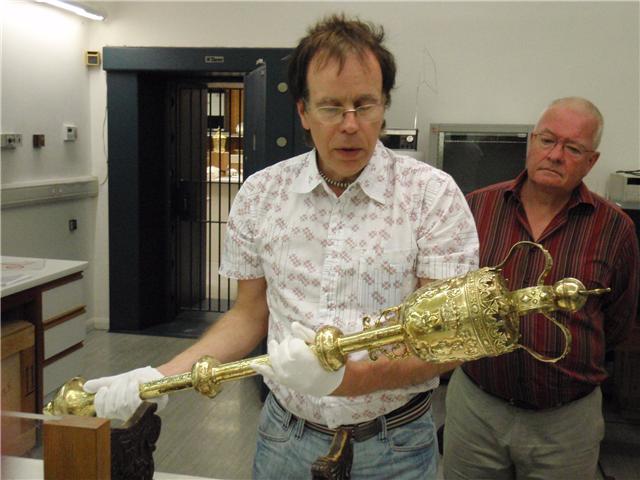
The corporation could also appoint ‘cowboys’ to look after the commons, jurymen to watch over local conditions, such as fire risk with thatch roofs, gather in tolls, dung heaps in the street; the clatter of wheels and clogs on a Sunday during divine services. There were also town clerks, petty constables, and mace bearers. The mace[7] was the symbol of authority, and had to be present at formal meetings. The minute taker for the corporation presents an interesting case of bilingualism. John or Jean Micheau kept the corporation minutes in English, and the French church accounts in French.
The corporation met formally twice a year, feast day of Saint John the Baptist, and the feast day of Saint Michael (Michaelmas) when appointments, re-elections would be made. We know the names of the first burgesses of Portarlington from the first of the surviving manuscript minute books with the date 1669: Lord Arlington, Francis Leigh, James Leigh, Robert Leigh[8], William Leigh, William Lestrange, Anthony Kelly, Simon Donnelly, Daniel Gahan, John Keating, William Powell, Richard Warburton, Joseph Williamson.
Minutes of the early borough have not survived[9]. There are two manuscript volumes of minutes in the National Library of Ireland[10]. Therefore, information is available for post 1727, and what was recorded in the minutes is an interesting as what was not. There was a town clock that needed maintenance; town dwellers had to be penalised for letting dung pile up; and above all the correct times for markets, correct weights for turf, vegetables, correct measures for liquids, and efforts to ensure blown meat was not offered for sale, and the public not victim to insider dealing by corn merchants[11].
Given in full in the minute books are the oaths required by different grades of officials in the corporation. These all required a denial of the mass, of transubstantiation, the intersession of the Virgin Mary, and denied the secular power of the Pope. Patrick McDermott became the only Catholic, post penal laws, to be appointed as a freeman to Portarlington corporation in 1793. He became portreeve 1794-97.
The minute books reveal interesting changing patterns. The first is the dropping of business evidence from the 1730s; and secondly, the dramatic reduction of freeman appointments. These features can be fairly laid at the influences, financial, social, political of the dominant landlord family, the Dawsons of Dawsons Court, and later of Emo. This feature is not unique to Portarlington, many Irish corporations and Parliamentary seats became the possessions of landlord families[12]. At the beginning of the nineteenth-century Portarlington’s corporation were all connected to the Dawson family by marriage or patronage, and were mostly absentee. The Dawson family had acquired the town’s common land. When the Union government investigated Irish local government in the 1830s the Portarlington investigators found four burgesses married into the Dawsons, further four with the Dawson surname[13]. Only three of the fourteen burgesses lived in Portarlington. “A corporation so circumscribed could not accomplish much towards the advancement of prosperity … by alienation of their property, the corporation deprived themselves [sic] of the power of being useful”.
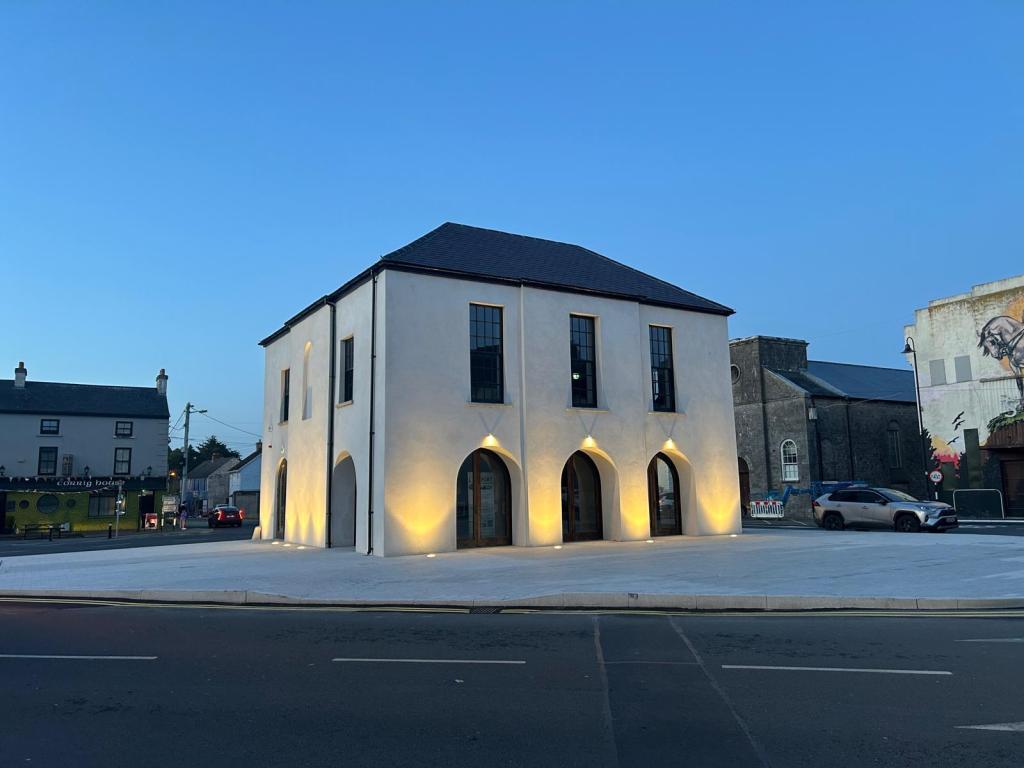
The building itself changed fundamentally in the 1750s into what we see today. In September 1750 it was recorded that the current building was in a dangerous state and “that the present Tholsel or Court House of the said Borough be pulled down and that the rent and revenue of the borough be applied to building a new one”.
The rectangular building of 1678 disappeared and was replaced with essentially a square building, with gated arches on the ground-floor, and assembly rooms above. A plaque detailing the building below the central window, and seen on early postcards has disappeared. In the restoration work of the 2020s the foundation stones of the earlier building were found, together with windows on the first floor which had been bricked in at an early stage and then rendered over. Part of the 1678 foundation wall has been preserved and open to view[14].
Most unusual, perhaps unique, Portarlington tholsel carries a valley roof, and the pitches of both sides are not quite equal. Along the centre of the building underneath the valley is a substantial load bearing wall, and question has to be raised as to whether this wall might be a remnant of the seventeenth-century. The 1750s building is predominantly a brick building, with relieving arches for opening and weight carrying. The brickwork was not sophisticated. A stairwell was placed in the north-east corner, and the space facing Main Street (Queen Street, in 1678[15]) was given to a large room for assemblies, with a coved ceiling which has survived.
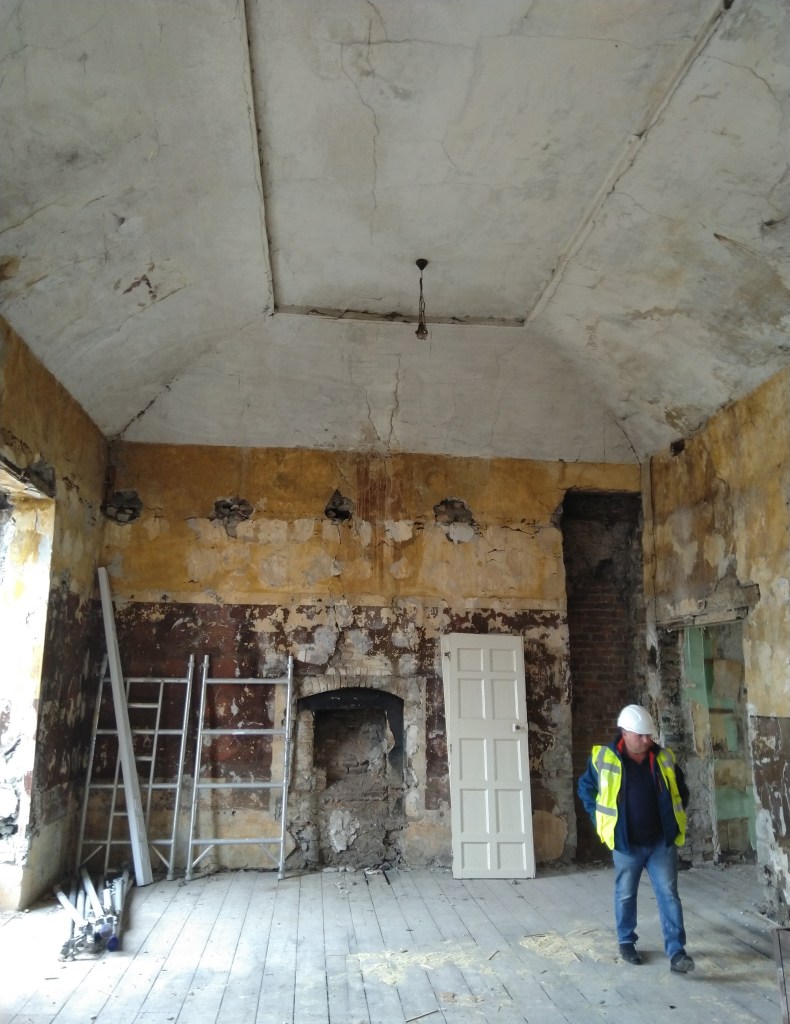
On the north side of the Tholsel facing Spa Lane[16] was a smaller room, later turned into a kitchen and a fireplace inserted. A corridor, alongside the valley wall stretched the length of the building. At each end were doorways meant to impress, wide double doors, each door with ten panels, and wide enough for anyone carrying a sword, or wearing wide hooped dresses, could passage easily, no need for a turn.
It is possible the main room carried wooden panelling, given the presence of plaster lines and nails; also hooks for interior shutters on the three main windows. It can be a conjecture that official furniture existed for the corporation and possibly a carving of the royal arms above where the town sovereign held court. If such existed, all has disappeared.
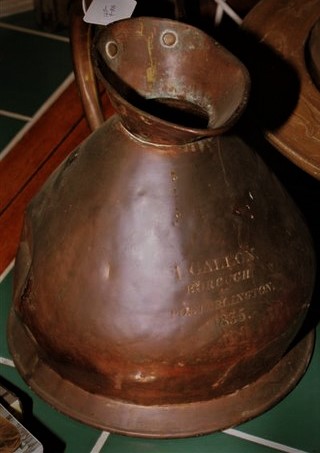
In and around the ground floor arches were the places of markets. Tripod weighing scales were evident into the early twentieth century, and balance weights, in-set at ground level for the weighing of carts[17]. All corporations had to possesses officially graded vessels for liquids[18].
The tholsel building itself is referenced in the various accounts, written and oral, of the 1798 rebellion in Portarlington. The Rebellion Papers in the National Archives barely reference Portarlington. There is no record in the corporation minutes. In February 1798 the corporation meets to elect two members for Parliament, namely Frederick Trench of Woodlawn Co. Galway and Thomas Stannus of Portarlington. There was an assembly on 5th June, when the rebellion was in force, and “the court first met at the tholsel of Port: arlington and then adjourned to the house of Peter Kelly, innholder, in Port: arlington [sic]in said borough and there transacted the business of the day”. The business is not recorded. There is a final session that year on 1st October, which records the election and oath taking of officials. The only mention of any problem occurred on 30th September 1799 where “The court first met at the tholsel but the reason of its ruinous state adjourn’d to the house of Mr John Kelly where the business of the day was finally transacted”. What had happened to the building? There is no corroborating evidence from the contemporary French church registers and accounts. In 1804 the French church suffered damage from what appears to be soldier vandalism. On 20th January 1798, a correspondent of the Cambridge Intelligencer newspaper reported a state of near panic generally in Portarlington, fearing what might happen, and two men “unmercifully cudgelled” on the market scales[19].
There is a strong popular history that rebels were strung up and hanged from the upper windows of the tholsel, as part of a massive round-up by whom? army? militia? fencibles? locals? There is no contemporary evidence for this: indeed, what there is suggests tranquillity during the actual rebellion time, set against the dread earlier that year with the nearest battle being at Monasterevin and closer-by at Clonanny. Unfortunately, the written account by Annraoi O Duinn Mac Mhuilleóra in Kildare in 1798 [20]does not cite sources and its partiality renders the account suspect.
In the new century, the tholsel and corporation continued to function. In 1832 the Reform Act changed voting to property qualifications, not secret until 1872, so the counts and registers were held in the tholsel. The government decision to dissolve most Irish corporations as unfit affected Portarlington. Its last entry was 13th May 1841, and no reference to it being a last assembly. Following dissolution artefacts, notices &c., were sold, spirited away or cast away. Markets were still held around and under the tholsel arches, and the large weighing scales still functioned. The assembly council chambers became a magistrates’ court of Petty Sessions. Public events were held therein too, and a magic lantern slide by Percy French was given in 1904. In the early twentieth century electric lighting was installed, and an early ceiling fitting was discovered behind plaster boarding.
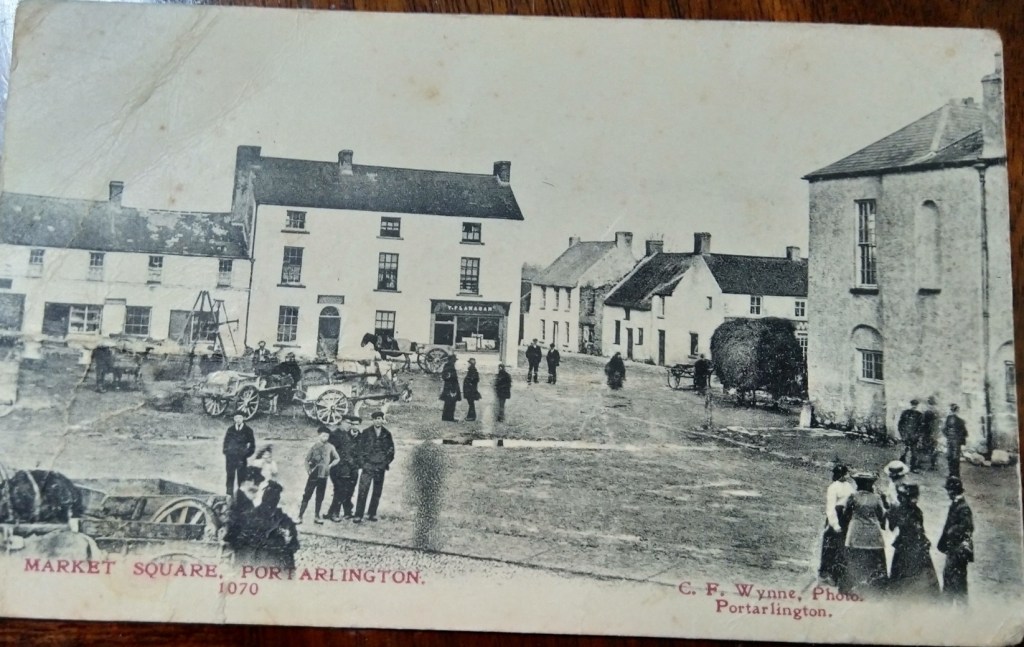
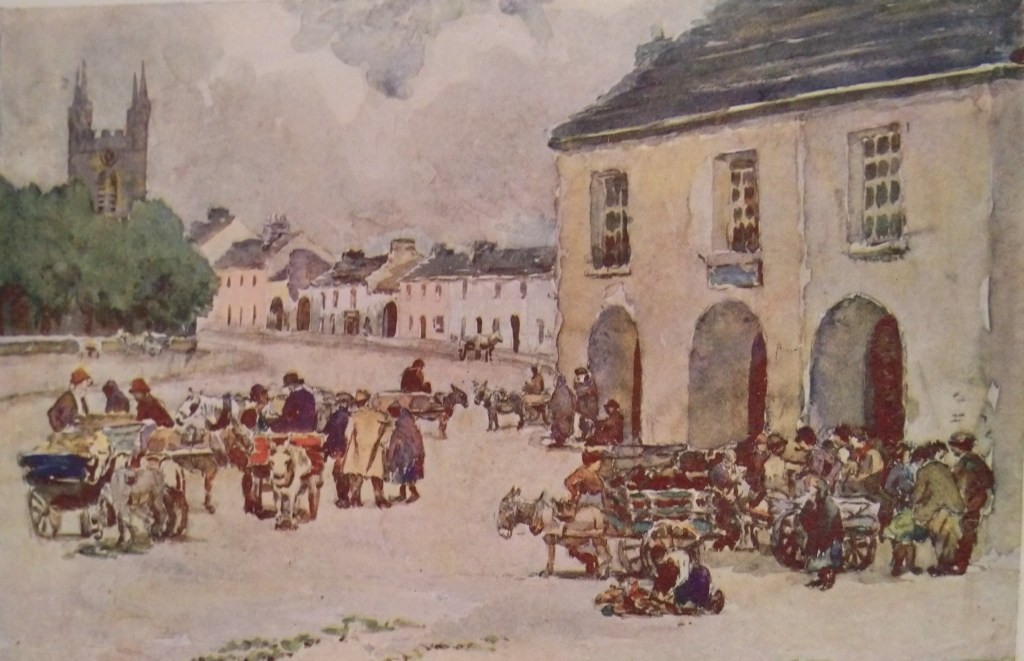
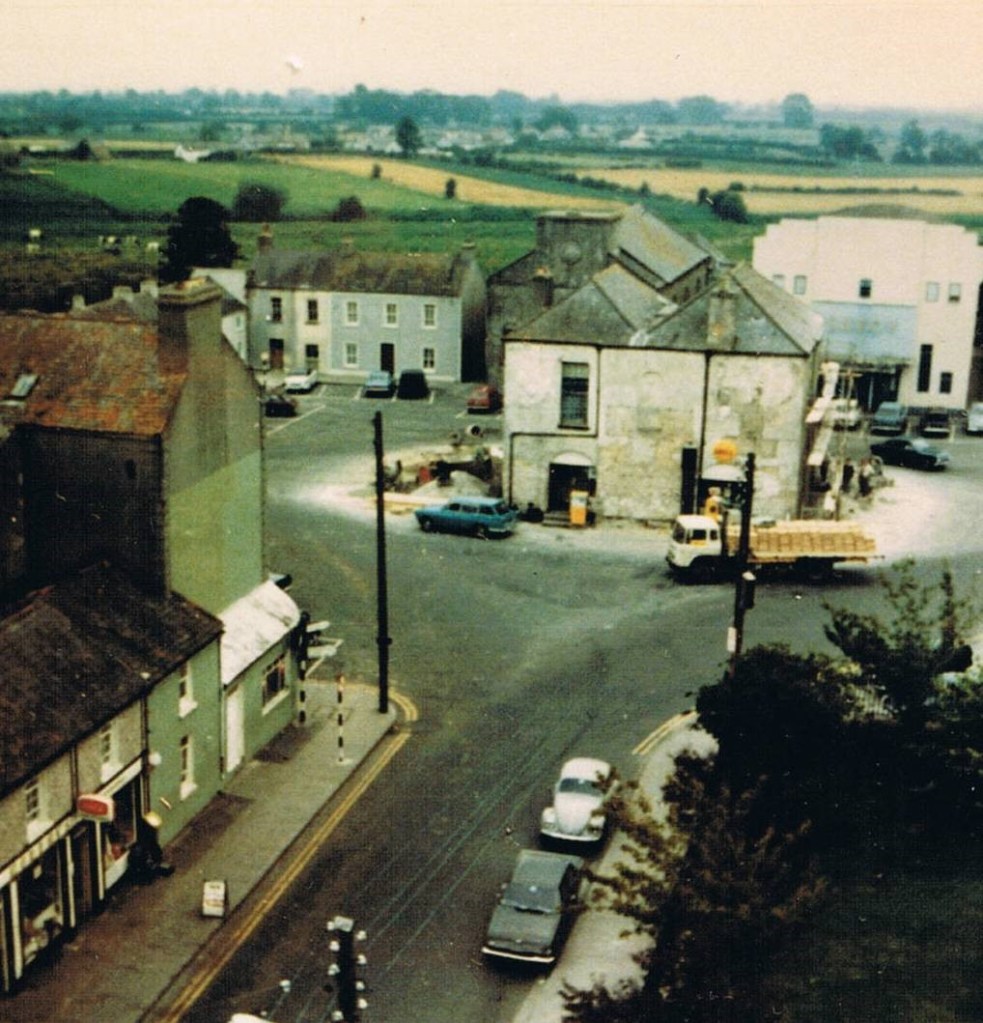
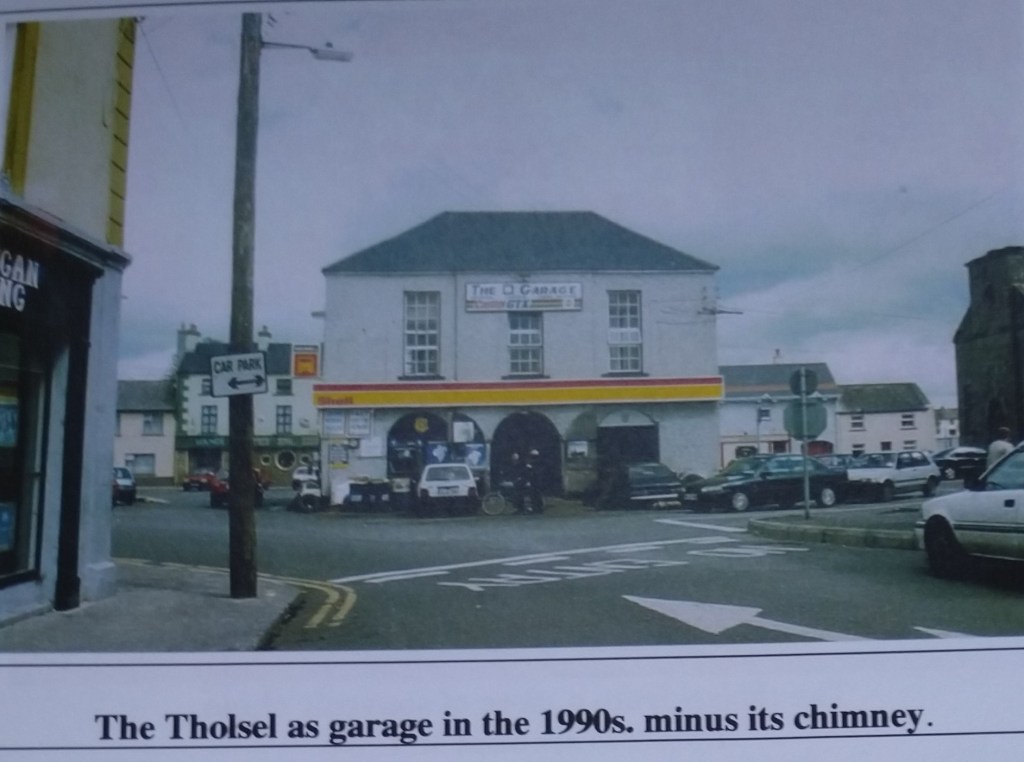
At what exact date the tholsel became a garage for petrol sales and maintenance is uncertain. By 1970 Ryan’s garage was a main town feature. But everything in its season, and at this time, markets and marts were closing or re-locating. In 1927 Laetitia Hamilton painted the tholsel, the gates are there, so are donkeys and carts around. But the later garage also encountered difficulties. There were safety issues with having fuel so close to houses, and road traffic, the presence of piles of rubber tyres were fire risks. The arches were sealed with solid gates, the earlier gates removed. The interior floor dug up for examining pits. The building became also a residence, and the upstairs rooms were split and partitioned into living room, kitchen, bedrooms and toilets: water supply and waste were installed, and the Georgian coved ceiling hidden.
There can be little doubt that the resistance to move by the garage owner saved the Tholsel from demolition in the 1970s when the Link Road broke the uniformity of the town square, and the site had the attraction of becoming a traffic roundabout. In the early 2000s the petrol tanks had been filled in, but repairs were still spilling out into the square. At various times, various loud advertising signs were put on and around the building.
Heritage awareness came to feature later on, and after a few changes of hands in the garage, the building was closed for business. What to do with it: a museum? local authority offices? a pavement café? Who would maintain it and for what purpose? Is there anything like regular tourism in Portarlington to promote a museum? Would the new tholsel improve footfall in what was becoming a deserted town centre? Occupation by the county council, the entire building was opened up for conservation and re-development. Health and safety measures demanded fire-doors, a lift to the first floor, disability access and modern facilities. The arches now have fixed security doors, the roof is reslated, the valley retained; arches inserted to balance the original from the 1750s. The surviving original double doors are not there, neither are the slippy, uneven, unsafe, ancient floor slabs on the ground floor.
While its present role in the town is just beginning, beyond a historian to comment, a note should be added that the art-deco front Savoy cinema, and the parochial hall have rolls in the townscape. The parochial hall, originally built new in 1819 served as Saint Michael’s ‘English’ Church of Ireland. With Saint Paul’s French Church these were established following the Huguenot arrival as chapels-of-ease[21] to Lea parish church. We know the English church was consecrated in 1702, but we have no idea where it was or what it looked like. Built in 1819, with a spire, and a clock[22], jutting out into the square, it functioned as a church until 1885[23], and devolved into a parochial hall for events, especially sport. The wooden spire was removed as rotten and dangerous in the 1920s, but just as the tholsel has undergone revival into new use, the parish has succeeded in gaining a grant to replace the iron and concrete windows, with glazing and full windows as originally fitted.
To everything there is a season: a new one beckons from Portarlington.
Names of Portarlington’s Sovereigns (Mayors) in alphabetical order, with dates.
William Adair[24] 1771-72
John David Boyer[25] 1727-28
Josias Champagné[26] 1729-1732
Jonathan Chetwood[27] 1801-03, 1805, 1806-07
Jonathan Clarke[28] 1772-74, 1777, 1779, 1783, 1786
Jonathan David Clarke 1815, 1819, 1821-23, 1825, 1827, 1829
Reverend Richard Clarke[29] 1814, 1816, 1818, 1820, 1824, 1825-26, 1828, 1830-38
James de Crosat[30] 1740
Ephraim Dawson[31] 1726-27
John Dawson[32], elected Sovereign 1783, but resigned
William Henry Dawson[33] 1736-37, 1750-54, 1756, 1766-68
John Doxey of Ballyroan[34] 1734-36
John Dunne of Bellview[35] 1841
James Lewis Higgins 1798-99, 1812
Francis Leigh[36] 1669-
James Medlicot[37] 1728
Robert Murray 1733
Henry Parnell[38] 1807-08
Charles de Petit Bosc[39] 1743-44, 1746-48
John Stewart of Ballyroan[40] 1732-33, 1734, 1736
Ephraim Stewart of Ballyroan 1737-39, 1741-42, 1745-46
James Stannus[41] 1780-02, 1784-85, 1787-98, 1800, 1802, 1804, 1806
Reverend James Stannus 1817
Trevor Stannus 1748-50, 1755, 1757-66, 1769-71
Thomas Stannus 1775-76, 1778, 1809, 1811-13, died 1813
Thomas Stannus 1839-40, died 1840
Jocelyn Thomas 1809-10
[1] NLI ms 21F55
[2] There is no evidence that Arlington ever came to Ireland, nor to his town, which gave him rental revenue, and two voices in Parliament.
[3] Corporation and Parliamentary jurisdictions overrode those of the separate counties
[4] Patrick F. Meehan Members of Parliament for the King’s and Queen’s Counties 1584-1800 (Laois Heritage Society, 2001), and Members of Parliament for Laois and Offaly 1801-1918 (Leinster Express, 1983) The Act of Union could be noted as an act of Parliamentary reform, in that so many constituencies were abolished: Portarlington’s survival with one M.P. is remarkable when set alongside Maryborough, Athy, Philipstown, Kildare, which lost all.
[5] Maryborough (Portlaoise) and Philipstown (Dangean) had ‘Burgomasters’ instead of ‘Sovereigns’
[6] The term Portreeve is derived from Saxon and English usage. The Reeve was a magistrate or manorial official: the Shire-reeve (Sherrif) for a county, the Port-reeve for a centre within a county, a distribution point. A Reeve was a storyteller in Geoffrey Chaucer’s Canterbury Tales.
[7] The Portarlington mace has its own history. The mace, described as the Portarlington Mace in the custody of the London Goldsmiths Company, has all the signs of being the Athlone mace, and name-change after the 1841 dissolution of so many Irish boroughs and the selling off of artifacts. A silver mace presented by Ephraim Dawson (not seen by this writer) is believed still to be with the present Earl of Portarlington.
[8] Robert Leigh was Lord Arlington’s town agent.
[9] A mention is made of the “humble address of the Sovereign, Burgesses, Bayliffs and Freemen of Her Majesty’s Corporation of Portarlington” in the London Gazette of May11-14, 1702.
[10] Ms 90 for period 1727-1777: Ms 5095 for period 1777-1841.
[11] Food rioting was a constant fear. No direct local evidence has emerged for Portarlington, but James Kelly’s study Food rioting in Ireland in the eighteenth and nineteenth centuries, the moral economy and the Irish crowd (Dublin, 2017) indicates this feature was endemic.
[12] A recent exposé of this is printed in Kieran Keenaghan and James Scully’s That beats Banagher (2025)
[13] John Colhoun and Henry Baldwin investigated twenty-four boroughs, Sept-Oct 1833.
[14] At the official opening a voice was heard to another explaining that was a Roman wall!!
[15] The queen was Catherine of Braganza, the Portuguese wife of King Charles II. The area of Upper Main Street by the Bank of Ireland was named Katherinestown after her. Robert Leigh, Lord Arlington’s land agent, wrote from Katherinestown. Her husband’s Charlestown was on the King’s County side.
[16] In 1678 this street was known as Bennet Street after Lord Arlington, then Camelin Lane after a Huguenot settler, to finalise as Spa Street.
[17] The weighing mechanism in-set by the west side of the tholsel, was later removed to provide for the petrol tanks in Ryan’s garage. A corner bollard to prevent cart wheels colliding with the Tholsel still remains.
[18] This writer remembers seeing these copper vessels in the 1970s; one later featured on an auction site. While not holding a Portarlington piece, I do hold a half-gallon vessel clearly marked for Tuam Corporation.
[19] John Stocks Powell, Schooling in Ireland: a clustered history 1695-1912 (Tullamore, 2020) p.22
[20] Kildare in 1798, ed. by Peadar Mac Suibhne (Naas, 1978)
[21] A chapel-of-ease, a convenient place, but with lower status than the parish church of Lea, to where only marriages and funerals, the gathering-in of tithes could be performed
[22] The hole for the clock is still visible above the door. The clock was transferred to the French Church when the building ceased to be a church, and working into the 1980s. Similarly, it is thought possible that wall monuments inside the building were also transferred to the French Church walls.
[23] One page of baptism records has survived by re-use. Other registers were destroyed in the Four Courts fire of 1922.
[24] Of Rath, ancestor of John George Adair 1823-85
[25] Born Civray, Poitou, wounded at Limerick
[26] 1673-1737, home in King Street (Frenchchurch St). His accounts are a major source of Portarlington’s history
[27] Landed family based at Woodbrook, on familiar terms with Dean Jonathan Swift
[28] Important active family in Portarlington at the end of the C18th, agents to the Dawson family at Emo
[29] Born 1775, brother of Jonathan, magistrate, minister of the English church in Portarlington 1801-38, organised and oversaw the construction of the church, now the parochial hall. (The building archives are in the Representative Church Library, Dublin)
[30] Jacques de Crosat, Seigneur des Pruniers: fought at the Boyne
[31] Banker; married Anne Preston of Emo, bought Portarlington town in 1709, began the family’s trajectory from Trade into aristocracy; subscribed six copies of Jean Cavalier’s book 1726; died 1746
[32] Grandson of Ephraim; patron of James Gandon, began Emo Court, 1st Earl of Portarlington 1885; died 1798
[33] 1712-79, son of Ephraim, and father of John, 1st Viscount Carlow 1776, M.P. for Portarlington 1733-62, 1769-70; active in subjection of Portarlington Corporation into a family business, restricted freemen numbers, advancing family relations
[34] An example of Dawson family patronage: the Dawsons owned property in and around Ballyroan
[35] The last Sovereign of Portarlington. Bellview was also known as Porterstown, and Doulough: as Porterstown it was a major private boys’ school
[36] Leigh family of Rosegarland Co. Wexford: Leighs obtained monastic lands of Holy Cross Killeagh: Francis became M.P. for Kildare borough; attainted for treason by loyalty to James II
[37] Died 1733, family lands at Youngstown and Dunmurry Co. Kildare
[38] Famous family in politics, based near Maryborough, owned Dunamase one-time; married into the Dawson family
[39] Charles Gaspard le Grand du Petit Bosc, born 1695; active in the French church
[40] Stewart family, as with Doxey, tenants and clients of the Dawson family: similarly Thomas Willis of Ballyroan came to open a school in Portarlington through Dawson support
[41] Stannus family, resident and influential in Portarlington from mid C18th: marriage to the sister of Ephraim Dawson ensured their status
Offaly History thanks JSP for this important article and congratulates all concerned with restoring the building.

