
The foundation stone for the Tullamore jail was laid on 13 September 1826 just 200 years ago. Two hundred years of history as we pass those gates of what is now Kilcruttin Business Park. We may wonder at what went on there over 200 years. In many ways the former jail encapsulates the history of Tullamore since the 1820s. When the jail was built Tullamore was not yet the county town. There was no railway until 1859 at this location. No road up from Kilcruttin until 1938, Lloyd Town Park was agricultural land with an old out-of-town cemetery nearby. Only the ‘Charleville Parade’ houses north of the courthouse were built. The courthouse was not completed until 1835. The jail was designed to accommodate 120 prisoners and had double that number during the Famine years of the late 1840s. It was well run on reform lines but Victorian prisons were tough places.
(more…)Category: stone cutting
-
Portarlington market house: a place of many uses and now restored. By John Stocks Powell. Blog no. 801 in the Offaly History Blog Series, 12 June 2026
On Thursday 23rd April 2026 the new, changed, developed, market house in Portarlington’s square was formally opened, following over a year’s work on the structure to commence a new chapter in its long history. The new occupier is the Portarlington Community Development Association, and the building has become available, for gatherings, conferences, presentations. There is no doubt this is a construction for specific purposes.
And the building has two names: market house, though there is no longer a market; and tholsel, a name given to municipal buildings in Ireland where tolls and dues were collected. Tholsels had an authority in a town, and usually hosted corporation bodies. Notable examples of tholsels in Ireland may be found at Carlingford, Clonmel, Kilkenny and Youghal. In other locations tholsels have been changed into other uses, or gone to demolition, such as that in Mountrath.
(more…)
-
Fergal MacCabe architect, town planner, artist and heritage brand ambassador for Tullamore. No 11 in a series on the paintings and drawings heritage of County Offaly, 1750-2000, explored through the works of artists from or associated with County Offaly. By Michael Byrne. Blog No 732, 19th July 2025
Fergal MacCabe is an architect, town planner and a topographical artist. He has managed to combine all three disciplines in his career. His fondness in recent years for the capriccio style of painting in many ways pulls together all his skills in how he views buildings and sees them in context. In his capriccio style Fergal MacCabe draws on real architectural elements and it is their juxtaposition that is whimsical. Yet he has regard to his own aesthetics, architectural and town planning skills in the buildings he selects and how he brings these buildings together.
For his jovial attitude to life we can probably thank his mother Winifred, who was by all accounts a character up to early passing in 1960.
(more…)
-
Michael Scott: his Midland Connections and Networks. By Fergal MacCabe. No 2 in a series on the paintings and drawings heritage of County Offaly, 1750-2000, explored through the works of artists from or associated with County Offaly. Blog No 705, 2nd April 2025
The Murals Bar Cultural life in 1950s Tullamore centred around ‘The Murals’ bar. This was where us local artists, actors, historians and writers drank, clutching our copies of ‘Ulysses’ in its concealing brown paper cover while engaging in fevered and sparkling debates on cubism, existentialism, atonality and Marxism.
I may be exaggerating somewhat, but ‘The Murals’ really was our Deux Magots, our Cafe de Flore. The bar was the meeting place of what passed for an intelligentsia in Tullamore at a time, which, though it is now regarded as restrictive and obscurantist, I remember as stimulating and progressive. Maybe I was lucky.
The attraction of ‘The Murals’ was its design which was quite unlike any of the more traditional pubs of the town which were usually small, dark and poky. With its high ceiling, stripped down design, timber veneering, bright red stools, it was cool and elegant and above all- modern.
(more…)
-
Modern Times: mid-twentieth century architectural styles in Tullamore, Ireland. By Fergal MacCabe. Published to mark Heritage Week 2004 and no. 8 in Offaly History Anniversaries Series. Blog No 646, 24th August 2024
What we construct and what we take down is often the most significant indicator of the nature and health of our society. Also, the choice of an aesthetic style for a new building tells us much about the values of its proposer. Government or religious institutions will seek to emphasise their role and power by providing substantial and prominent structures, often using ancient architectural styles to suggest their continuity and permanence. Successful businesses or go-ahead institutions will express their vitality and cosmopolitanism in a more modern manner. Home builders may wish to attract respect for their taste and sophistication.
(more…)
-
Shannon Harbour, completed in 1804, and described by Sean Olson in 1979, 45 years ago. Canal events this August weekend, 45 years on, in Pollagh and Tullamore. Article no. 7 in the Offaly History Anniversaries Series. Blog No 645, 23rd August 2024
The Grand Canal was completed to the River Shannon in 1804, 220 years ago. By 1864 passenger traffic was finished and commercial by 1960. Cruise traffic was only in its infancy and when this article was written 45 years ago things were bleak. In looking at the building of the Grand Canal from Tullamore to Shannon Harbour, we need to look at a piece written in the Irish Times by Sean Olson with photographs by Pat Langan, which was published on Thursday, 7 June 1979 in the Irish Times. The newspaper had been a good supporter of keeping the canal open in the 1960s when it was under threat from Dublin Corporation.
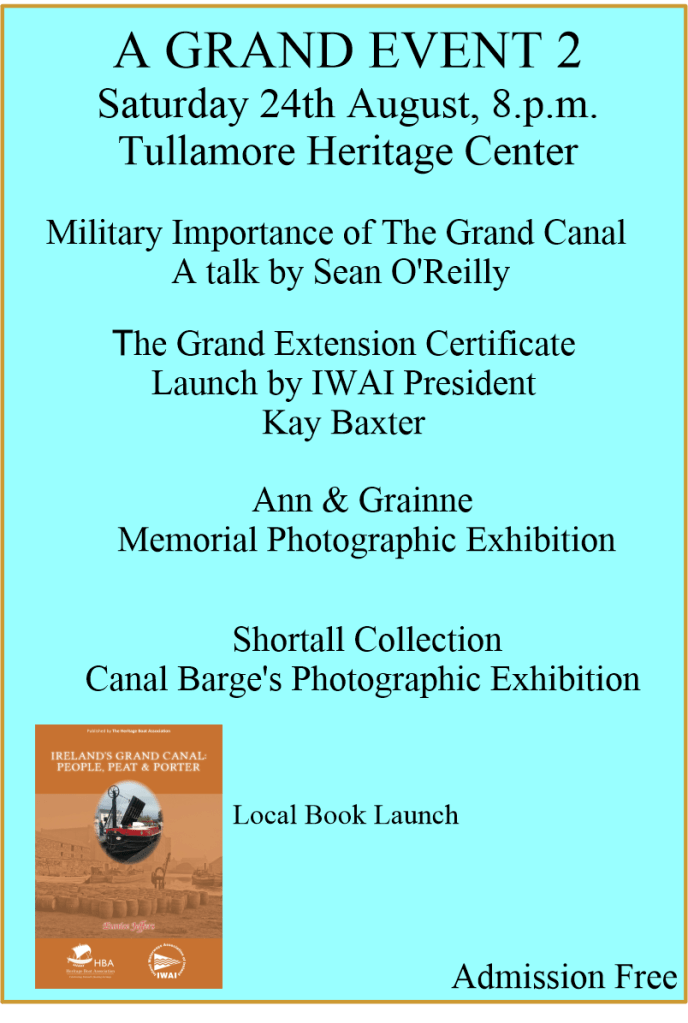
Things have improved so much in recent years with the towpaths now the focus of attention to promote walking and cycling. Today 23 August see the launch of an excellent study of the canal system as illustrated. Then on Saturday evening and Sunday there are two events from Waterways Ireland to be held in the Offaly History Centre Exhibition Hall beside the canal at Bury Quay (neighbour to Old Warehouse Bar and Restaurant), as illustrated.


Olson is worth reproducing to remind us that we do not want to go back there and was an excellent record of its time. Also worth mentioning is our over 60 blog articles on the Grand Canal available as blogs at http://www.offalyhistory.com. All free to read and download.
‘If the steps of the ruined canalside hotel at Shannon Harbour, Co. Offaly could talk they would have a tale to tell. It would be a story of bustled Victorian ladies and their potb-bellied merchant husbands, of trade, of business deals finalised in airy rooms overlooking the still waters of the canal.
For once the pulse of commerce beat hard at Shannon Harbour. It was an inland port – a staging post leading to the mighty Shannon river. It was built by the commerce of a different age, a monument to an era when the first hesitant puff of the steam engine sounded the death knell for trade on inland waterways. It was a slow lingering death. When it finally came in 1960, there were few obsequies for Shannon Harbour. Those there were hardly took the place into account at all. It all but died with the departure of the last barge.
Now the once fine hotel, later home of several families who made their living from the barges, stands staring roofed, inside gutted, steps broken and lifted. The warehouses once full of goods and porter, are roofless sentries before the lock gates that lead down to the Shannon.
(more…)

